
How to Choose Names for Expat and International Families

Choosing a baby name becomes more layered when family life stretches across countries.
One parent’s relatives may speak one language while the other parent’s relatives speak another. Your child may be born abroad, carry more than one passport, attend international schools, or move again before kindergarten. A surname that feels ordinary in one country may need spelling help in another. A first name that sounds warm at home can become confusing at airport check-in, school registration, or a clinic desk in a different language.
That is normal life for many expat and international families.
A name may need to work with grandparents in one country, classmates in another, documents in a third, and a future career somewhere else. Parents may not know where their child will grow up long term. They are choosing for the family they have now and for the life that may come later.
Do not solve that uncertainty by choosing the blandest “global” name.
A child’s name should not have to lose culture, history, sound, and family meaning just to move easily through forms and introductions. The stronger goal is range: a name that can travel without becoming anonymous.
Origin matters here. A name that works internationally still needs to be understood through language, pronunciation, spelling, cultural roots, and family story. Baby Names by Origin is a useful starting point when you want portability without erasing where a name comes from. For the wider decision process, Expert Baby Naming Guides for Choosing the Right Name can keep this search connected to surname flow, middle names, popularity, spelling, initials, family pressure, and final testing.
Sofia and Sophia both travel widely, but their spellings can signal different language preferences. Leo feels portable because it is short and recognizable in many places. Mateo and Matteo may work differently depending on Spanish, Italian, or local context. Aoife and Niamh preserve cultural spelling beautifully, but they need pronunciation support outside Irish contexts. Noor is compact and meaningful, though it may be heard differently by language and community.
International naming is rarely about finding a name that works everywhere equally. Very few names do.
It is about choosing a name that can move with your child without becoming a constant source of correction, confusion, or lost identity.

International Names Need Range, Not Blank Neutrality
A good international name is not necessarily one that everyone pronounces perfectly the first time.
That standard is unrealistic. Accent variation is part of international family life. A name may sound slightly different in English, French, Arabic, Spanish, Vietnamese, German, Italian, or Mandarin-influenced speech. What matters is whether the name can be recognized, learned, and carried without constant strain.
A name may work well for an expat or internationally mobile family when it is:
- Pronounceable with reasonable effort across family languages. Close relatives should be able to learn it with care.
- Clear enough for school and document systems. The name should not create avoidable paperwork friction.
- Free from strong negative meaning in a core language. You do not need to check every language in the world, but the important ones matter.
- Meaningful to the family. “Global-sounding” is too thin when nothing deeper supports the choice.
- Flexible across childhood and adulthood. A name that travels should still grow with the child.
- Compatible with the surname in more than one accent. The full name matters more than the first name alone.
- Culturally respectful and explainable. A rooted name should come with a truthful story.
- Usable in official paperwork. Passports, visas, school records, and airline bookings can expose weak planning.
- Not too tied to one temporary location. Expat bubbles can make certain names feel more portable than they truly are.
- Personal enough to feel chosen. Ease should not drain the name of identity.
Names such as Anna, Maya, Leo, Luca, Sofia, Clara, and Noah may feel portable in many contexts because they are relatively short, familiar across borders, and easy to introduce.
Other names carry stronger origin signals. Santiago, Aisha, Noor, Niamh, Aoife, and Siobhan may be meaningful and highly usable in the right family context, but they ask for more pronunciation, spelling, or cultural explanation in some places.
That does not make them bad choices.
It means the family should understand what kind of support the name will need. How to Choose Names With Strong Cultural Roots Respectfully can help you evaluate rooted names without treating culture as a usability problem.
An international name should not be chosen only because it looks smooth on a passport. It should also fit the child’s family story, surname, likely languages, and future adulthood.
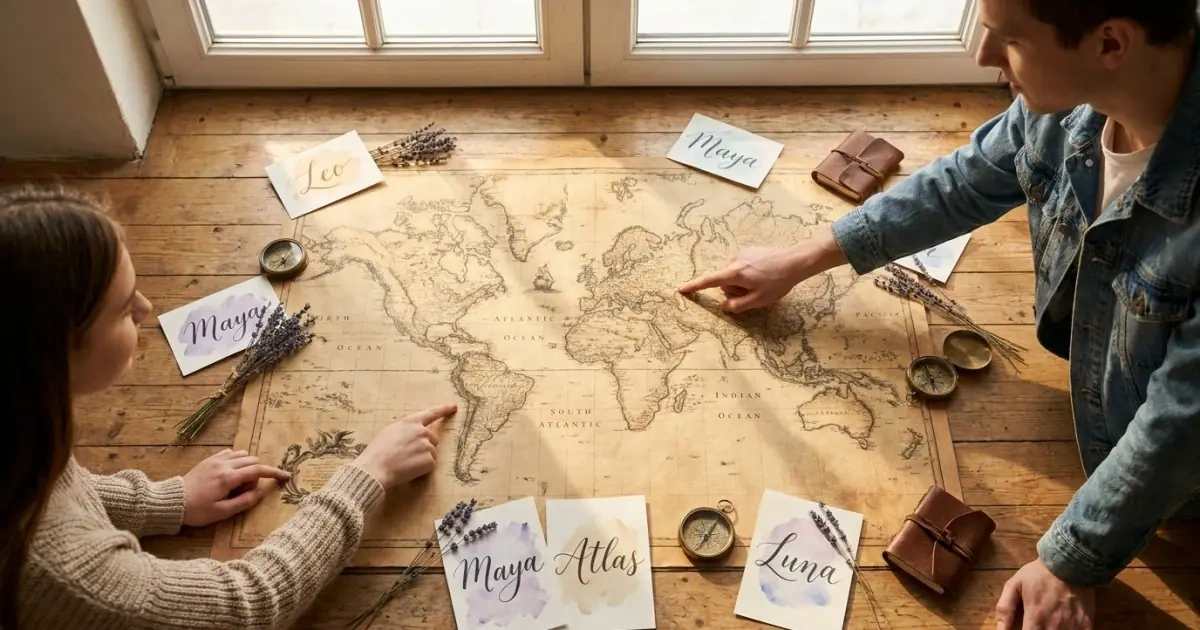
Map the Countries, Languages, and Communities That Actually Matter
“International” is too broad to guide a real naming decision.
A name does not need to work everywhere in the world. It needs to work in the places that are likely to matter in your child’s life.
Start by mapping the real contexts:
- Parents’ native languages. These are often the strongest pronunciation and emotional anchors.
- Family languages. Grandparents, cousins, and close relatives need to be considered.
- Current country of residence. This affects schools, documents, forms, and daily introductions.
- Likely future countries. A probable move deserves more weight than an abstract possibility.
- Passport or citizenship countries. Legal names may need to work across official systems.
- Relatives’ pronunciation needs. Close family should be able to say the name with respect.
- School or community language. The child will hear the name in this setting often.
- Faith or cultural community. A name may carry specific meaning inside a community.
- Surname language and spelling. The last name may already carry complexity or heritage.
- Likely adult-use contexts. A name eventually appears on resumes, degrees, email accounts, and introductions.
A Vietnamese-French family in Canada has different naming needs from a Spanish-Italian family in London or an Arabic-English family in Singapore. A name may be perfect for two languages and awkward in a third that barely affects the child’s life. Another may sound lovely in the current country but become difficult if the family is likely to move back to a parent’s home country.
This mapping prevents two opposite mistakes.
Over-optimizing makes parents search for a name that works in every possible country, accent, and future. That can flatten the shortlist until nothing feels personal. Under-testing creates the opposite problem: a name fits the current expat bubble, then proves difficult for grandparents, legal documents, or the child’s likely school language.
Aim for realistic coverage.
When English, Spanish, and Arabic are active family contexts, test those. When one parent’s family speaks Vietnamese and the child will visit often, test that too. A hypothetical issue in a language with no real connection to your child should not dominate the decision.
For a broader cross-cultural process, read Best Baby Name Strategies for Multicultural Families. When two active languages matter most, How to Choose a Name That Works in Two Languages gives the decision a tighter structure. If belief communities belong in the family map, How to Choose Interfaith-Friendly Baby Names can help balance faith, culture, and daily use.
A strong international name begins with the child’s real world, not an abstract global checklist.

Pronunciation Should Be Tested Across Accents, Not Just Languages
Pronunciation is not only about language. Accent matters just as much.
Even within one language, speakers may shape vowels, consonants, stress, and rhythm differently. A name may be easy in written form but sound noticeably different when spoken by relatives in another country or by teachers in an international school.
Not every pronunciation difference is a problem.
International families need a realistic standard: can the name be said with reasonable effort, recognized after teaching, and treated with care by close family?
Use a practical pronunciation test:
- Parent one says it. Listen for whether the name feels natural in that parent’s speech.
- Parent two says it. The name should not belong comfortably to only one parent’s mouth.
- Grandparents say it. Close relatives need a fair chance to learn it.
- Relatives in each core language say it. This reveals sound changes that may not appear on paper.
- The name is spoken with the surname attached. First-name ease can disappear in the full combination.
- The name is said quickly in everyday speech. Real names are often called across rooms, clipped in a hurry, and repeated when people are tired.
- The name is read aloud like a school roll-call. This shows how a new teacher may handle it.
- The name is spoken like an airport or clinic announcement. Public-use testing catches practical friction.
- The name is used in an adult introduction. A name that works on a child should still work later.
Names such as Ari, Kai, Maya, Leo, and Luca may shift slightly across accents while remaining recognizable. Leila and Layla may have accepted pronunciation differences depending on language and family preference. Names such as Saoirse, Caoimhe, Aoife, or Niamh usually require more teaching in many English-speaking or international settings.
The point is not to avoid every name that needs teaching.
The point is to know the teaching burden before you choose. Close family should be expected to learn the intended pronunciation with care. A distant teacher, airport agent, or new classmate may need help. Those are different situations.
For deeper pronunciation testing, use How to Choose Names That Work Across Different Accents and How to Say a Baby Name Out Loud and Hear Its Real Flow.
A name that travels well does not need one identical sound everywhere. It needs a stable identity across variation.
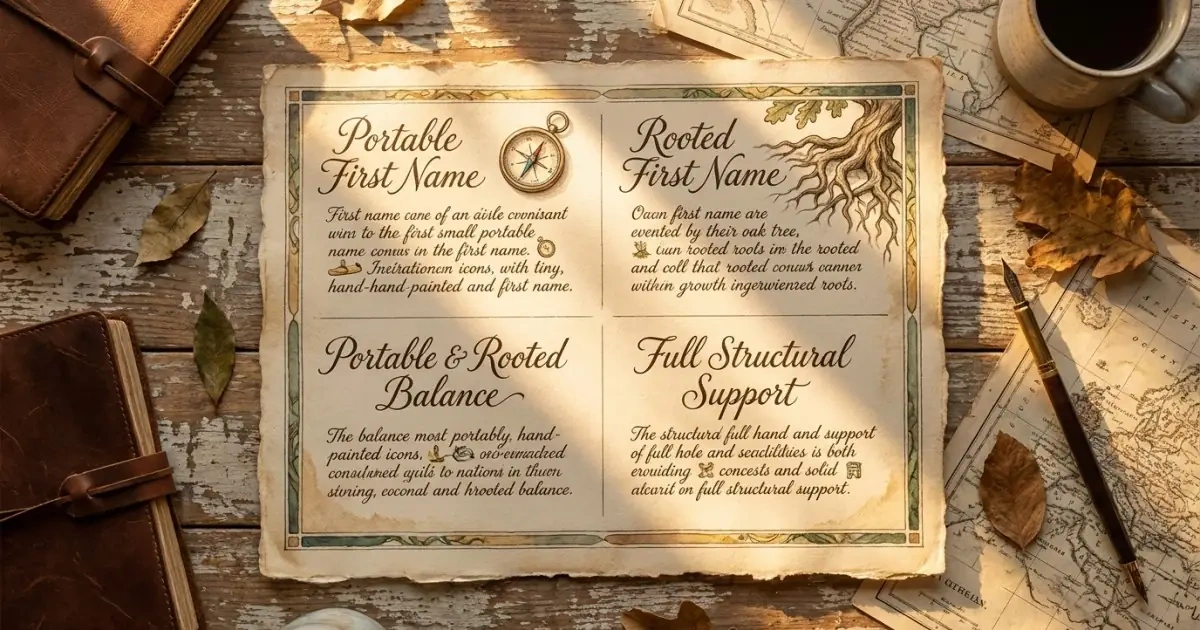
Choose Between Portability, Rootedness, and a Two-Part Balance
International families often feel pulled between two good goals.
Portability gives the child ease in schools, documents, travel, and daily introductions. Rootedness keeps culture, language, family story, faith, or heritage visible. The mistake is assuming one must erase the other.
Decide which job belongs to the first name, which belongs to the middle, and which may already be carried by the surname.
A portable first name can make daily life easier
A portable first name works well when the child may move often, parents want easy school and document use, the surname already carries heritage, or the family wants broad daily usability.
Names such as Anna, Leo, Maya, Sofia, Clara, and Noah can work this way in many families. They are not empty names. They simply ask less from strangers at first contact.
This route may be especially helpful when the surname is long, hyphenated, hard to spell in the current country, or strongly tied to one language.
The caution is emotional thinness. Do not choose a portable first name only because it seems safe if neither parent feels connected to it.
A rooted first name can keep identity visible
A rooted first name works when cultural identity should be visible daily and parents are willing to teach pronunciation or spelling.
Santiago, Aisha, Noor, Aoife, Niamh, and other strongly rooted names can be excellent first names when they reflect the family’s real background and parents are ready to support them.
This route works best when the name has meaning beyond style. The child should be able to learn why the name was chosen and how to explain it simply.
The practical side still matters. A rooted first name may need a pronunciation plan, a spelling plan, or a supportive middle and surname combination.
A portable first name with a rooted middle can balance daily ease and heritage
This is one of the strongest structures for internationally mobile families.
The first name handles daily introductions. The middle carries cultural depth, family honor, or a spelling that may be harder outside the family.
Examples include:
- Leo Santiago. A compact international first name makes room for a more culturally specific middle.
- Anna Aoife. The first name stays broad while the middle preserves Irish spelling.
- Sofia Niamh. A widely usable first name supports a rooted middle with pronunciation needs.
- Maya Noor. The full name carries both portability and luminous meaning.
- Clara Miriam. A familiar first name pairs with a deeper heritage or scriptural thread.
This structure works well when exact heritage spelling matters, one language name is harder outside the family, or the surname already adds complexity.
The middle should still be taught and valued. It should not become invisible.
A rooted first name with a portable middle can give the full name support
Some families want the first name to visibly carry culture while the middle name provides balance.
Examples include:
- Aisha Grace. A rooted first name gains a familiar virtue middle.
- Santiago Leo. A substantial first name gets a shorter support point.
- Niamh Rose. A pronunciation-specific first name is paired with a familiar middle.
- Noor Clara. A compact first name gains a classic second layer.
A simple middle can soften the full name, support pronunciation, or give the child a flexible full-name shape. It can also help when the surname is long or unfamiliar in the child’s main country.
For more help with this structure, read How to Use Middle Names to Carry Heritage and Meaning and How to Choose a Middle Name. When the middle also needs to soften, strengthen, or balance the first name, How to Choose Middle Names That Soften or Strengthen a First Name can refine the pairing.
The best first-middle structure gives your child both travel and roots.

Popularity Looks Different Across Borders
Popularity gets complicated when a family lives across countries.
A name may be common in one country and rare in another. It may feel classic in one place, trendy in another, dated in a third, and unfamiliar somewhere else. Parents need to decide which popularity context matters most.
For expat and international families, the most important context is usually one of these:
- The child’s current country. This affects daily school, playground, and community use.
- The parents’ home countries. Relatives may hear the name through different naming eras.
- The likely future country. A probable move deserves real testing.
- The child’s language community. A name may be common inside one linguistic group and rare outside it.
- The family’s cultural or religious community. Community use can matter more than national rankings.
- The likely school environment. International schools often create their own naming patterns.
Sofia and Sophia may be widely recognized, but spelling and popularity vary. Noah may be highly familiar in many English-speaking settings. Mateo may feel mainstream in some places and distinctive in others. Arthur, Henry, and Clara may read as classic, revived, or old-fashioned depending on region.
A name that is common internationally can be useful because people recognize it. Common is not automatically better. Some parents want a name that travels well without sounding like every other child in an international school has it.
Rare names can also work when the sound, spelling, and explanation are manageable. The problem is not rarity itself. The problem is unmanaged friction.
Ask:
- Is this name common where we live now?
- Is it familiar in our family countries?
- Is it rising quickly in international schools or expat circles?
- Does it feel dated to one side of the family?
- Is the rare option still easy enough to use?
- Would we still like the name if we moved?
Use Baby Names by Popularity to compare familiarity and use. Popular vs Rare Baby Names: How to Decide can help weigh commonness against distinctiveness, while How to Read Baby Name Popularity Data keeps the conversation grounded. When a name feels tied to a trend in one country, How to Avoid Choosing a Name That Dates Too Fast belongs in the check.
A good international name does not need to be rare everywhere or common everywhere. It needs the right level of familiarity for your child’s likely life.

Spelling and Document Friction Should Be Checked Before You Fall in Love
Expat families deal with more paperwork than many parents expect.
A child’s name may appear on birth certificates, passports, visas, residence permits, school forms, airline bookings, health insurance records, medical charts, bank accounts, exam registrations, and digital systems. If the spelling is inconsistent across documents, small problems can become tiring.
This matters most when a name includes diacritics, apostrophes, hyphens, non-English letters, multiple scripts, or transliteration from a language that does not use the Latin alphabet.
That does not mean parents must avoid those names.
It means they should plan.
Consider:
- Will the birth country allow the spelling you want?
- Will passport systems preserve diacritics?
- Will airline systems drop accents or special characters?
- Will school records match the legal name?
- Will the name need a transliterated form?
- Are there multiple accepted Latin spellings?
- Will the family use one legal spelling and one cultural spelling?
- Can the spelling remain consistent across countries?
Sofia and Sofía may create different document questions depending on local systems. Sean, Saoirse, Aoife, and Niamh use standard English letters but require pronunciation teaching. A transliterated Arabic, Hebrew, Chinese, Vietnamese, or other language name may have more than one Latin spelling, so parents need to choose the version they want to carry legally.
A name can be culturally meaningful and still need a paperwork strategy.
When spelling is central to the name’s identity, read How to Keep a Cultural Spelling Without Creating Constant Friction. Before finalizing the full legal name, use How to Check Initials, Monograms, and Awkward Combinations as well.
The goal is not to let forms choose your child’s name. It is to avoid surprises that could follow them across borders.
Names With Multiple International Forms Need a Spelling Strategy
Many names have more than one legitimate form.
That can be helpful, but it also makes the decision more precise. When a name has several international versions, the spelling you choose may signal language, culture, pronunciation, family identity, or religious context.
Choose intentionally.
Do not change spelling only to look more international. Do not choose the easiest form if it erases what the name was meant to carry. Do not choose a more complex form only because it looks distinctive when your family has no connection to it.
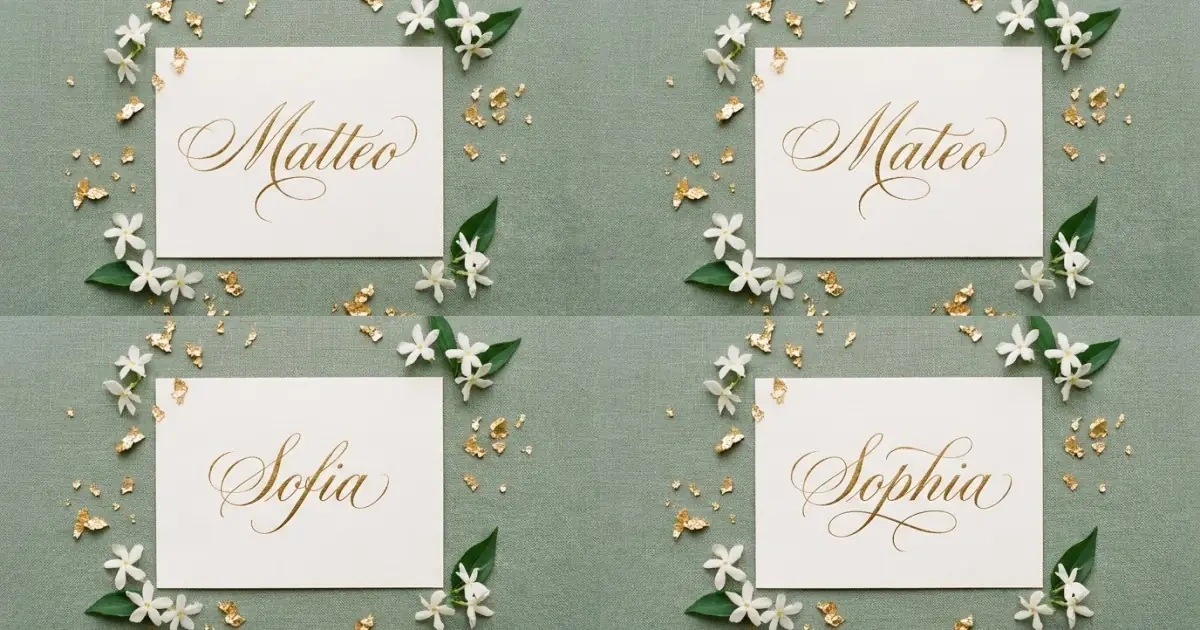
Even minor spelling variations broadcast distinct cultural signals: Sofia and Sophia may sound similar but reflect different language preferences, just as a single letter distinguishes the cultural imprint of Mateo and Matteo. Leila versus Layla can alter visual style and pronunciation; related names like Maria, Mary, and Miriam project very different historical tones in daily life. Even familiar pairs such as Noa and Noah, or Anna and Anne, show how slight differences can reshape gender perception, cultural context, and overall resonance.
Ask:
- Which spelling reflects our family language?
- Which spelling will relatives recognize?
- Which spelling supports the pronunciation we want?
- Which version will be easiest on documents?
- Does changing it alter the name’s identity?
- Which spelling will the child most often need to explain?
- Which form feels most honest to our family?
A spelling strategy should protect both the name’s roots and the child’s daily usability. Sofia may align with certain European or Spanish-language contexts, while Sophia may feel more familiar in many English-speaking settings. Mateo and Matteo point to different language worlds. Leila and Layla may suggest different pronunciation or cultural expectations. Noa and Noah may differ in gender perception, spelling expectation, and cultural association.
When the name is traditional and you are considering a modernized form, read How to Adapt a Traditional Name for Modern Everyday Use. If the original spelling matters culturally, return to How to Keep a Cultural Spelling Without Creating Constant Friction.
A spelling strategy protects both the name’s roots and the child’s daily usability.

Meaning Can Bridge Cultures, But It Should Not Flatten Them
Meaning can help international families find common ground.
When languages, countries, and family expectations differ, shared themes can give parents a way forward. Light, peace, joy, wisdom, strength, gift, blessing, life, nature, and hope can all work as bridges.
A name is still more than its meaning.
Do not treat names from different cultures as interchangeable just because they share a theme. Origin, sound, faith context, spelling, pronunciation, and style still matter.
Noor and Clara can both connect to light, but they come from different languages and create different impressions. Irene carries peace through a classic form. Felix brings happiness or good fortune with a brighter rhythm. Grace, Hope, and Joy may feel virtue-based and English-word familiar.
A meaning-led name works best when the meaning, sound, and cultural context all feel right.
A family drawn to light might choose Clara because it is easier in their languages. Another might choose Noor because it sits closer to family heritage. A third family may avoid both and choose a name from their own language with a related meaning.
Use Baby Names by Theme to explore meaning categories. For deeper nuance, read Why Name Meaning Changes How a Name Feels and How to Balance Meaning, Sound, and Style in a Baby Name. When meaning is also spiritual or sacred in your family context, How to Choose Spiritual and Sacred Baby Names can help judge the weight carefully.
Meaning can be a bridge. It should not flatten culture into a keyword.

The Surname Can Make or Break an International Name
The surname can change everything.
International families often have surnames that signal one language, culture, spelling system, or migration story. A surname may be long, short, hyphenated, accented, difficult in one country, common in another, or frequently misspelled.
The first name should be tested with the surname, not chosen in isolation.
A simple first name may balance a complex surname. A rooted first name may work beautifully with a shorter surname. A long first name plus a long hyphenated surname may feel heavy. A name with pronunciation friction becomes harder if the surname also requires repeated correction.
Test:
- First + surname. This is the name’s daily public shape.
- First + middle + surname. The full name should not feel overloaded.
- First + passport surname. Official forms may use a different order or structure than family speech.
- First + hyphenated surname. Length and rhythm need special attention.
- Initials. Letters can create issues across formats.
- Email or account-style version. International children often live inside digital systems early.
- School roll-call. The name should be speakable in ordinary public settings.
- Airport check-in. Travel exposes spelling and document friction quickly.
- Adult introduction. The name should hold up outside childhood.
- Quick family speech. Real names are called, shortened, repeated, and used when people are busy.
Leo may support a longer international surname because it is short and clear. Santiago may need a simpler middle if the surname is also long. Noor Clara may feel balanced in one order, while Clara Noor may work better with another surname. Niamh may be worth the pronunciation teaching, but the full name should not overload every element unless each part has a strong reason.
Also consider official order. Some countries handle middle names, double surnames, patronymics, or family-name-first formats differently. Parents should know what the child’s full legal name will look like in the systems they will use most.
For surname rhythm, read How to Match a First Name With Your Surname. For first-middle-surname design, use How to Build a First-Middle-Surname Combination That Flows. If your child may use more than one surname format, How to Check Initials, Monograms, and Awkward Combinations can catch issues in different official versions.
A name that travels well should travel as a full name, not only as a first name.

Gender-Neutral Names May Shift Across Countries
Gender-neutral names do not travel the same way everywhere.
A name that feels comfortably unisex in one country may be strongly gendered in another. A surname-style name may feel modern in one English-speaking setting and confusing in a country where surnames are not commonly used as first names. A short international name may feel neutral in one language and clearly masculine or feminine in another.
This matters for expat families because a child may move between naming systems.
Names such as Quinn, Avery, Rowan, Ari, Kai, and Noa may shift by country and language. Noa and Noah can create different gender, pronunciation, and spelling assumptions depending on where the child is.
International families do not need to avoid gender-neutral names.
They do need to test assumptions.
Ask:
- Is the name unisex in our current country?
- Is it gendered in either parent’s home country?
- Will school systems or documents make assumptions?
- Will relatives understand the name the way we intend?
- Does the surname change the gender signal?
- Would the child have to correct assumptions constantly?
Some families welcome flexibility. Others want a name that reads clearly in a certain way across core languages. Either choice can work when it is intentional.
For a deeper guide, read How to Choose a Gender-Neutral Name. For sound and accent testing, use How to Choose Names That Work Across Different Accents. When surname-style or nature-style names are part of the shortlist, Baby Names by Style can help compare how the style may be read in different places.
A gender-neutral name should be tested internationally, not only locally.

Give the Child a Name Story That Works in More Than One Place
International children are often asked about their names.
Where is it from? How do you say it? Why did your parents choose it? Is it from your mother’s side or your father’s side? Does it mean something?
A child should not be responsible for carrying every adult detail behind the name. Still, a simple, warm story helps.
A good name story is short, true, and easy to repeat.
Examples:
- “My name works in both of my parents’ languages.”
- “My first name is easy to use where we live, and my middle name carries my grandmother’s language.”
- “My name means light, which mattered to my parents.”
- “This spelling comes from my family’s heritage.”
- “My name was chosen because it could travel with me.”
- “My middle name honors the country my family comes from.”
The story matters because it turns a possible explanation burden into a sense of connection.
When a child has a highly portable first name and a deeply rooted middle, they should know both parts matter. When a child has a cultural spelling, they should know why it was preserved. When the name was chosen for meaning, the family should be able to explain the meaning without making it sound like a slogan.
Avoid choosing a name only because it sounds global. A child may eventually ask why that name was chosen. “It was easy everywhere” can feel thin when no deeper reason supports it.
For heritage balance, read How to Honor Heritage Without Forcing Tradition. For names with strong cultural roots, How to Choose Names With Strong Cultural Roots Respectfully can help build a story with care. If a family name is part of the story, How to Name a Baby After a Relative Well can keep the honor clear without asking the child to carry too much expectation.
A name that travels well should still feel like it belongs somewhere.

Do Not Choose Only for the Country You Live in Right Now
Expat families know that “home” can change.
A name that fits perfectly in the current country may not work as well after a move. A name that feels normal in an international school may sound unusual in a parent’s hometown. A name chosen to blend into a temporary expat community may not reflect the family’s long-term identity.
At the same time, do not over-optimize for every possible future country.
Test realistic scenarios:
- Current country. This is the child’s immediate daily environment.
- Parents’ home countries. Family recognition and pronunciation matter.
- Likely next move. A probable future deserves more attention than a remote one.
- Passport countries. Legal and official systems may shape the name’s use.
- Family languages. Close relatives need to be able to say the name with care.
- Adult global use. The name should travel beyond childhood.
- The surname in each setting. The full name may change by language and order.
Ask:
- Would this name still work if we moved back home?
- Would relatives in both families recognize it or learn it?
- Would documents stay consistent?
- Would the child have an easy explanation?
- Is this name tied too tightly to a temporary expat bubble?
- Does it fit both our current life and our family roots?
A name may be trendy in one city’s international community yet disconnected from both families. Another may feel slightly less fashionable but offer better roots and broader pronunciation stability.
A child’s name does not need to predict every move. It should be resilient enough for the most likely ones.
Before making the final decision, use How to Test a Baby Name Before Finalizing It. If your family is choosing between two names because one fits the current country and one fits a likely future home, How to Decide Between Two Baby Names can help compare them without starting over.
Choose for the life your child may realistically live, not only the country listed on the birth certificate.

International Name Strategies Need Rethinking When Smoothness Starts Erasing Identity
Sometimes a name looks internationally smooth but still needs rethinking.
That does not mean the name is wrong. It means the current strategy may not be solving the real problem.
A strategy may need revision when:
- The name works in one language but fails badly in another key language.
- Parents are choosing only for global smoothness and losing all meaning.
- The name erases one parent’s culture entirely.
- The spelling creates document problems parents are not willing to manage.
- The surname plus first name is too hard in the child’s main country.
- The name is trendy in the current expat community but not meaningful to the family.
- Relatives in a core language cannot say it with reasonable effort.
- The child would need to explain every part of the name constantly.
- Parents cannot explain why the name was chosen beyond “it sounds international.”
- The first and middle names both create high friction without a strong reason.
- The name’s gender perception changes in a way parents are not comfortable with.
You may not need to start over. You may need to change the structure.
A rooted first name might move to the middle. A portable first name might gain a meaningful middle. A spelling might shift to an established variant. A pronunciation plan might solve what first looked like a dealbreaker. A too-generic name might be replaced with one that has more family story.
For a wider multicultural naming framework, read Best Baby Name Strategies for Multicultural Families. For practical final testing, return to How to Test a Baby Name Before Finalizing It. When the strategy is failing because parents value different things, How to Choose a Name When You and Your Partner Have Different Tastes can translate preferences into criteria.
A good international name strategy should reduce friction without removing identity.

A Practical Framework for Expat and International Baby Names
Use this framework when your family needs a name that can work across borders.
Step 1: Map the real-life countries and languages
List the child’s current home, likely future homes, parent languages, family languages, passport countries, school language, surname context, and core cultural communities.
Do not test the name against every language in the world. Test it against the places your child is most likely to live, visit, study, and belong.
Step 2: Choose the name’s main job
Decide what the name needs to carry first.
It may need to provide portable daily use, visible heritage, bilingual ease, spiritual or meaning-based connection, family honor, professional international fit, gender flexibility, or cultural spelling preservation.
One name cannot do everything equally.
Step 3: Choose the first-middle structure
Decide whether the full name should use:
- Portable first + rooted middle. This gives daily ease while preserving heritage.
- Rooted first + portable middle. This keeps identity visible and gives the full name support.
- Shared international first + family middle. This works when the first name needs broad comfort.
- Cultural first + simple middle. A simpler middle can reduce full-name friction.
- Bilingual first + meaning-based middle. Sound and meaning can carry different jobs.
- Meaning-based first + heritage middle. Shared values can sit beside family roots.
The structure can solve tension that a single name cannot.
Step 4: Test pronunciation and spelling
Ask close relatives, local speakers, and people unfamiliar with the name to say it. Test quick speech, school-style reading, document spelling, and the family’s intended pronunciation.
Decide which variations are acceptable and which need correction.
Step 5: Test full-name flow and documents
Check surname rhythm, initials, passport-style writing, hyphenation, email forms, school registration, and adult introduction.
A name that works internationally as a first name may still need adjustment when paired with the legal surname.
Step 6: Prepare the child’s name story
Make sure the child can explain the name simply and warmly in more than one place.
The story might be about language, meaning, family, heritage, portability, or a combination. It should feel like connection, not an apology.
Step 7: Choose the name that balances travel and roots
The final name should be portable enough for real life and meaningful enough to feel like home.
It should help the child move through the world without asking them to leave their family story behind.

Questions Parents Ask About Expat and International Baby Names
Does an international baby name need to be easy in every language?
No. It needs to work in the languages and countries that are likely to matter in your child’s real life. A name can be unfamiliar in some places and still be a strong choice if it works in the family’s core contexts.
Should we avoid cultural spellings if we live abroad?
Not automatically. Preserve meaningful spellings when they matter, but prepare pronunciation, document, and spelling support. The important work is knowing what the spelling protects and what kind of friction it may create.
Is it better to choose a common international name?
Sometimes, but common is not the same as right. A name should still fit your family’s story, surname, style, and likely future homes.
Can the middle name carry the harder heritage name?
Yes. This can preserve culture while reducing daily friction, as long as the middle name is still taught and valued. A middle name can carry real identity even if it is not used every day.
What if a name is popular in one country but rare in another?
Decide which context matters most: current home, family country, likely future home, or the child’s main community. Popularity should be measured against the life your child is most likely to live.

Where to Go Next When a Name Needs Both Roots and Range
A strong international name does not have to be bland.
It does not have to erase culture, flatten spelling, or choose the easiest possible option for strangers. It also does not need to create constant correction in the name of meaning.
The best choices give a child both roots and range.
They work across the countries, languages, documents, schools, relatives, and future moves that are likely to matter. They also carry enough family meaning to feel like more than a convenient passport label.
That may mean a portable first name with a rooted middle. It may mean a cultural first name with a simple supporting middle. It may mean choosing between Sofia and Sophia, Mateo and Matteo, Noa and Noah, Leila and Layla, based on family identity and daily use. It may mean preserving a spelling like Aoife or Niamh with a clear pronunciation plan.
The right name is not the one that works everywhere equally. It is the one that works honestly in your child’s world.
Let your exact concern shape your next move. If language and heritage dictate the choice, anchor your search through Baby Names by Origin and broaden the frame with Best Baby Name Strategies for Multicultural Families.
When two active languages are carrying most of the tension, fine-tune the decision through How to Choose a Name That Works in Two Languages. If the middle name is where heritage belongs, How to Use Middle Names to Carry Heritage and Meaning can secure that depth without making it decorative.
Before finalizing, pressure-test the entire combination with How to Test a Baby Name Before Finalizing It.
For expat and international families, a baby name is not only something that sounds good in one room.
It is something your child may carry through many rooms, languages, forms, and introductions. Chosen well, it can help them feel at home in more than one place.