
Irene Name Meaning: Roots, Mood, and Timeless Appeal

Irene is one of those names that appears simple until you sit with it for a while. At first glance, it seems almost transparent: two syllables, an elegant rhythm, a meaning most people immediately understand. But that surface clarity is exactly what gives the name its depth. Irene does not work by spectacle. It works by restraint. It belongs to a long tradition of names that have survived because they offer something steadier than fashion: an idea that still feels worth carrying. In this case, that idea is peace, not as decoration, not as vague sweetness, but as a disciplined way of moving through the world.
That is why Irene has endured across very different eras. It began in the Greek world, where peace was important enough to be personified, and it continued into Christian history, where the word gained moral and spiritual gravity. Later it traveled into ordinary family life, where it became the kind of name people chose because it felt dignified, calm, and usable. Today, Irene still carries all three layers at once. It has classical roots, historical legitimacy, and modern clarity. For parents who want a name that sounds composed rather than trendy, familiar rather than worn out, and graceful without becoming fragile, Irene remains unusually hard to replace.
Irene's U.S. popularity rank over time, 1880–2024
Popularity statistics are based on official data from the Social Security Administration baby name records.
Irene: A Venerable Pillar of Universal Peace
Irene functions as a name with one unmistakable center of gravity, sustained by its standing as a perennially popular choice for girls for over a century . This Greek classic often reflects a naming-culture preference for choices that provide a sense of reliability and inner calm .
The name has maintained clear feminine clarity with minimal crossover elsewhere . Reaching a significant height in 1918, its balanced two-syllable rhythm remains widely trusted across generations .
Irene, in one clear frame
| Key Facts | Information | Quick Insight |
|---|---|---|
| Name | Irene | Short, established, and visually clean, Irene looks formal enough for adulthood while remaining easy to say and spell. |
| Primary origin | Greek | Its Greek root gives the name cultural depth without making it feel remote or hard to wear in English. |
| Core meaning | Peace | This is one of the rare virtue meanings that feels substantial rather than ornamental, because peace suggests judgment, composure, and moral steadiness. |
| Pronunciation | eye-REEN | The stress on the second syllable gives Irene lift and elegance, keeping it from sounding flat or severe. |
| IPA | US /aɪˈriːn/; UK /aɪˈriːn/ | The shared US and UK form makes Irene unusually stable across English-speaking contexts. |
| Syllable count | 2 | Two syllables help Irene feel concise and polished, with enough room for formality but no excess weight. |
| Primary usage | Female | Irene reads clearly feminine in modern use, but it does so through history and tone rather than through anything overly frilled. |
| U.S. girls’ rank (2024) | No. 638 | That position keeps Irene recognizable without making it overexposed, which is often exactly the sweet spot modern parents are looking for. |
Irene is what happens when “peace” becomes a personal style
Some names that mean peace feel airy and abstract, as if they belong more to aspiration than to lived personality. Irene is different. It has enough history behind it that the meaning lands with weight. Peace here does not read as passivity. It reads as composure under pressure. That distinction matters. In real life, peaceful people are not always the quietest people in the room; often they are the ones who know how to lower the temperature, make a firm decision without theatricality, and create order where other people create noise. Irene naturally leans toward that stronger version of the word.
This is part of the name’s enduring appeal. Parents are often drawn to meanings that sound kind, but kindness alone can become vague in naming language. Peace is more structurally useful. It suggests calm, yes, but also self-command. It implies that a person can hold tension without being ruled by it. That gives Irene a more adult emotional range than many softer virtue names. It can belong to a child, but it also makes immediate sense on a judge, an architect, a teacher, a cellist, or a grandmother whose authority comes from steadiness rather than force.
The emotional tone of Irene is also unusually balanced. It is gentle without becoming sentimental. It is serious without becoming cold. It does not ask to be admired for uniqueness, and that restraint is one of its strengths. In a naming era crowded with impact names, invented spellings, and carefully curated rarity, Irene offers a different kind of confidence. It says that coherence matters more than performance.
That is why the name often feels more sophisticated on second hearing than on first. Its meaning is not flashy, but it is durable. Many names can project energy, glamour, sweetness, or edge. Fewer can project calm without sounding passive. Irene can. And once that quality registers, the name begins to feel less like a quiet choice and more like a very deliberate one.

From Eirene to Irene
The deep strength of Irene comes partly from its lineage. In the Greek world, the ancestral form of the name was tied to Eirene, the personification of peace. That origin gave the word symbolic importance long before it became a personal name in everyday use. Peace was not treated as a trivial luxury. It was something civic, moral, and hard won. That background still matters, because it explains why Irene carries more gravity than a merely pleasant sound would suggest.
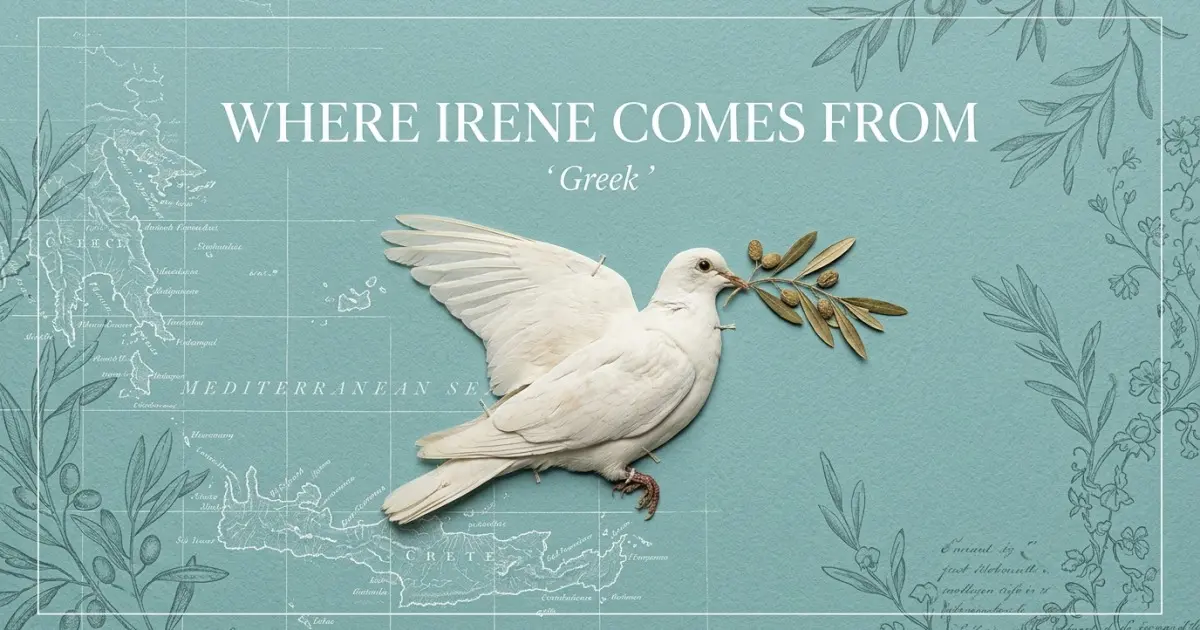
As the name moved beyond the ancient Greek setting, it entered Christian use and gathered a second layer of meaning. What had once been linked to classical thought and public order could now also suggest spiritual peace, inward stillness, and reconciliation. This transition helped Irene travel widely. It was no longer only a classical relic; it became a usable, respectable, durable personal name. That kind of transition is often what separates a beautiful ancient word from a living name. Irene made the crossing successfully.
The result is a name with two strong inheritances. One is classical: lucid, balanced, and intellectually clean. The other is historical: devout, serious, and humanly grounded. Together they give Irene a breadth that many short names do not have. It can feel literary, ecclesiastical, continental, and domestic all at once. That is why it wears well in different cultures and generations. The same root also connects Irene to international relatives such as Irena and Irina, which expands its reach without weakening its identity.
There is another advantage here. Names with ancient roots sometimes feel museum-like in English, admired more than used. Irene escapes that problem because its modern form is so accessible. The history is long, but the name itself is not cumbersome. You do not need specialist knowledge to pronounce it, spell it, or understand it. That combination of depth and ease is rare. It lets Irene feel cultivated without feeling academic, and inherited without feeling trapped in the past. For more names shaped by the same tradition, explore browse Greek baby names.
Why Irene sounds steadier than sweeter
The sound pattern of Irene does a great deal of invisible work. The opening eye gives the name brightness and immediacy. It starts cleanly and clearly, with no crowded consonants and no uncertainty about how to enter it. Then comes the stressed second syllable, REEN, which gives the name height and direction. Because the emphasis lands late, Irene rises as it moves. That makes it sound more poised than names that expend all their energy at the beginning.
Its sonic texture is also worth noticing. Irene is soft, but not hazy. The long ee sound keeps it luminous, while the closing n stops it neatly. There is no spillover, no ornamental tail. In practical terms, that means the name sounds polished in conversation. It has shape. It arrives, opens, and closes with control.
This balance affects perception. Irene does not feel sugary in the way some vowel-heavy girls’ names can. Nor does it feel stern. It sits in a narrower, more difficult register: calm authority. That gives it professional range. It can sound refined in formal settings and still warm at home. It also helps the name age well. There are names that belong beautifully to childhood but need help in adulthood. Irene does not have that problem. It sounds complete from the beginning. To explore more names that sit in this same category, see browse girl names.
Style-wise, Irene often appeals to people who like the dignity of Helen, the cool intelligence of Claire, or the old-world elegance of Lydia, but want something slightly less expected. It shares some atmosphere with those names while keeping its own emotional center. Irene is not airy, flashy, rustic, or overtly romantic. Its identity is composure.
Irene in the current naming landscape
Recent U.S. ranking data places Irene at No. 638 for girls in 2024, which tells an important story about the name’s present position. Irene is not disappearing, but it is also nowhere near saturation. That middle distance is a major part of its appeal. Most people know the name immediately. Few will regard it as strange. Yet a child named Irene is still unlikely to share her name with several classmates. In modern naming terms, that is an enviable balance.
The rank also suggests that Irene now occupies a selective rather than automatic place in family decision-making. It is no longer being chosen by habit alone. Parents who choose Irene today are usually making an intentional move toward clarity, history, and understatement. That kind of intentionality often gives a name more style than sheer popularity ever can. Irene does not need chart dominance to feel secure. Its legitimacy is already built in.
This matters because contemporary taste has become increasingly polarized. On one side are parents seeking vintage revival names with strong ancestry. On the other are parents seeking highly original or sharply modern sounds. Irene sits in a compelling space between those poles. It is historical without being heavy, and distinctive without feeling experimental. It can therefore satisfy several naming instincts at once: familiarity, rarity, grace, seriousness, and international usability.
For families thinking long term, Irene also has a protective quality. Because it is not pinned to one obvious decade-specific craze, it is less likely to feel dated in a hurry. Some names announce the era in which they were chosen. Irene resists that. It belongs more to continuity than to a moment, and that often ages better.
What Irene promises in everyday life
A name does not determine character, but it does shape first impressions, and Irene’s first impression is unusually useful. It suggests intelligence without snobbery, gentleness without weakness, maturity without stiffness. That makes it an easy name to live with. In school, it sounds dependable. In professional settings, it sounds credible. In family life, it sounds intimate once spoken often, because the formality of the written name softens when it becomes part of ordinary speech.
Irene also works well because it is visually and socially uncluttered. It is easy to spell, easy to read, and stable in pronunciation. That kind of ease is underrated. Many parents want a name with heritage but do not want their child correcting people all day. Irene gives them history with relatively little friction. It also travels well across accents and languages, which becomes more valuable in a global, mobile culture.
Then there is the question of fit within a full name. Irene generally pairs well with a wide range of surnames because its rhythm is compact and its sound is clear. It can soften a harsher surname, but it can also sharpen a very flowing one. It tends to work especially well when the surname has stronger consonants, because Irene brings balance rather than competition. That versatility is one reason the name keeps resurfacing whenever parents want elegance without excess.
Perhaps the most attractive promise Irene makes, though, is this: it allows a child room to become herself. It does not over-script a persona. It does not insist on sparkle, rebellion, aristocratic grandeur, or rustic charm. Instead, it offers a clean, credible frame. Names that leave that much room often prove the wisest over time.
Where Irene can lead next
Middle names that widen Irene rather than soften it
Irene is structurally neat, so it often pairs best with middle names that either add warmth or extend rhythm. Short, crisp middles can make it feel even more tailored, while longer lyrical middles can open it out. The next step is less about finding another elegant name and more about deciding whether you want Irene to sound classical, romantic, or quietly modern in full. If you want the full pairing logic behind that contrast, see Irene middle names.
Nicknames that keep Irene recognizable
Irene is already concise, which means nickname choices work best when they feel organic rather than forced. Some families will use the full name almost all the time, while others may prefer affectionate shortenings that keep the original outline visible. The strongest options are usually the ones that preserve Irene’s calm identity instead of replacing it with something unrelated. To see how those different moods shorten in real life, explore nicknames for Irene.
Pronunciation notes that help Irene travel well
Because Irene has an established English form and close relatives in several European languages, pronunciation is one of the most interesting parts of its story. In American and British English, the familiar form is stable and elegant, but the name also opens outward into other traditions. That gives Irene both certainty at home and flexibility abroad. If you want the full sound pattern behind that rhythm, read how to pronounce Irene.
Why Irene endures
Irene endures because it solves a problem many parents cannot quite name at first. They want something beautiful, but not fragile. Historical, but not dusty. feminine, but not overworked. Distinctive, but not performative. Irene answers all of those wishes by refusing to overstate itself. It carries one of the clearest meanings in the naming tradition, yet never sounds like a slogan. It comes from one of the oldest cultural languages in the Western world, yet remains plain enough to use every day. It has prestige, but not vanity.
In literary terms, Irene is a name of controlled atmosphere. It does not burst into the room; it settles it. That may be its deepest strength. Peace, in real life, is not the absence of complexity. It is the ability to move through complexity without losing form. Irene captures that beautifully. It suggests a person who can remain intelligible to herself, who does not need noise to prove presence, and who carries dignity in a way that others feel before they fully notice it.
For that reason, Irene is more than a pretty antique or a mild virtue name. It is a disciplined classic. It belongs to the small group of names that make restraint feel rich. And in an age that often mistakes volume for identity, that may be exactly what makes Irene feel so modern.