
Grace Name Meaning: The Meaning, History, and Style Behind It

Grace is one of the rare names that seems to speak in two directions at once. It looks upward, toward favor, blessing, and the idea of something given rather than earned. But it also looks outward, toward deportment, poise, and the way a person moves through the world. That double life is the central reason the name has lasted. Many virtue names announce an ideal. Grace does something harder. It takes an invisible gift and makes it feel human, visible, social, and livable.
That is why Grace continues to sound meaningful without sounding heavy. Official Social Security Administration (SSA) data shows Grace ranked No. 40 for girls in the United States in 2024, yet the name does not behave like a modern fashion piece. It feels older than trend and lighter than doctrine. It carries a deeply religious history, but it is not locked inside church language. It suggests refinement, but not vanity. It offers blessing, but not passivity. Few names manage that many layers while remaining only one syllable long. Grace does, and that compression is part of its power.
Grace's U.S. popularity rank over time, 1880–2024
Popularity statistics are based on official data from the Social Security Administration baby name records.
Grace: A Virtuous and Luminous Favorite
Grace reads as a name with one unmistakable center of gravity, with the girls’ side of the chart providing its primary visibility and cultural weight. Its enduring appeal likely stems from a blend of virtuous meaning and a short, punchy sound that provides “staying power” across generations .
While the boys’ lane shows historical traces, the modern era gives the name renewed force as a feminine pillar. Representing favor and blessing, its simple elegance allows it to sit comfortably alongside other polished classics of the current era.
What Grace tells you before the history unfolds
Even before you trace Grace back through Latin vocabulary, Christian theology, and centuries of English usage, the name already gives a remarkably coherent first impression. Meaning, sound, and cultural tone all point in the same direction.
| Key Facts | Information | Quick Insight |
|---|---|---|
| Name | Grace | The form is brief and transparent, which helps a very old moral and spiritual idea feel fresh in daily life. |
| Primary Origin | Latin | The name comes from a vocabulary of favor and blessing that shaped both religious and social language for centuries. |
| Core Meaning | Favor; blessing | The meaning implies gift, goodwill, and benevolence, which gives the name warmth rather than mere polish. |
| Pronunciation | GRAYS | The sound is clean and decisive, keeping the name from drifting into softness or sentimentality. |
| Syllables | 1 | The single-syllable structure gives Grace unusual strength and clarity for a name with such delicate associations. |
| U.S. girls’ rank (2024) | No. 40 | Grace remains widely chosen, but not in a way that feels overused or trend-dependent. |
| Historic Peak | #13 in 1883 | The name’s highest early rank shows that Grace is not a recent revival. It has deep, documented continuity in American naming life. |
| Gender Pattern | Primarily female; rare for boys | Its social identity in current English is highly stable, which makes the name feel both classic and immediately legible. |

Why Grace turns favor into character
Grace begins as a gift, not a performance
The most important thing about Grace is that its meaning starts with reception. Favor and blessing are not achievements. They are bestowed. That makes Grace different from names tied to victory, beauty, or power, all of which can sound like visible outcomes. Grace begins with something more interior and more relational. It implies being held in goodwill, being met with kindness, being touched by something generous that exceeds strict merit.
That difference matters because it changes the emotional atmosphere of the name. Grace does not ask the child to dominate, dazzle, or prove. It suggests a life received within benevolence. That is one reason the name feels so steady across generations. Even when people are no longer consciously unpacking the theological language behind it, they still feel the softness of the concept. Grace sounds like protection, welcome, and moral clarity without sounding helpless.
Why Grace feels larger than other virtue names
Grace is often grouped with names such as Faith, Hope, Mercy, or Joy, and it certainly belongs in that family. But it behaves differently from all four. Faith leans inward, toward belief. Hope looks forward, toward expectation. Mercy points toward forgiveness. Joy points toward emotional brightness. Grace alone carries both spiritual and social meanings with equal force. It names blessing, but it also names bearing. It can refer to divine favor, elegance of movement, tact in conduct, and a certain ease under pressure. That semantic reach gives the name unusual richness.
Research suggests that names with multiple active meanings often survive better than names attached to only one narrow emotional register. Grace benefits from that breadth. It can be devotional without sounding exclusively religious. It can be refined without sounding aristocratic. It can be gentle without sounding frail. In practical naming terms, that makes it one of the most adaptable classic girls’ names in the language.

Grace began as a Latin word and became one of English’s deepest moral vocabularies
From Latin favor to a major cultural idea
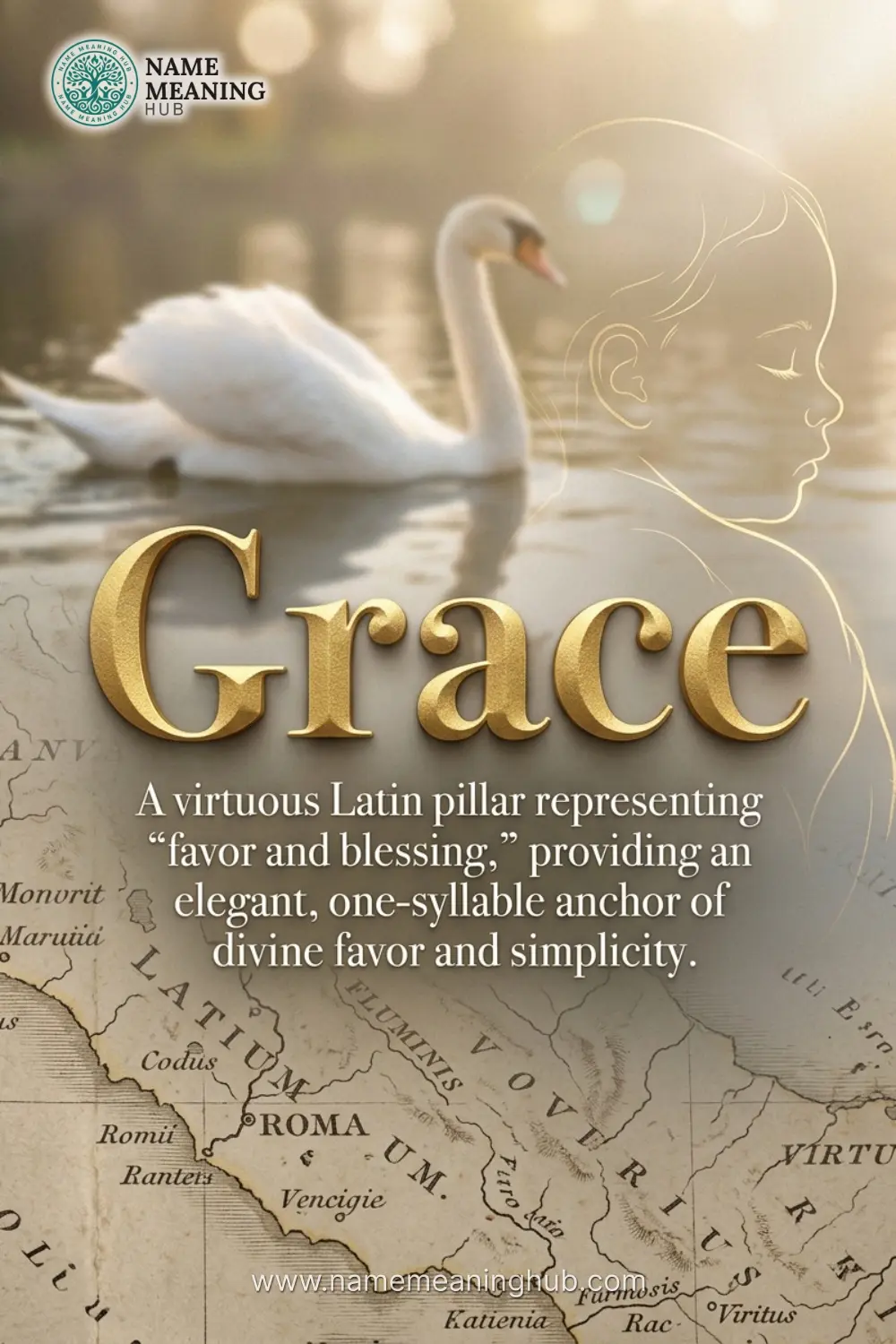
Grace comes from the Latin tradition and is tied to the semantic field of favor, goodwill, thanks, and blessing. That matters because the underlying idea was never small. It belonged to social exchange, to gratitude, to benevolence, and later to theology in an especially powerful way. Over time, the English word “grace” absorbed both sacred and secular force. It could name a divine gift, a prayer before meals, an elegance of carriage, or a kindness shown under strain. Very few words travel so successfully between religion, ethics, and ordinary social life.

That journey shaped the name. Grace is not just a beautiful sound chosen first and explained later. It is a personal name formed from a word that already carried major moral and spiritual weight. When parents choose Grace, they are drawing from an inherited vocabulary that has long linked blessing with gratitude, beauty with restraint, and goodness with generosity.
How Grace entered English naming life
Historically, Grace became especially important in English-speaking naming traditions shaped by Christian thought and, later, by the virtue-name habits that flourished in early modern Protestant culture. That does not mean the name belongs to only one religious moment. It means Grace entered ordinary naming life because the word itself had become central to how people spoke about moral life and divine help. Unlike more ornate names that survived through aristocratic fashion alone, Grace carried a common vocabulary advantage. People already lived with the word before they gave it to children.
That kind of entry point matters. Names rooted in a living word often last differently from names preserved only by lineage. Grace did not depend on a dynasty or a single literary craze. It was anchored in everyday language. That gave it resilience. Even when naming fashions shifted dramatically, the underlying word never disappeared from public speech.
Why the name never lost either its holiness or its worldliness
Many names with sacred resonance eventually split into two fates: they either become too devotional for ordinary life or they secularize so completely that the original meaning becomes ornamental. Grace resisted both outcomes. It kept its religious undertone, helped enormously by the long cultural life of expressions such as divine grace and by the emotional endurance of the hymn “Amazing Grace.” At the same time, it remained fully worldly because “grace” also described courtesy, poise, and a kind of human elegance. If you want to expand your shortlist within this origin, browse more names from this origin.
That doubleness is the name’s secret. Grace can belong to a church bulletin, a ballet program, a legal contract, or a film credit without sounding misplaced. In the twentieth century, Grace Kelly added glamour and composure to the public image of the name, but she did not erase its older moral depth. That is precisely what makes Grace so unusual. Public beauty never managed to empty out the private seriousness already inside it.
Why Grace sounds modern despite its age
One syllable gives Grace unusual authority
Phonetically, Grace is a study in compression. It is only one syllable, yet it never feels abrupt in a crude way. The opening consonant cluster gr- gives the name texture immediately. It begins with firmness, not mist. The long vowel opens the sound, and the closing s gives it a clean, almost crystalline finish. The result is a name that sounds both fluent and exact.
That sound pattern helps explain why Grace still feels contemporary. Many old names retain their dignity but sound heavier than modern taste prefers. Grace avoids that problem by being structurally lean. It does not need trimming, respelling, or modernization. It was already minimal before minimalism became fashionable.
Grace is soft in meaning, not in structure
This is one of the most important distinctions in the name. Grace may suggest tenderness, blessing, and benevolence, but the sound itself is not airy or fragile. Compared with names like Lily, Daisy, or Ella, Grace has more edge. Compared with names like Claire, Jane, or Ruth, it has more spiritual warmth. That gives it a rare middle position. It can sit beside romantic names and sharpen them, or beside tailored classics and soften them.
It also explains why Grace often works so well as both first name and middle name. As a first name, it is complete and lucid. As a middle, it lends meaning and finish without clutter. The same phonetic economy supports both roles.
What Grace’s popularity says about permanence rather than trend
Grace has been visible for far longer than most current favorites
Official SSA data places Grace at No. 40 for girls in the United States in 2024, but the deeper popularity story is what makes the name remarkable. Grace reached No. 13 as early as 1883, has been recorded continuously since 1880, and has accumulated well over half a million female births in that span. That is not the profile of a fashionable rediscovery. It is the profile of a name that stayed in circulation because it was never entirely dependent on the tastes of one decade.
This matters for parents thinking beyond immediate style. Some names feel fresh because they were absent long enough to return with novelty. Grace does not need that cycle. It has remained alive in the bloodstream of English naming. That continuity gives it trust. It also gives it a different texture from names that come back carrying obvious vintage theater around them. Grace does not feel revived. It feels retained.
Why current use still feels fresh
If Grace has been around so long, why does it not feel stale? The answer lies in its design. The name is brief, transparent, morally resonant, and socially adaptable. It can sound traditional, minimalist, literary, or quietly devout depending on the family using it. That flexibility keeps it from belonging to only one style tribe.
Its female usage remains overwhelmingly dominant in current records, while its use for boys is extremely rare. That stability also contributes to its clarity. Grace arrives in public life with very little ambiguity about tone, gender pattern, or pronunciation. Names that are easy to place tend to wear well. Grace is one of the clearest examples. To keep exploring names in this same lane, visit girl names and meanings.
The Grace pages parents usually open next
Middle names that sharpen or widen Grace
Because Grace is only one syllable and already dense with meaning, middle-name choices do a great deal of tonal work. Some pairings make Grace feel more tailored and exact, while others open it into something softer, more literary, or more ceremonial. If you want the full pairing logic behind that contrast, see middle names for Grace.
Nicknames that reveal Grace’s private warmth
Grace does not produce the same nickname landscape as longer names, but the few affectionate forms it allows tend to matter precisely because the full name itself is so crisp and self-contained. To see how those different moods shorten in real life, explore Grace nicknames.
Pronunciation and why Grace sounds stronger than it looks
The sound pattern in Grace is part of its lasting appeal. The name appears simple at first glance, but its consonant structure and clean ending give it more authority than many people notice at first. If you want the full sound pattern behind that rhythm, read Grace pronunciation guide.
Why Grace still means Grace
What makes Grace enduring is not just that it means favor and blessing, but that it never stopped teaching English speakers how to hear those ideas. The word remained active in prayer, literature, ethics, music, and ordinary manners. The name remained active in families. Over time, the two kept strengthening one another. That is why Grace still feels more alive than many names with equally noble meanings. It belongs to a concept the culture never quite stopped needing.
There is also something almost literary about the way Grace survives. It is not loud. It does not rely on novelty, ornament, or dramatic image. It works by compression and resonance. One syllable carries a theology, a social ideal, a physical elegance, and a long female naming history, yet the result never feels overburdened. That balance is difficult to achieve. Grace achieves it so completely that the name can seem effortless, even though its meanings are anything but small.
And that is the final truth about Grace. It names blessing without passivity, refinement without vanity, and goodness without sentimentality. It is one of the few names that can sound poised on a child, dignified on an adult, and morally luminous in any century. Grace does not merely point to favor. It makes favor audible. That is why the name continues to hold. Grace still sounds like what it says.