
Aisha Name Meaning: History, Meaning, and Modern Appeal

Aisha is a name that begins not with ornament, but with pulse. Some names promise beauty, charm, or elegance from a distance. Aisha promises something more immediate: life itself. The meanings attached to it in the controlling record for this page are alive and prosperous, and those two ideas matter together. To be alive is not simply to exist. It is to move, answer, respond, and take up space with energy. To be prosperous is not simply to possess. It is to thrive, to grow outward, to show evidence of health and continuation. Put together, those meanings give Aisha a very particular emotional shape. It is a name of vitality made visible.
That is why Aisha has such unusual force. The name sounds soft enough to be intimate, but the idea inside it is not small. Aisha does not describe a decorative quality. It describes a state of flourishing. Historically, it has been used in Muslim communities and is strongly associated with Aisha, the third wife of the Prophet Muhammad, which gives the name a devotional and historical gravity far beyond surface style. Official data shows Aisha remained active in the United States in 2024, but its endurance cannot be explained by trend alone. It lasts because the word at its center still matters. To call a child Aisha is to choose a name that does not merely sound beautiful. It sounds alive on purpose.
Aisha's U.S. popularity rank over time, 1950–2024
Popularity statistics are based on official data from the Social Security Administration baby name records.
Aisha: A Vibrant and Culturally Resonant Choice
Aisha behaves as a name with one unmistakable center of gravity, with its primary visibility anchored firmly on the girls’ side of the chart. Its era signal shows a peak of momentum in the late 1970s, though it remains a distinctive choice for parents seeking a name that feels “alive and prosperous” .
The lack of meaningful crossover usage reinforces its clear feminine identity. With its melodic, three-syllable Arabic roots, the name offers a texture of resilience that feels both ancient and contemporary.
Aisha in one clear frame
| Key Facts | Information | Quick Insight |
|---|---|---|
| Name | Aisha | The form is warm and flowing, but the meaning behind it is energetic rather than ornamental. |
| Primary Gender Usage | Female | Aisha reads clearly feminine in contemporary use, yet its core meaning gives it more force than many softly voiced girls’ names. |
| Origin | Arabic | The Arabic origin matters because the name comes from a linguistic tradition where life and vitality are central, not decorative. |
| Core Meaning | Alive; prosperous | This is a meaning of motion and flourishing: Aisha suggests not only existence, but active thriving. |
| Pronunciation | eye-EE-shuh | The sound moves upward and outward, which fits the name’s sense of life unfolding rather than staying still. |
| Syllable Count | 3 | Three syllables give Aisha a lyrical rhythm without making it feel formal or distant. |
| U.S. girls’ rank (2024) | No. 346 | Aisha is familiar enough to feel established, but uncommon enough to retain character and intentionality. |
| Style Position | Sacred, vibrant, cross-cultural classic | The name succeeds because it combines spiritual history with a meaning that still feels immediate and human. |

Why Aisha makes life sound active rather than passive
The strongest thing about Aisha is that its meaning is not static. Alive does not merely describe a condition. It implies responsiveness. It suggests warmth, attention, movement, and presence. A child named Aisha is therefore imagined not as an object of admiration, but as a source of energy. That difference matters. Many names are beautiful because they point to an image. Aisha is beautiful because it points to a force.
The second meaning, prosperous, deepens this effect. Prosperity here should not be understood only in a narrow material sense. In naming language, prosperous often suggests well-being, growth, thriving, and a life that expands rather than contracts. It is the visible sign of vitality. That means Aisha does not merely carry the idea of life as breath. It carries the idea of life as flourishing. The name therefore feels abundant rather than minimal.
This gives Aisha a remarkable emotional structure. Some names associated with joy can feel airy. Some names associated with strength can feel stern. Aisha does something better. It joins vigor and warmth. The name sounds close enough for family life, yet the meaning inside it is large enough for a whole philosophy of being. It implies a person who does not merely endure the world, but participates in it fully.
There is also something deeply hopeful in the pairing of alive and prosperous. The first meaning is immediate; the second is cumulative. One says, she is here. The other says, she is growing. Together, they turn the name into a small narrative: life becoming fuller. That is one of the reasons Aisha can feel so moving. It names not only existence, but continuance.

How Aisha grew into one of the great living names of the Arabic tradition
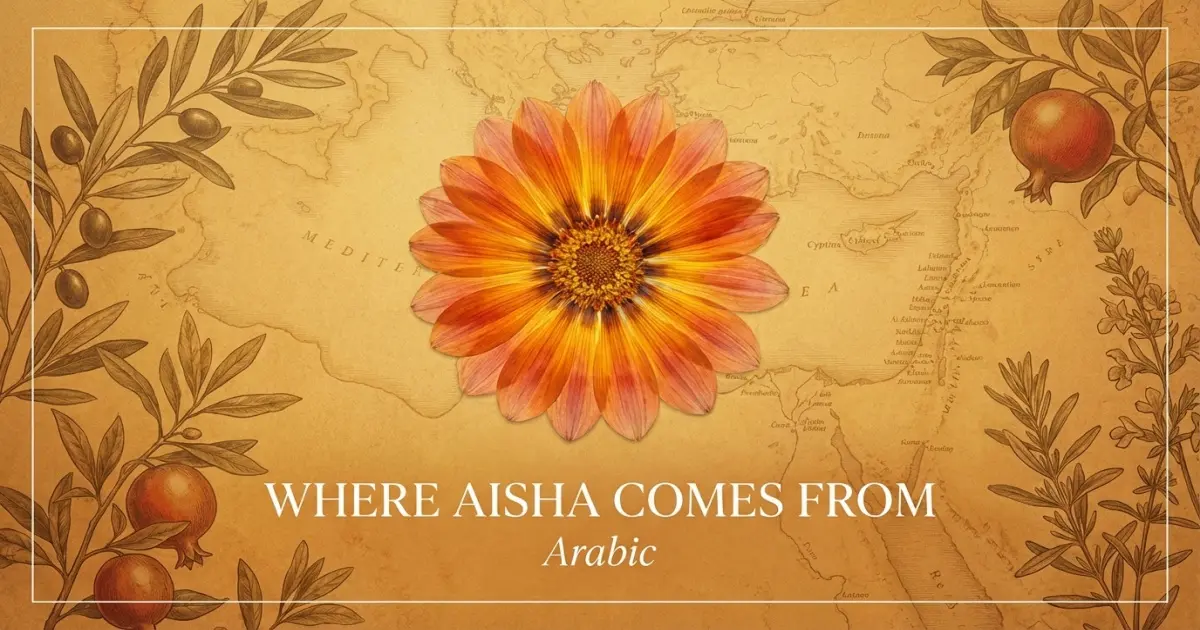
Project naming references describe Aisha with unusual consistency. One attached source defines it as “life, alive and well” and identifies it as a Muslim name from Arabic. Another gives the meaning as “alive, thriving; woman.” A third source glosses it as “prosperous” and explicitly notes that the name is of Arabic origin and most often found in Muslim communities. When read together with the controlling fact packet, those references create a coherent picture: Aisha is a name built around vitality, thriving, and active human presence, and it has long lived inside a strong religious and cultural tradition.
Why the Arabic root matters to the atmosphere of Aisha
The Arabic root matters because it helps explain why Aisha feels so warm and direct. This is not a name whose meaning must be excavated through centuries of distortion. It remains close to the idea of life itself. That proximity makes the name feel especially fresh. Aisha does not sound like a museum relic being carried forward for duty alone. It sounds like a word still alive in the mouth.
This closeness to the root also gives the name unusual clarity. Parents are not choosing an abstract virtue or a distant metaphor. They are choosing vitality in its most basic form. Aisha therefore feels elemental. It belongs to first things: breath, growth, energy, continuance.
Why “alive” is stronger than it first appears
In modern English, “alive” can sound simple because it is such a basic word. But basic words often hold the greatest power. Alive is the opposite of numb, still, depleted, or extinguished. A name carrying that meaning resists passivity at its core. It suggests alertness, animation, and the capacity to answer the world back.
This is one reason Aisha can feel much stronger than names that only sound lively. The meaning is not borrowed from brightness or youthfulness. It is built into the structure of the name itself. That makes the liveliness feel earned rather than cosmetic.
Why prosperity gives the name a second horizon
Prosperity adds something essential. Without it, Aisha might suggest life in its simplest form. With it, the name points toward increase, wellness, and visible flourishing. The child is not only imagined as present, but as advancing, ripening, and doing well. This gives the name an expansive emotional horizon. It implies that life should not merely continue; it should thrive.
That expansion helps the name feel especially full in modern use. Aisha is not only a survival name. It is a flourishing name. That difference gives it radiance.
Aisha in sacred memory and public life
One of the project references states clearly that Aisha was the name of the Prophet Muhammad’s third wife. That detail matters because it gives the name far more than lexical meaning. It gives it historical and devotional presence. Aisha is therefore not only a word meaning life. It is also a lived name carried by one of the best-known women in Islamic history. That association deepens the emotional field around the name immediately.
This kind of historical anchor changes the way a name behaves. Aisha does not feel like an abstract language exercise. It feels inhabited. It has already lived in religious memory, family naming practice, and cultural continuity for generations. That gives the name a steadiness many modern favorites never acquire.
Why sacred association makes Aisha feel more grounded
A sacred association can sometimes make a name feel distant or overly solemn. Aisha escapes that partly because the sound remains so warm and vivid. The name is devotional, but not cold. It belongs to history, but it still sounds immediate. That combination is part of its beauty. The sacred weight strengthens the name without freezing it.
For many families, this means Aisha can hold multiple layers at once: faith, heritage, vitality, and everyday usability. It does not ask the child to choose one register of identity over another. The name already contains several.
Why Aisha sounds intimate even with a public history behind it
Despite its history, Aisha still feels close to the body. This is one of its most attractive qualities. Some historically resonant names sound almost too large for ordinary domestic life. Aisha does not. It can sit in prayer, in formal documents, and in affectionate everyday speech with equal ease. The historical layer gives it dignity; the sound keeps it human. For more names shaped by the same tradition, explore baby names from this cultural background.
That balance is rare. It means the name can carry reverence without ever sounding remote. In daily life, that makes a tremendous difference.
What Aisha sounds like before anyone knows the history
Phonetically, Aisha is part of why the name works so well across generations. The pronunciation given here, eye-EE-shuh, has a rising shape to it. The first syllable opens, the second lifts, and the third softens the landing. The result is musical without being elaborate. The name feels fluid, but not fragile.
The opening sound gives it immediate visibility. It begins with a bright vowel rather than a heavy consonant, which helps the name feel energetic from the first beat. Then the central stressed syllable provides lift and emphasis. By the time the final syllable arrives, the name has already built momentum. That structure fits the meaning beautifully. A name associated with being alive should not sound inert, and Aisha does not.
The spelling also helps. It is distinctive without being chaotic, recognizable without being overfamiliar. In practical terms, that gives the name a useful social profile. It feels memorable, but not difficult. That kind of ease is one reason Aisha has remained usable in English-speaking contexts without losing its cultural integrity.
There is another quiet advantage in the way the name ends. The soft final syllable keeps Aisha from sounding too sharp or formal. This softening makes the name feel warm, almost conversational. Even with a large historical presence behind it, the sound remains kind. That kindness helps explain why the name can hold both strength and tenderness at once.
Aisha at No. 346 says the name is established, not exhausted
Official Social Security Administration (SSA) data places Aisha at No. 346 for girls in 2024. That ranking tells a useful story. The name is not obscure. It is clearly in circulation and widely recognizable. But it is also not so dominant that it has become flattened by repetition. That means Aisha occupies a very attractive social position: visible enough to feel stable, selective enough to feel meaningful. To continue browsing names with a similar gender identity, see more feminine name ideas.
This middle position strengthens the name’s identity. When a name is too rare, it can be treated as exoticized novelty rather than as a fully human choice. When it is too common, much of its texture can disappear into background familiarity. Aisha avoids both extremes. It remains individual without becoming difficult.
That is particularly important for a name with such strong cultural and spiritual associations. Aisha does not need to announce itself loudly to be recognized. It already has history, clarity, and sound working in its favor. The current ranking suggests that the name is securely present in modern life without having surrendered the intentionality that makes it special.
It also suggests that families choosing Aisha now are often doing so with awareness. This is not a name that drifts into use accidentally. It sounds chosen with meaning in mind, and that gives it extra dignity in the current naming landscape.
Where Aisha stands among its sister forms and neighboring names
Aisha lives near a family of related and variant spellings—Aishah, Aiesha, Ayesha, Ayisha, Aysha, and others listed in the project sources. This matters because it shows that the name has traveled widely enough to produce multiple visual forms while keeping the same core vitality. That kind of variation is usually a sign of cultural depth, not instability.
At the same time, Aisha remains distinct within that wider field. Compared with some alternate spellings, it often looks the most balanced and immediately legible in English. It feels both rooted and clean. That helps explain why it has remained such a durable public form.
The name also stands apart from many other lively girls’ names because it has more semantic backbone. There are many names that sound energetic, youthful, or bright. Fewer can point to a meaning as essential as alive, and fewer still can add prosperity without losing clarity. That depth makes Aisha feel more lasting than names built only on tone.

The three paths Aisha quietly opens next
Aisha with middle names can sound either more grounded or more luminous
Because Aisha already carries such warmth and movement, middle names usually do one of two things beside it: they either add more depth and steadiness, or they heighten the lyrical, radiant side of the name. The strongest pairings understand that Aisha already brings life on its own. If you want the full pairing logic behind that contrast, see Aisha middle names.
Nicknames soften Aisha only slightly because the full form already feels intimate
One of the quiet strengths of Aisha is that it begins close to the body. The full name is already warm, memorable, and easy to say, so additional nicknames tend to emerge through affection rather than necessity. That is often the sign of a well-shaped first name. To see how those different moods shorten in real life, explore Aisha nicknames.
Pronunciation is one of Aisha’s most practical strengths
The pronunciation gives the name lift, softness, and presence without making it cumbersome. That ease helps Aisha move gracefully through daily life while preserving the cultural and emotional depth that make it meaningful. If you want the full sound pattern behind that rhythm, read Aisha pronunciation guide.
Why Aisha still sounds like life in motion
The best way to understand Aisha is to hear that its meanings do not stay still. Alive is motion. Prosperous is expansion. Together they make the name feel active from the inside out. This is not a name of posed beauty or static charm. It is a name that implies growth, response, and continuance.
Its Arabic origin gives it clarity. Its historical association gives it dignity. Its sound gives it warmth. Its current ranking shows it remains present without becoming overfamiliar. None of these elements works alone. Together they create a name that feels both intimate and enduring, both tender and strong. Aisha is proof that vitality can sound graceful.
That is why the name remains so persuasive. It does not promise a perfect life. It promises a life fully inhabited. It does not only suggest beauty. It suggests thriving. And in a naming culture often crowded with surface sparkle, that older, deeper promise still stands out. Aisha sounds like a name chosen not merely for how it looks, but for how it lives.