
How to Check Nickname Potential Before Choosing a Baby Name

Some baby names have two lives.
There is the full name: the one on the birth certificate, school forms, passports, graduation programs, wedding invitations, and professional introductions. Then there is the everyday name – the one family calls across the house, teachers use in class, friends shorten on the playground, teammates shout from the sideline, and the child may eventually choose for themselves.
That second life is nickname potential.
Parents often notice it only after they have fallen in love with the formal name. You may love Elizabeth but feel unsure about Liz, Beth, Ellie, Libby, Betty, or Eliza. You may love Theodore but prefer Theo over Teddy or Ted. You may like the strength of James without wanting Jim or Jimmy. Alexander may feel handsome in full, while Alex, Xander, and Alec pull the name in very different directions.
None of those nicknames is wrong.
The real decision is whether you can live with the short forms most likely to appear.
Because nicknames change the style and daily feel of a name, it helps to compare full names and short forms through Baby Names by Style. A formal legal name can feel classic, elegant, and substantial, while its nickname may feel sporty, cute, vintage, casual, or modern. Parents should like the name in the mode their child is most likely to use.
For the wider naming process, Expert Baby Naming Guides for Choosing the Right Name can help you keep nickname potential in proportion with pronunciation, spelling, surname fit, popularity, sibling names, and long-term usability.
You cannot control every nickname. Friends, siblings, teams, classmates, and your child’s own personality may create names you never predicted.
You can, however, check the obvious ones before you choose.

Nickname Potential Is About Daily Use, Not Just Cute Options
Nickname potential is often treated as a light, enjoyable side question.
Parents ask, “What cute nicknames could we use?” That can be fun, but it is not enough. The sharper test is what people will naturally call the name when they are not thinking as carefully as you are.
Nickname potential can come from several routes:
- Obvious short forms.
- Traditional diminutives.
- Parent-preferred nicknames.
- Unwanted short forms.
- Initials-based nicknames.
- Surname-based nicknames.
- Rhyming or teasing possibilities.
- Sibling nickname patterns.
- Adult nickname choices.
A name may look flexible because it has many nickname options. Flexibility only helps when at least one of those options feels right. When the most obvious nickname bothers you, the full name deserves a harder test.
Ask:
- What is the first nickname most people will reach for?
- Do we like that nickname enough to hear it often?
- Can the full name realistically stay full?
- Does our preferred nickname sound natural with the full name?
- Would the nickname feel too childish later?
- Does the nickname fit the surname?
- Could the nickname make the name feel more popular than the legal name suggests?
Nickname potential belongs inside full-name usability. It sits beside spelling, pronunciation, syllable flow, surname fit, initials, and adult use. If you are close to finalizing a name, How to Test a Baby Name Before Finalizing It can help you check those pieces together.

The Nickname Potential Framework Parents Can Use
A good nickname check separates the kinds of nicknames a name may create.
Not every short form has the same likelihood or emotional weight. A nickname used only by one grandparent is different from the default short form every teacher, coach, and friend might reach for.
Use this framework before deciding whether nickname potential is an asset, a neutral detail, or a warning sign.
| Nickname Route | What It Means | Example Pattern | Main Risk |
| Obvious short form | The nickname people reach for first | Daniel → Dan or Danny | You may dislike the default |
| Traditional nickname | A long-established diminutive | William → Bill, Margaret → Peggy | Older relatives may use it naturally |
| Parent-preferred nickname | The short form you plan to introduce | Theodore → Theo | It may not block every other option |
| Initial-based nickname | A nickname made from initials | James Thomas → J.T. | The initials may create a style you did not intend |
| Surname-based nickname | A school, team, or workplace short form | Surname-derived | Harder to predict or control |
| Rhyming or teasing nickname | A nickname made from sound play | Name rhyme | Usually matters only when obvious and repeated |
This framework is not meant to make naming mechanical. It simply helps you see whether the nickname layer supports the name or quietly works against it.
Obvious Short Forms Matter Most Because They Are Hardest to Block
Obvious short forms are the nicknames people reach for without much thought.
Daniel becomes Dan or Danny. Benjamin becomes Ben, Benny, or Benji. Thomas becomes Tom or Tommy. Elizabeth has several familiar routes, including Liz, Beth, Ellie, and Libby.
The most obvious nickname matters because it is the one you may need to redirect.
Ask:
- What is the first shortened version people will use?
- Is it one syllable, two syllables, or a familiar diminutive?
- Do we like it enough to hear it often?
- Does it work with our surname?
- Would it still feel usable on an adult?
A disliked but unlikely nickname may be manageable. A disliked default nickname is different.
Parents often say they will simply insist on the full name, and sometimes that works. James often stays James. Some families use Thomas in full without much resistance. But a longer name with several easy short forms will invite more shortening, especially in school, sports, and family settings.
When you love the formal name but dislike the obvious short form, pause before you commit. That does not mean the name is wrong. It means the everyday version needs as much attention as the birth certificate version.

Traditional Nicknames Can Surprise Modern Parents
Some names carry old nickname traditions that may not be obvious at first.
William can become Will, Bill, Billy, or Liam. Margaret has routes such as Maggie, Meg, Greta, Daisy, and Peggy. Richard brings Rich, Rick, Ricky, and older diminutives that some modern parents would strongly avoid. Katherine and Catherine can become Kate, Katie, Kat, Kathy, or Kit.
These traditional nicknames are not equally likely today. Some feel current; others feel dated, regional, or family-specific. Still, older relatives may assume them, and family habits can be surprisingly hard to redirect.
Check:
- Does the name have a long-standing nickname we dislike?
- Is that nickname still common in our community?
- Would older relatives naturally use it?
- Can we redirect it without constant correction?
- Does the traditional nickname change the style too much?
Traditional nickname logic can also change by language or culture. A name may shorten differently in another language, or a family may have a nickname pattern tied to heritage rather than English-language habit. When that matters, compare options through Baby Names by Origin and How to Choose Bilingual-Friendly Baby Names.
Parent-Preferred Nicknames Work Best When They Start Early
A parent-preferred nickname is the short form you plan to use from the beginning.
This can be a strong strategy. Introduce the name consistently, and family, friends, childcare providers, and teachers are more likely to follow your lead.
You might choose Theodore and use Theo from birth. You might choose Elizabeth and introduce Libby before Liz appears. Alexander can become Xander instead of Alex if that is the version your household uses naturally. Charlotte can move toward Lottie rather than Charlie when parents establish the habit early.
Use a clear introduction:
- “Her name is Elizabeth, and we’re calling her Libby.”
- “His name is Theodore, but we use Theo.”
- “This is Alexander – we call him Xander.”
- “Her name is Charlotte, and we’re using Lottie.”
Then test the plan:
- Does our preferred nickname sound natural with the full name?
- Are we willing to use it consistently?
- Will close family understand and respect it?
- Are we comfortable if another nickname appears later?
- Does the nickname still work with the surname?
Using a nickname early can guide the name’s daily life. It cannot guarantee control forever.
A teenager may choose a different version. A coach may use the surname. Friends may create something private and affectionate. A workplace may use initials. Parent influence matters most at the beginning; it does not script the whole name’s future.
When partners disagree about the preferred short form, settle that before announcing the name. How to Choose a Name With Your Partner is useful when the formal name works but the nickname plan does not.

Unwanted Nicknames Need an Honest Likelihood Test
Unwanted nicknames are the ones you hope no one uses.
This is where parents need to be blunt with themselves. A nickname that is rare, dated, or unlikely may not matter. A nickname most people will choose first deserves real attention.
James may become Jim or Jimmy in some families, though many people now use James in full. Thomas may become Tom or Tommy. Francesca can become Fran, Franny, Frankie, or Chessie depending on the community. Richard carries traditional nickname concerns that some parents will want to avoid entirely.
Ask:
- Which nickname would truly bother us?
- Is it the most obvious short form?
- Would family members use it naturally?
- Would classmates or teammates discover it easily?
- Can our preferred nickname realistically redirect it?
The severity depends on likelihood.
A remote unwanted nickname should not control the whole decision. A default unwanted nickname can become a recurring battle. If you already feel defensive when someone mentions the obvious short form, listen to that reaction before you sign the paperwork.
For broader regret prevention, read How to Avoid Baby Name Regret.
Some Names Invite Nicknames More Strongly Than Others
Nickname potential is not evenly distributed.
Some names almost invite shortening. Others hold their full form more easily.
High-nickname-potential names often have:
- Three or four syllables.
- Familiar short forms.
- Long historical use.
- Multiple sound zones.
- Common family or school nicknames.
- Strong formal-to-casual contrast.
Elizabeth, Alexander, Benjamin, Theodore, Margaret, and Victoria all offer several nickname paths. That flexibility can be wonderful. A child can grow from a sweet childhood nickname into a more formal adult version, or move between forms depending on setting. The risk is that other people may choose the option you like least.
Lower-nickname-potential names often have:
- One or two syllables.
- Compact sound.
- No obvious shorter form.
- Strong standalone identity.
Max already feels compact. Lucy may become Luce or Lulu, but it often holds as Lucy. Mia is already short. Jack feels complete to many modern parents, even though it has historical roots as a short form.
Short names are not nickname-proof. They simply give people less obvious material.
Syllable length is one of the strongest clues. For more on how long names behave in daily speech, read How to Use Syllable Flow to Choose a Better Name.
Long Formal Names Need Both Full-Name and Nickname Tests
Long formal names can be beautiful because they give a child options.
That flexibility is one reason names like Elizabeth, Alexander, Theodore, Sebastian, Nathaniel, and Victoria remain appealing. They feel substantial in full but can become easier in daily use.
The key is testing both versions.
Do not only ask whether you love Elizabeth. Ask whether you can live with Liz, Beth, Ellie, Libby, Eliza, or Betty. Theodore may feel warm and classic, but Theo, Teddy, and Ted each create a different daily impression. Alexander sounds strong in full; Alex and Xander make the name travel through the world differently.
Test:
- Full name + surname.
- Nickname + surname.
- Full name in a formal announcement.
- Nickname in a casual introduction.
- Full name in an adult professional setting.
- Nickname on a school label.
- Nickname as a teenager’s preferred name.
A long name may be the right choice when you love the formal version and like at least one natural nickname. It becomes riskier when you admire the formal version but dislike every likely short form.
For long-term name identity, read How to Choose a Name That Sounds Professional Later in Life. For rhythm, pair this with How to Use Syllable Flow to Choose a Better Name.
Short Names Can Still Pick Up Nicknames
Choosing a short name can reduce nickname risk.
It cannot remove it completely.
Short names can pick up affectionate add-ons, rhymes, initials, surname nicknames, team nicknames, and personality-based nicknames. Max may become Maxie in the family. Lucy may become Lulu. James may become Jim or Jimmy. Jack may become Jackie, J, or a surname-based nickname at school.
The difference is that short names usually have fewer built-in routes.
Max is already compact and can stand alone. Lucy has affectionate possibilities but often remains Lucy. James is one syllable, yet its long history gives it familiar diminutives. Jack feels complete to many parents, even though it has been used historically as a short form.
This matters because parents sometimes choose a short name to avoid nicknames entirely. A better expectation is more realistic: a short name reduces the obvious pathways, but it cannot prevent informal naming.
When you truly want a name used in full most of the time, choose one that already feels complete in its short form and does not have a nickname you strongly dislike. If that compact style matches your taste, How to Choose Minimalist Baby Names can help you compare short names without treating them as interchangeable.
When You Like the Nickname More Than the Full Name
Sometimes the nickname is the name you actually love.
You may love Max more than Maxwell. Theo may feel more natural to you than Theodore. Maggie may be the part of Margaret that has your heart. Lottie may matter more than Charlotte.
That creates a real decision: should the nickname become the legal name, or should the full name provide flexibility?
A full name can offer:
- A formal option.
- Adult flexibility.
- Family tradition.
- A more complete legal identity.
- Multiple nickname paths.
- A way to honor heritage or relatives.
A nickname as the legal name can offer:
- Clarity.
- Honesty.
- Daily ease.
- Fewer unused forms.
- A name that matches what you will actually say.
Neither path is automatically better.
Using the full name can feel thoughtful when you love both the formal version and the nickname. It can feel performative when you never plan to use the full name and do not truly like it. Using the nickname as the legal name can feel warm and direct when the short form is established and adult-friendly. It may feel too casual when the nickname is strongly tied to childhood.
Max works well as a standalone for many families because it feels complete. Other nicknames need more testing. Imagine the short form on a resume, an email signature, a wedding invitation, and a professional introduction.
For that adult-fit layer, read How to Choose a Name That Ages Well and How to Choose a Name That Sounds Professional Later in Life. When the short form feels cute but you are unsure about long-term use, What Makes a Name Feel Cute Without Feeling Childish? is a useful next read.
Nickname Style Can Be Very Different From Full Name Style
A full name and its nickname can feel like different style worlds.
That can be a strength. It gives a child range. A formal name can offer dignity while the nickname brings warmth. A classic full name can feel grounded while the short form feels friendly and current.
The contrast still has to be one you like.
A formal name can shift sharply in tone depending on its daily abbreviation. Theodore, for instance, moves from the modern-classic gentleness of Theo to the vintage warmth of Teddy or the spare, adult brevity of Ted. Elizabeth carries regal weight in full, yet its short forms splinter into very different emotional temperatures – from Ellie to Libby to Eliza. Margaret offers its own wide social range, spanning the easy warmth of Maggie and Meg, the unexpected charm of Daisy, and the more tailored rhythm of Greta.
Josephine shows the same range. Jo feels short and strong; Joey becomes more playful; Josie turns sweet and vintage; Posy lands somewhere more whimsical. The same legal name can carry several possible lives.
Before choosing a name with strong nickname potential, test the whole style range:
- Formal version.
- Parent-preferred nickname.
- Most obvious nickname.
- Childhood version.
- Adult version.
- Possible sibling or family version.
A nickname can make a formal name usable. It can also pull a name into a style you never intended.
For broader style comparison, use Baby Names by Style, Classic vs Modern Baby Names: How to Decide, and How to Choose Familiar Baby Names With Personality.

Surname and Initials Can Create Nicknames You Did Not Expect
Not all nicknames come from the first name.
Some come from initials. Some come from the surname. Others come from a blend of first and last sounds, especially in schools, sports teams, dorms, workplaces, and friend groups.
Initial nicknames can stick. J.T., A.J., J.J., C.J., and similar forms often come from first-middle or first-last initials. If you like that style, initials can be a bonus. If you dislike it, check the letters before you finalize the name.
James with a J middle name may become J.J. Gabriel may naturally become Gabe, but initials could create another route. Alexander may become Alex at home, while a school team might use a surname-based nickname instead.
Check:
- First-middle initials.
- First-last initials.
- First initial + surname.
- Surname sound.
- First name + surname blend.
- Sibling initials.
- Obvious rhymes.
Surname nicknames are harder to predict because they depend on the actual surname and social setting. You cannot forecast every version. You can catch the obvious ones.
For this layer, read How to Check Initials, Monograms, and Awkward Combinations and How to Match a First Name With Your Surname.
Pronunciation and Spelling Can Push People Toward a Nickname
Sometimes a nickname appears because the full name feels hard to use.
When people are unsure how to pronounce a name, they may shorten it. When the spelling is long or unfamiliar, they may reach for an easier form. A name with multiple pronunciations may produce a nickname simply because the nickname feels safer.
That can be helpful when you like the short form.
It can be frustrating when you chose the full name because you wanted it used in full.
Elizabeth may be shortened because it is long. Isabella may become Bella or Izzy. Gabriel may become Gabe. Siobhan may be shortened informally in communities where the spelling or pronunciation is less familiar.
A nickname can increase usability. It can give a child a simple daily option while preserving a meaningful formal name. But when the nickname exists mainly because everyone avoids the full name, ask whether the formal name is really working the way you want.
Before choosing a name that may be shortened for convenience, read How to Evaluate Pronunciation Ease and How to Avoid Spelling Regret.

Popular Names Often Share Nickname Families
Popularity is not only about legal names.
It is also about sound families and nickname clusters.
A child named Elizabeth, Eleanor, Ella, Isabella, Arabella, or Gabriella may share the Ellie, Ella, or Bella sound space with many other children, even when the legal names differ. Charlotte may become Charlie or Lottie. William may become Will or Liam. Eleanor may become Ellie, Nora, or Nell.
This means a name can feel more common in daily life than its legal-name ranking suggests.
When everyone uses the nickname, the nickname’s popularity matters. A rare formal name with a very common nickname may not feel rare in school. A familiar formal name with a less common nickname can feel more distinctive than expected.
This is not a reason to avoid popular nickname families automatically. Familiarity can be comfortable, easy, and socially smooth. Parents who want distinctiveness should check the nickname level, not only the birth certificate name.
Use Baby Names by Popularity for the bigger picture. For classroom use, read How Popularity Affects Classroom Identity and Nickname Duplication and How to Read Baby Name Popularity Data.

Sibling Nicknames Can Make Names Feel More Matched Than Intended
Sibling names may look different in full and still overlap as nicknames.
This is easy to miss when parents compare only legal names.
Eleanor and Elizabeth are distinct in full, yet both can become Ellie. Theodore and Thomas may become Theo and Tommy, giving the set a T-heavy, traditional sound. Alexander and Isabella can become Alex and Bella, shifting the sibling style from formal-classic to friendly and familiar.
Check sibling names at four levels:
- Full legal names.
- Everyday nicknames.
- Initials.
- Names called together.
The nickname level may reveal matching you did not intend. It can also show that two formal names become much more compatible in daily use.
Twins deserve extra care because their names and nicknames will often be said together. Distinction matters more when two children are constantly introduced as a pair.
For family sets, read How to Choose Sibling Names That Fit Without Matching Too Hard and How to Name Twins Without Being Too Matchy.
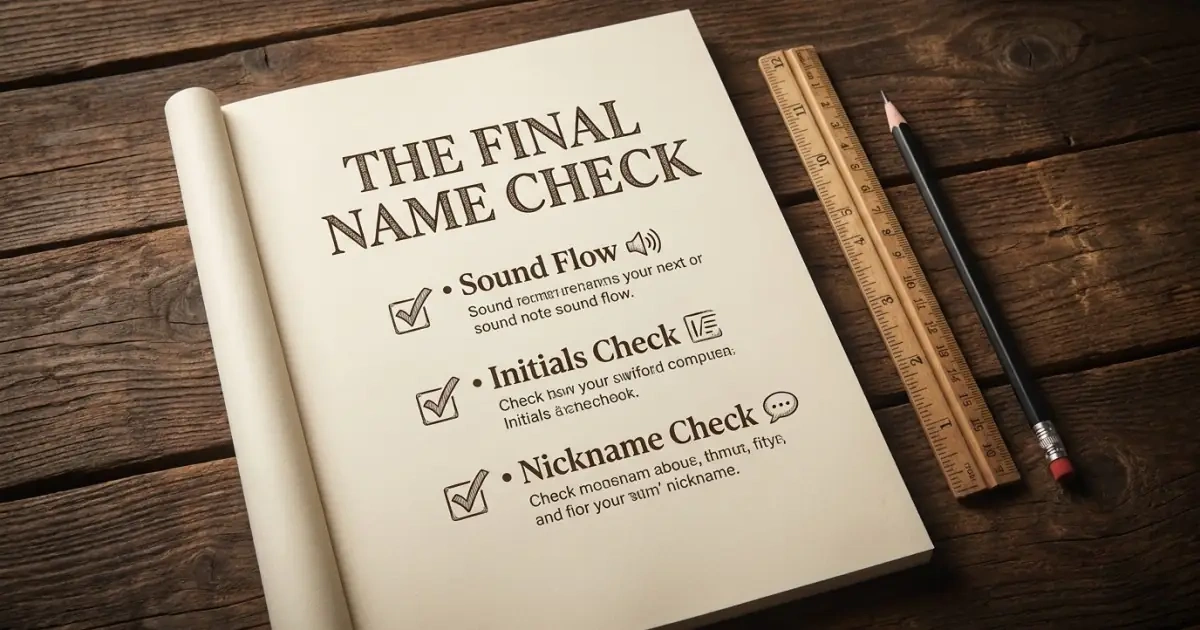
The Nickname Risk Test Before You Finalize a Name
A good nickname check is simple and honest.
Do it once a name becomes a serious contender.
Use this sequence:
- Write the full name.
- List every obvious nickname.
- Mark each one: love, tolerate, or dislike.
- Circle the nickname others are most likely to use.
- Test the full name with the surname.
- Test each likely nickname with the surname.
- Check initials-based nicknames.
- Check surname-based nickname risk.
- Say the name in school, team, and workplace contexts.
- Decide whether you can live with the most likely nickname.
You can also use this table.
| Nickname Type | What to Check | Example |
| Obvious short form | First nickname people reach for | Elizabeth → Liz |
| Parent-preferred | Nickname you introduce early | Theodore → Theo |
| Traditional | Older familiar form | William → Bill |
| Initial-based | Letters that may become a name | James Thomas → J.T. |
| Surname-based | Team or workplace nickname | Surname-derived |
| Teasing or rhyme | Obvious sound risk | Name rhyme |
This test is not about predicting every future nickname. It is about noticing the ones obvious enough to affect the decision.
For the full sound check, use How to Say a Baby Name Out Loud and Hear Its Real Flow. For the broader decision, use How to Test a Baby Name Before Finalizing It.

Nickname Red Flags Worth Taking Seriously
Some nickname concerns are minor.
Others deserve a pause.
Take the concern seriously when:
- You dislike the most obvious nickname.
- You only like the full name in formal settings.
- You only like the nickname, not the legal name.
- Your partner and family naturally use different nicknames.
- The nickname clashes with the surname.
- The nickname duplicates a sibling’s name.
- The nickname feels too childish for adulthood.
- The nickname makes the name feel more popular than you want.
- You expect to fully control what classmates will call your child.
- You feel defensive every time someone suggests the obvious short form.
That last point matters. If you are defending the nickname issue before the baby is born, the friction may already be larger than you want to admit.
The most serious red flag is disliking the nickname people are most likely to use. You can guide family, but you cannot guarantee every teacher, friend, teammate, relative, or future coworker will follow your preferred version.
For close calls, read How to Avoid Baby Name Regret and How to Decide Between Two Baby Names.

When an Unwanted Nickname Is Not a Dealbreaker
An unwanted nickname does not always mean you should reject the name.
Some risks are remote. Some are dated. Some are unlikely in your community. Some may appear briefly in childhood and disappear later. Some children never use the nickname their parents feared.
An unwanted nickname may be manageable when:
- It is not the most obvious short form.
- Family will not use it.
- Your preferred nickname is strong and natural.
- The full name has deep meaning.
- The child can choose their own version later.
- The issue is mild, rare, or unlikely.
- The name works beautifully with the surname.
- The adult version remains strong.
Parents cannot protect a child from every possible nickname. They can only avoid predictable problems that would bother them often.
A meaningful name should not be discarded because of a remote possibility. An obvious nickname you strongly dislike should not be brushed aside either.
This is where proportion matters. When the full name gives your child history, flexibility, elegance, cultural connection, or family meaning, a minor nickname concern may be worth accepting. When the full name mainly creates a nickname fight you do not want to have, keep looking.
For help recognizing when a name is still worth choosing, read How to Know When a Name Feels Right and When an Unusual Name Is Worth It.

Practical Questions About Baby Name Nickname Potential
Can I stop people from using a nickname I dislike?
You can guide early use, especially with family, childcare, and school. You cannot fully control friends, teammates, classmates, coworkers, or your child’s own future preference. When the nickname is very obvious and you strongly dislike it, take that seriously.
Should I avoid a name if I dislike one nickname?
Only when that nickname is likely to appear often. A rare, dated, or unlikely nickname may not matter much. A default nickname is harder to avoid.
Is it okay to use a nickname as the legal name?
Yes, when the nickname feels complete, usable, and mature enough for your child’s whole life. Some short forms stand strongly on their own. Others may feel too casual for the flexibility you want.
What if my child chooses a nickname I do not like later?
That is part of the child owning their name. Choose a full name whose likely options you can mostly live with, knowing that your child may eventually prefer a different version.
Do long names always become nicknames?
Not always, but long names are more likely to be shortened informally by family, friends, schoolmates, teammates, or coworkers. If you choose a long name, make sure at least one natural nickname feels acceptable.

Where to Go Next When Nickname Potential Is the Deciding Factor
Nickname potential is part of full-name usability.
It should be checked alongside spelling, pronunciation, surname fit, initials, syllable flow, popularity, sibling names, and adult use. A name does not need perfect nickname control. It needs nickname possibilities you can live with.
Let your exact concern shape your next move. If your hesitation is rooted in aesthetic shifts, return to Baby Names by Style; concerns about crowded daily use are better viewed through Baby Names by Popularity. When cultural nickname logic matters, Baby Names by Origin gives the short form a steadier frame.
Finally, refine the mechanical friction – whether optimizing rhythm through How to Use Syllable Flow to Choose a Better Name, testing flow with How to Match a First Name With Your Surname, or checking hidden letter-based risks through How to Check Initials, Monograms, and Awkward Combinations.
A good name does not have to block every possible nickname. It should offer a formal identity, an everyday path, and enough flexibility that your child can grow into the version that feels most like them.