
Francesca Name Meaning: What It Means and Why Parents Love It
Francesca is a name that makes freedom sound cultured. That is its central tension and its deepest appeal. On the page and in the ear, Francesca feels graceful, polished, almost ceremonial. It has the sweep of an Italian classic, the softness of a feminine ending, and the kind of rhythm that seems to belong naturally to literature, opera, and old stone cities. But the meaning beneath that elegance is much firmer than the sound first suggests. Francesca means from France and free man. In other words, beneath the silk of the name lies the old idea of liberty.
That is why Francesca has more internal strength than many names that look equally beautiful. It does not merely offer romance. It offers a lineage tied to place, people, and freedom. Official data shows the name remained active in U.S. use in 2024, but its attraction is not just modern taste. Francesca survives because it does something unusually satisfying: it takes an old, almost rugged inheritance and reshapes it into something refined. The name carries both movement and composure. It suggests someone who is not simply elegant, but independently formed. Francesca sounds like a woman entering the room with poise, but the word at its center still belongs to freedom.
Francesca's U.S. popularity rank over time, 1895–2024
Popularity statistics are based on official data from the Social Security Administration baby name records.
Francesca: An Elegant Italian Peak
Francesca reads as a name with one unmistakable center of gravity, with the girls’ side of the chart carrying nearly all of its visibility. Its current position at a peak in 2024 suggests it fits a broader taste for sophisticated, multi-syllabic names that feel “familiar but fresh” .
The trace presence in the boys’ lane is scattered experimentation rather than a broad identity shift. Meaning “free man,” its rhythmic Italian sound adds a layer of literary polish and timeless charm.
Francesca in one clear frame
| Key Facts | Information | Quick Insight |
|---|---|---|
| Name | Francesca | The name feels distinctly Italian and feminine, but its deeper history is broader and more structurally strong than its elegance first suggests. |
| Primary Gender Usage | Female | Francesca reads clearly feminine, yet its meaning comes through a line of names historically built on identity, lineage, and freedom. |
| Origin | Italian | The Italian origin matters because it gives the name cultural polish while preserving its connection to an older European root. |
| Core Meaning | From France; free man | This dual meaning is the name’s real engine: origin and liberty meet in the same line, giving Francesca both location and principle. |
| Pronunciation | fran-CHESS-kuh | The pronunciation is musical but not soft-edged; the strong middle syllable gives the name backbone. |
| Syllable Count | 3 | Three syllables give Francesca grandeur and momentum, which helps the name feel complete rather than merely decorative. |
| U.S. girls’ rank (2024) | No. 314 | Francesca is visible enough to be familiar, but uncommon enough to feel consciously chosen and individually styled. |
| Style Position | Italian classic, romantic with backbone | The name works because it marries cultural elegance with a meaning rooted in freedom rather than softness alone. |
Francesca makes freedom sound cultivated
The most compelling thing about Francesca is that it refuses to choose between beauty and structure. The phrase from France gives the name a sense of origin, of belonging to a people and a place. It makes the name feel geographical and historical rather than purely invented. The phrase free man changes the emotional register entirely. Suddenly the name is no longer only about place. It is about status, liberty, and independence.
That double meaning is not a weakness. It is the point. Some names promise only atmosphere. Francesca promises atmosphere and inheritance. It suggests a child who belongs to a long cultural line, but also a person who carries within her the older European idea of freedom. Even though the literal phrase “free man” comes through a historical linguistic route rather than a modern gender statement, what remains alive in the name today is the idea of freedom itself. That matters. It gives Francesca far more backbone than many names of similar romantic richness.
This is part of why the name feels so persuasive in the present day. Many parents want a daughter’s name that sounds graceful without sounding passive. Francesca offers exactly that. It sounds composed, but not submissive. It sounds cultivated, but not overhandled. The freedom inside the name makes the polish feel earned rather than ornamental. A Francesca is not imagined only as lovely. She is imagined as formed, self-possessed, and standing inside a tradition without being trapped by it.
There is also something satisfying in how the name transforms its inheritance. A phrase like “free man” can sound heavy or old-world in its original form. Francesca translates that old meaning into something more socially fluid and distinctly feminine without losing its force. The result is a name that turns an ancestral idea into modern poise.
How Francesca traveled from France into Italian life
The attached naming references are especially useful here because they frame Francesca with remarkable consistency. One source calls it the Italian form of Frances and notes that it originally existed as a word for “French” and still carries the meaning “from France.” Another describes it as the Italian feminine form of Francesco. A third identifies it as a form of Frances meaning “free man.” When read together with the controlling fact packet, the picture is clear: Francesca stands at the crossing point of national identity, linguistic inheritance, and an older freedom-rooted name family.

Why “from France” matters more than geography
At first glance, “from France” may sound like a simple place label. But names built from nationality or geographic identity often carry more than location. They imply cultural memory, movement between peoples, and a sense of belonging shaped by history. Francesca therefore does not only tell us where the older line points. It also gives the name a social texture. This is a name that comes carrying the idea of origin. For related names from the same origin family, see Italian baby names.
That gives Francesca more seriousness than many romantic names possess. It is not a fantasy construction built only for sound. It has a remembered direction behind it. The name looks elegant, but its root is anchored in the real world of peoples, borders, and linguistic inheritance.
Why “free man” becomes freedom in Francesca
The second half of the meaning deepens everything. Project naming references trace the Frances family through older forms connected with Franciscus and with language linked to the Franks and the idea of freedom. The wording “free man” belongs to that older naming world, and in modern use the living force of the phrase is liberty rather than literal social rank. That is what makes Francesca so appealing today. It sounds refined, but the idea underneath it is not ornamental. It is independent.
This is one reason the name avoids becoming sugary. Freedom gives it edge. It suggests that the person carrying the name is not merely beautiful or cultured, but inwardly self-directed. That quality can be felt even when the listener does not consciously know the etymology. The name’s structure seems to remember it.
Why the Italian feminine form changes the whole atmosphere
Francesca’s Italian form matters enormously. The project books repeatedly present it as the feminine form of Frances or Francesco, and that shaping changes the emotional tone of the name. Where Francis can feel austere and Frances can feel quietly Anglo-classic, Francesca sounds more fluid, more lyrical, more visibly crafted. The Italian ending turns an old identity name into something more musical without weakening the underlying strength. To compare tone, familiarity, and fit across similar names, explore stylish girl names and meanings.
That is exactly why Francesca can feel at once romantic and durable. The cultural form gives it artistry. The inherited meaning gives it ground. One without the other would be less convincing. Together they create a name that feels beautifully made.
Francesca in the long Italian imagination
Francesca gains even more texture from the wider Italian name family around it. The project references do not stop at the simple gloss. They also place Francesca directly in the orbit of Francesco, and one of the attached books explicitly notes that Francesco is the Italian version of Francis, meaning “free man,” and that St. Francesco of Assisi is the patron saint of Italy. That matters because it helps explain why Francesca feels so culturally grounded. The family line around it is not abstract. It lives near one of the strongest spiritual and national figures in Italian memory.
Another reference from the attached materials names Francesco Petrarca as one of the great lyrical poets in Italian. Again, this is not Francesca directly, but it helps define the cultural air around the family. The name sits close to saintliness, lyric tradition, and the durable prestige of Italian naming. That atmosphere is one reason Francesca sounds so naturally literary even when no explicit literary namesake is being invoked.
What makes this especially interesting is that the name does not become heavy under that inheritance. Some culturally rich names feel almost too ceremonial to wear. Francesca does not. The sound keeps the name flowing. The weight stays in the background as strength rather than burden.
This balance is central to the name’s appeal. Francesca can feel continental and cultured without becoming inaccessible. It can gesture toward cathedrals, Renaissance paintings, and old family names, yet still remain perfectly usable in ordinary modern life. That is a rare achievement. Many names can sound elegant. Fewer can sound elegant and inhabited at the same time.
What Francesca sounds like before anyone asks what it means
Phonetically, Francesca is one of those names that announces form. fran-CHESS-kuh begins with a grounded opening, gathers force in the strong middle syllable, and ends with a soft but stable release. This shape is important. It keeps the name from floating into pure romance. The central stress gives Francesca its backbone. Without that strong middle beat, the name might become too airy. With it, the name sounds composed and controlled.
The sound also explains why Francesca feels both feminine and substantial. The first syllable opens the name warmly, the middle sharpens it, and the last syllable relaxes it just enough to remain human. That balance makes the name effective across life stages. It can sound lovely on a child, but it does not remain child-sized. It has enough weight to live well on an adult woman.
There is also a practical advantage in the name’s sound. Although it is clearly Italian in flavor, it is still highly manageable for English speakers. The pronunciation looks more elaborate than it really is. Once heard, it is easy to remember. That low-friction elegance is one reason the name can feel distinctive without becoming socially difficult.
Visually, too, Francesca carries proportion well. The spelling is full but not crowded, decorative without excess. It looks like a name meant to be written in full, which suits its emotional character. Some names invite shortening almost immediately. Francesca earns its full length.
Francesca after the chart: familiar, selective, still strong
Official Social Security Administration (SSA) data places Francesca at No. 314 for girls in 2024. That is a revealing rank. The name is not obscure, and most people will recognize it as established and graceful. But it is also far enough from the very top of the chart that it retains selectiveness. This is often where classic international names are strongest: present enough to feel legitimate, uncommon enough to feel intentional.
That social position suits Francesca especially well. A name this elegant can lose some of its edge if it becomes too ubiquitous. At the same time, it is too historically grounded and too publicly legible to function best as a hidden rarity. No. 314 suggests a middle path. Francesca still feels cultured and specific, but without requiring explanation.
This also means the name tends to signal taste rather than fashion. Parents choosing Francesca now are often choosing length, heritage, sound, and meaning all at once. The name does not sound accidental. It sounds considered. That is part of its modern appeal. It manages to feel expressive without ever sounding chaotic.
And because its meaning line is so strong, the name is somewhat protected from the flattening effect that chart popularity can have on lighter names. Francesca has too much built into it to become empty quickly. Even when heard often, it still feels layered.
Francesca among its sisters and cousins
Francesca lives near Frances, Francis, Francine, Francisca, Franceska, and the broader Francis family, but it occupies a very particular position among them. Frances is quieter and more Anglo-classic. Francine is sleeker and more twentieth-century in feel. Francisca is more overtly Iberian. Franceska or Franchesca keep the same shape with different graphic emphasis. Francesca, by contrast, is the version that most fully combines lyric Italian form with the old freedom-root beneath it.
That distinctness matters. It means Francesca is not simply “the Italian one.” It is the one in which the family becomes most visibly romantic without losing all of its structure. Where some related forms feel plainer or sharper, Francesca feels complete in a more expansive way. It carries the family’s old meanings with the greatest sweep.
This helps explain why the name appeals even to parents who are not otherwise drawn to heavily Italian names. Francesca sounds cultured, but it also sounds emotionally legible. It has enough familiarity through its root family to be easy, and enough individuality in form to stand apart.
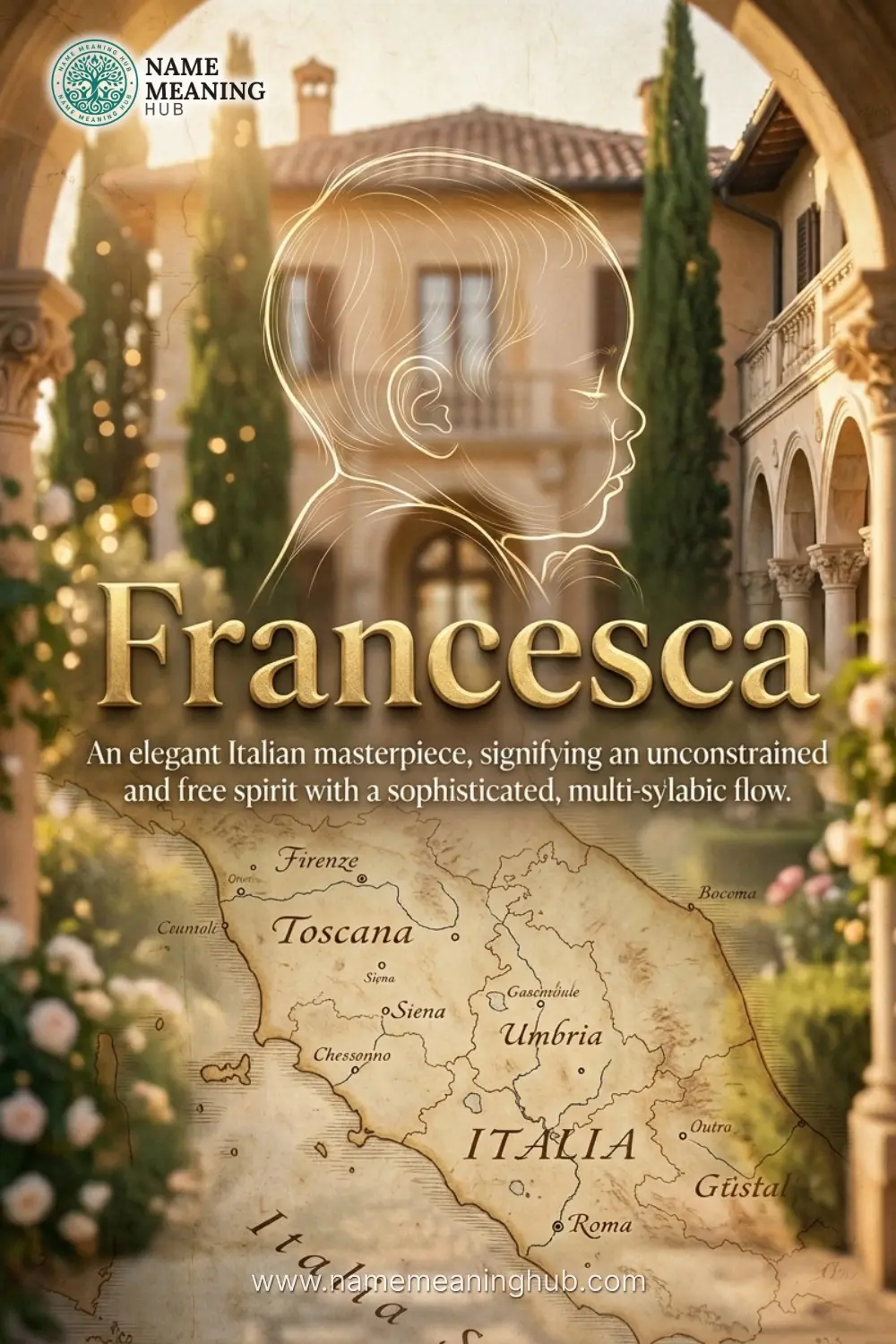
Where Francesca opens next
Francesca with middle names can sound either more stately or more intimate
Because Francesca already carries so much length and elegance, middle names usually do one of two jobs beside it: they either add classical gravity or create contrast through brevity and restraint. The strongest pairings understand that Francesca already arrives fully dressed. If you want the full pairing logic behind that contrast, see middle names for Francesca.
Nicknames soften Francesca without draining its structure
One of the pleasures of Francesca is that such a formal full name opens naturally into warmer, quicker short forms. That flexibility gives the name social ease without diminishing the strong meaning beneath it. The contrast between the full form and the nickname is part of its charm. To see how those different moods shorten in real life, explore Francesca nicknames.
Pronunciation is one of Francesca’s quiet strengths
The name’s pronunciation sounds cultured, but it is still highly manageable in English. That practicality matters because it allows Francesca to retain all its elegance without becoming burdensome in ordinary use. For the detailed stress pattern, accent notes, and IPA, see Francesca pronunciation guide.
Why Francesca still feels like freedom in full dress
The deepest strength of Francesca is that it makes an old idea of freedom sound civilized rather than raw. That is not a weakness. It is a transformation. The name takes ancestry, geography, and liberty, then gives them Italian line, rhythm, and polish. It allows a daughter’s name to be overtly beautiful while still carrying something more rugged and serious underneath.
Its meaning line through France and freedom gives it identity. Its Italian form gives it elegance. Its wider family ties to Francesco and the saint-and-poet atmosphere around that family give it cultural depth. Its current ranking gives it enough air to feel chosen. None of these elements works alone. Together they make Francesca unusually complete.
That is why Francesca remains such a compelling name. It is not only romantic. It is not only historical. It is not only graceful. It is a name in which freedom has learned manners without losing force. The result is a rare thing: a name that sounds refined, but whose core idea is still liberty. That is exactly why Francesca lasts.