
How to Avoid Spelling Regret When Choosing a Baby Name

Sometimes the name feels right before the spelling does.
You may already know the sound you love. You can imagine saying it to your baby, writing it on a birthday card, calling it across the room, and pairing it with your surname. Then you put the name on paper, and the decision becomes sharper.
Is it Sophia or Sofia? Elliot or Elliott? Aisha or Aysha? Ciaran or Kieran?
A spelling choice can look like a finishing detail. It is not.
Spelling changes how a name moves through real life. It affects pronunciation, paperwork, school records, online accounts, travel bookings, family memory, and the first impression the name gives before anyone hears it spoken.
Spelling regret rarely begins with one dramatic moment. It usually grows through repetition: the wrong letter on every class list, a grandparent who cannot remember the version you chose, an accent mark that disappears from official forms, or a child who has to say “with one T” so often that the correction becomes part of the name.
That does not mean parents should always choose the most common spelling.
Some less common spellings are beautiful, established, meaningful, and deeply connected to language or family history. A cultural spelling should never be judged the same way as a spelling invented only to look different. The goal is not to avoid every correction. The goal is to choose a spelling whose tradeoffs you understand and can still stand behind years later.
Because spelling changes a name’s style as much as its sound, it helps to compare options through Baby Names by Style. A single sound can feel classic, streamlined, international, ornate, modern, playful, or trend-coded depending on the letters you choose.
For the broader naming path, Expert Baby Naming Guides for Choosing the Right Name can help you keep spelling in proportion with pronunciation, meaning, origin, popularity, surname fit, and long-term confidence.
A spelling should not only look good on a baby announcement.
It should still feel clear, meaningful, and livable when your child writes it on schoolwork, uses it on forms, introduces themselves as an adult, and decides how much explanation they want attached to their name.

Spelling Regret Usually Comes From Repeated Friction, Not One Bad Choice
Parents often imagine spelling regret as a sudden thought: “We chose the wrong version.”
More often, it is cumulative.
It may start with appointment desks. Then school systems. Then birthday invitations. Then email addresses. Then your child learns that other people rarely spell the name correctly on the first try.
Small corrections are not automatically a problem. Many good names need them. The real question is whether the correction feels reasonable for the reason behind the spelling.
Daily spelling friction can sound like:
- “It’s Elliot with one T.”
- “It’s Sofia with an F, not PH.”
- “It’s Aisha, not Aysha.”
- “It’s Niamh, pronounced NEEV.”
- “It’s Jaxon with an X.”
Those explanations do not carry the same weight.
A family may gladly explain Niamh because the spelling preserves Irish heritage. The same family may feel less sure about correcting Jaxon if they chose it mainly because Jackson felt too common.
Spelling regret usually falls into four patterns:
- Misspelling regret: People constantly write the name incorrectly, even after hearing it clearly. Elliot and Elliott are both usable, but either version may invite “one T or two?” corrections.
- Mispronunciation regret: The spelling leads readers toward the wrong sound. This overlaps strongly with How to Evaluate Pronunciation Ease.
- Style regret: The spelling feels more tied to a trend than to the child. A fresh-looking spelling can lose its appeal when it becomes visibly era-coded.
- Identity regret: The spelling weakens the reason the name mattered. A simplified spelling may reduce friction while also removing cultural, family, or historical meaning.
A spelling is less likely to cause regret when its reason is strong. Heritage, family honor, origin, pronunciation clarity, or an established variant can make a correction feel worthwhile.
When the spelling is different only because the common form felt too ordinary, test harder.
For the broader emotional side of naming decisions, read How to Avoid Baby Name Regret.

The Four Spelling Paths Parents Usually Choose From
Most spelling decisions fall into four broad paths: traditional, variant, phonetic, and creative.
Naming stress often increases when parents mix these paths without realizing it. A cultural spelling that needs explanation is not the same decision as a creative spelling that adds novelty. A variant with long usage is not the same as a respelling designed to make a popular sound look rarer.
Once you know which path you are on, the tradeoff becomes clearer.
| Spelling Path | What It Usually Does | Examples | Main Risk |
| Traditional spelling | Gives the name its most expected written form in your language or community | Sophia, Catherine, Jackson, Chloe | May feel too expected if parents want visual distinction |
| Variant spelling | Uses an established alternative with history, style, origin, or family logic | Sofia, Katherine, Isobel, Elliott | May need recurring clarification |
| Phonetic spelling | Makes the sound clearer in one language community | Kieran, Aysha, Mikayla | May soften or change cultural depth |
| Creative spelling | Makes a familiar sound look more unique or modern | Jaxon, Jaiden, some newly altered forms | Can create correction without true distinctiveness |
Traditional spellings often do invisible work. They help people spell the name after hearing it, give readers a familiar pronunciation path, and move smoothly through documents. Variant spellings can be excellent when they carry origin, family history, or a style you consistently prefer. Phonetic spellings can make daily pronunciation easier, especially in English-speaking contexts. Creative spellings need the sharpest test because the child, not the parent, lives with the correction.
The spelling path itself is not the problem.
The problem is choosing a path without understanding what it asks from daily life.

Traditional Spellings Are Not Boring When They Make a Name Easier to Carry
Many parents move away from traditional spellings because they worry the name will feel too common.
That concern is understandable, especially when the sound is widely recognized. But spelling is not the only way to create individuality.
A traditional spelling can feel distinctive because of the surname, the middle name, the nickname, the sibling set, the family story, or the child who carries it. You do not always need to alter the letters to make the name personal.
Traditional spellings often reduce invisible labor:
- Teachers write them more easily.
- Relatives remember them faster.
- Forms are less likely to produce errors.
- Future email addresses feel more straightforward.
- Professional introductions require less clarification.
Sophia may be familiar, but it also looks balanced, elegant, and internationally recognizable. Catherine carries classic stability, while Kathryn feels more compact and tailored. Jackson has surname-style familiarity; Jaxon changes the name toward something sharper, newer, and more trend-coded.
The useful test is not whether the traditional spelling is common.
Ask:
- Does the alternative spelling give the child something valuable?
- Does it improve pronunciation?
- Does it preserve family or cultural meaning?
- Does it match the style we truly prefer?
- Does it create more correction than distinction?
Parents sometimes underestimate how much personality a clear spelling can still have. A familiar spelling does not erase meaning, sound, or family connection. It may simply make the name easier to carry.
For more on recognizable names with character, read How to Choose Familiar Baby Names With Personality. If you are weighing classic stability against a fresher spelling, Classic vs Modern Baby Names: How to Decide can help frame the style choice.

Variant Spellings Work Best When the Reason Is Clear
A variant spelling can be a strong middle path.
It gives parents a version that feels more specific than the dominant spelling without creating a fully invented form. The best variants usually explain themselves. They may reflect language tradition, appear in the family tree, create the pronunciation you want, balance better with the surname, or simply be the spelling your family has always used.
Sofia beside Sophia is a clean example. Both are familiar. Sophia may read as more common in many English-speaking contexts, while Sofia can feel streamlined, international, and visually lighter.
The Isabel family shows how spelling can shift style without changing the core name completely. Isabel feels clean and direct. Isabelle adds romance and ornament. Isobel feels less expected and may carry a Scottish-style impression.
Catherine, Katherine, and Kathryn create a similar gradient: formal classic, familiar alternative, and compact tailored form. Elliot and Elliott differ only slightly on paper, yet the chosen version can affect how often the child clarifies the letters.
A variant spelling is usually stronger when it reflects:
- Origin or language.
- Family tradition.
- Established usage.
- Desired pronunciation.
- A visual style you consistently prefer.
- A meaningful regional or cultural connection.
A variant is weaker when it adds correction without adding meaning.
Before choosing one, say the correction aloud:
- “Sofia with an F.”
- “Elliott with two Ts.”
- “Kathryn with a K and Y.”
- “Isobel with an O.”
When the correction sounds calm and worthwhile, the variant may be a good fit. When it already feels irritating, keep testing.
For close comparisons, use How to Compare Baby Names Objectively so the decision does not collapse into which spelling looks prettiest today.

Creative Spellings Carry More Weight Than Parents Expect
Creative spellings can feel exciting during pregnancy.
They seem to make a familiar sound more personal. They can look modern, energetic, and distinctive. But the child carries the spelling after the naming moment is over.
That spelling may appear in school records, email addresses, spelling tests, introductions, medical forms, sports rosters, online searches, job applications, and official documents. It may also shape how people perceive the name before they meet the person.
Before choosing a creative spelling, ask what it actually does:
- Does it make pronunciation clearer?
- Does it honor someone?
- Does it connect to a language or family pattern?
- Does it solve a real problem with the traditional spelling?
- Does it only make the name look different?
Jaxon beside Jackson shows how one letter can change the whole feeling. Jackson looks surname-style and established; Jaxon feels sharper, newer, and more trend-coded.
Jayden and Jaiden raise a related issue. Two spellings may sound alike, so the rarer written form can still be heard as part of the same sound trend while requiring more spelling correction.
Michaela and Mikayla are more nuanced. Michaela carries a traditional, etymological visual form that may not be obvious to every reader. Mikayla feels more phonetic and modern. Either can work, but the choice should be made with style durability in mind.
Creative spelling tends to create regret when parents try to solve popularity with letters alone. When the sound is already common, changing the spelling may not make the name feel rare in real life. Other children, teachers, and classmates usually hear the sound first.
A distinctive spelling can make a name stand out on paper.
It cannot always make a familiar sound feel uncommon in a classroom.
For more on trend durability, read How to Avoid Choosing a Name That Dates Too Fast. If popularity is part of the reason you are considering an alternate spelling, Baby Names by Popularity can help you think beyond one spelling’s rank.

Cultural Spellings Should Not Be Judged Like Made-Up Spellings
A cultural spelling and a made-up spelling are not the same kind of choice.
This distinction is essential.
A name can be difficult for outsiders to spell and still be correctly spelled. It may follow rules from Irish, Welsh, Hebrew, Arabic, Spanish, French, Greek, Japanese, or another language tradition. It may look unfamiliar only because the reader is unfamiliar with that tradition.
Niamh is not a random arrangement of letters. Aoife is not trying to be difficult. Siobhan has a history and identity beyond the first reaction of someone who has never seen it before.
That does not mean cultural spellings create no friction. A child named Niamh in a community unfamiliar with Irish names may need to spell and pronounce it often. The difference is that the explanation carries heritage rather than novelty.
Ask:
- Does this spelling carry family, cultural, or historical meaning?
- Would simplifying it feel helpful or like a loss?
- Can we teach the spelling and pronunciation confidently?
- Will the child have a positive story behind the name?
- Is the correction manageable in daily life?
Ciaran and Kieran show the decision many families face. Ciaran may feel closer to Irish spelling tradition. Kieran may be easier for many English-speaking readers to approach. Neither choice is automatically better. The right spelling depends on what the family wants the name to carry.
Do not dismiss a cultural spelling simply because it requires teaching. At the same time, do not choose it without thinking about the child’s everyday experience.
For more on heritage balance, read How to Choose Irish Names for Everyday Life and How to Honor Heritage Without Forcing Tradition. You can also browse Baby Names by Origin when origin is central to the spelling decision.

Spelling and Pronunciation Should Be Tested Together
A spelling decision is rarely only visual.
It affects how people say the name.
A good spelling should guide people toward the sound you want, or at least not lead them strongly away from it. Some names are widely recognized even when they are not phonetic. Others are visually beautiful but misleading for readers who do not know the origin.
Chloe is not perfectly phonetic in a simple English sense, but it is familiar enough that most people pronounce it correctly. The spelling works because the name is established.
Aisha and Aysha show how spelling can influence pronunciation expectations. Some readers may find Aysha more immediately sound-driven; others may recognize Aisha more quickly because they have seen it before.
Maya and Maia can also lead to different assumptions. Both are attractive, but the visual difference may affect whether people say MY-ah, MAY-ah, or pause before choosing.
Test the name in both directions:
- Can people pronounce it after seeing it?
- Can people spell it after hearing it?
A name may pass one test and fail the other. That is not always a dealbreaker. It simply tells you where the correction will happen.
Use these checks:
- Show the spelling and ask someone to read it.
- Say the name and ask someone to spell it.
- Say the full name over the phone.
- Write the name on a form and see whether it feels intuitive.
- Ask whether a teacher reading it from a roster would likely get close.
If pronunciation ease is one of your biggest concerns, read How to Evaluate Pronunciation Ease before finalizing the spelling. If accent variation is part of the concern, continue with How to Choose Names That Work Across Different Accents.
The Spelling Correction Burden Test Makes Daily Friction Visible
A spelling can be beautiful and still ask too much of daily life.
The correction burden test helps you see the difference.
Rate each factor from 1 to 5.
| Factor | Question | Score |
| First-spell accuracy | Can people spell it after hearing it? | 1 – 5 |
| First-read accuracy | Can people pronounce it after seeing it? | 1 – 5 |
| Correction length | Can the correction be said quickly? | 1 – 5 |
| Form friendliness | Will it fit forms, IDs, email, and school systems easily? | 1 – 5 |
| Searchability | Is it easy to search online without constant clarification? | 1 – 5 |
| Style durability | Will the spelling still feel right in 10 – 20 years? | 1 – 5 |
| Reason strength | Is there a meaningful reason for this spelling? | 1 – 5 |
Read the total this way:
- 30 – 35: low spelling-regret risk.
- 24 – 29: mostly usable, with minor corrections likely.
- 18 – 23: worth using only if the reason is strong.
- Under 18: test more before committing.
This scoring system should not make the decision for you. It should help you talk about the tradeoff clearly.
Sophia may score high for first-spell and first-read accuracy. Sofia may require occasional “with an F” correction in some English-speaking contexts but remains highly usable. Niamh may score lower for first-spell accuracy in many places but very high for reason strength if Irish heritage matters. Jaxon may score well for pronunciation but lower for style durability if parents worry about trend-coded spellings.
The most important score is not always the highest one. A name with a strong cultural reason can be worth a lower ease score. A creative spelling with no strong reason may need a much higher usability score to justify the extra correction.
If this scorecard reveals that your spelling concern is really part of a larger shortlist issue, use How to Build a Baby Name Shortlist to compare your options more cleanly.
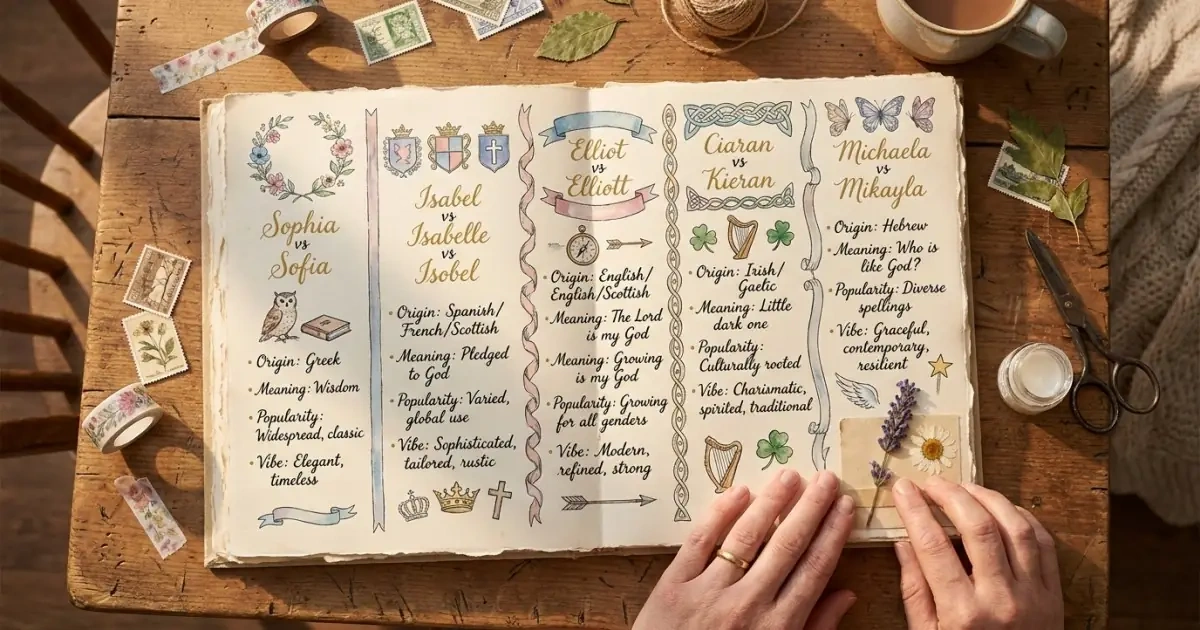
How to Compare Two Spellings of the Same Name
When two spellings are both plausible, do not rely only on which one looks prettiest in the moment.
Compare them across practical and emotional factors.
Ask:
- Which spelling is most recognized?
- Which spelling best matches your intended pronunciation?
- Which spelling fits your style?
- Which spelling matches the name’s origin?
- Which spelling creates fewer corrections?
- Which spelling would your child most easily explain?
- Which spelling still feels right on an adult?
Then apply those questions to the specific pair.
Sophia vs Sofia
Sophia may feel more familiar in many English-speaking contexts, with a classic, elegant, widely recognized look. Sofia feels more streamlined and international, especially for families with European or Spanish-speaking connections. Both are strong; the decision is really about which style and origin signal you want the spelling to carry.
Isabel vs Isabelle vs Isobel
This family shows how letters change atmosphere without changing the core name. Isabel feels clean and direct, Isabelle adds an ornate romantic flourish, and Isobel introduces a less expected Scottish-style impression. None is inherently wrong. Each asks the name to wear a different kind of elegance.
Elliot vs Elliott
The choice between Elliot and Elliott often comes down to visual weight. Elliot looks slightly lighter on the page, while Elliott may feel fuller or more traditional to some readers. Either way, the likely correction is simple but recurring: one T or two, one L or two. Choose the version you prefer only after accepting that occasional clarification may follow either form.
Ciaran vs Kieran
When heritage is involved, the spelling decision carries more than convenience. Ciaran preserves a stronger visual connection to Irish tradition, whereas Kieran offers an easier bridge for many English-speaking readers. This is not a right-versus-wrong choice. It is a decision about how much cultural form you want the name to keep in daily use.
Michaela vs Mikayla
Michaela retains more etymological depth and traditional structure, while Mikayla leans into modern phonetic clarity. Both can be valid. The stronger choice depends on whether you want the spelling to foreground history or immediate sound.
For a broader comparison process, read How to Compare Baby Names Objectively.

Spelling Choices Can Affect How Trendy a Name Feels
The same sound can feel very different depending on spelling.
This matters because spelling can date a name faster than sound alone. Certain letters and patterns become strongly associated with particular naming eras. Ys, Xs, doubled letters, dropped vowels, and highly phonetic respellings can make a name feel modern now but more time-stamped later.
That does not make those spellings bad.
It means parents should understand the style signal they are choosing.
Jackson and Jaxon may be counted separately in popularity data, but they are closely related in sound. A child may still share the same sound space with other Jacksons, Jaxons, and similar names.
Jayden and Jaiden work the same way. Different spellings can make the written name feel more individual, while the ear may still group them together.
Zoe and Zoey show a softer version of this choice. Both are recognizable. Zoe feels compact and classic; Zoey feels more phonetic and playful to many readers.
Popularity lists often separate spellings. Real life does not always separate sounds. When your goal is to avoid a name feeling too common, consider the whole sound family, not just one spelling’s rank.
Baby Names by Popularity can help you think through familiarity and sound overlap. You may also want How to Read Baby Name Popularity Data and How Popularity Affects Classroom Identity and Nickname Duplication if your concern is how the name will sound among peers.

Digital Life Makes Spelling More Important Than Parents Expect
A baby name no longer lives only on birth announcements and school notebooks.
It also lives in digital systems.
That means spelling affects more than handwriting. It can shape email addresses, usernames, medical records, school portals, travel bookings, certificates, online searches, and social media tags.
A spelling may become frustrating when:
- People cannot search it easily.
- Autocorrect changes it constantly.
- Forms reject accent marks.
- Apostrophes or hyphens cause system errors.
- The name is repeatedly split or reformatted.
- The child must clarify the spelling in every official setting.
This does not mean you should avoid every accent mark, apostrophe, hyphen, or unusual spelling. It means you should test how the name behaves outside a baby-name list.
Chloe and Chloé may feel very close emotionally, but the accent mark can behave differently across systems. Isabelle and Isabel are both system-friendly, but they differ in length, style, and search behavior.
Try the name in practical formats:
- Lowercase email style.
- First initial plus surname.
- School portal style.
- Airline booking style.
- Social handle style.
- Handwritten form style.
You are not trying to make the name tech-perfect. You are checking whether the spelling creates problems you would rather avoid.
For this modern usability layer, read How to Choose a Name That Works Online and Offline.

Surnames, Middle Names, and Initials Can Change the Best Spelling
A spelling that works well on its own may feel different inside the full name.
Always test the first name with the surname. Then test it with the middle name. Then test the initials.
A long first-name spelling may be fine with a short surname. A visually complex spelling may feel heavier beside a long or hyphenated surname. A simple spelling may create cleaner initials or a better monogram.
For example, Isabelle may look elegant, while Isabel may feel more balanced with a long surname. Elliott may look complete, while Elliot may feel lighter in a full-name combination.
Middle names can also solve spelling tension. If you love a culturally rich or harder-to-spell family name but worry about daily use, it may work beautifully in the middle. That does not mean meaningful names must be hidden. It simply gives parents another way to balance heritage and everyday clarity.
Before finalizing, write the name as:
- First name plus surname.
- First name, middle name, surname.
- Initials only.
- Monogram order.
- First initial plus last name.
- Likely email address.
If the full name introduces new awkwardness, the spelling choice may need another look.
For deeper full-name testing, read How to Match a First Name With Your Surname, How to Check Initials, Monograms, and Awkward Combinations, and How Middle Names Work When You Are Building a Full Name.

Spelling Red Flags Worth Catching Early
Some spelling concerns are small and manageable. Others are early signs that the spelling may become a burden.
Pause and test more when:
- You chose the spelling mostly because the common version felt too popular.
- You need to explain the spelling every time you mention the name.
- Your partner keeps spelling it differently.
- Close family members cannot remember it.
- Autocorrect changes it constantly.
- The spelling suggests a pronunciation you do not want.
- The spelling looks tied to a specific trend era.
- You dislike the nickname created by the spelling.
- The name has multiple accepted spellings and you only like the rarest one.
- You feel defensive before anyone has questioned it.
Names like Maya and Maia, Aisha and Aysha, Elliot and Elliott, or Zoe and Zoey can all be strong choices. The point is not to avoid variation. The point is to choose the version you can explain without regret.
For nickname-related spelling concerns, read How to Check Nickname Potential Before You Choose.

A Harder Spelling Can Still Be the Right Choice
A harder spelling is not automatically the wrong spelling.
Sometimes the less convenient spelling is the one with the most meaning.
A harder spelling may be worth choosing when:
- It preserves heritage.
- It honors a relative.
- It appears in the family tree.
- It reflects the original language.
- It has established history.
- It carries meaning a simplified spelling would lose.
- The correction is manageable.
- Parents can introduce it confidently.
Niamh may be worth preserving over a phonetic form if Irish heritage matters deeply. Aoife may be worth the cold-read challenge because the spelling is central to the name. Siobhan may require explanation in some settings, but it has a strong established identity.
Isobel may be less common than Isabel or Isabelle, but that may be exactly why it feels right to a family drawn to its specific cultural and visual style.
The key difference is intention.
A harder spelling is easier to defend when it gives the child something: heritage, history, family connection, beauty, meaning, or a clear story. It is harder to defend when it only gives the child extra correction.
If you are trying to honor family background without making the name feel forced, read How to Honor Heritage Without Forcing Tradition and How to Use Middle Names to Carry Heritage and Meaning.

How to Choose the Final Spelling With Confidence
By the time you choose the final spelling, you should be able to explain why that version belongs to your child.
It does not have to be the easiest spelling. It does not have to be the most popular spelling. It does not have to satisfy everyone in your family.
It should feel considered.
Use this final checklist:
- Write each spelling with the surname.
- Say each full name aloud.
- Ask people to spell the name after hearing it.
- Ask people to pronounce the name after reading it.
- Try the spelling in email or username form.
- Check initials and monograms.
- Imagine your child saying, “It’s spelled…”
- Compare the spelling with sibling names.
- Ask whether the spelling feels like a gift or a burden.
- Let the choice sit for a week before deciding.
A strong final spelling balances several things at once:
- Meaning.
- Clarity.
- Style.
- Heritage.
- Pronunciation.
- Digital usability.
- Long-term fit.
When a spelling wins only because it looks cute for a baby, test it on an adult. When a spelling wins only because it avoids correction, ask whether it loses too much meaning. When a spelling feels beautiful but creates constant friction, decide whether that friction has a reason you still trust.
This is where a shortlist process helps. Instead of debating every spelling in isolation, compare your strongest options in a structured way. How to Build a Baby Name Shortlist can help you narrow the field, while How to Test a Baby Name Before Finalizing It gives you practical ways to pressure-test the final choice. If you are waiting for the decision to feel settled, read How to Know When a Name Feels Right.

Common Questions About Avoiding Baby Name Spelling Regret
Is it bad to choose a unique spelling for a baby name?
Not always. A unique spelling can work when it has a clear reason and does not create too much spelling or pronunciation burden. The risk is higher when the spelling exists only to make a familiar name look different.
Should I choose the most popular spelling?
Often, the most recognized spelling is easiest to carry. But a less common spelling can be right when it reflects origin, family, style, or pronunciation in a way that matters to you.
Are cultural spellings too hard for everyday life?
Not necessarily. Cultural spellings may require teaching, but they can carry history, identity, and family meaning. The key is whether the correction burden feels manageable and whether the child will have a positive story behind the spelling.
What if I like the sound but not the traditional spelling?
Compare traditional, variant, phonetic, and creative options. Make sure the spelling you choose still feels mature, clear, and usable long-term. A spelling that looks fresh now should still feel comfortable on a teenager, an adult, and an older person.
Can spelling affect popularity?
Yes. Popularity lists may count spellings separately, but people often hear similar spellings as the same sound family. Related spellings can make a name feel more common than one ranking suggests.

Where to Go Next After Choosing a Spelling Direction
Spelling is not a decorative detail. It is part of the name’s identity.
Let your exact concern shape your next move. If aesthetic tone dictates the spelling, return to Baby Names by Style; if cultural roots are paramount, Baby Names by Origin provides a much steadier ground. Finally, refine the mechanical aspects by checking spoken clarity through How to Evaluate Pronunciation Ease or modern practicality with How to Choose a Name That Works Online and Offline.
A spelling does not have to be the easiest possible version to be the right one. It needs to be chosen with enough clarity that, years from now, you and your child can understand why it was worth carrying.