
Margaret Name Meaning: Heritage, Meaning, and Elegant Appeal
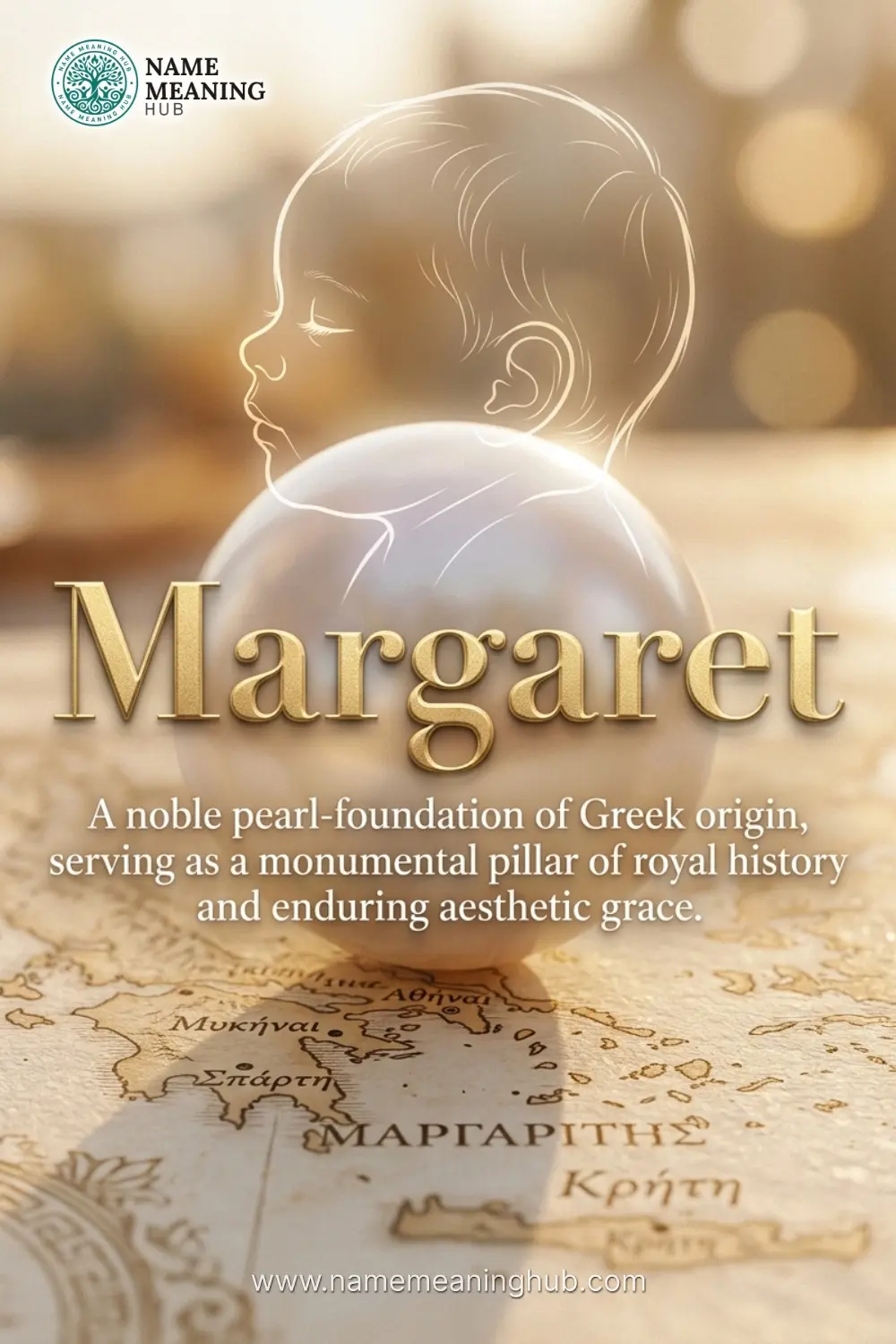
Margaret is one of those names that seems almost too familiar to need interpretation, until you stop and listen to what it has survived. It has crossed languages, dynasties, churches, classrooms, family trees, and style cycles without ever becoming entirely old news. That is unusual. Many names remain in circulation because they cling to one era or one image. Margaret lasts because it keeps changing register while holding onto one hard center. The supplied meaning, “pearl,” helps explain why. A pearl is not flashy in the way a diamond is flashy. It is quieter, older, formed rather than cut. It suggests patience, substance, and finish.
That central quality is what keeps Margaret alive. Official Social Security Administration (SSA) data places it at No. 119 for girls in the United States in 2024, which means the name now sits in a fascinating position: no longer dominant, certainly not forgotten, and newly visible to parents who want a classic with real backbone. Historically, it was once a giant. Early twentieth-century American charts in the project’s naming references show Margaret among the leading girls’ names of the era, not as a decorative outlier, but as part of the core naming vocabulary of the country. Today it reads differently. Less automatic. More chosen. And that shift has made the name more interesting, not less.
Margaret's U.S. popularity rank over time, 1880–2024
Popularity statistics are based on official data from the Social Security Administration baby name records.
Margaret: A Legacy Classic with Noble History
Margaret functions as a name with one unmistakable center of gravity, sustained by a deep historical identity as a foundational choice for over a century. This “legacy classic” often reflects a naming-culture preference for choices that provide a sense of reliability and strength .
The absence of crossover usage helps the name maintain its clear feminine clarity across generations. Meaning “pearl,” its three-syllable rhythm remains both polished and widely trusted.
Margaret is a classic that does not have to ask for respect
| Key Facts | Information | Quick Insight |
|---|---|---|
| Name | Margaret | The full form feels formal and complete, yet it contains one of the richest nickname systems in English naming. |
| Primary gender usage | Female | Its femininity is unmistakable, but the sound is sturdy enough to avoid delicacy alone. |
| Primary origin | Greek | The Greek root gives the name ancient depth, while its later spread across Europe gives it remarkable cultural range. |
| Core meaning | Pearl | This is a gem meaning, but not a glittering one; it suggests refinement through time, pressure, and finish. |
| Pronunciation | MAHR-guhr-uht | The broad opening and grounded middle make the name sound more substantial than many current girl names. |
| IPA (US) | /ˈmɑːrɡərɪt/ | The American form keeps the name conversational while preserving its authority. |
| IPA (UK) | /ˈmɑːɡrət/ | The British form is slightly tighter, but the overall identity remains stable and unmistakable. |
| Syllable count | 3 | Three syllables give Margaret enough shape to feel formal, but not so much that it becomes grandiose. |
| U.S. girls’ rank (2024) | No. 119 | The name now occupies a revival-friendly zone: familiar enough to feel secure, rare enough to feel intentional. |
Margaret makes “pearl” feel structural, not decorative
There are many names whose meanings point to beauty, but not all beauty means the same thing. Margaret’s pearl is not the beauty of speed, novelty, or spectacle. It is the beauty of something finished by time. That difference changes the whole emotional profile of the name. A pearl is organic rather than manufactured, elegant without shouting, and precious without needing sharp edges. When parents choose Margaret, they are not choosing a loud jewel-name. They are choosing a quiet one.
Why the pearl inside Margaret feels mature
This matters because modern naming can sometimes confuse beauty with brightness. Many currently fashionable names sparkle in the ear, but they do not always carry weight. Margaret’s meaning works differently. “Pearl” suggests something that has been brought to completion slowly. That makes the name feel older in the best sense: not dusty, but finished. It implies a person who may be gracious, but not flimsy; polished, but not fragile.
That maturity is one reason Margaret has endured through so many centuries of use. It offers a precious meaning without turning the bearer into an ornament. The name does not say, “Look how lovely.” It says, “Here is something of value.” That is a very different social message, and it is one that tends to age well.
Why Margaret avoids the jewel-name trap
Many gem names today read either intensely modern or intensely decorative. Margaret escapes both extremes. Partly that is because the meaning is filtered through history rather than sitting exposed on the surface. Most people do not hear Margaret and instantly think of jewelry. They hear lineage, intellect, formality, and cultural memory first. Only afterward, if they know the meaning, does the pearl emerge. That sequence is a strength. It allows the name to carry beauty without being reduced to beauty alone.
In practical terms, this gives Margaret unusual depth. It can sound academic, literary, grandmotherly, political, affectionate, or quietly glamorous depending on who is wearing it and which nickname comes forward. The pearl remains the hidden center, but the name never becomes trapped in one simplistic reading of it.
Margaret crossed Europe because history kept choosing it again
Margaret’s durability is not accidental. The project’s naming references repeatedly trace it back to a Greek word for “pearl,” often via the Latin margarita, and then show how widely the name spread across Europe. That spread was not merely linguistic. It was historical and devotional. Saints, queens, and noblewomen carried the name, and the name kept acquiring new life each time it entered a different language.
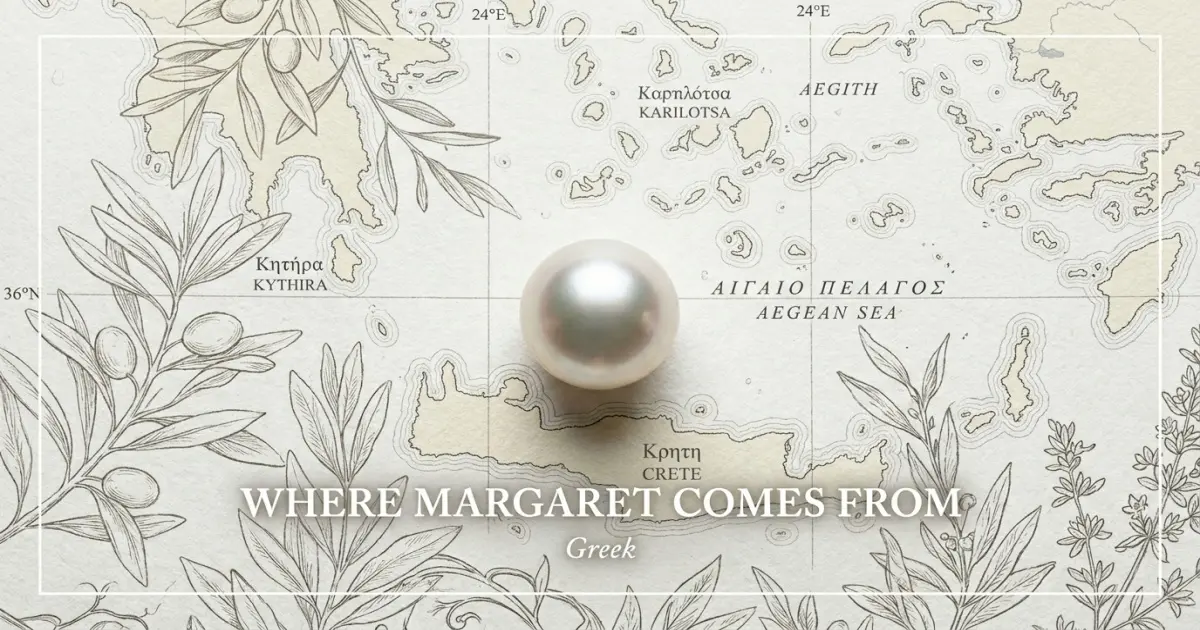
From Greek root to Latin road
The Greek origin matters because it gives Margaret antiquity without making it obscure. It belongs to the ancient world, but it reached modern English through well-traveled routes. That is often the sign of a strong classic: not a name frozen in one place, but a name translated many times without losing itself. Margaret became Marguerite in French, Margarita in Spanish and Russian, Margherita in Italian, Margit in Hungarian and Scandinavian contexts, Mairéad in Irish, and many others besides. The name did not merely survive translation. It thrived on it. To view more names linked to this cultural tradition, explore baby names of Greek origin.
This is one reason Margaret never feels provincial. Even in its plainest English form, it carries the memory of a much larger naming family. A girl named Margaret belongs not to one narrow tradition, but to a whole continental history of naming, literature, sainthood, and family adaptation.
The saint stories that made Margaret travel
The attached Irish naming reference gives two particularly useful historical anchors: St Margaret of Antioch and St Margaret of Scotland. Margaret of Antioch, though surrounded by legendary material, became one of the most popular saints of medieval western Europe and was especially invoked by women in childbirth. Margaret of Scotland, who died in 1093, was also deeply important to the spread and prestige of the name. Those figures mattered not only because they were saints, but because they turned the name into something the medieval world wanted to repeat.
That religious history left a permanent mark. Margaret became a name that could sound holy without being severe, noble without being rigid, and feminine without being fragile. Even now, long after many people have forgotten the specific saint legends, the cultural residue remains. Margaret sounds established because it was established in the hardest possible way: by centuries of being chosen over and over again.
Margaret may be the most generous nickname name in the language
Few names in English have generated as many living variants, diminutives, and descendants as Margaret. The attached naming books list an astonishing range: Maggie, Meg, Peggy, Peg, Margo, Margot, Greta, Gretchen, Gretel, Maisie, Megan, Mairéad, Margarita, Marguerite, and many more. This matters because it reveals something about Margaret beyond its meaning or history. It is a name that has invited intimacy for centuries.
Why Margaret contains whole other names inside it
Most names have one or two obvious shortenings. Margaret has an ecosystem. Some of its daughters now feel so independent that many people forget they began here at all. Megan, Maisie, Greta, Margo, Margot, and Peggy each have their own social life, their own style, their own generation of bearers. Yet they all lead back to Margaret. This gives the full name extraordinary practical strength. A Margaret can sound formal and traditional on paper while still growing into a nickname that feels bright, literary, vintage, playful, or modern.
This is part of why the name has never fully gone out of use. Even when the full form feels quieter in one generation, its descendants keep circulating. Then, eventually, the full form itself returns, bringing with it the strength of all those side branches.
Why that nickname wealth matters today
For contemporary parents, this flexibility is gold. Margaret offers one of the rare combinations modern naming often struggles to find: a formal classic with enormous room for personality. A child can be Maggie in kindergarten, Meg in adolescence, Margaret in professional life, or Margo in adulthood if the family wishes. The full name does not trap her. It gives her options.
That freedom is not superficial. It changes the social life of the name. Margaret can age brilliantly because it does not force one register forever. It can be warm, plainspoken, intellectual, glamorous, or grandmotherly depending on which form is foregrounded. Few names are that structurally generous.
Margaret sounds firmer than most “pretty” classics
Phonetically, Margaret is more grounded than many female classics that travel beside it. It does not flutter. It lands. The broad opening MAHR gives the name weight from the beginning. The middle consonants hold it together. The last syllable releases just enough softness to keep it from sounding harsh. This is a large part of why the name reads as authoritative without becoming severe. If you are weighing names with a similar gender profile, visit more girl names and meanings.
The sound is older than the style cycle
One of the reasons Margaret feels so durable is that its sounds are not trying to flatter current taste. It is not especially airy, not dependent on fashionable endings, and not built around the breathy openness that defines many present-day girls’ names. Instead, it relies on broad vowels and firm consonants. This makes the name feel older than fashion in the best way. It does not bend itself to a trend. It survives the trend.
The supplied pronunciations also reveal something important. The U.S. and U.K. forms differ slightly in compression, but not in identity. In both, the name remains grounded and unmistakable. Margaret is the kind of name that does not lose its character when accents shift. That is a mark of strong construction.
Why the name feels intelligent almost immediately
Some names carry a social impression of charm. Others carry confidence. Margaret often carries intelligence. This is not only because of famous bearers or historical associations. It is also because the sound itself feels measured. The name suggests a person who can be warm without being informal by default. That gives Margaret a rare sort of social dignity. It does not need prestige borrowed from elsewhere. It sounds self-sufficient.
That self-sufficiency is a major part of the name’s modern appeal. Parents who choose Margaret today are often choosing against the grain of disposable prettiness. They want a name with finish. Margaret gives them that.
Margaret in America went from default to deliberate
The historical chart material in the project’s naming references shows Margaret as one of the great American girl names of the early twentieth century. In the 1910s, 1920s, and 1930s, it appears among the top names for girls in the United States, sharing space with Mary, Helen, Dorothy, Ruth, and other foundational classics. That matters because it confirms what cultural memory already suggests: Margaret was once not just respected, but ordinary in the strongest sense. It was part of the center of American naming life.
From statistical giant to revival classic
Names like Margaret often pass through a predictable cycle. First they dominate. Then they become associated with mothers, grandmothers, or schoolteachers. Then they grow quiet. Finally, if they are structurally strong enough, they begin to return—not as defaults, but as acts of taste. Margaret is clearly in that last stage now. At No. 119 in 2024, it is visible again, but no longer compulsory. That makes it richer. The name now signals intentional classicism rather than simple convention.
This is exactly the kind of position that often produces long-term revival strength. A name that has enough cultural memory to feel trusted, but enough current rarity to feel distinctive, is often more appealing than either the ultra-fashionable or the truly obscure. Margaret now lives in that sweet spot.
What Margaret feels like now
In the present, Margaret sounds steadier than many of its competitors. It has not been stripped bare by overuse, and it has not become so quaint that it needs an ironic defense. Instead, it reads as serious, warm, and increasingly stylish to parents who want history without fuss. It also benefits from the continued popularity of its nickname daughters. Families who love Maggie, Greta, Margot, or Maisie often discover that Margaret gives them all of that range inside one older and stronger frame.
So Margaret now offers something rare in the American naming landscape: a classic with both gravitas and play.
Where Margaret opens next
Middle names that let Margaret breathe
Because Margaret already carries weight and history, it often pairs best with middles that either lighten the full name or refine its formality without adding too much more structure. The best combinations tend to respect the name’s solidity rather than compete with it. If you want the full pairing logic behind that contrast, see Margaret middle names.
Nicknames that reveal different lives inside Margaret
Few names offer as many believable social selves. Margaret can become Maggie, Meg, Greta, Margo, Peggy, or Maisie, each with a completely different emotional temperature. That range is one of the name’s greatest practical strengths. To see how those different moods shorten in real life, explore nicknames for Margaret.
Pronunciation that keeps Margaret grounded
The broad opening and firm middle are what make the name sound so dependable. Once those are placed clearly, Margaret retains the very weight and warmth that give it such unusual staying power. If you want the full sound pattern behind that rhythm, read how to pronounce Margaret.
Why Margaret still belongs to the future
Margaret endures because it is a name with true reserves. It has ancient origin, medieval reach, saintly prestige, international variants, a jewel meaning that does not reduce it to ornament, and one of the richest nickname ecologies in the language. It was once one of America’s core girl names, and now it returns with the added power of distance. That distance has clarified what the name always was: not merely popular, but well made.
In the end, Margaret is a name about value that does not need spectacle. Like its pearl meaning, it suggests finish, patience, and a kind of beauty that survives fashion because it was never built on fashion in the first place. That is why Margaret can sound grandmotherly, intellectual, literary, and newly stylish all at once. It is not a name trying to convince you. It is a name that already knows what it is. And that is why Margaret still feels entirely alive.