
How to Know When a Name Feels Right

Many parents expect the right baby name to arrive with clean certainty.
The fantasy is familiar: one name appears, both parents feel it immediately, the surname flows, the meaning lands, the family accepts it, and the search ends. A few people do experience that kind of instant clarity. Most do not.
Real naming confidence is often quieter.
You may have a name that keeps returning after every list. It makes you pause. It sounds more like your child than the others. Still, the decision feels too important to trust easily. Calm can look suspicious. Excitement can look like proof. Doubt can disguise itself as wisdom.
That is where parents get stuck.
The problem is rarely a total lack of good names. More often, the final stage becomes difficult because parents cannot separate a name that feels exciting, a name that feels sensible, and a name that feels genuinely right.
Those are different signals.
An exciting name creates a rush, then has to prove it can survive repetition. A sensible name may pass every practical check and still never feel emotionally alive. A right name usually behaves differently: it holds its shape under pressure, works in real speech, and stops needing to be sold every time it enters the room.
When your broader taste still feels unsettled, begin with baby names by style and notice which direction keeps pulling you back. Once a name is close enough to feel possible, the work becomes more subtle. You are no longer hunting for inspiration. You are learning whether confidence is real.

The Right Baby Name Often Feels Settled Before It Feels Dramatic
The more important a decision feels, the easier it is to distrust calm.
Baby names carry unusual pressure. They are intimate, public, emotional, and long-lasting. A name will appear in family stories, school rosters, passports, introductions, signatures, and memory. Parents are not wrong to take that seriously.
The trouble starts when seriousness becomes theatrical expectation.
Many parents wait for a lightning-bolt moment, then doubt anything quieter. A name that simply keeps working can seem less convincing than a name that overwhelms them for an hour. Yet long-term naming confidence rarely behaves like a movie scene.
A strong name often earns trust by staying intact.
It still sounds good after being said repeatedly. It feels natural with the surname. It becomes easier, not harder, to imagine in ordinary family life. It does not require a fresh argument every time you mention it.
That kind of calm is easy to underestimate.
A name like Clara may not create the same dramatic charge as a rarer finalist, but its clean sound and steady style can make it feel more usable over time. Maeve carries compact force and sharper texture; for the right family, that edge becomes the confidence. Neither pattern is superior. The useful question is which name keeps holding after the first reaction fades.

What You Are Really Sensing When a Name Feels Right
When parents say a name “feels right,” they may be describing several things at once.
The phrase can mean emotional resonance, spoken ease, family fit, style alignment, surname flow, or simple relief after a long search. Confusion comes from treating all those feelings as one vague instinct.
Break the instinct into parts.
| Signal Inside “It Feels Right” | What It Usually Means | What to Check Before Trusting It |
| Emotional pull | The name carries meaning, memory, identity, or warmth | Make sure the feeling belongs to the name, not only the story behind it |
| Spoken ease | The name feels good in your actual voice | Test it with the surname, quickly and casually |
| Family fit | The name sounds like it belongs in your household | Compare it with siblings, surname, culture, and daily style |
| Practical calm | The name creates fewer worries than the alternatives | Check initials, nicknames, spelling, and pronunciation |
| Repetition strength | The name improves or settles after several days | Let it live outside a naming session |
| Shared ownership | Both parents can use the name with warmth | Listen for ease in both voices, not just agreement on paper |
A right name usually does not win every column perfectly. It creates enough alignment that the weak points stop controlling the decision.
That is the difference between a name you admire and a name you can actually use.
When hesitation comes from balancing emotional depth, sound, and aesthetic taste, How to Balance Meaning, Sound, and Style in a Baby Name gives the decision a cleaner frame.
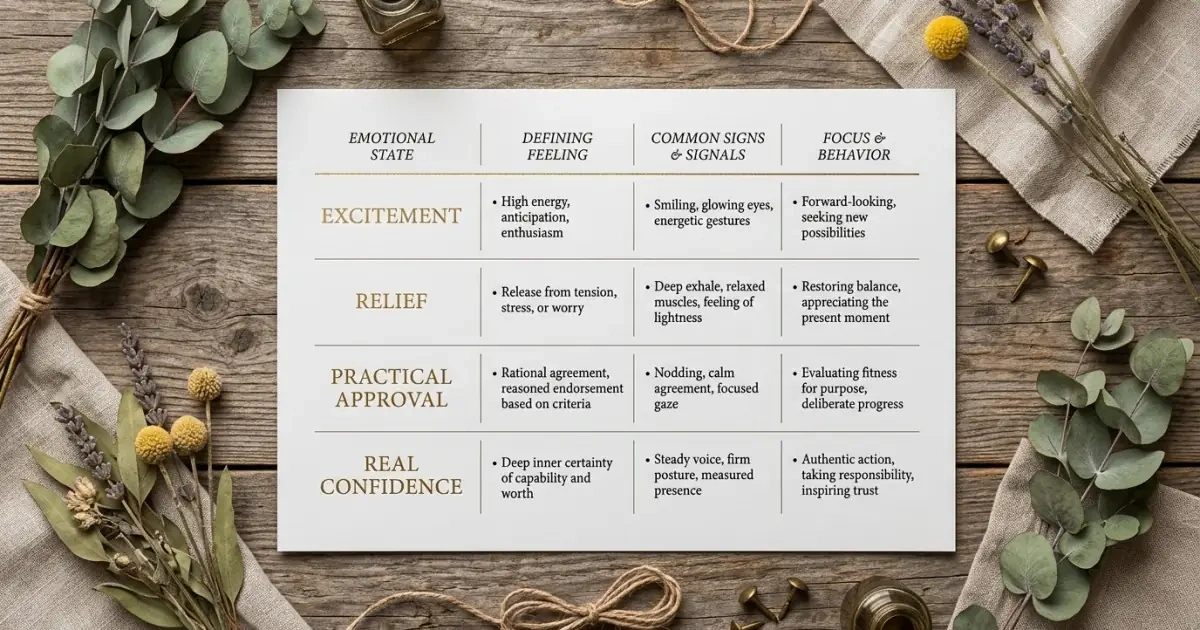
Excitement, Relief, and Real Confidence Are Not the Same Feeling
Excitement matters. It often points toward something real.
A name may have a beautiful sound, a striking image, a rare texture, a strong meaning, or a style that feels immediately more vivid than everything else on the list. That first charge should not be dismissed. It is information.
It is not the whole answer.
Exciting names often rely on one dominant feature. A name can feel thrilling because it is unexpected, stylish, or emotionally loaded, while weaker parts remain hidden: surname friction, nickname discomfort, trend exposure, pronunciation burden, or a style that works better in fantasy than in daily life.
Relief is different. Relief may arrive when the search finally narrows, even if the chosen name is only “good enough.” That can be healthy when the name has truly passed the necessary checks. It can also be fatigue wearing a cleaner coat.
Real confidence is steadier than both.
| Feeling | How It Shows Up | What It Can Hide |
| Excitement | The name feels vivid, fresh, meaningful, or unusually attractive | A single strong feature may be drowning out weak daily fit |
| Relief | The search finally feels quieter | You may be tired rather than certain |
| Practical approval | The name checks the boxes | It may still lack emotional life |
| Real confidence | The name keeps working across sound, meaning, style, and daily use | It may feel calmer than expected, which can make parents doubt it |
A name such as Juniper may excite because it feels botanical, bright, and distinctive. Rose may feel quieter but hold more cleanly across surname flow, family use, and adulthood. The stronger choice depends on what remains after both names have been tested in ordinary conditions.
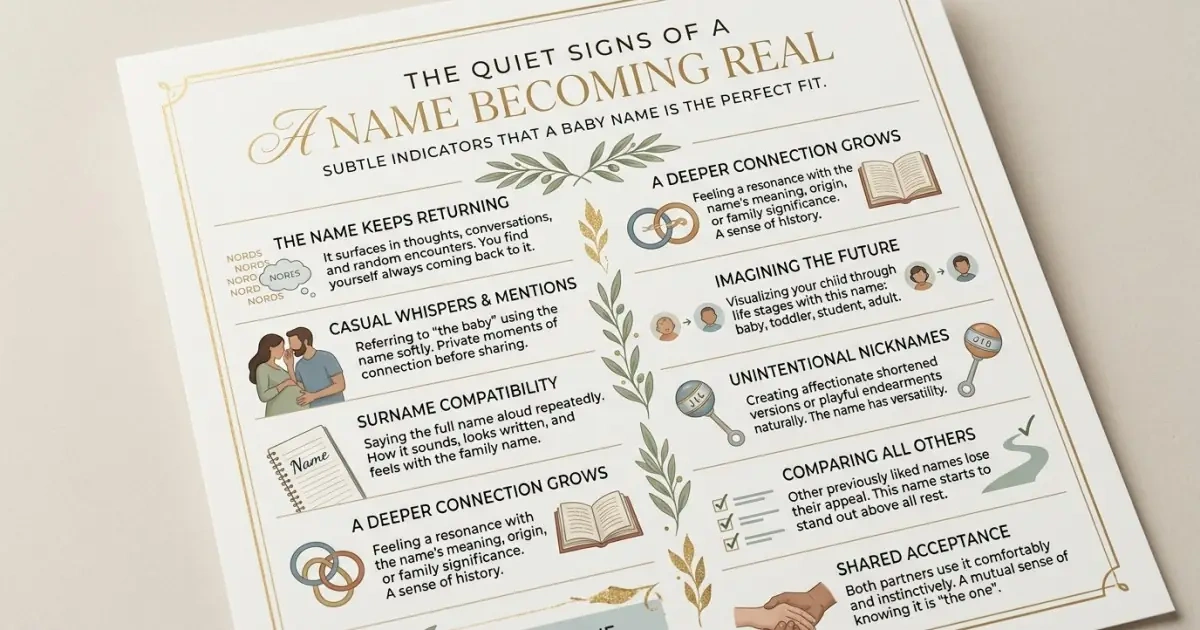
Quiet Signs a Baby Name Is Becoming More Real Than the Others
The right name does not always announce itself loudly.
Often, it becomes harder to remove.
You may keep returning to it after trying to move on. It appears in conversation without effort. Your partner says it casually, and the sound feels less strange each time. The surname pairing starts to feel complete rather than experimental.
The most reliable signs are practical, not mystical.
| Quiet Sign | Why It Matters | What It Suggests |
| The name keeps returning without being forced | Attraction is surviving comparison | The name may be more than a temporary crush |
| You use it casually in conversation | The name is leaving theory and entering family speech | Real-life ownership is beginning |
| Your partner’s voice makes it stronger | The name works beyond your private imagination | Shared use may be possible |
| The surname improves it | Full-name reality supports the choice | The name is structurally sound |
| You stop building arguments for it | The name no longer needs constant defense | Trust is replacing persuasion |
| Letting it go feels sharper than expected | Attachment is deeper than preference | The name may be leading emotionally |
A name like Elias may grow because its rhythm, heritage feel, and gentle strength keep returning after flashier options fade. Leo may win in another family because it is short, confident, and effortless in daily speech.
The right sign is not intensity. It is consistency.
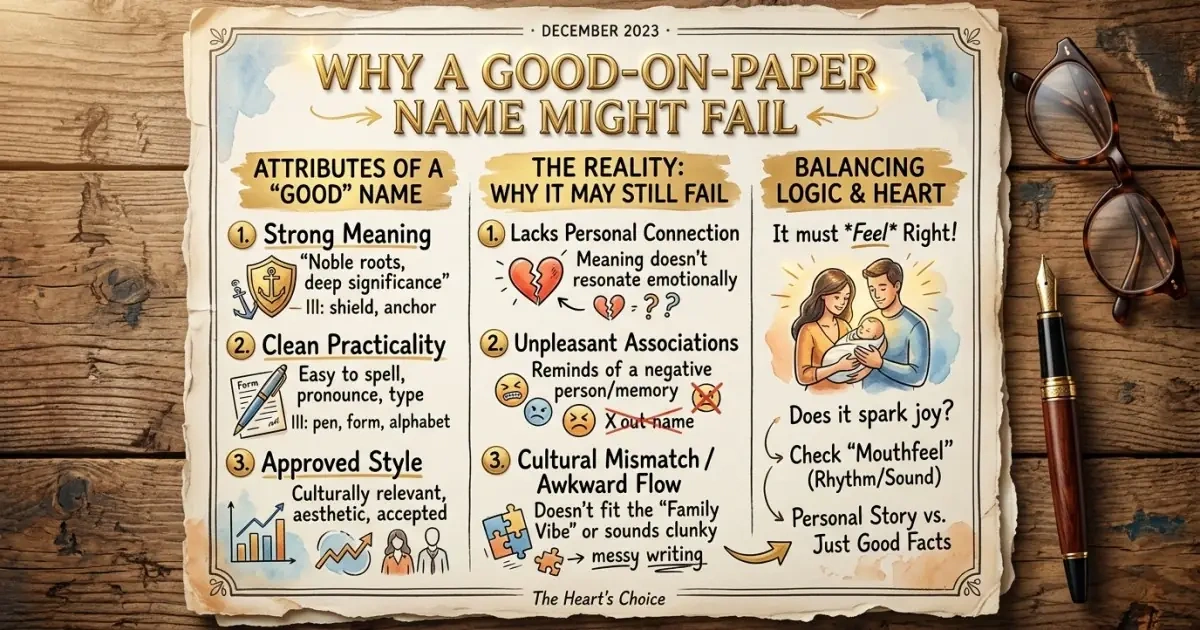
Why a Good-on-Paper Name May Never Feel Fully Chosen
Some names fail quietly.
Nothing is visibly wrong. The meaning is good, the spelling is sensible, the style is approved, and the surname fit is acceptable. Still, the name never becomes yours.
That gap matters.
A name can be admirable without being inhabitable. Parents often keep these names on the shortlist because rejecting them feels irrational. It may be elegant, meaningful, and easy to live with – yet every time you imagine using it, the connection stays inexplicably thin.
A baby name should not be chosen only because it makes sense.
Sense matters. It protects the decision from chaos. But names live in relationship, not just logic.
| Good-on-Paper Strength | Why It May Still Fail | What to Notice |
| Strong meaning | The story is better than the daily name | You like explaining it more than saying it |
| Clean practicality | The name is usable but emotionally flat | It passes tests without becoming alive |
| Approved style | The name looks right for your taste category | It still feels like someone else’s family chose it |
| Familiarity | The name is easy for others | Ease may be replacing personal conviction |
| Balance | Nothing is wrong enough to cut it | Lack of friction is not the same as fit |
Names such as Naomi, Grace, or Felix can feel deeply right in one family and merely respectable in another. The difference lies in relationship: sound, memory, use, and whether the name starts to feel attached to the child you are imagining.
Admiration is not obligation.
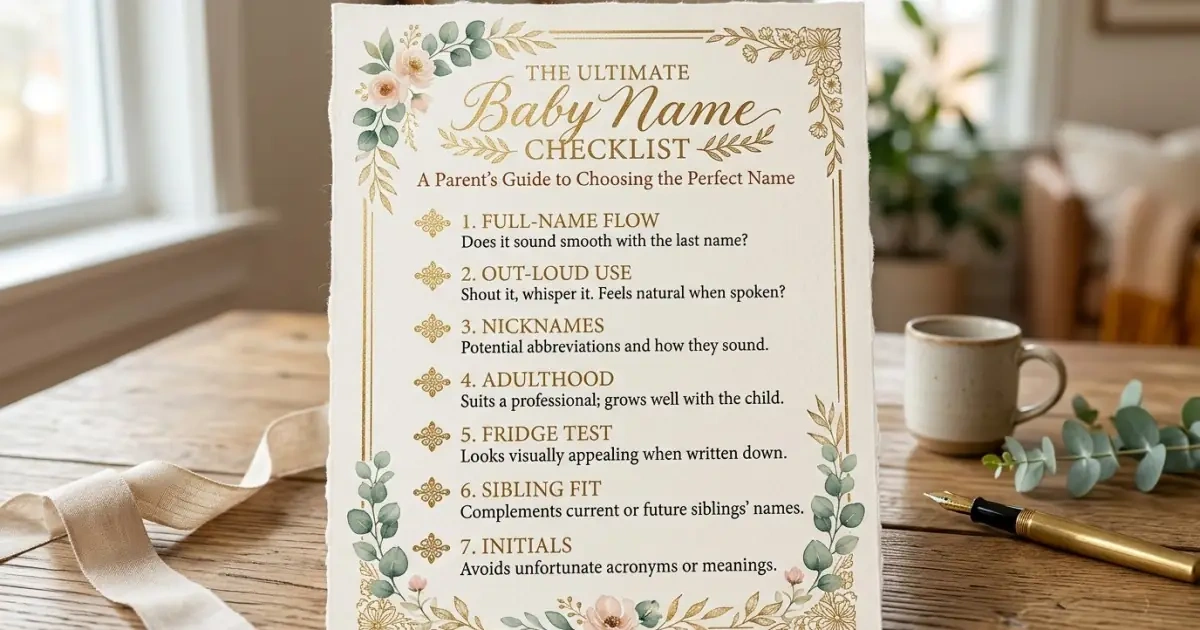
The Practical Checks Beneath the Feeling of Rightness
Intuition works better after the name has faced reality.
A name that feels right usually has passed several checks quietly, even when parents have not written them down. The practical layer matters because it separates grounded confidence from mood.
| Practical Check | How to Test It | What a Strong Name Usually Does |
| Full-name flow | Say the first name, middle name if known, and surname together | Feels more convincing, not more awkward |
| Out-loud use | Speak it warmly, quickly, casually, and publicly | Holds up outside a careful naming voice |
| Nicknames | List the obvious short forms and casual versions | Avoids nicknames you strongly dislike |
| Adulthood | Imagine the name on a teenager and adult | Has range beyond the nursery |
| Fridge test | Write it somewhere visible for several days | Grows calmer or stronger with repetition |
| Sibling fit | Say it beside existing children’s names | Belongs without matching too hard |
| Initials | Check first-middle-last and common shorthand forms | Avoids preventable awkwardness |
These checks do not remove every doubt. They remove preventable doubt.
A name that survives them deserves more trust than a name that only shines in the abstract. How to Test a Baby Name Before Finalizing It is the natural next step when the feeling is close but still needs pressure. Nickname discomfort belongs with How to Check Nickname Potential Before You Choose, while long-term fit deserves the sharper lens of How to Choose a Name That Ages Well.
The feeling of “right” becomes more trustworthy when the practical problems have stopped shouting.
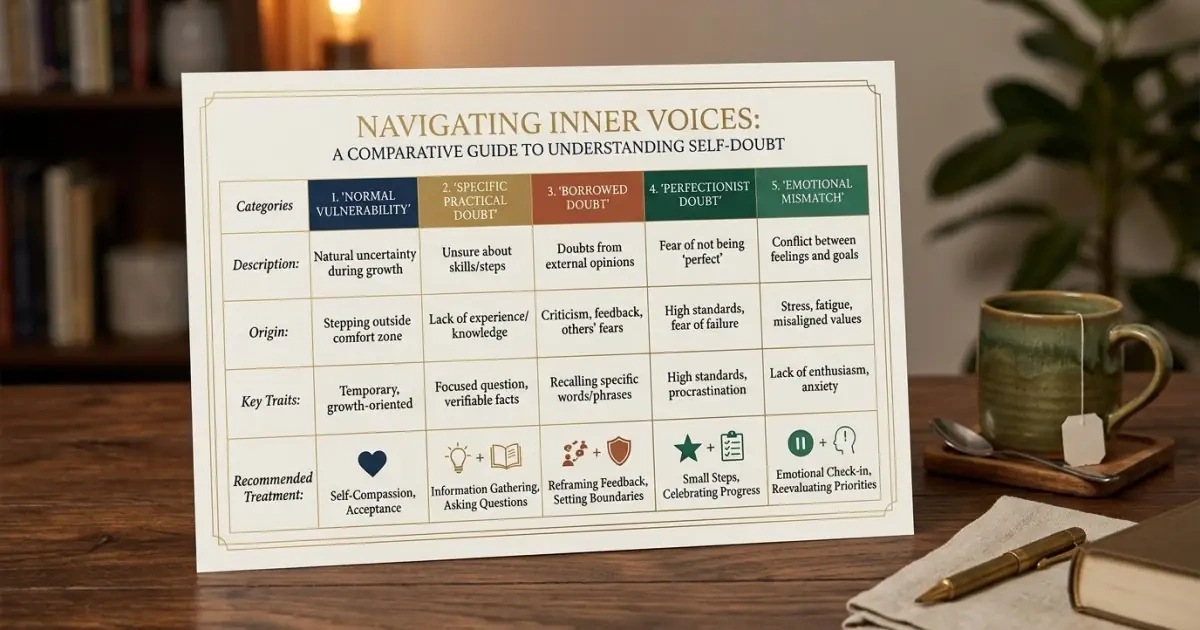
Nervousness Is Not Always a Warning Sign
A serious decision can make even a good name feel fragile.
That is especially true near the end. Once a name moves from possibility to commitment, the mind starts testing loss. Other names look newly appealing. Minor flaws get louder. Future scenarios multiply. A perfectly usable name can suddenly feel exposed because the decision is becoming real.
That anxiety is not automatically insight.
It may simply be the cost of choosing.
| Type of Doubt | What It Sounds Like | How to Treat It |
| Normal vulnerability | “This is a big decision. What if I feel different later?” | Let the name settle after practical checks |
| Specific practical doubt | “The surname rhythm still bothers me.” | Test the issue directly |
| Borrowed doubt | “My aunt disliked it, so now I’m unsure.” | Separate outside taste from useful information |
| Perfectionist doubt | “There might be something better somewhere.” | Stop expanding the search unless a real flaw appears |
| Emotional mismatch | “I can defend it, but I do not feel connected to it.” | Take the lack of attachment seriously |
Nerves deserve compassion. They do not deserve full control.
When the doubt is specific, test it. When the doubt keeps changing shape, the problem may be fear of finality rather than the name itself. How to Avoid Baby Name Regret can help separate useful hesitation from anxiety. When the search has become a way to delay commitment, When to Stop Searching for the Perfect Baby Name belongs in the decision path.

Outside Opinions Can Make a Good Name Sound Less Stable
Names often sound more controversial before the baby is born.
Before birth, people react to an idea. They bring old classmates, celebrities, fictional characters, family memories, pets, politicians, class signals, and generational taste into the room. Their reaction may be honest. It may also have very little to do with your child.
Useful feedback has a narrow job.
It can reveal pronunciation friction, awkward initials, a nickname you missed, or a cultural association you genuinely need to know. It should not become the court that approves the name.
| Outside Reaction | Useful Information? | How Much Weight It Deserves |
| “I misread the pronunciation.” | Yes | Test whether the mistake is common or manageable |
| “Those initials spell something awkward.” | Yes | Check the full-name combination carefully |
| “I knew someone with that name.” | Sometimes | Weigh the strength and relevance of the association |
| “I just don’t like it.” | Rarely | Taste belongs to the parents, not the crowd |
| “That sounds too old/new/weird to me.” | Sometimes | Consider the source’s generation and style bias |
| “Your child will definitely hate it.” | Usually noise | No one can predict a child’s full relationship to a name |
Once a baby arrives, many objections soften because the name attaches to a real person. A relative who disliked Arthur in theory may stop hearing “old-fashioned” once it belongs to a grandson. A friend unsure about Milo may adjust quickly when the name has a face.
Protect a nearly right name from too many voices.
Feedback should sharpen clarity, not replace it.

When the Name Only Settles After the Baby Arrives
Some parents do not know before birth.
That does not mean they failed.
Before birth, the child is partly imagined. After birth, the name meets a real face, cry, presence, and family atmosphere. A name that felt abstract may suddenly fit. Another that seemed perfect during pregnancy may feel wrong once spoken to the actual baby.
That final recognition can be legitimate.
The pre-birth process still matters. A tested shortlist gives you better candidates when the baby arrives. You are not starting from panic; you are bringing well-considered names into the room and seeing which one becomes believable.
This approach works best with a narrow shortlist. Three usable names give space for recognition. Ten names create noise.
| Before Birth | After Birth | What Helps |
| The baby is imagined | The baby becomes specific | A short, tested finalist list |
| Names carry projection | Names meet real presence | Saying each name aloud to the baby |
| Doubt can feel abstract | Fit may become more physical | Trusting the name that feels speakable |
| Pressure can make parents rush | Meeting the baby may calm the choice | Avoiding a huge list at the final moment |
Waiting is not weakness when the process remains thoughtful. It becomes avoidance only when no real narrowing has happened.

What “You Just Know” Gets Right and What It Misses
People like to say that with the right name, you just know.
There is some truth in that. There is also a missing middle.
That “knowing” often comes after dozens of quieter checks: repetition, surname flow, partner use, meaning, nickname comfort, family fit, and the gradual removal of friction. By the time the name feels obvious, it may already have passed more tests than you realize.
Intuition works best when it has been informed.
A sudden crush on a name can be real. A calm sense of rightness after testing carries more weight. The first is intensity. The second is integration.
| Intuition Type | How It Feels | How Reliable It Is |
| First-impact instinct | Fast, vivid, persuasive | Useful, but still untested |
| Anxiety-driven attachment | Urgent, defensive, hard to question | Often needs slowing down |
| Tested intuition | Calm, repeatable, clearer after practical checks | Usually more trustworthy |
| Borrowed certainty | Strong because others approve | Fragile when outside opinion changes |
| Settled ownership | The name feels usable without performance | A strong sign of real fit |
The right name may still arrive with feeling. It simply does not depend on feeling alone.
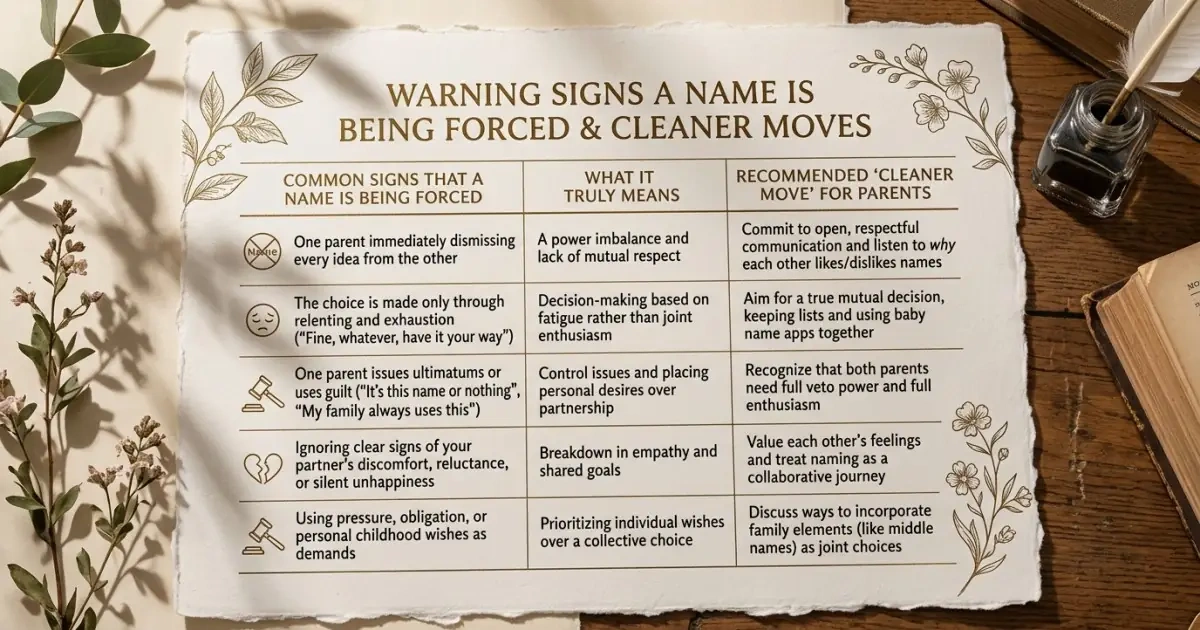
Warning Signs the Name Is Being Forced
A name that is wrong for you does not always collapse dramatically.
Often, it needs too much maintenance.
Watch out for the exhaustion of constant defense: explaining why meaning compensates for a clumsy sound, insisting the surname flow is “fine,” or justifying a style that never actually felt like your family. You like the idea of the name more than the life of it.
Pay attention to the repair work.
| Warning Sign | What It Usually Means | Cleaner Move |
| You need a long explanation every time | The argument may be stronger than the name | Test whether you still like it without the story |
| The same practical flaw keeps returning | The concern is not random anxiety | Examine the exact issue directly |
| You feel lighter imagining another name | Relief is pointing away from the contender | Let the name leave the shortlist |
| The name works only in one mood | It may depend on fantasy conditions | Test it in ordinary settings |
| Your partner can approve it but not inhabit it | Agreement is not the same as ownership | Listen to how both voices use it |
| The name feels like a performance | Style may be outrunning family fit | Return to real-life use and surname flow |
A name should not need constant rescue.
That does not mean every concern is fatal. It means repeated friction deserves more respect than a name’s best feature demands.
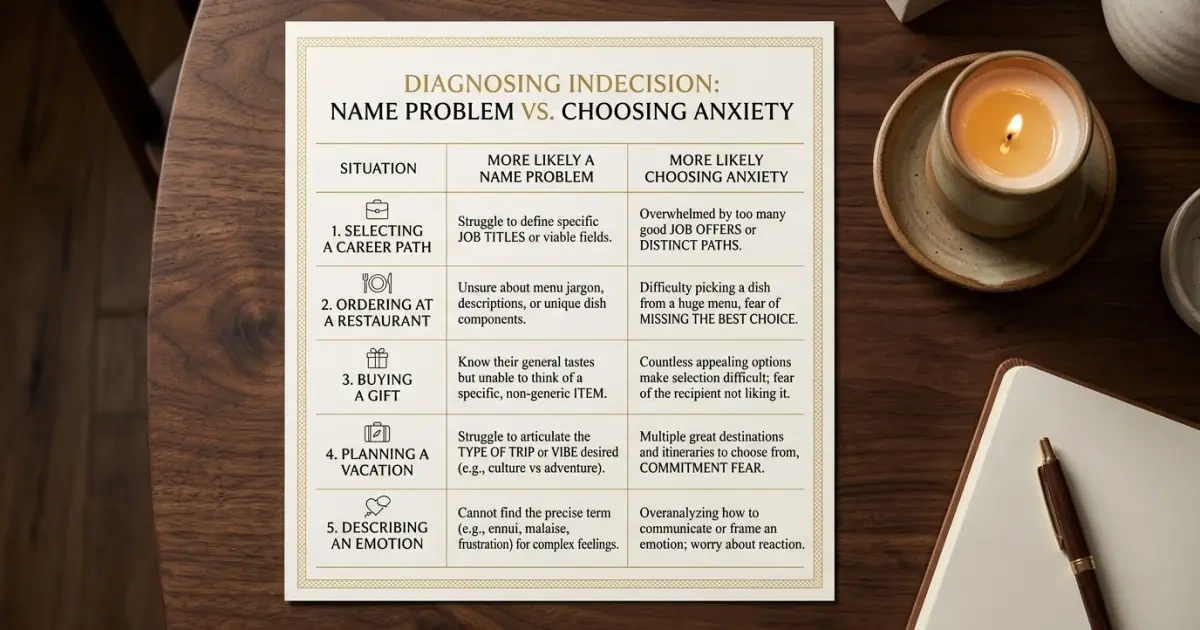
Anxiety of Choosing Versus a Real Problem With the Name
This is one of the hardest distinctions in the final stage.
A useful rule: a real name problem stays specific. Anxiety keeps inventing new problems.
Surname rhythm, nickname discomfort, pronunciation burden, awkward initials, partner resistance, or style mismatch can all be tested. Vague dread is harder because it shifts every time you answer it.
| What You Notice | More Likely a Name Problem | More Likely Choosing Anxiety |
| The same flaw repeats | Yes | Less likely |
| The concern changes every few days | Less likely | Yes |
| Testing gives clearer information | Yes | Less likely |
| Testing creates new hypothetical worries | Less likely | Yes |
| Another name feels genuinely more usable | Yes | Maybe |
| No name feels safe once it becomes possible | Less likely | Yes |
| The name grows stronger with repetition | Less likely | Anxiety may be fading |
| You keep searching despite strong finalists | Maybe | Yes |
This is where structure helps. How to Compare Baby Names Objectively can restore proportion when emotional swirl makes every option feel unstable.
The broader Expert Baby Naming Guides for Choosing the Right Name page can also help you choose the right next guide instead of returning to random browsing.

A Practical Seven-Step Way to Recognize When a Name Feels Right
Use this when the decision feels close but your confidence keeps slipping.
| Step | What to Do | What It Should Reveal |
| 1. Keep only usable names | Remove names you admire but would not actually use | The real decision field |
| 2. Say the leading name aloud | Use warm, casual, public, and full-name contexts | Whether it behaves like real speech |
| 3. Check the practical structure | Test surname flow, nicknames, initials, and adulthood | Whether hidden friction remains |
| 4. Live with it for a few days | Write it down and use it in conversation | Whether the name deepens or fades |
| 5. Reduce outside noise | Stop widening the audience when opinions destabilize you | Your own response becomes clearer |
| 6. Watch the trend | Notice whether the name grows stronger or weaker | Durability beyond first impression |
| 7. Trust usable calm | Choose the name that feels clearer, steadier, and livable | Confidence rooted in use, not drama |
This process is especially useful after a shortlist has already been narrowed. When too many names remain, return to How to Build a Baby Name Shortlist before trying to force final confidence out of a crowded list.
A name cannot feel right when it is still buried under too many maybes.

Why Settled Often Beats Spectacular
Parents sometimes worry that a calm final choice means they are settling.
Often, calm is the point.
A spectacular name can create a strong first impression. It may be rare, elegant, symbolic, dramatic, or stylistically exact. That force can be intoxicating. It can also be fragile.
A settled name produces a different kind of confidence. It works with the surname. It fits your taste. It carries enough meaning. It survives real speech. It does not create ongoing resistance in your mouth, mind, partner, or family life.
That does not make it dull.
It makes it integrated.
Theodore may appeal because it offers formal strength and nickname range. Soren may feel more spare, distinctive, and quietly serious. Eleanor can bring tradition and flexibility; Clara gives a cleaner, brighter line. A spectacular favorite may still be the right one, but only after it proves it can live past the spectacle.
The best final name rarely needs to dominate every comparison.
It needs to hold together better than the alternatives.

Questions Parents Ask When a Baby Name Feels Almost Right
What if a baby name feels right one day and wrong the next?
Look for the pattern across several days. A temporary mood can distort any name. A serious warning usually repeats in the same place: surname flow, nickname discomfort, style mismatch, pronunciation burden, or lack of emotional connection.
Can a name be right even when I still feel nervous?
Yes. Nervousness often reflects the weight of the decision rather than a flaw in the name. A name that has passed practical checks and grows calmer with repetition can still feel emotionally exposed before commitment.
Should I trust a name that feels calm rather than exciting?
Often, yes. Calm can signal fit. Excitement is valuable, but a name chosen for daily life needs steadiness as much as spark.
What should I do when the name feels right but other people dislike it?
Separate useful information from taste noise. Pronunciation problems, awkward initials, and strong cultural associations deserve attention. Personal preference from relatives or friends should not control the decision.
Can the right name become clear only after birth?
Yes. Some parents need the real child in front of them before the name settles. A narrow, tested shortlist makes that moment much easier.
How do I know whether I am unsure because of the name or because I am scared to choose?
Specific doubts can be tested. Shifting doubts often point to fear of commitment. When every strong name begins to feel wrong the moment it becomes possible, the problem may be the finality of choosing rather than the name itself.

Where to Go Next When the Name Feels Close but Not Fully Settled
Let the remaining problem choose the next step.
A crowded list needs How to Build a Baby Name Shortlist. A final pair belongs with How to Decide Between Two Baby Names. Trade-off confusion calls for How to Compare Baby Names Objectively.
When the name is close but still needs real-world pressure, How to Test a Baby Name Before Finalizing It should come before more browsing. Regret anxiety belongs with How to Avoid Baby Name Regret, while endless searching needs the firmer boundary of When to Stop Searching for the Perfect Baby Name.
Most parents do not need a flawless feeling before they can trust a name.
They need a name that keeps holding together once sound, meaning, repetition, fit, and real life have all had a chance to speak. That is usually what “right” sounds like: not untouchable, not cinematic, not immune to nerves.
Just steady enough that you can stop arguing with it and begin imagining your child inside it.