
Isabella Name Meaning: What It Means and Why Parents Love It

Some names arrive in the nursery already carrying a world. Isabella is one of them. It has the sweep of old courts, cathedral echoes, handwritten letters, and storybook heroines, yet the reason it lasts is not only its beauty. Beneath the velvet sound is a much older idea: devotion. In the tradition behind the name, Isabella belongs to the broad Elizabeth family of names, and its meaning points toward a vow, a bond, a promise kept. Read that way, Isabella does not simply sound elegant. It sounds committed.
That tension is what gives the name its unusual depth. On the surface, Isabella feels soft, musical, and socially effortless. It opens gently, widens through the middle, and lands on a bright, memorable stress in the third syllable. But its meaning is not airy or decorative. “Pledged to God” is serious language. It suggests a name shaped not just by affection, but by intention. That is why Isabella has remained so durable across generations of fashion. Parents may first hear its grace, but many stay for its backbone. It offers grandeur without stiffness, femininity without fragility, and romance without losing its sense of moral weight.
Isabella's U.S. popularity rank over time, 1880–2024
Popularity statistics are based on official data from the Social Security Administration baby name records.
Isabella: A Lyrical and Enduring Classic
Isabella presents as a name with one unmistakable center of gravity, with the girls’ side of the chart carrying nearly all of its long-term visibility and cultural weight. Its sustained popularity likely stems from a blend of lyrical polish and a soft, modern sound, which helps it feel durable rather than fad-driven .
The trace presence in the boys’ lane appears to be scattered experimentation rather than a true second identity. Meaning “pledged to God,” the name provides a sense of traditional elegance that has remained fresh and relevant through the modern era.
Why Isabella carries more than beauty at first glance
| Key Facts | Information | Quick Insight |
|---|---|---|
| Name | Isabella | One of those rare names that feels expansive and intimate at the same time. |
| Primary meaning | Pledged to God | The heart of the name is a vow, which gives its prettiness unusual seriousness. |
| Primary origin | Hebrew | Its deepest root belongs to an ancient sacred naming tradition, even though the form most people know traveled widely through Europe. |
| Primary gender use | Female | Its current identity is unmistakably feminine, but its strength comes from meaning rather than ornament alone. |
| Pronunciation | iz-ə-BEL-uh | The bell-like center gives the name lift and memorability, which helps explain its lasting mainstream appeal. |
| IPA | US: /ˌɪzəˈbelə/ · UK: /ˌɪzəˈbɛlə/ | The slight vowel shift between accents does not change the name’s overall poise or rhythm. |
| Syllables | 4 | Four syllables give Isabella ceremony and movement, making it feel fuller than clipped modern choices. |
| U.S. girls’ rank (2024) | No. 7 | It is still deeply loved, which means the name now reads less as a fad than as a modern classic. |
| U.S. boys’ rank (2024) | No. 10259 | The modern usage pattern is overwhelmingly feminine, with male use so rare that it functions more like a statistical trace than a living style. |
Isabella turns a promise into a personality
Names that mean “light,” “beauty,” or “joy” often work because they immediately flatter the ear and the imagination. Isabella works differently. Its central idea is relational. A pledge is not a mood. It is not a color or a flower or a season. It is a decision. That gives Isabella a rare kind of gravity for such a lyrical name. Even parents who are not especially drawn to religious language often respond to that underlying sense of intention. The name implies that a life is not random, that a child is welcomed with care, and that identity can be anchored in something larger than fashion.
Why “pledged” changes the emotional tone
“Pledged to God” is stronger than a vague spiritual association. The word pledged suggests fidelity, accountability, and a bond that lasts. That does not make Isabella severe. Instead, it gives the name hidden architecture. Many names sound lovely for a season and then fade because they have no deeper story to support them. Isabella does. The beauty of the form is constantly reinforced by the seriousness of the meaning. That combination helps explain why the name can feel equally appropriate on a child, a student, an artist, a judge, or a grandmother.
There is also something psychologically reassuring about a name with a meaning like this. It tells a child, at least symbolically, that she was not named casually. Parents often choose Isabella because it feels rich and graceful, but the meaning allows the name to do more than decorate. It can communicate care, thought, and a sense of heritage. Even in highly secular settings, that old language of promise can still be heard as a language of belonging.
The softness of the sound, the firmness of the idea
Part of Isabella’s success lies in the contrast between what it means and how it sounds. The sound is open and fluid. The meaning is solid and covenantal. That contrast creates balance. A name that sounded stern and also meant something solemn might feel heavy. A name that sounded airy and meant something airy might disappear into sweetness. Isabella avoids both extremes. Its vowels give it ease; its meaning gives it permanence.
That balance is also why the name rarely feels one-dimensional. Some parents hear nobility in it. Others hear warmth. Some hear romance; others hear faith. All of those readings can coexist because Isabella has enough internal depth to support them. It is a name that welcomes projection without becoming empty.
How Isabella traveled through history without losing its center
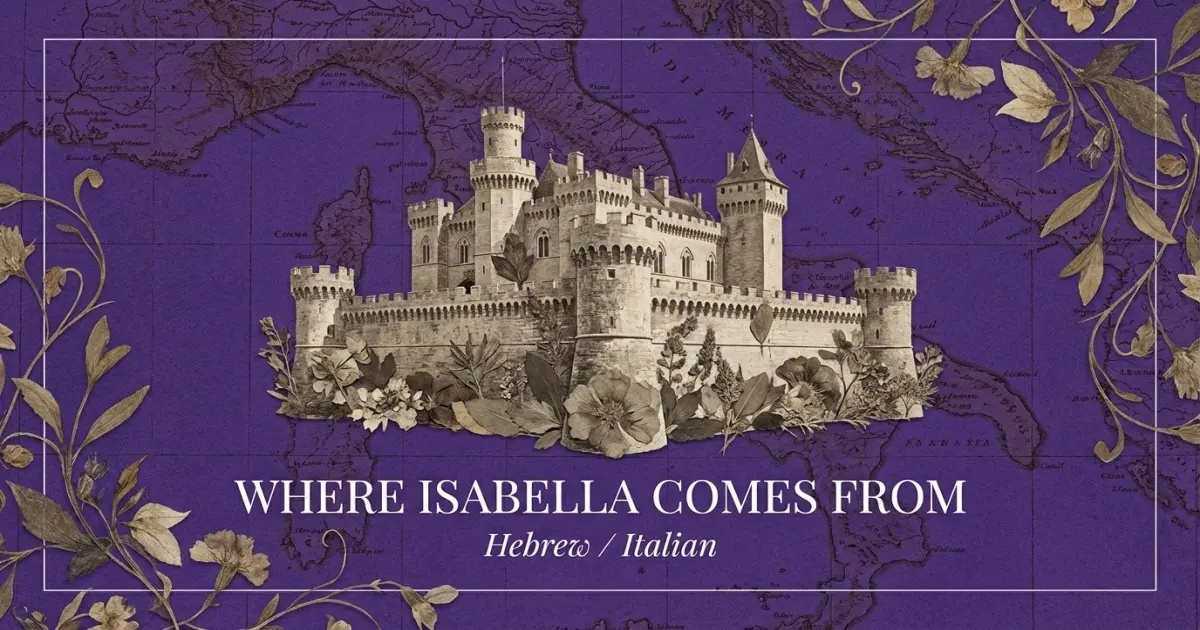
Although the deepest root of the name is treated as Hebrew in meaning and origin, the form Isabella is the result of a long historical journey through European languages. That matters because it explains the name’s double identity. Isabella is spiritually old but socially cosmopolitan. It belongs to an ancient family of names tied to Elizabeth, yet the version most people recognize arrived shaped by Latin and Romance-language tradition. That is why the name can feel both biblical at a distance and continental up close. For related names from the same origin family, see names with Hebrew roots.
From sacred root to courtly form
The Elizabeth family has long carried ideas such as oath, promise, blessing, and sacred obligation. Over time, different regions produced their own versions: Elisabeth, Isabel, Isabelle, Isobel, and Isabella among them. Isabella became one of the most ornate and courtly branches of that lineage. Compared with Elizabeth, which can feel stately and Protestant in English-speaking settings, Isabella sounds more velvety and southern, with a warmer, more flowing cadence. Compared with Isabel, which feels leaner and more tailored, Isabella feels more ceremonial and expansive.
This is one reason the name has had such range in literature and public memory. It can belong to queens and actresses, but it can also belong to contemporary children without sounding borrowed or theatrical. Historically famous bearers, especially royal and artistic ones, helped preserve the name’s aura of dignity. Yet the form never hardened into museum glass. It remained usable because its sound stayed approachable.
The cultural turns that kept Isabella alive
Names survive not only because of etymology, but because each era finds a new use for them. Isabella had the advantage of already possessing grandeur when modern parents began rediscovering elaborate feminine names. In the late twentieth and early twenty-first centuries, English-speaking naming style moved toward names that felt romantic, international, and vowel-rich. Isabella fit that mood perfectly. It had the length of older classics, the softness of modern favorites, and the familiarity of Elizabeth-family naming without the formality of Elizabeth itself.
Popular culture also gave the name a fresh wave of visibility. One reason often cited for its modern surge is its prominence in the Twilight era, when Isabella became widely recognizable to a new generation through a heroine better known as Bella. That moment did not create the name, but it sharpened its public image. Suddenly Isabella could feel both historical and current, both literary and mainstream. A strong name usually needs exactly that sort of bridge to become multigenerational again.
What Isabella suggests in modern life
In present-day use, Isabella reads as polished but accessible. It is not a minimalist name, and that is part of its appeal. Parents who choose it are rarely aiming for starkness. They are usually choosing a name with shape, mood, and social presence. Isabella enters a room fully dressed, but not overdressed. It has formality available to it, yet daily life softens it quickly. Teachers, relatives, and friends know how to say it. Children can grow into it without carrying an impossible costume.
Isabella in the social imagination
The image of Isabella is often gracious, articulate, and composed. Because the name has historical heft, people tend to hear intelligence and self-possession in it. Because it also has a flowing, affectionate sound, the impression is rarely cold. Isabella often feels like the meeting point between cultivated and warm. It is easy to imagine on a child who is artistic, bookish, expressive, or quietly confident, but it is broad enough to suit a wide range of personalities.
That versatility matters. Some elaborate names work beautifully on paper but feel restrictive in life, as though they require one kind of family or one kind of child. Isabella does not. It can live in a formal household or a casual one. It can sound at home with classical siblings, modern siblings, bilingual households, or blended heritages. The reason is simple: the name has both familiarity and atmosphere. People know it, but it still feels composed.
Its style neighbors and why it outlasts many of them
Isabella belongs to a group of names that combine history, elegance, and emotional softness. Yet it often outlasts trendier alternatives because it is anchored by an older naming tradition. Names that merely sound ornate can date quickly. Isabella has a deeper trunk. It carries the reassurance of a long lineage while still giving parents the drama and musicality they may want from a more expressive choice.
Its four-syllable rhythm also helps. Short names often depend on sharpness or novelty. Isabella depends on movement. It unfolds. That unfolding quality gives the name an almost narrative feeling, as though it introduces itself in stages. In a naming landscape crowded with clipped, efficient choices, Isabella still offers amplitude. That is not a small advantage.
Isabella after the peak: a popular name that now behaves like a classic
Official Social Security Administration (SSA) data places Isabella at No. 7 for girls in 2024, which confirms that the name remains firmly in the top tier. But the more revealing story is not simply that it is popular. It is that Isabella has already lived through the cycle that defeats many names and has emerged with its prestige intact. The attached reference material also shows Isabella near the very top of American girls’ rankings in the 2010s, including a No. 1 placement in 2010 and another top-tier finish in 2013. That means the name is no longer enjoying a brief spike. It has demonstrated staying power. If you want to branch out from Isabella without leaving this category, explore classic and modern girl names.
This matters for parents who worry about choosing something that feels overexposed. A truly trend-bound name often becomes hard to separate from its moment. Isabella has enough historical and international depth to resist that flattening. Yes, many people know it. Yes, it has been visible for years. But it now reads less as a craze than as part of the permanent modern repertoire, the set of names that many families recognize as beautiful before they even begin researching.
Its popularity also reveals something about contemporary taste. Families continue to want names that feel feminine without being flimsy, refined without being remote, and recognizable without being plain. Isabella answers all three desires at once. In that sense, its success is not accidental. It solves a naming problem that many parents still have: how to choose something graceful and substantial at the same time.
Where Isabella naturally leads next
Middle names that steady Isabella rather than compete with it
Because Isabella is long, musical, and emotionally full, it usually pairs best with middle names that either sharpen its outline or quiet its grandeur. The strongest combinations tend to provide contrast rather than more decoration, which is why the right middle name can make Isabella feel even more confident. If you want the full pairing logic behind that contrast, see Isabella middle names.
Nicknames hidden inside Isabella’s formal elegance
One reason parents stay loyal to Isabella is that it contains several social versions of itself. It can remain fully formal, or it can soften in intimate settings without losing identity. That built-in flexibility helps the name travel through childhood, adolescence, and adulthood with unusual ease. To see how those different moods shorten in real life, explore Isabella nicknames.
Pronouncing Isabella with confidence in real-life conversation
The name’s rhythm is one of its greatest strengths, and its stress pattern does much of the work. Even across accents, Isabella stays recognizable and poised, which is one reason it performs so well internationally and so rarely feels awkward when spoken aloud. For the detailed stress pattern, accent notes, and IPA, see Isabella pronunciation guide.
Why Isabella still feels like Isabella
Some names become popular because they flatter the present tense. Isabella does more than that. It keeps returning because it speaks two languages at once: the language of beauty and the language of vow. Parents hear the music first, but the meaning is what keeps the name from dissolving into ornament. It remains memorable because it carries a private seriousness beneath a public grace.
That is the final secret of Isabella. It does not ask a child to choose between tenderness and strength. It offers both. It sounds generous, but it is built on commitment. It feels worldly, but it remembers an older sacred root. It can belong to a little girl, a grown woman, a public figure, a dreamer, or a scholar without changing its center. In an age when many names are chosen for speed, novelty, or surface mood, Isabella still feels like a full sentence. It has history, melody, and moral weight. And that is why Isabella remains not just admired, but trusted.