Chloe Name Meaning: A Name Rich in Meaning and Character
Some names arrive with a finished image attached to them: a jewel, a saint, a flower, a queen. Chloe works differently. It does not describe a polished object already complete in the world. It names a moment just before completion: the first push of living green through soil, the tender shoot that proves winter has ended even before the field looks full. That is why the name has held its place across generations. Chloe does not merely sound pretty. It carries a small drama inside it, the drama of beginning.
That single idea explains much of the name’s staying power. Chloe feels light, but it is not flimsy. It feels youthful, but it is not childish. It feels natural, yet it avoids the overworked sweetness that some overtly botanical names can gather. A parent choosing Chloe is often choosing more than softness. They are choosing movement, renewal, and a form of beauty that is still unfolding. Official Social Security Administration (SSA) data shows Chloe remained strongly placed in the United States in 2024, ranking at No. 20 for girls, which confirms how fully it has moved from fashionable favorite to modern classic.
Chloe's U.S. popularity rank over time, 1880–2024
Popularity statistics are based on official data from the Social Security Administration baby name records.
Chloe: A Fresh and Melodic Greek Classic
Chloe reads as a name with one unmistakable center of gravity, with the girls’ side of the chart carrying nearly all of its recent visibility and momentum. Its sustained popularity likely reflects a taste for “vowel-rich modern names” that feel both current and classic .
The lack of a secondary track for boys reinforces its strong default identity. Meaning “young green shoot,” its two-syllable sound carries a sense of nature and blooming energy that has made it a favorite for parents seeking a fresh but familiar choice.
Why Chloe Reads Like Spring in a Single Word
| Key Facts | Information | Quick Insight |
|---|---|---|
| Name | Chloe | Short, clear, and instantly recognizable, Chloe has the kind of structure that feels polished without sounding stiff. |
| Primary Origin | Greek | Its Greek background gives the name classical depth, but its modern sound keeps it from feeling museum-like or remote. |
| Primary Meaning | Young green shoot | This is a meaning of emergence rather than ornament, which gives Chloe a living, forward-moving quality. |
| Pronunciation | KLOH-ee | Easy to say and easy to remember, the sound is one reason the name travels well across regions and generations. |
| IPA | US: /ˈkloʊi/ | UK: /ˈkləʊi/ | The small US-UK vowel difference is minor enough that the name stays stable and recognizable in both settings. |
| Syllable Count | 2 | Two syllables give Chloe a balanced rhythm: brisk enough for everyday use, but not abrupt. |
| Primary Usage | Female | Chloe reads clearly feminine in current usage while still feeling contemporary rather than decorative. |
| U.S. girls’ rank (2024) | No. 20 | This is the profile of a name that is widely accepted and enduring, not a fleeting novelty or a niche choice. |
Chloe and the Power of Naming a Beginning
The strongest thing about Chloe is that its meaning does not point to a fixed trait such as beauty, bravery, or wisdom. Instead, it points to a phase of life. A young green shoot is not the full tree, not the field at harvest, not the bouquet after cutting. It is the first visible sign that life is working. That makes Chloe unusually rich for a short name. It suggests promise without forcing ambition, freshness without emptiness, and youth without fragility.
Not a decorative nature name, but a living one
Many names connected to the natural world are chosen for surface imagery. Rose carries scent and bloom. Ivy suggests climbing elegance. Lily often reads as pure and delicate. Chloe belongs to the same broad family of nature-linked names, but its emotional tone is different. It does not picture the finished blossom. It pictures growth itself. That difference matters. A name tied to a completed flower can sometimes feel static or idealized. Chloe feels active. Something in it is always arriving.
That is one reason parents often experience Chloe as both bright and grounded. The green shoot in its meaning carries tenderness, but also resilience. Shoots break through. They survive frost, weather, pressure, and season. So the name’s softness is only one layer. Underneath it sits a quieter strength: life insisting on itself.
Why the image feels so emotionally current
Modern parents are often drawn to names that feel alive without becoming theatrical. Chloe answers that desire well. It is organic but not rustic, feminine but not frilly, classic but not solemn. In an era that favors names with clarity and emotional warmth, Chloe offers both. It sounds open and friendly in conversation, yet the meaning gives it more substance than many equally popular names.
There is also something psychologically appealing in giving a child a name about first growth. New parents are living inside uncertainty: a new body, a new household, a new identity, a future not yet visible. Chloe meets that experience with a fitting symbol. It says beginnings are enough. One tender sign of life is already a form of abundance.
From Greek Fields to Modern Life: How Chloe Traveled
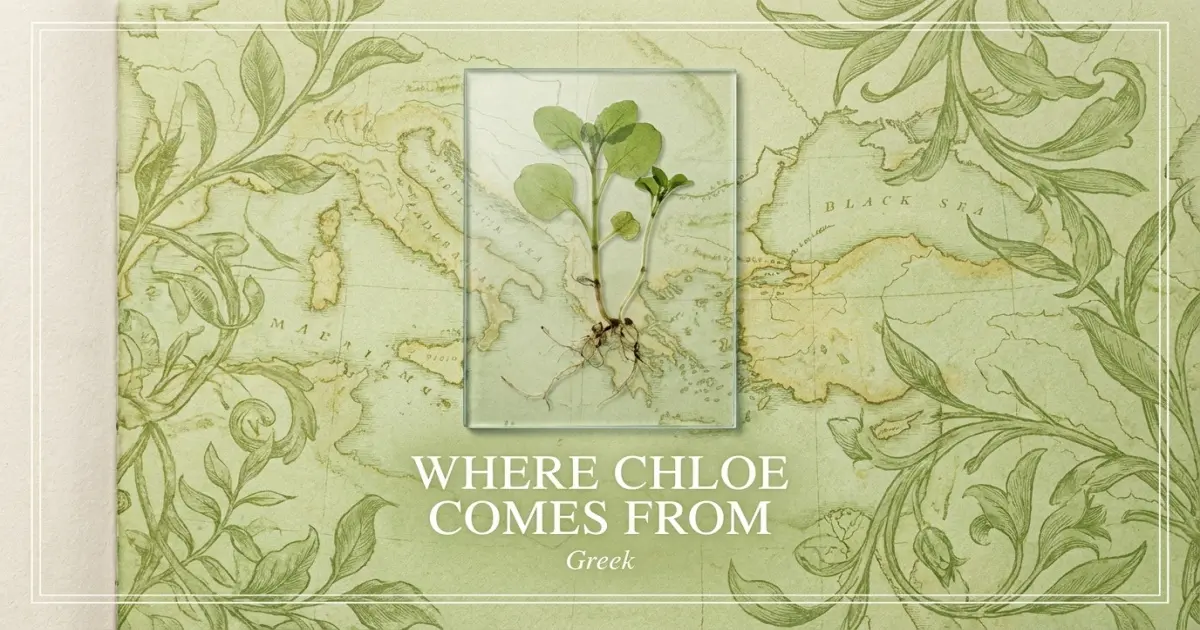
Chloe’s Greek origin gives the name one of its most enduring advantages. It belongs to a language world that has long shaped Western literature, myth, philosophy, and naming culture. In that context, names were rarely just labels. They carried imagery, ritual associations, and social meaning. Chloe emerged from a word associated with green, verdant, fresh growth, and it was linked to the agricultural imagination of springtime and fertility. If you want to compare Chloe with names from the same heritage, browse names from this linguistic background.
Chloe as an older name for new growth
Historically, Chloe was associated with Demeter, the Greek goddess connected with the earth’s fertility and cultivated fields. That link matters because it gives the name more than pastoral prettiness. It places Chloe in a cycle of sowing, waiting, return, and harvest. The name’s imagery is agricultural rather than merely floral. It belongs to the field, not just the vase.
This helps explain why Chloe can feel classical without sounding severe. Some ancient names carry heavy marble with them. Chloe carries sunlight on a field edge. Its antiquity is real, but its symbol is perennial. Every generation understands the sight of first green growth. The name therefore survives not by nostalgia, but by recognizability. It keeps being legible to the human imagination.
Why Chloe never sounds trapped in the past
Many classical names return in waves because they depend on elite taste, literary revival, or fashion cycles. Chloe has certainly benefited from all of those at different moments, but it also has a simpler advantage: it sounds modern in the mouth. The opening cluster is crisp, the long “o” gives the name air, and the final “ee” keeps it warm. The result is a name with ancient roots and contemporary ease.
That balance is difficult to manufacture. Some names are historically impressive but acoustically heavy. Others sound modern but have little depth once you look beneath the surface. Chloe offers both layers at once. It has a documented Greek inheritance and a lived, everyday friendliness. That combination is rare enough to make the name feel unusually secure.
The variant spelling Khloe, which has circulated in modern naming culture, proves another point about Chloe’s durability. The fact that alternative spellings appear at all usually signals that a name has entered broad public life. But the original Chloe remains the stronger form because it already feels complete. It does not need embellishment to seem current.
What People Hear in Chloe Now
In present-day use, Chloe occupies an especially interesting social position. It is familiar, but not exhausted. Stylish, but not precarious. Gentle, but not weak. These balances shape how the name tends to be perceived in real life. It does not sound invented, and it does not sound inherited under family pressure. It sounds chosen.
Bright without becoming brittle
Phonetically, Chloe benefits from a neat contrast. The opening consonant blend gives the name edge and definition. The rest of the sound opens out into a rounded vowel and a light ending. That means Chloe has sparkle without sharpness. It lands cleanly, but it does not snap. This is part of why the name can suit many personalities. On one child it may read lively and sociable; on another, thoughtful and poised.
That flexibility is socially valuable. Parents often fear choosing a name that overdirects the child’s identity. A dramatically romantic name can create one expectation. A sternly traditional one can create another. Chloe leaves room. It implies youthfulness and freshness, but it does not force a performance of sweetness.
Familiar enough to trust, distinctive enough to remember
Official SSA data showing Chloe at No. 9910 in the United States in 2024 places it in a useful band. It is well known. Most people will spell it correctly, pronounce it correctly, and accept it immediately. Yet it is not so overused that it disappears into background noise. Parents who want a name that feels established without feeling anonymous often end up in this exact territory.
Chloe also benefits from being cross-generational in a healthy way. It feels natural on a child, believable on a student, and entirely plausible in professional adulthood. That aging curve matters more than many parents realize. Names attached too tightly to infancy can become awkward later. Chloe does not have that problem. Its softness matures well because its structure is clean and its history is deep.
Style-wise, Chloe sits comfortably beside names such as Zoe, Phoebe, Lucy, Ruby, Daphne, and Cora. What separates it from them is the blend of brightness and rootedness. Zoe feels more kinetic, Phoebe more literary, Lucy more sunny and familiar, Daphne more mythic, Cora more antique. Chloe alone carries that specific sense of spring already underway.
When Chloe Became More Than a Trend
Popularity can either flatten a name or prove its permanence. With Chloe, the latter is closer to the truth. Official SSA data places it at No. 20 for girls in 2024, which means the name is not merely surviving on residual affection. It is still actively chosen. That matters because names with shallow appeal tend to fall faster once the first wave passes. Chloe’s continued strength suggests that parents still find fresh value in it. To discover related options in this naming space, explore baby girl names and meanings.
The reason is embedded in the name’s design. Chloe is short, vowel-rich, internationally legible, and semantically hopeful. It asks almost nothing difficult of the outside world. Teachers can say it. Grandparents can remember it. Children can learn to spell it. Employers do not blink at it. At the same time, parents can still feel they have chosen something with texture, history, and image. In naming terms, that is an unusually efficient combination.
There is also no harsh conflict between Chloe’s popularity and its meaning. Some names become common because they are fashionable sounds detached from substance. Chloe’s rise feels easier to accept because the substance is attractive. If a name means first green life and people continue choosing it, the public taste behind that choice makes emotional sense.
For that reason, Chloe no longer reads as a momentary darling of one decade. It reads as part of the settled modern repertoire: a name that has already proved it can stay visible without becoming stale. Parents worried that a popular name must automatically feel generic should pay attention to that distinction. Some names spread thin. Chloe, by contrast, tends to keep its image intact.
Three Future Paths Hidden Inside Chloe
Middle names that can widen Chloe’s mood
Because Chloe is short and bright, it pairs well with middle names that either add gravity or deepen its lyric quality. A longer, calmer middle can give the full name extra weight, while another light, vowel-rich middle can make it feel airy and musical. The strength of Chloe is that it does not need rescuing; it simply gives parents room to choose what kind of atmosphere they want around it. If you want the full pairing logic behind that contrast, see middle names for Chloe.
Nicknames that change the texture, not the identity
Chloe is already concise, so it does not require a nickname to become usable. That is an advantage. Any shortened form feels optional rather than inevitable. Parents who value a stable everyday name often appreciate that. Informal variants can still emerge, but the core name remains intact, which helps Chloe feel consistent from childhood onward. To see how those different moods shorten in real life, explore nicknames for Chloe.
Pronunciation that stays elegant in ordinary speech
KLOH-ee is one of those pronunciations that sounds graceful without asking for ceremony. It is simple enough for daily life, yet still carries a faint polish. That combination contributes to the name’s long reach. Chloe does not depend on explanation. It enters a room already understood. If you want the full sound pattern behind that rhythm, read how to pronounce Chloe.
Why Chloe Keeps Returning to the Light
In the end, Chloe lasts because it names one of the most reassuring images human beings know: the proof that life begins again. Not triumph at full volume, not perfection in bloom, not grandeur already achieved. Just the first clean green sign that something is alive and moving upward. That is a surprisingly profound inheritance to give a child.
It also helps explain why Chloe feels equally at home in the nursery and in adulthood. The name is youthful, but its meaning is not shallow youth. It is renewal, resilience, and emergence. Those qualities do not expire after childhood. They remain useful in every decade of life. A girl named Chloe carries a name that suggests she is not fixed in one finished image. She is becoming.
That, finally, is the literary elegance of Chloe. It turns growth itself into identity. It makes tenderness feel active, not passive. It gives spring a human voice. And because beginnings are among the few themes no age ever outgrows, Chloe continues to sound what it has always meant to sound like: the world starting again.