
How to Choose a Name That Works Online and Offline

A baby name no longer lives only in family conversations, classroom roll calls, and handwritten birthday cards.
It also appears in search bars, email addresses, school apps, medical portals, airline bookings, usernames, professional bios, social profiles, and forms that may not handle punctuation, accents, or unusual spellings gracefully.
That does not mean parents should name a child for the internet.
A baby name is still spoken by real people first. It will be whispered to a newborn, called across a playground, printed on school labels, said by relatives, written on certificates, and introduced in adulthood. Digital life simply adds a new layer of pressure: can this name move between warmth and systems without becoming a daily problem?
That question matters whether you love classic names, rare names, nature names, cultural spellings, gender-neutral names, or short modern choices. Baby Names by Style can help you see how style affects both real-life impression and digital readability: classic, modern, surname-style, soft, strong, word-name, gender-neutral, formal, nickname-friendly, or minimalist. For the broader naming process, Expert Baby Naming Guides for Choosing the Right Name can keep this digital-era question connected to surname flow, popularity, initials, middle names, pronunciation, family meaning, and final testing.
A name like Ava, Emma, or Liam is easy to type, spell, and recognize, though it may be less distinctive in search results or school settings. River, Sage, and Wren feel memorable and warm, but they need testing for surname flow, professional range, and word-name impression. Aoife, Niamh, and Saoirse carry meaningful cultural spelling, yet they often need pronunciation support in many online and offline contexts.
The goal is not maximum searchability, perfect username availability, or the smoothest possible form entry.
The goal is digital-era usability: a name that is easy enough to say, spell, type, search, introduce, and carry while still feeling human, personal, and rooted in something real.

A Name That Works Online and Offline Needs More Than Digital Clarity
A name that works online and offline can move through different settings without changing character completely.
It can handle spoken introductions and typed forms. It can work in school and in search bars. It can feel affectionate at home and usable in adulthood. Friction is allowed, but it should be worth what the name gives back.
A name needs to handle several kinds of use:
- Spoken introductions. The name should sound natural when said by a parent, teacher, doctor, relative, or future colleague.
- School roll-call. A new adult should have a fair chance of saying it, or the correction should be simple enough to teach.
- Family use. The name should feel warm in ordinary home speech, not only impressive on a list.
- Forms and documents. The spelling should work in the systems your child is likely to use.
- Email addresses. The name should not create obvious awkwardness when shortened, initialed, or paired with the surname.
- Usernames and handles. Future platforms are impossible to predict, but the full name should offer flexible identity options.
- Search results. The full name may be very common, very rare, or somewhere between; each path has tradeoffs.
- Autocorrect and typing. A spelling that is constantly changed by devices may become tiring.
- Professional profiles. The name should have enough range for adulthood, even if it stays warm or creative.
- Nicknames. Likely shortcuts can shape both offline familiarity and online identity.
- Surname pairing. The first name should not be judged separately from the last name.
- Privacy expectations. A rare full name may make a person more findable; a common one may create confusion.
- Cross-cultural or accent variation. A name may move through more than one language, country, or speech pattern.
This does not mean the name must be perfectly unique. It also does not mean the name must be instantly searchable, stripped of culture, or simplified to the most common spelling.
The real distinction is manageable friction versus constant friction.
Ava is simple to say, type, and recognize, but families with a common surname may want a more distinctive middle name for identity flexibility. Saoirse is distinctive and meaningful, though it needs a pronunciation plan in many settings. Parker feels familiar online and modern in real life, but parents should test gender perception, surname rhythm, and whether the surname-style sound fits their family.
A name can be easy without being plain. It can be rare without becoming impractical. It can be culturally specific without turning into a problem. The important work is knowing which kinds of use matter most for your child’s likely life.
When you are already weighing a familiar option against a more distinctive one, Popular vs Rare Baby Names: How to Decide can frame that tradeoff before the digital details take over.

Searchability Matters, But It Should Not Control the Name
It is reasonable to wonder how searchable a child’s name may be later.
A very rare full name may make someone easier to find online. A very common full name may offer some privacy, while also creating confusion with other people. An unusual spelling may stand out in search results and still create correction in forms, emails, and introductions.
This is a real tradeoff. It should not control the entire decision.
Searchability changes. Platforms change. Privacy norms change. A name that feels unusually searchable today may not feel the same in twenty years. A name that seems common may be less common in your child’s actual school, profession, or city. Parents cannot predict every digital system their child will use.
A balanced approach usually works better.
Consider structures such as:
- Familiar first name + distinctive middle. This can add identity flexibility without making daily use harder.
- Distinctive first name + clear spelling. The name stands out, but the child does not have to spell it endlessly.
- Common first name + meaningful full-name combination. The full name can carry personality through rhythm, middle name, or family story.
- Rare first name + simple surname flow. Distinction works better when the full name stays easy to say.
- Formal name + flexible nickname. A child can move between official and casual identities.
- Cultural spelling + pronunciation support. A meaningful spelling can be preserved with a clear teaching plan.
Emma Grace with a common surname may be harder to identify online. River Elizabeth with a rare surname may become highly searchable. Theodore and Theo give a child formal and casual identity options without forcing one version into every setting.
Do not choose a name as if you are optimizing a web page.
Ask whether the full name offers enough privacy, enough distinction, and enough real-life usability for your comfort. Baby Names by Popularity can help you understand how familiar a name may feel, and Popular vs Rare Baby Names: How to Decide can help weigh distinctiveness against ease.
A child’s name should be searchable enough to function and private enough not to feel exposed by design.

Popularity Affects Classrooms, Usernames, and Privacy
Popularity affects both the classroom and the internet.
A popular name can make life easier. People recognize it. Teachers, relatives, classmates, and coworkers usually know how to spell it. Online, a common name may also provide some privacy because many people share it.
That ease comes with costs.
A very familiar name may lead to classroom duplication, username competition, email-address workarounds, and the need for surname initials. It may also make the child harder to distinguish in search, especially with a common surname.
Rare names create the opposite tradeoff.
They can be memorable, distinctive, and easier to claim as handles or email variations. They may reduce classroom duplication. They can also make the child more searchable, easier to identify, and more likely to face spelling or pronunciation correction.
Popular names can offer:
- Recognition. People understand the name quickly.
- Easy spelling. The child may not need to correct it often.
- Less explanation. The name moves smoothly through ordinary settings.
- Some search privacy. Shared names can create a layer of digital blending.
- Less feeling of standing out. Some children and families prefer that ease.
Popular names can also create:
- Classroom duplication. The child may need an initial, surname, or nickname.
- Email or username competition. Common combinations may already be taken.
- Need for surname initials. The child may become “Ava M.” or “Liam T.” in daily settings.
- Less distinctiveness in search. This can create confusion later.
- Confusion with others who share the name. School, work, and digital systems can blur identities.
Rare names can offer:
- Memorability. People may remember the name quickly.
- Stronger identity distinction. The full name may feel more individual.
- More handle flexibility. Digital combinations may be easier to create.
- Less classroom duplication. The child may avoid being one of several.
- A clearer personal signature. The name may feel more immediately specific.
Rare names can also create:
- Search visibility. A rare full name can be easy to find.
- Spelling correction. Distinction may come with repeated clarification.
- Pronunciation burden. People may need help with the sound.
- Pressure to explain the name. The child may be asked about it often.
- Less privacy with a rare surname. Two distinctive elements can create a very visible full name.
Names like Olivia, Ava, Emma, Noah, and Liam may be familiar but duplicated. Names such as Wren, Noa, Ari, and Sage may feel more distinctive but need context.
The strongest choice is not always the rarest or the most familiar. It is the name whose level of visibility fits your child’s likely world.
For classroom identity, read How Popularity Affects Classroom Identity and Nickname Duplication. For a more data-minded approach, use How to Read Baby Name Popularity Data. When a name feels fashionable enough to date quickly, How to Avoid Choosing a Name That Dates Too Fast belongs in the same check.
Popularity is not only about taste. It shapes how easy, visible, duplicated, or private a name may feel in daily systems.

Spelling, Typing, and Autocorrect Friction Need a Real Test
Names get typed constantly now.
They appear in texts, class apps, airline bookings, online forms, search bars, email accounts, medical portals, digital calendars, and school databases. A spelling that looks beautiful on a shortlist may feel different when it has to be entered, corrected, searched, and repeated for years.
This does not mean every name should use the most obvious spelling.
Some spellings preserve language, heritage, family history, or the identity of the name itself. Those may be worth the extra teaching. A spelling invented only to look different deserves more scrutiny.
Ask:
- Can most people type it after hearing it? A spoken name that leads to several possible spellings may need frequent clarification.
- Can most people read it after seeing it? Visual beauty is not enough if the pronunciation is constantly missed.
- Is the spelling established or invented? Established variants usually carry more legitimacy and less novelty fatigue.
- Does the spelling preserve culture, language, or family meaning? Extra friction is easier to justify when it protects something real.
- Will the child need to spell it every time? Some correction is normal; constant correction becomes part of daily life.
- Does the spelling create email or form confusion? Repeated errors in records can become frustrating.
- Does autocorrect tend to change it? Digital systems may quietly alter unfamiliar spellings.
- Will voice-to-text misread it often? This matters more as names move through voice tools and dictated messages.
- Is the correction short and manageable? A quick explanation is different from a long lesson every time.
Sofia and Sophia are established variants. The choice may reflect language, family preference, or local familiarity. Noa and Noah look close, but the difference can affect gender assumptions, pronunciation, and cultural perception. Aoife, Niamh, and Saoirse are meaningful cultural spellings that may require pronunciation support outside familiar communities.
The burden is not only whether strangers guess correctly. The real test is whether the family can teach the name calmly and whether the spelling matters enough to preserve.
For spelling clarity, read How to Choose Names That Are Easy to Spell Without Feeling Plain. For culturally meaningful spellings, use How to Keep a Cultural Spelling Without Creating Constant Friction. When accent variation is part of the issue, How to Choose Names That Work Across Different Accents can test sound more fairly.
A spelling should either make life easier or preserve something meaningful. When it does neither, reconsider it.

Digital Clarity Cannot Replace a Name That Sounds Human Offline
Digital clarity is useful.
It is not the whole name.
A name can be easy to type and still feel cold, flat, overly branded, or awkward aloud. It can look sleek in a username but feel unnatural when called across a playground. It can seem distinctive on a screen while feeling too stylized in a family sentence.
Offline use still matters most.
Before thinking about usernames or search results, test the name as a living sound:
- Across the room. The name should work when called, not only when read.
- Whispered to a baby. It should have tenderness, not only sharp design.
- In an adult introduction. The name should grow beyond childhood.
- First + surname said quickly. Full-name rhythm reveals problems the first name hides.
- Inside a family sentence. The name should feel natural at home.
- In a professional bio. It should have enough range for future public use.
- On a playground. The name should survive casual, noisy, real speech.
- With affection and frustration. Parents use names in every emotional register.
- In a school roll-call. Public reading exposes pronunciation and rhythm issues.
Names such as Clara, Maya, Theo, Nora, and Leo can work well because they are simple to type and warm aloud. They have digital clarity without sounding like labels. A very sharp or stylized name may look striking online but feel less natural in daily speech.
Trust the ear as much as the eye.
A name is not only read. It is spoken, misheard, shortened, repeated, and lived with. The full sound matters as much as the typed shape.
If warmth is part of your decision, read How to Choose a Name That Feels Warm and Approachable. To test sound properly, use How to Say a Baby Name Out Loud and Hear Its Real Flow. When warmth needs to be balanced against future seriousness, How to Choose a Name That Sounds Professional Later in Life can compare both needs.
A name that works online should still feel like a name when nobody is looking at a screen.

Professional Range Should Not Make the Name Stiff
A child’s future name may appear in places parents cannot fully imagine.
It may be on resumes, work profiles, email signatures, conference badges, creator pages, portfolios, academic publications, business cards, legal documents, or professional directories. Some of those settings will be formal. Some may be creative. Some may not exist yet.
The name does not need to sound corporate.
It simply needs enough range for the child to use seriously later if they want to.
Formal names with natural nicknames can give flexibility. Theodore and Theo offer different levels of formality. Elizabeth and Eliza give a similar range. Eleanor and Nora can balance formal structure with a warmer daily form.
Modern names can also have professional range. Quinn, Avery, and Rowan may feel contemporary and capable in many contexts. River and Sage can work professionally too, especially with a balanced surname or middle name. A word or nature name does not automatically lack adulthood fit; it simply needs testing beyond babyhood.
Ask:
- Does the full name work in an adult introduction? The name should sound credible when your child is grown.
- Does the name sound too cute without a formal option? A playful name may still need adult range.
- Does the nickname feel optional rather than forced? A nickname should expand the name, not rescue it.
- Does the surname balance the first name? A softer or bolder first name can shift when paired with the last name.
- Could the child choose a more formal or casual version later? Flexibility gives them room to shape their own identity.
Professional does not mean stiff. It means usable beyond childhood.
For a deeper adulthood check, read How to Choose a Name That Sounds Professional Later in Life. For nickname pathways, use How to Check Nickname Potential Before You Choose.
A good name gives the child room to be approachable, serious, private, public, creative, or formal as life requires.
Usernames and Email Practicality Belong in the Check, Not in Charge
Parents cannot predict future platforms.
By the time today’s baby is choosing usernames, the tools may look completely different. Still, it is fair to think about whether the name gives the child some flexible digital options.
A common name may require initials, middle names, numbers, or creative handles. A rare name may have more availability but less privacy. A name with punctuation, diacritics, or difficult spelling may create account friction on platforms that do not handle every character well.
Do not let username availability choose the name.
Use it as a small stress test.
Try simple combinations:
- First + surname. This is the most obvious digital identity pattern.
- First initial + surname. Check whether the letters create anything awkward.
- First + middle initial + surname. A middle initial can add useful distinction.
- Nickname + surname. The likely casual identity should also work.
- Full first + full middle + surname. This may become useful for formal profiles.
- First + surname initial. Some platforms and school systems use this structure.
- First + meaningful middle. A distinctive middle can give a common first name more flexibility.
These are not future predictions. They are practical pressure tests.
When every version creates awkward initials, strange letter combinations, or confusing spelling, that is useful to know. When the only issue is that a popular first name may need a middle initial someday, the problem is usually manageable.
Middle names can help here. They can create identity flexibility for email, professional use, documents, or formal profiles later. A distinctive middle can make a common first name more specific. A classic middle can ground a rare first name.
Before finalizing, use How to Check Initials, Monograms, and Awkward Combinations and How to Build a First-Middle-Surname Combination That Flows. When the middle name is doing practical identity work, How to Choose a Middle Name can define its role clearly.
A future handle is not the name. The full name should simply give your child enough room to create one.

First Name and Surname Search Together, So Test Them Together
Digital identity depends on the full name, not just the first name.
A rare first name with a rare surname may be highly identifiable. A common first name with a common surname may blend into search results but create confusion. A distinctive middle can help official identity without becoming the name your child uses every day.
Surname testing matters.
Ava with a common surname may offer privacy but less distinctiveness. Sage with a rare surname may be very searchable. Henry with a distinctive surname may balance familiarity and identity. Mila with a very common surname may benefit from a more distinctive middle.
Ask:
- Is the full name extremely common? Too much overlap can create confusion in school, work, or search.
- Is the full name unusually searchable? A very rare combination may feel more visible than parents expect.
- Does the middle name add useful distinction? A middle can help separate one identity from many similar ones.
- Does the first name balance the surname’s style? A complex surname may call for a simpler first name.
- Does the full name sound natural in introductions? Digital function should not weaken spoken ease.
- Do initials create confusion or awkwardness? Email-style formats can expose problems quickly.
- Does the spelling of the surname make a simple first name useful? A difficult last name may make clarity in the first name especially valuable.
This is not about making a child invisible or perfectly branded. It is about understanding how the whole name functions.
A rare surname may make a very unusual first name feel extra visible online. A complex surname may make a simple first name feel kind and practical. A common surname may make a distinctive first or middle useful.
For surname fit, read How to Match a First Name With Your Surname. For full-name design, use How to Build a First-Middle-Surname Combination That Flows.
A name that works online and offline should be tested as a full identity, not a floating first name.

Word Names Need to Feel Like Names in Both Spaces
Word names can be beautiful.
They can feel vivid, warm, nature-connected, modern, and easy to remember. They also need extra testing because they live as both names and words.
Online, a word name may feel more searchable, more brand-like, or more tied to general search results. Offline, it may feel poetic and personal, or it may feel more like a concept than a person’s name, depending on the name and the full combination.
Names such as River, Sage, Wren, Ivy, and Iris can work beautifully when they have rhythm, personal meaning, and a supportive surname or middle name.
Test whether the word name feels like a person’s name in real sentences:
- Introduction test. “This is River Elizabeth.”
- Appointment test. “Sage Eleanor, your appointment is ready.”
- School test. “Ivy Parker, please come to the front.”
- Self-introduction test. “My name is Wren Josephine.”
- Classroom test. “Iris Grace will be joining the class.”
Pairing can help. River Elizabeth may feel more grounded than River alone with some surnames. Sage Eleanor can balance calm modern style with classic structure. Wren Josephine pairs a short nature first with a fuller middle.
The question is not whether the name is a word. Many strong names are words, nature images, virtues, or surnames. The question is whether it feels like your child’s name, not only a stylish idea.
For more guidance, read How to Choose Nature and Flower Names Without Feeling Too Themed and browse Baby Names by Theme for meaning-led directions. When the word name is also meant to feel calm, kind, or approachable, How to Choose a Name That Feels Warm and Approachable can test the tone.
A word name should feel alive offline, not only striking online.
Gender-Neutral Names Need Testing Across Digital and Real-World Assumptions
Gender-neutral names can offer flexibility.
They can also be read differently depending on region, platform, school, profession, language, and surname. Online profiles often provide less context, so a name may be interpreted differently there than in person. Offline introductions may resolve ambiguity faster because voice, presence, and social context add information.
Names such as Quinn, Avery, Parker, Rowan, Ari, Kai, and Noa may shift by community. Some families welcome that flexibility. Others want a name that is read more consistently.
Ask:
- Is the name gender-neutral in our community? Local naming habits shape first impressions.
- Is it more strongly gendered elsewhere that matters to us? A name can change signal across regions or languages.
- Will the surname or middle clarify if needed? The full name may change how the first name reads.
- Are we comfortable with occasional assumptions? Some correction may come with the style.
- Does the name still feel personal offline? Category appeal is not enough.
- Does the name work in formal and casual contexts? The child may need range later.
- Will the child have a nickname or middle option if they want one? Flexibility can be useful.
Gender-neutral does not mean confusing by default. It also does not mean universally neutral. A name can feel balanced in one setting and less so in another.
Choose knowingly.
When this style is on your shortlist, read How to Choose a Gender-Neutral Name. If the name also has cross-cultural pronunciation questions, use How to Choose Names That Work Across Different Accents.
A gender-neutral name should work as a lived name, not only as an appealing category.

The Middle Name Can Add Flexibility to Online and Offline Identity
The middle name can do practical work.
It can add distinction to a common first name. It can ground a rare or word-based first name. It can preserve heritage without adding daily friction. It can help with email, official forms, professional identity, and future name preferences. It can also give the child another style option if they eventually prefer it.
A strategically chosen middle name can shape the whole identity. Pairing Ava with Elizabeth or Grace gives a simple first name more formal range, while a vivid word name like River often gains useful weight beside Henry or Elizabeth. Cultural depth can sit gracefully in the middle too: Sofia Niamh and Clara Noor let an accessible first name carry a rooted second layer, just as Theo William balances friendly brevity with traditional substance.
The middle should not be an afterthought.
Ask:
- Does the middle add useful distinction? A middle can separate a common first name from many similar full names.
- Does it support the first name’s style? The middle should balance the first name rather than fight it.
- Does it preserve meaning, family, or heritage? A practical middle can still carry emotional weight.
- Does it create good initials? The full set of letters needs checking.
- Does it help the full name sound complete? Rhythm matters in formal and everyday use.
- Could it serve as an alternate identity later if needed? Some children eventually use a middle, initial, or fuller form.
A middle name can make an online/offline name more flexible, especially when the first name is very common, very rare, very short, or strongly styled.
For heritage use, read How to Use Middle Names to Carry Heritage and Meaning. For tone balancing, use How to Choose Middle Names That Soften or Strengthen a First Name. If the middle name is also an honor name, How to Name a Baby After a Relative Well can keep the story warm rather than heavy.
A strong middle name can give a child more room without making the daily name heavier.

Avoid Names That Feel Too Tied to a Moment, Meme, Platform, or Brand
Some names age because of style.
Others age because culture changes around them.
A name or spelling can become tied to a viral trend, app, brand, influencer, meme, fictional franchise, or platform mood. Sometimes the association fades. Sometimes it sticks long enough to date the name more than parents expected.
This does not mean parents must avoid every pop-culture echo. Almost every name has associations. The concern is choosing a name mainly because it feels exciting online right now.
Ask:
- Would we like this name without the current trend? The name should have value after the moment passes.
- Is the spelling tied to a brand or platform style? A trendy visual form can date quickly.
- Does the name feel like a child’s full identity or a moment? A person needs more than a reference.
- Could the association date quickly? Some cultural links fade badly.
- Would we still like it if the trend became uncool? The name should survive a shift in taste.
- Does the name have meaning beyond the reference? Lasting reasons matter.
A word name like River or Ivy may feel timeless to one family because the nature connection matters. A trend-driven spelling or platform-inspired name may feel less stable if the only appeal is current visibility.
The safest names are not always the oldest names. The strongest names have reasons that can outlast the trend.
If you are worried about fast-dating choices, read How to Avoid Choosing a Name That Dates Too Fast. Baby Names by Popularity can also help you see whether a name is rising because of broad style change or a very specific moment.
A name should be able to survive the internet cycle.

Online and Offline Name Strategies Need Rethinking When One Side Fails
A name can look good in one space and struggle in the other.
It may look clean online but feel awkward aloud. It may sound lovely in family conversation but create constant spelling confusion in forms. It may be rare enough to feel special but so searchable that parents feel uneasy. It may be common enough to feel private but too duplicated in school or email.
A strategy may need revision when:
- The name is chosen mainly for username availability. A future handle is too unstable to lead the decision.
- The name is so rare that the child may have little online privacy. Distinction can become unwanted visibility.
- The spelling is hard to type but has no cultural or family reason. Friction should protect something real.
- The name looks good online but feels awkward aloud. Screen appeal cannot replace spoken use.
- The name sounds warm offline but creates constant form or email confusion. Repeated system friction matters.
- The first + surname combination is too searchable or too generic for your comfort. The full name may need adjustment.
- The nickname path creates a digital identity you dislike. Likely shortcuts should be checked early.
- The name is tied too strongly to a current trend, meme, brand, or platform. Cultural moments can date names quickly.
- Parents cannot explain the name beyond “it looked cool online.” Style needs a stronger foundation.
- The full name creates awkward initials in email-style formats. Initials often appear more online than parents expect.
- The name has no clear adult version and feels too tied to childhood. Range matters over time.
Rethinking does not always mean abandoning the name.
You may need a different middle. You may use the formal version instead of the nickname as the legal name. You may keep a cultural spelling but build a pronunciation plan. You may choose an established spelling instead of an invented one. You may test the surname combination more carefully.
For a full final pass, use How to Test a Baby Name Before Finalizing It. If you and your partner disagree about which risks matter most, How to Choose a Name When You and Your Partner Have Different Tastes can turn preferences into criteria.
A name should not be optimized for screens at the expense of real life. It also should not ignore the digital systems your child will likely use.
A Practical Framework for Choosing a Name That Works Online and Offline
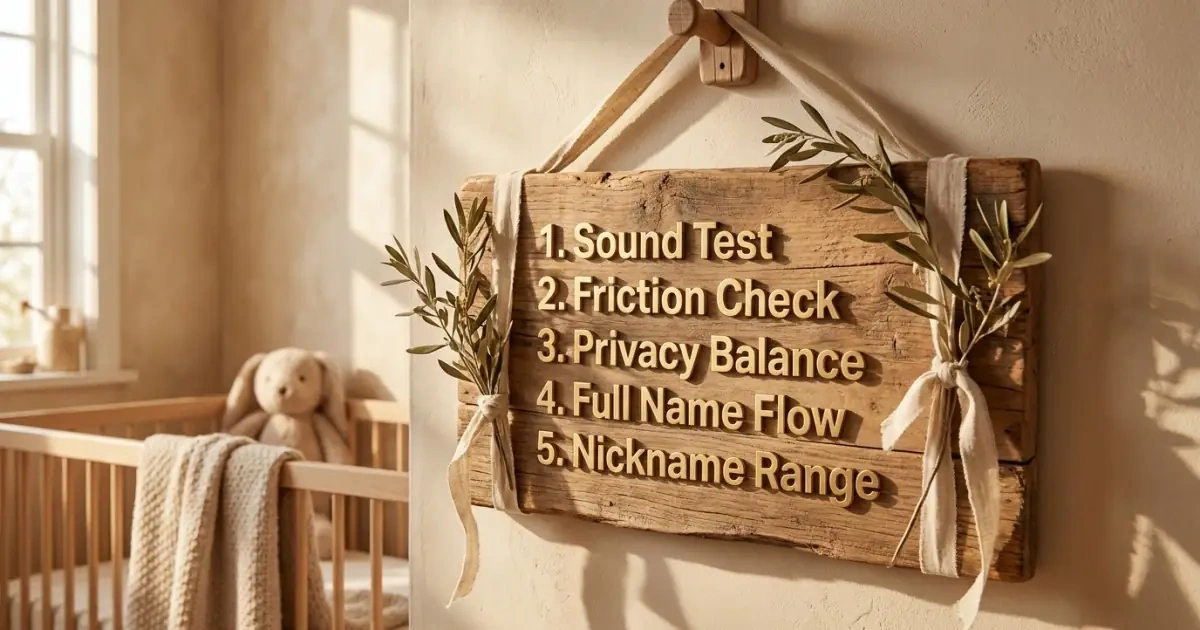
Use this framework when a name feels good, but you want to test its modern usability.
Step 1: Test real-world sound first
Say the name in family, school, doctor’s office, playground, and adult introduction contexts.
Digital clarity will not rescue a name that feels wrong when spoken. A child’s name should sound human before it looks efficient.
Step 2: Check spelling and typing friction
Look at how easily the name can be read, typed, autocorrected, searched, and entered into forms.
This is especially important for unusual spellings, cultural spellings, word names, names with punctuation, and names that sound like more common alternatives.
Step 3: Compare popularity and privacy
Decide whether you prefer familiarity, search privacy, distinctiveness, or a balance.
A common name may blend in. A rare name may stand out. Neither is automatically better. The full name and surname matter.
Step 4: Test the full name, not just the first name
Check first + surname, initials, middle options, email-style forms, and search distinctiveness.
A first name that works beautifully on its own may need adjustment when paired with the surname.
Step 5: Check nickname and professional range
Make sure likely nicknames and formal versions both feel usable.
A child may later prefer the full name, a nickname, initials, middle name, or a more formal version. Give them room when you can.
Step 6: Preserve meaning, culture, or style intentionally
Do not simplify a meaningful spelling only for convenience.
Do not add friction only for novelty either. When the name is harder to spell, pronounce, or type, know what that difficulty protects.
Step 7: Choose the name that feels human, usable, and future-flexible
The final name should work in introductions, documents, search bars, and adulthood without losing warmth.
It should feel like a real person’s name first and a functional digital identity second.

Questions Parents Ask About Baby Names in the Digital Age
Should we choose a rare name so our child can get usernames later?
No. Username availability is too unpredictable to drive the whole decision. Consider it lightly, but prioritize sound, meaning, spelling, surname fit, and long-term usability.
Is a common name better for online privacy?
Sometimes, but common names can also create identity confusion. The full name, surname, middle name, initials, and future digital habits all affect privacy.
Should we search a baby name online before choosing it?
Yes, as a light check. Look for obvious associations, especially with the surname. Search results should not replace deeper testing for sound, spelling, meaning, and daily use.
Are unusual spellings bad for online life?
Not always. Cultural or established spellings may be worth preserving. Invented spellings need careful testing because they can add correction without adding meaning.
Do professional names matter in a social media age?
Yes, but professional does not mean stiff. The name should have enough range for adulthood while still feeling warm, personal, and usable in everyday life.
A Name Built for Screens Still Has to Belong to a Person
A child’s name will almost certainly live in digital spaces.
It may appear in usernames, school portals, email addresses, search results, social platforms, portfolios, and professional profiles. It should be easy enough to type, spell, search, and use without becoming a constant obstacle.
But a name is still spoken before it is searched.
The best online-and-offline names feel human first. They sound natural in introductions. They have enough warmth for family life and enough range for adulthood. They respect meaning, culture, spelling, surname flow, popularity, privacy, and nickname possibilities without becoming overly engineered.
Do not choose a name for a platform that may not exist in twenty years.
Choose a name your child can carry through real rooms and digital systems with confidence.
A name that works online and offline is not sterile, trendy, or built for search alone. It is a name with enough clarity for systems, enough warmth for people, and enough flexibility for the child who will make it their own.