
How to Name a Baby After Birth With Confidence
Some parents only begin naming clearly once the baby is in their arms.
That can feel unsettling, especially after months of assuming the name would be decided before birth. A pregnancy favorite may suddenly feel too polished, too heavy, or not quite true. A quiet name from the shortlist may become easier to say than expected. Relatives may already be asking, paperwork may be waiting, and the honest answer may be simple: you need a little more time.
That does not mean the naming process failed.
It means the decision has entered its most real stage.
Before birth, names live in projection. After birth, they meet a room, a voice, a face, a surname, a tired parent, a partner’s first attempts, and the strange intimacy of early care. Some names strengthen immediately. Others lose their shine. A few do not collapse, exactly; they simply stop feeling like the child in front of you.
Naming after birth should not become a hospital-room panic. It should also not become a wide-open search. The strongest post-birth decisions stay narrow: a real shortlist, a few honest tests, a protected circle, and enough quiet to hear which name begins to feel usable.
When your taste is still broad, baby names by style, baby names by theme, and baby names by popularity can help define the direction. Once the baby has arrived, though, the work changes. You are no longer collecting possibilities. You are asking which name can live in the room.

Naming After Birth Is Not a Failure of Preparation
A “prepared” family is not always a family with the name locked before labor.
Some parents know early. Others need the child in front of them before the choice settles. That difference is not a moral score. Naming has an emotional layer that cannot always be completed in theory.
Pregnancy gives parents time to research, compare, test, and imagine. Birth changes the reference point. The baby is no longer a future idea; the baby is present, specific, and already changing the emotional weather around the name.
| Before Birth | After Birth |
| Names are tested against imagination | Names are tested against real care |
| Parents picture a future child | Parents hear the name beside an actual baby |
| Style and meaning may dominate | Speech, rhythm, and tenderness become more obvious |
| A favorite can feel settled in theory | The name has to survive first use |
| Uncertainty can feel abstract | Fit becomes more physical and immediate |
A name such as Clara may have seemed clean and classic on paper, then feel even stronger when said softly to a newborn. Maeve may gain force because its compact sound is easy to use in exhausted speech. Theodore may still carry formal warmth, though its length and nickname options can feel more noticeable after birth.
The baby’s arrival does not magically choose the name. It changes the evidence.
That is why a short post-birth pause can be wise. It gives the strongest names one final chance to prove themselves in the life they are supposed to enter.

What Actually Changes Once the Baby Is Here
After birth, parents stop hearing names only as ideas.
The sound becomes more important. A name must leave the page and enter ordinary speech: whispered, repeated, shortened, written, texted, and said by another parent who may not hear it the same way you do.
The emotional frame also narrows. During pregnancy, a name may represent a whole imagined future. After birth, it has to attach to this child, in this family, with this surname, under real pressure.
That shift often reveals truths that were difficult to access earlier.
| What Changes | Why It Clarifies the Name |
| The baby is physically present | Names stop floating in abstraction |
| Parents begin speaking to the baby | Mouth feel and warmth become clearer |
| The partner’s voice enters the decision | Shared use becomes harder to fake |
| Family pressure intensifies | Boundaries reveal how confident the parents really are |
| Paperwork approaches | The name must become practical, not only beautiful |
| Fatigue rises | Names that require too much effort show strain faster |
This does not mean the baby has to “look like” a name in a mystical way. Newborns are new. Their appearance and personality will shift constantly.
The more useful test is quieter: does the name become more believable with use, or does every repetition create more resistance?
Wise Waiting Is Different From Panic Delaying
Not deciding immediately after birth can be thoughtful.
Opening the entire naming universe again is another matter.
Wise waiting keeps the decision narrow. It uses the baby’s arrival to test the real contenders, not to erase months of work. The shortlist stays small, the criteria stay visible, and the parents listen for which name becomes easier to use.
Panic delaying feels less disciplined. Old rejections return. New names arrive because they feel fresh, not because they are stronger. Outside opinions start reshaping the shortlist. Fatigue makes every option look weaker. The process widens at the exact moment it should be narrowing.
| Wise Waiting | Panic Delaying |
| Tests a shortlist that already exists | Restarts the whole search |
| Gives names room to settle | Keeps adding names to avoid choosing |
| Uses the baby’s arrival as evidence | Treats uncertainty as a reason to begin again |
| Protects the decision from too many voices | Lets relatives, comments, and pressure take over |
| Moves toward clarity | Creates motion without progress |
The distinction matters because the first can build confidence. The second usually erodes it.
A post-birth pause should deepen the decision, not scatter it. When the search starts expanding because commitment feels frightening, When to Stop Searching for the Perfect Baby Name is more useful than another list.
The First 24 to 72 Hours Need Structure, Not Drama
The first days after birth are tender, messy, and often loud.
Parents may be exhausted. Relatives may be eager. Medical forms may feel urgent. The baby may feel familiar and astonishingly unfamiliar at the same time. This is not the moment to invite chaos.
A calm naming window needs limits.
| In the First Few Days | Why It Matters |
| Keep the shortlist small | Decision fatigue grows quickly after birth |
| Avoid broad family polling | Outside excitement can become pressure |
| Use the names in real speech | Sound reveals more than silent comparison |
| Listen to both parents say each name | Shared ownership becomes visible |
| Protect rest | Exhaustion makes even good names feel unstable |
| Test the full name | The surname still matters |
| Notice repetition | Strong names usually get calmer, not more brittle |
Three to five contenders are enough. More than that usually means the pre-birth work was not narrowed enough, or the post-birth emotion has reopened the field.
Do not treat the hospital room as a debate stage. Treat it as a listening room.
Say the names quietly. Use them in normal sentences. Write them once or twice. Let the strongest names meet reality without forcing a dramatic answer in the first hour.

Start With a Shortlist, Not an Open Field
Naming after birth still needs boundaries.
The temptation is to stay “open,” especially when the planned name suddenly feels uncertain. In practice, an open field almost always makes the decision harder. Every extra name demands comparison, testing, emotional energy, and discussion at a moment when parents are least equipped for clutter.
A shortlist turns anxiety into work.
| Keep on the Post-Birth Shortlist | Cut Before You Begin Testing |
| Names you could genuinely use today | Names you admire but would never choose |
| Names both parents can discuss seriously | Names kept only to avoid disappointing someone |
| Names that pass basic surname use | Names with a known deal-breaker |
| Names that still feel alive after pregnancy | Names that survived only because no one removed them |
| Names with manageable nicknames | Names whose likely short form already bothers you |
A name like Eden may stay because it feels soft, modern, and easy to say. Soren may stay because its restraint and distinction still feel right, though pronunciation and surname flow deserve testing. Luca may remain because its warmth and cross-cultural ease make it highly livable.
The shortlist should contain real possibilities, not emotional clutter.
When the list still feels bloated, How to Build a Baby Name Shortlist should come before any final decision attempt. Once the field is genuinely tight, How to Compare Baby Names Objectively becomes far more useful than another round of impressions.

Use the Baby’s Arrival to Test Names More Honestly
The baby’s arrival gives parents a chance to hear names under better conditions.
Not perfect conditions. Honest ones.
| Post-Birth Test | How to Use It | What It Reveals |
| Cuddle-and-conversation test | Say the name while holding, feeding, or talking to the baby | Whether the name feels natural in intimate use |
| Full-name test | Use the first name with middle name if known, plus surname | Whether the full structure holds |
| Tired-voice test | Say it without polishing the sound | Whether the name works outside a careful naming voice |
| Partner voice test | Listen to the other parent use it casually | Whether the name belongs to both of you |
| Announcement test | Imagine the text, card, or message using the name | Whether the name feels ready to become public |
| Form test | Picture it on paperwork and medical records | Whether spelling and structure feel manageable |
| Future-introduction test | Say “This is ___” and “Hi, I’m ___” | Whether the name can grow beyond newborn tenderness |
The goal is not to manufacture certainty. It is to notice which name becomes easier to use.
Rose may feel spare and grounded in those first sentences. Juniper may feel brighter, more distinctive, and more expressive. Neither reaction is automatically better. The stronger name is the one that fits the way your family will actually speak.
These tests are not gimmicks. They are how a name leaves theory.

What to Do When the Planned Name Suddenly Feels Wrong
This feeling can be startling.
A name may have been the favorite for months, then feel strangely off once the baby is here. Parents often panic because they assume a true name should survive birth untouched.
Not always.
Birth can temporarily distort everything. Exhaustion, adrenaline, pain, relief, hormones, visitors, and the sheer strangeness of meeting a new person can make any major decision feel unstable. A planned name that feels uncertain for a few hours is not necessarily wrong.
The real test is repetition.
| Post-Birth Reaction | What It May Mean | Next Move |
| The name feels briefly unfamiliar | Normal adjustment | Keep using it gently for a short period |
| The name sounds good but too formal | The nickname or middle-name balance may need attention | Test likely everyday versions |
| The surname now feels awkward | A practical issue may have been underestimated | Compare full names directly |
| One parent cannot say it naturally | Shared ownership may be weaker than expected | Pause and revisit the shortlist together |
| The name feels less true every time | The mismatch may be real | Compare it with the strongest alternatives |
| A quieter backup feels more natural | The shortlist may already contain the answer | Give that name a serious test |
Do not abandon a long-held favorite in a rush. Do not cling to it out of pride either.
A planned name deserves a fair test, not automatic loyalty.
When the shift is tied to symbolism, family history, or cultural feel, return briefly to baby names by theme or baby names by origin before letting a meaningful name go. The goal is to understand what changed, not to restart the search out of shock.

How to Handle Family Pressure After the Baby Arrives
Outside pressure often intensifies immediately after birth.
People want the name. They want to text it, post it, embroider it, announce it, react to it, and claim a piece of the story. Their excitement may be loving. It is still not the same as clarity.
Parents need language that protects the decision without sounding defensive.
| Pressure Moment | Calm Response |
| “Do you have a name yet?” | “We have a short list and want a little time with the baby before choosing.” |
| “Just tell us the finalists.” | “We’re keeping the list private until the name is settled.” |
| “Everyone is waiting.” | “We know. We’ll share it when we’re confident.” |
| “I like this one best.” | “We’re not taking votes, but we’ll share the final name soon.” |
| “Why is it taking so long?” | “We’re close. We want to choose carefully, not quickly.” |
A smaller circle usually produces a clearer decision.
Too many reactions can make a good name feel unstable. Not because the name is weak, but because the process has become crowded. Before birth, opinions are already risky; after birth, they can feel urgent enough to override your own judgment.
Useful feedback has a specific job: pronunciation, initials, spelling, cultural context, or a practical concern you genuinely missed. General taste reactions should not control the name.
The Practical Checks Still Matter After Birth
The emotional intensity of birth does not cancel practical reality.
A newborn makes every name feel softer for a moment. That softness will not fix a surname clash, an unwanted nickname, a spelling burden, or a partner’s unresolved hesitation.
| Practical Check | Why It Still Matters |
| Surname flow | The full name is the identity your child will carry |
| Nickname risk | Other people will shorten names quickly |
| Initials and monograms | Preventable awkwardness is easier to catch now |
| Pronunciation ease | First-read confusion can become daily friction |
| Spelling burden | A beautiful announcement does not erase years of correction |
| Popularity comfort | A sweet newborn fit may still feel socially too common or too rare later |
| Adulthood fit | The baby will use the name longest as an adult |
| Partner conviction | A post-birth choice should not become one parent’s quiet surrender |
Arthur may feel rich and traditional, but its full-name rhythm matters. Nora may be clean and warm, yet popularity comfort still deserves honesty. Iris may offer botanical clarity and concise sound; Felix brings brightness and compact energy. Each name still has to work beyond the newborn room.
Specific friction deserves a specific tool. Use How to Match a First Name With Your Surname for flow, How to Check Nickname Potential Before You Choose for social shortcuts, How to Check Initials, Monograms, and Awkward Combinations for preventable combinations, How to Evaluate Pronunciation Ease for first-read friction, and How to Choose a Name That Ages Well for long-term range.
When the uncertainty is bigger than one flaw, What Makes a Good Baby Name? can bring the decision back to the full standard.

What to Do When You and Your Partner React Differently After Birth
Post-birth emotion can sharpen old disagreements.
A longtime favorite may feel confirmed to one parent and wrong to the other. A backup name may suddenly gain force. One parent may feel calm, while the other hears only pressure.
That does not mean the process has collapsed. It means the shortlist is being tested under real conditions.
The loudest feeling is not always the truest one. It may be clarity. It may also be fatigue, disappointment, fear, or the pressure of wanting the decision done.
| Partner Reaction | What to Do |
| One parent feels newly certain | Ask what changed after birth and whether the name still passes practical checks |
| One parent loses confidence | Separate temporary overwhelm from a specific name concern |
| Both parents like different finalists | Return to the agreed criteria, not volume or persuasion |
| One person wants to reopen the list | Identify the flaw before adding new names |
| A family honor name becomes tense | Separate the tribute from first-name usability |
| Both parents keep using one name naturally | Treat that pattern as meaningful evidence |
The strongest post-birth decision is not the one with the most dramatic reaction. It is the one both parents can begin to inhabit.
When the disagreement runs deeper than the names, How to Choose a Name With Your Partner belongs in the process. Once the shortlist has narrowed to two serious choices, How to Decide Between Two Baby Names gives the comparison a cleaner edge.
Keep Testing a Name Only When It Is Getting More Believable
Not every post-birth doubt deserves the same amount of patience.
A strong name may feel slightly unfamiliar at first, then grow steadier with use. That is normal. A weak name usually demands more explanation as the hours pass.
| Keep Testing When… | Drop or Downgrade When… |
| The name still sounds good but needs settling | The same friction appears every time |
| Both parents can say it, even with some nerves | One parent cannot imagine using it |
| The surname works well enough | Full-name rhythm keeps bothering you |
| The nickname world feels acceptable | The likely nickname already irritates you |
| The name feels calmer with repetition | The name grows more brittle with each use |
| Doubt is emotional, not practical | A practical flaw has become clearer |
The cleanest question is not whether the name feels perfect.
Watch whether it is becoming more believable.
A name that gathers ease deserves another round of testing. A name that requires more defense with every use is usually telling the truth.

The Real Risk After Birth Is Chaos, Not Slowness
Parents often worry about taking too long.
A little time is rarely the danger. Chaos is.
Rushing can produce a weak choice, but endless reopening can do the same. Confidence after birth does not come from speed. It comes from a narrow field, shared criteria, and real use.
| Calm Post-Birth Naming | Chaotic Post-Birth Naming |
| Uses a shortlist | Reopens the entire search |
| Tests names in real speech | Debates names abstractly while exhausted |
| Limits opinions | Lets outside pressure shape the choice |
| Watches which name settles | Chases the newest emotional reaction |
| Keeps practical checks visible | Lets the newborn moment erase long-term concerns |
| Moves toward a decision | Keeps delaying without better evidence |
Naming after birth can be more grounded than naming before birth, precisely because the names are no longer being judged against fantasy.
The process may feel less polished. That is not a flaw. A post-birth decision can be quieter, more practical, and more true.
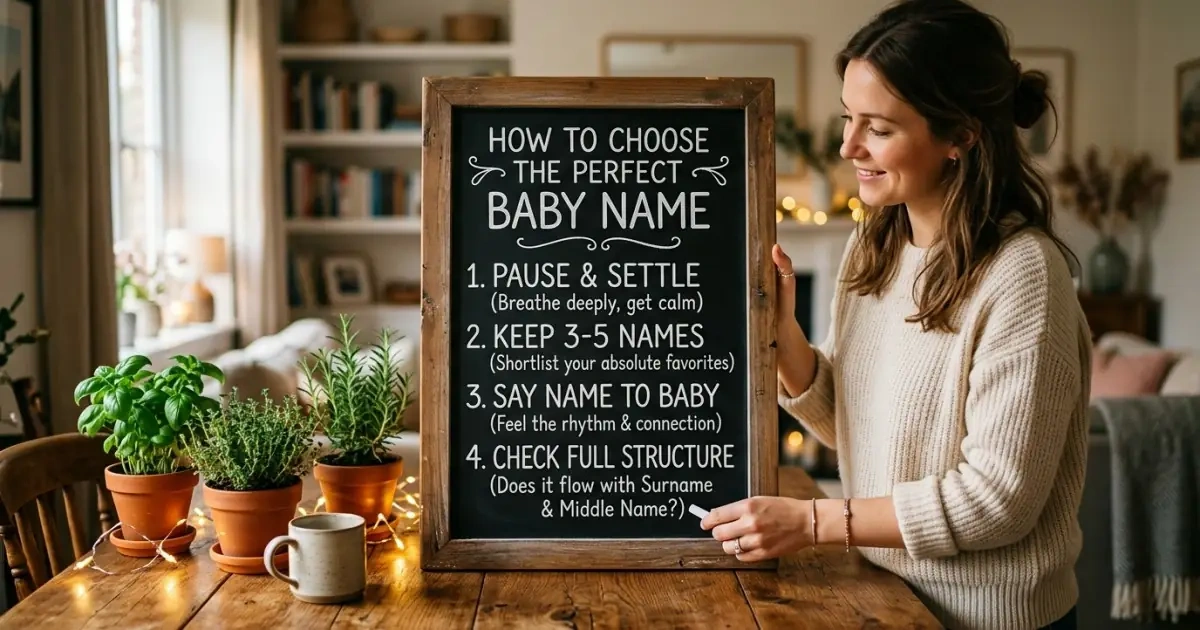
A Seven-Step Framework for Naming a Baby After Birth
Use this process when the baby is here and the name still needs to settle.
| Step | What to Do | Why It Works |
| 1. Pause before widening the search | Do not treat uncertainty as proof that you need more names | Protects the decision from panic |
| 2. Keep three to five real contenders | Remove admired names, guilt names, and known deal-breakers | Creates a usable field |
| 3. Say the names with the baby present | Use them while holding, feeding, or speaking naturally | Tests real warmth and mouth feel |
| 4. Check the full name | Use surname, middle name if chosen, initials, and likely nicknames | Keeps emotion tied to practical reality |
| 5. Listen to both parents | Notice which names can be used with ease in both voices | Builds shared ownership |
| 6. Reduce outside pressure | Share only what protects the decision | Keeps reactions from becoming noise |
| 7. Choose the name that becomes more livable | Trust the name that grows calmer and clearer with use | Replaces drama with confidence |
The best post-birth framework is not complicated.
It simply prevents the decision from widening when it should be settling.

Signs a Post-Birth Name Decision Is Getting Stronger
A good post-birth decision often strengthens quietly.
One name returns without being forced. It becomes easier to say. The shortlist shrinks naturally. The remaining concerns feel emotional rather than practical. Both parents start using the same name more often, sometimes before they have officially agreed.
Those signs are subtle. They are also useful.
| Strengthening Signal | What It Suggests |
| The name feels easier each time | Repetition is building trust |
| The surname sounds more natural | Full-name reality is supporting the choice |
| Both parents begin using it casually | Shared ownership is forming |
| Other names feel less necessary | The shortlist is narrowing without pressure |
| The doubts become smaller and more specific | Anxiety is losing control |
| The name feels usable, not merely impressive | Fit is replacing performance |
Do not wait only for fireworks.
Many excellent naming decisions arrive as a calm reduction of resistance.

Signs You Need More Time, Not a New Search
Sometimes the answer after birth is not immediate commitment. It is also not another list.
You may need rest, repetition, and a quieter room.
| What You Notice | What It May Mean |
| The shortlist is strong, but you feel overloaded | Exhaustion is interfering with judgment |
| Two names still feel genuinely alive | A short testing window may resolve the tie |
| No practical red flag has appeared | The uncertainty may be emotional, not structural |
| You feel pressured by announcements or relatives | Boundaries may matter more than more names |
| Your reaction changes by the hour | Sleep and repetition may clarify the pattern |
| You keep wanting to browse despite good finalists | The issue may be perfectionism |
A tired parent does not need a thousand new names. A tired parent needs a narrow process.
When the shortlist is already strong but the urge to widen keeps returning, When to Stop Searching for the Perfect Baby Name is the better next step than a name generator.

Why Naming After Birth Can Still Be a Confident Choice
Confidence after birth is built, not summoned.
It comes from narrowing instead of widening, testing instead of scrolling, and noticing what grows calmer rather than what feels loudest. The name no longer has to impress you in imagination alone. It has to work in the first language of your family life.
That is a powerful advantage.
Before birth, parents often compare names against a child they have not met. After birth, even with all the exhaustion and pressure, names begin to show how they behave in use. They either become more natural or less convincing. They either gain warmth in a parent’s voice or keep needing to be explained.
A post-birth name choice can be deeply confident because it is grounded in reality.
Not rushed. Not random. Not theatrical.
Chosen narrowly enough to be honest.

Questions Parents Ask About Naming a Baby After Birth
Is it normal not to have a baby name before birth?
Yes. Many parents do not feel fully settled until the baby is here. A post-birth decision can still be thoughtful when it begins from a real shortlist rather than a wide-open search.
How long is it reasonable to wait after birth before deciding?
A short window can be useful, especially when you are testing finalists instead of reopening the entire process. The key is whether the time is creating clarity.
What if the baby does not seem to fit the planned name?
Give the planned name a fair test before abandoning it. Use it aloud, pair it with the surname, listen to your partner say it, and compare it only with the strongest alternatives. A temporary shock is different from a repeated mismatch.
Should we tell family the shortlist after birth?
Usually not unless their feedback has a specific purpose. Broad taste reactions can destabilize a decision that is still clarifying.
What if we feel more confused after the baby arrives?
Confusion after birth often means the process needs structure, not more names. Narrow the shortlist, reduce outside pressure, and test each finalist in real speech.
Can the right name feel calm instead of dramatic?
Yes. Post-birth confidence often feels like ease rather than fireworks. The name that becomes more usable with repetition is often stronger than the one that creates the biggest first reaction.

Where to Go Next When the Baby Is Here and the Name Is Close
Let the final obstacle dictate your next move. If your list remains unmanageable, apply the strict filters in How to Build a Baby Name Shortlist,. For a tight pair of contenders, seek the sharper contrast found in How to Decide Between Two Baby Names, or use How to Compare Baby Names Objectively to break the tie when strong finalists constantly trade places.
A name that looks good in theory still has to meet ordinary life. Use How to Test a Baby Name Before Finalizing It when sound, surname flow, nicknames, initials, or adulthood fit remain untested. When one name keeps returning but you cannot quite trust the signal, How to Know When a Name Feels Right will help separate real confidence from fatigue. Fear of choosing badly belongs with How to Avoid Baby Name Regret, especially when anxiety is louder than the actual flaws.
For the wider editorial path through the naming process, Expert Baby Naming Guides for Choosing the Right Name can help you move from broad uncertainty into the guide that matches the problem in front of you.
Naming a baby after birth is not a sign that the process failed. Often, it is the moment when the strongest name finally becomes clear enough to trust. The work is not to choose instantly. It is to choose calmly, narrowly, and honestly enough that the name still feels steady after the first rush has passed.