
Nicknames for Roger: Easy Nickname Ideas That Really Work
Nicknames are not merely shorter names. They are social permissions. They reveal who is close enough to compress a formal identity, who wants warmth rather than distance, who prefers speed, and who is trying to make a familiar name fit a particular room. A first name may belong to the official world of attendance sheets, email signatures, and introductions, but a nickname belongs to the private traffic of a life: siblings, cousins, teammates, old friends, partners, grandparents, and the handful of people who can alter the sound of your name without altering your place in the world.
Roger is especially interesting because it sits right at the edge between formality and familiarity. Unlike a name that is already clipped down to its smallest practical form, Roger has room to be shortened, softened, or redirected. Yet it is also such a settled, recognizable name that it does not require a nickname in order to feel usable. That tension gives Roger a richer nickname life than many modern short names. With Roger, nicknames are less about rescue and more about tone. They show whether the name is being made friendlier, younger, rougher, more playful, or more private. Nicknames add personality at the surface, but the deeper weight of the name still sits in Roger meaning.
What the Nickname World Around Roger Reveals About the Name Itself
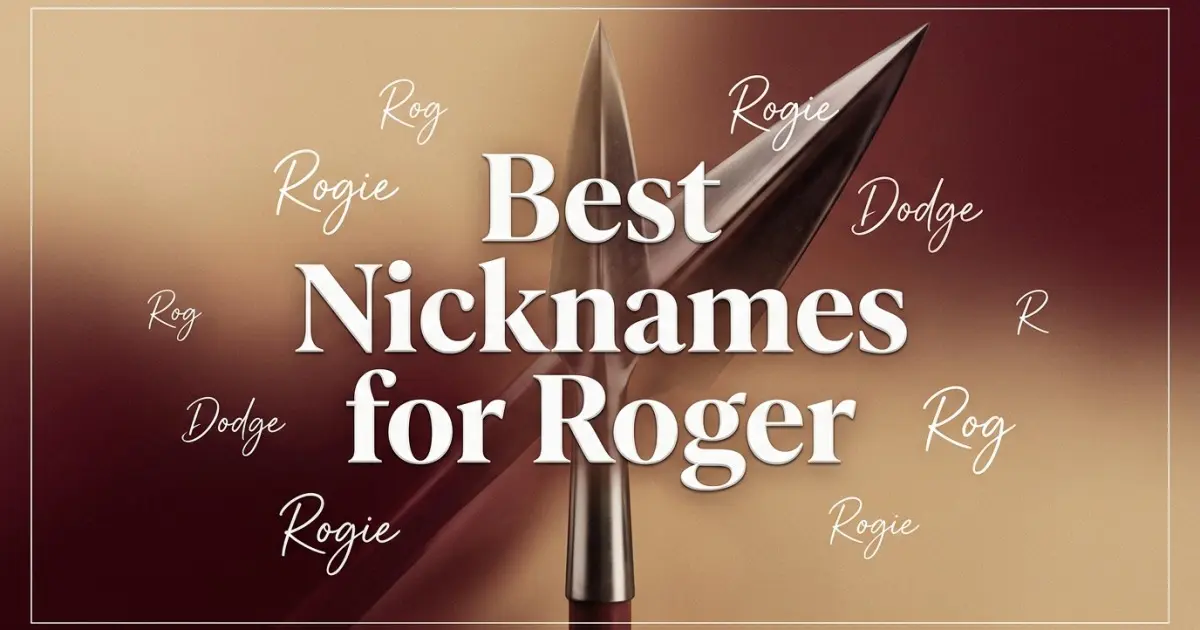
| Group | Suggested Nicknames | Persona | Use Context |
|---|---|---|---|
| Classic everyday forms | Roger, Rog, Rodge | Steady, recognizable, socially easy | School, work, introductions, long-term casual use |
| Affectionate home-circle forms | Rogie, Roger-Boy, Ro-Ro | Warm, familial, playful | Parents, grandparents, siblings, partners, early childhood |
| Ultra-short insider forms | R, Roj, Ro | Minimal, modern, friend-group specific | Texts, group chats, teammates, fast everyday shorthand |
| Playful social forms | Rodge, Rogs, Rogster, Roge | Humorous, easygoing, socially earned | Cousins, sports, friend circles, affectionate teasing |
| Historical or old-school forms | Hodge, Dodge | Antique, characterful, highly marked | Rare modern use, mostly stylistic, literary, or inside-joke territory |
| DIY identity tags | RJ, RT, Roger + middle initial, Roger + surname clip | Specific, practical, situational | Teams, schools, family repetition, online handles, friend groups |
Roger Has Nickname Room Because Roger Is Formal Enough to Be Trimmed
Why Roger does not have to stay untouched
Some names resist shortening because they are already compact. Roger is not one of them. It has two syllables, a clearly stressed first half, and a long history of living in both formal and familiar registers. That makes it unusually flexible. Roger can remain Roger for a whole lifetime and sound perfectly natural, but it can also move into shorter forms without losing recognition. That is one reason the nickname field around Roger feels more organic than forced. The name itself invites a few degrees of social adjustment.
This matters because Roger already sounds adult and complete. A nickname is therefore rarely needed for usability. It is chosen instead for intimacy, speed, or tone. Rog makes Roger more compact and less formal. Rodge makes it rougher and friendlier. Rogie softens it and turns it inward toward family life. The base name does the official work. The nickname tells you what kind of relationship is being expressed.
Why Roger’s best nicknames still need to feel lived in
Because Roger is such a settled traditional name, its nicknames work best when they sound genuinely used rather than cleverly designed. That is the hidden rule here. A believable Roger nickname should feel like something that could emerge naturally in a house, a schoolyard, a team, or a circle of old friends. The name has too much history to support a nickname that sounds purely invented for style points.
That is why Rog and Rodge feel stronger than many newer possibilities. They are direct, audible, and close to the base form. Even when a nickname is playful, Roger usually wants it to sound grounded in speech rather than manufactured on paper.
The Sound Zones Inside Roger Explain Most of Its Nickname Logic
The opening zone: the “Ro-” that makes the name softer than its meaning
Roger begins with a rounded opening: Ro-. That matters because it gives the name an easy entrance. Nicknames built from this opening tend to feel lighter and more intimate. Ro is the cleanest example. It is simple, modern, and plausible in texts or in close family circles. Ro-Ro belongs especially to childhood and affectionate home use, where repetition often turns a formal name into something softer and more playful.
The opening also explains why Roger can support a degree of warmth that some other old masculine names cannot. The first sound is not abrupt. It glides. That makes clipped nicknames feel less aggressive and more relational.
The stressed center: where “Rog” and “Rodge” get their force
The middle of Roger does much of the nickname work. In English speech, the stressed first syllable carries the strongest energy, and that is why forms like Rog and Rodge feel so natural. They grab the muscular center of the name and stop there. Rog sounds especially efficient and contemporary. Rodge has more texture and personality, and in many social settings it sounds more like a real nickname than a mere abbreviation. Nicknames often grow from the stressed part of a name rather than from spelling alone, so the next useful step is how to pronounce Roger.
This is the most productive nickname zone because it keeps the identity of Roger completely visible while changing the emotional temperature. Roger is the full, publicly composed form. Rog is the tighter, more immediate form. Rodge is the slightly rougher, friendlier, and more socially marked form. These are not radical transformations. They are tonal edits.
The ending zone: the “-er” that softens the formal edge
Roger ends with a weak final syllable, and that ending plays a quieter role in nickname making. It is not as productive as the opening or stressed center, but it contributes something important: softness. Because the name ends lightly, affectionate extensions can grow from it without sounding absurd. Rogie works because the ending is already relaxed enough to tolerate an affectionate lift. Roger-Boy works in family life because the full name itself still sounds speakable and warm, not too stiff to carry extra playfulness.
What the ending usually does not do is create highly independent nicknames. Roger’s strongest short forms come from the front half, not the tail. The ending helps emotional tone more than it helps structural reduction.
Roger Changes with Age More by Circle Than by Sound
Childhood Roger is where the cute forms feel easiest
In childhood, Roger can support a wider affectionate range than it often does later in life. Rogie, Ro-Ro, and Roger-Boy all make sense in family settings because children often receive nicknames that signal tenderness more than identity. The legal first name remains fully available for school and formal use, while the home circle plays with softer or more repetitive sounds. Roger is particularly good at this because its full form is already familiar and unthreatening.
That split can continue for years without difficulty. A child can be Roger in public and Rogie to one parent or grandparent for decades. The nickname does not need public legitimacy to feel real.
Adult Roger often settles into the shorter, drier forms
As Roger ages, the nickname field tends to narrow. Publicly, many adults named Roger remain Roger. In close male friendships, however, Rog, Rodge, or Rogs often feel more plausible than the softer childhood forms. These nicknames do not infantilize the name. They simply make it more compact and socially specific.
This is one of Roger’s strengths. It can support both warm early-life forms and tougher or drier later-life ones without seeming unstable. The full name stays intact. The nickname merely reflects who is speaking and from what kind of familiarity.
Roger Has a Few Historical Nicknames, but Not All of Them Belong to Modern Life
The antique branch: Hodge and Dodge
Historically, Roger produced older English forms such as Hodge and Dodge. These are real parts of the name’s nickname history and worth remembering because they show how long Roger has been lived with. They also reveal how aggressively older nickname culture could reshape a name’s surface while still keeping its identity inside the tradition.
In modern use, though, these forms are highly marked. They sound antique, literary, or comic unless there is a very specific family or stylistic reason to revive them. They belong more to the historical map of Roger than to its most likely everyday future. That does not make them irrelevant. It simply means they should be understood as heritage forms rather than default modern options.
DIY Roger nicknames should come from real need
The strongest do-it-yourself nicknames for Roger are often situational. RJ works if the middle name begins with J. RT or RB can work in school, work, or sports if initials matter. Roger plus a surname clip may emerge naturally in a team setting. These are believable because they arise from use, not from theory.
The guiding principle is simple: Roger’s best nicknames usually come from relationship or context, not invention for its own sake. This is a name with enough history and enough structure to carry a small, focused nickname world rather than an endless one.