
Roger Name Meaning: Symbolism, Heritage, and Everyday Appeal

Roger is a name that preserves the memory of force without needing to sound violent. Its meaning, “famous spear,” comes from an older world in which weapons were not decorative metaphors but markers of rank, survival, and renown. Yet in modern ears, Roger rarely lands as a brutal name. It lands as a name of bearing. That difference is the key to understanding it. Somewhere along the long road from Germanic warfare to present-day speech, the spear stopped feeling like mere aggression and started feeling like identity: the visible sign of a person known, remembered, and recognized.
That is why Roger remains more layered than its familiar surface suggests. The name sounds established, almost conversational, but the image inside it is ancient and sharply drawn. A spear is not vague power. It is directional power. It points, reaches, extends, and announces. Add the element of fame, and Roger becomes a name about public recognition tied to purposeful force. Yet because the name has also spent centuries in ordinary use, especially through French and English-speaking history, that force has been domesticated by time. Roger no longer sounds like a battlefield cry. It sounds like a person carrying an old idea of reputation in a form steady enough for modern life.
Roger's U.S. popularity rank over time, 1880–2024
Popularity statistics are based on official data from the Social Security Administration baby name records.
Roger: A Famous Spear with Mid-Century Poise
Roger presents a chart pattern of a broader past with a clearer present, reflecting a significant peak in 1945 that provides long-running cultural familiarity. While its adoption is more selective today, it continues to be a reliable choice parents trust for its professional feel and representation of a “famous warrior.”
While historical traces exist for girls, the modern era defines it as a primarily masculine staple. Meaning “famous spear,” its simple two-syllable rhythm remains both polished and widely trusted across style cycles.
Roger Carries More History Than Its Ease Lets On
| Key Facts | Information | Quick Insight |
|---|---|---|
| Name | Roger | Roger feels familiar in ordinary speech, which can hide how old and symbolically dense the name actually is. |
| Primary gender usage | Male | The name’s history, sound, and martial root have kept it firmly masculine across centuries of use. |
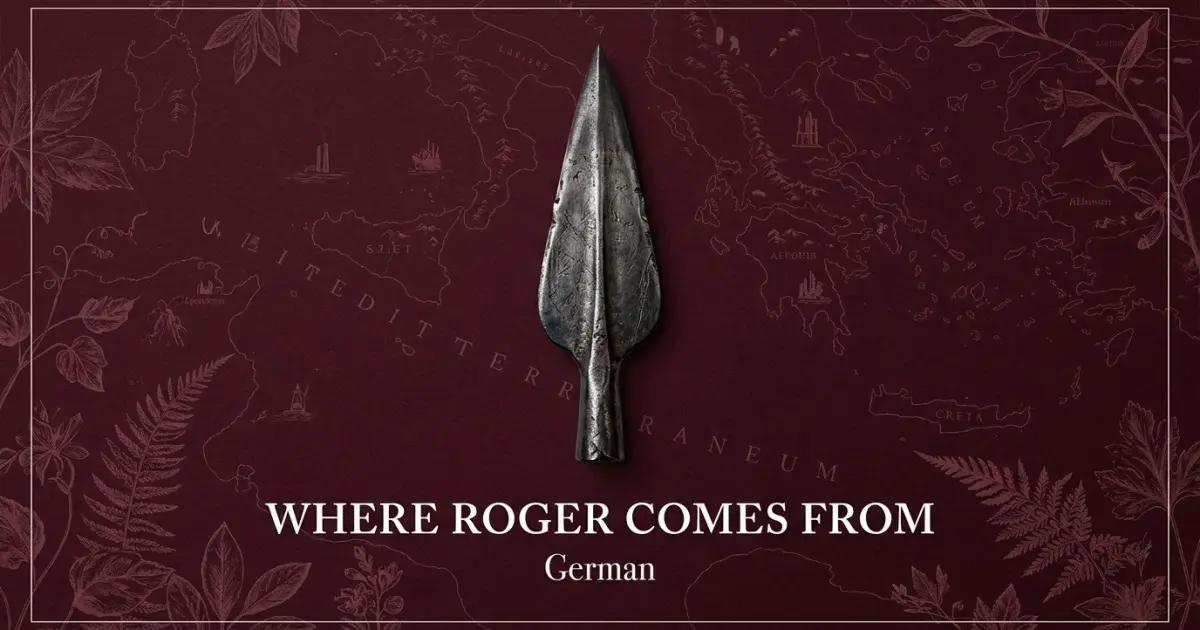
| Origin | German | The Germanic root places Roger in the tradition of old compound names built from fame, battle, and public rank. |
| Meaning | Famous spear | This is not generic strength. It is a meaning about direction, visibility, and reputation attached to force. |
| Pronunciation | RO-jer | The softened two-syllable English form helps the name carry ancient hardness without sounding harsh. |
| IPA (U.S.) | /ˈrɑːdʒər/ | The American version gives Roger a broader opening and a warmer middle, which makes it feel substantial but approachable. |
| IPA (U.K.) | /ˈrɒdʒə/ | The British pronunciation is slightly tighter and shorter, giving the name a cleaner, brisker profile. |
| Syllable count | 2 | Two syllables allow Roger to sound fuller and more socially polished than many one-syllable vintage names. |
| Latest U.S. year | 2024 | This places the name firmly in current records, showing that Roger remains active rather than purely archival. |
| U.S. boys’ rank (2024) | No. 750 | Official data suggests Roger is still recognizable but no longer crowded, which often gives a classic name new breathing room. |

Roger Begins in War Language but Ends in Social Recognition
The spear as symbol, not just weapon
The first instinct with Roger is often to focus on the spear. That makes sense. Of the two parts of the meaning, it is the more vivid image. A spear is older than many other weapon symbols found in names, and it carries a different emotional shape from a sword or shield. A sword often suggests noble combat or courtly status. A shield suggests defense. A spear suggests extension. It reaches beyond the body. It marks the distance at which a person can act on the world.
That matters because Roger is not just a “warrior” name in a vague sense. It is a name about directed force. Spears point. They travel. They define lines. In early naming traditions, that gave such weapon elements a strong symbolic charge. They could imply prowess, courage, public action, and the ability to stand visible among others. A spear was not an abstract emblem. It was a practical object associated with reputation.
But Roger does not mean spear alone. It means “famous spear,” and that first element transforms everything. Fame introduces the social world. The name is not merely about possessing force. It is about being known for it. That one shift takes Roger from simple martial imagery into the realm of legacy, memory, and public standing. It is a name built not only on capacity, but on recognition.
Why “famous” softens and enlarges the meaning at the same time
Names built from fame or renown often carry more social warmth than names built solely from brute power. They point toward reputation, not only impact. Roger belongs to that category. Even if the second element is hard, the first element makes the name more human because it imagines a witness. Someone sees, remembers, praises, or tells the story. In that sense, Roger is as much about being regarded as it is about fighting.
This is one reason the name has aged so interestingly. In a modern setting, very few parents hear Roger and picture a literal spear. What survives instead is the idea of earned standing. The force becomes metaphorical. The name starts to imply a person known for steadiness, influence, or visible competence. Historically, the old martial logic remains inside the name, but culturally it has been translated into a more social register. Roger now sounds less like a combatant and more like someone whose presence carries weight.
That translation is important. It is how old Germanic compound names continue to live. Their original materials stay intact, but the modern ear reinterprets them into character rather than conflict. Roger is a particularly good example because the form itself is so socially settled. The old spear is still there, but it now travels under the sign of recognition, not alarm.

How Roger Traveled from Germanic Roots into French and English Life
Roger belongs to a mobile name, not a fixed one
Although the user-facing origin is German, Roger is not a name that remained inside one linguistic boundary. Historically, it moved through French and English usage and became widely recognizable across Europe in adapted forms. Name dictionaries consistently treat Roger as a Germanic compound that took on a strong life in French and English, and some references note how common the name became during the medieval period. That wider circulation matters because it explains the split between the hard meaning and the more polished modern sound. To browse more names from this linguistic and cultural background, explore names with German roots.
The Germanic root gives Roger its old structure: fame plus spear. French and later English use gave it social wear, familiarity, and phonetic smoothing. That combination is why Roger can sound ancient in substance but civilized in delivery. It did not remain a raw battlefield form. It entered courts, churches, households, and records. It became lived with. By the time it reached modern ears, it had already been rounded by centuries of repeated human use.
Why medieval popularity still matters
Research suggests Roger was one of the most popular boys’ names during the medieval period. That is more than a trivia point. Medieval popularity changes the emotional profile of a name. It means the name was not reserved for a narrow elite or a single symbolic use. It spread. It became familiar enough to stop sounding exceptional and start sounding reliable. In naming history, that is often what gives a martial or noble name long-term survival. It ceases to be only emblematic and becomes communal.
That also helps explain why Roger can feel more worn-in than some other old Germanic compounds. A rarer name may retain more of its original hardness because it never had to become ordinary. Roger did become ordinary, and that ordinariness is part of its appeal. The name has passed through enough generations of daily speech to feel durable rather than theatrical.
It is also useful to remember that names change in emotional temperature when they are widely used for long enough. What once suggested military fame can, centuries later, suggest trustworthiness, maturity, or quiet stature. Roger underwent exactly that transformation. Its medieval strength became modern solidity.
Roger Sounds Softer Than Its Meaning, and That Is Part of Its Genius
The phonetic shape moderates the old warlike core
Phonetically, Roger is doing remarkable cultural work. The meaning is spear-focused and hard-edged, yet the standard English form contains softened consonants and a two-syllable rhythm that prevent it from sounding severe. In American English, /ˈrɑːdʒər/ opens broadly and then moves into the affricate j sound, which adds a rounded, almost conversational softness. In British English, /ˈrɒdʒə/ is slightly tighter, but still far from harsh. The name does not strike like a weapon. It moves with a kind of practiced civility.
That matters because sound often determines whether an old meaning survives as threatening or becomes socially acceptable. Roger’s phonetics help transform “famous spear” into something more like “well-known bearing” or “recognized presence.” The original components are still historically true, but the sound no longer amplifies literal combat. Instead, it gives the name maturity.
Why the two syllables matter
Roger also benefits from having two syllables rather than one. Many revived vintage names today are clipped and monosyllabic, which can make them feel stark or heavily stylized. Roger has more room. The first syllable establishes weight; the second releases it. That release is what keeps the name from sounding overcompressed. It gives Roger a fuller, more social rhythm, which in turn makes the name easier to place in formal and informal settings alike.
This is one reason Roger often feels more adult than boyish. The sound is not juvenile or cutesy. It is rounded and complete. That can be a real advantage for parents who want a classic name with substance, but not one that depends on a nickname to become usable later. Roger begins already shaped for public life.
It also makes the name flexible across class and style boundaries. Roger can sound learned, practical, traditional, or quietly distinguished depending on context. Few old names with martial meanings manage that range as effectively.
Roger in the Modern Ear Feels Mature, Underused, and Distinctive Again
Why official data now changes the name’s atmosphere
Official Social Security Administration (SSA) data placing Roger at No. 750 for boys in 2024 tells an important modern story. Roger is still known, but it is no longer crowded. That matters because when a name leaves the busiest part of public use, people begin hearing it differently. It regains outline. What once seemed commonplace can start to sound specific, even elegant, because it is no longer constantly repeated in every generation.
For Roger, this creates a particularly interesting moment. The name still has strong cultural recognition, but it has moved far enough from peak familiarity to feel selective again. That can be attractive to parents who want a name with real history, easy pronunciation, and a fully formed masculine profile, yet do not want something overexposed. Roger now occupies that middle ground: familiar without being frequent.
How Roger compares to other old masculine names
Stylistically, Roger sits near names like Walter, Ronald, Martin, Gordon, and Victor: names that feel inherited, adult, and culturally legible. But Roger differs from them in two ways. First, it has a brighter internal sound because of the j center and two-part motion. Second, its meaning carries sharper old-world imagery. Walter means rule in a broader way, Victor means victory outright, Ronald leans toward counsel and Norse force, but Roger keeps that spear image quietly visible behind the softened surface.
This makes Roger feel at once conventional and singular. It belongs to the classic male archive, yet it keeps a slightly more pointed symbolic spine than many neighboring names. That is why it can feel underused in a productive way. It is not obscure, but it has enough edge in meaning and enough smoothness in sound to feel newly worth hearing. If you are weighing names with a similar gender profile, visit classic and modern boy names.
Roger Is a Name of Reputation, Not Noise
From battle fame to civic character
The most useful modern reading of Roger may be this: it is a name about reputation earned through visible strength, not spectacle. The old meaning gives it martial architecture, but the centuries of usage redirect that architecture toward character. Roger now sounds like a name for someone established, reliable, and publicly legible. It suggests a person whose presence is recognized, not because he is loud, but because he has become known.
This is what makes Roger more subtle than it first appears. The fame inside the name matters as much as the spear. Without fame, the meaning would be only force. Without the spear, it would be only abstraction. Together they create a name that implies public standing attached to action. In a modern context, that can be interpreted as credibility, competence, or earned authority.
Why the old martial element still matters symbolically
Even when the literal weapon reading has faded, it still contributes symbolic sharpness. A spear is not diffuse. It is precise. Roger therefore carries not only strength, but directedness. That is part of the name’s deeper appeal. It does not imply vague power. It implies focused presence. The meaning gives the name spine; the sound gives it manners.
That balance is rare. It is also why Roger has not disappeared entirely despite changing fashions. Names that combine structure and social wear often survive longer than names built only on novelty. Roger belongs to that durable class. It has already proved it can move from harsh origin to civilized use without losing identity.
Where Roger Opens Next
Middle names that widen Roger without flattening it
Because Roger already has two syllables and a rounded shape, the middle name has to contribute either contrast or depth rather than mere length. The strongest pairings often sharpen the full line, add warmth, or give the name a second register of gravity. If you want the full pairing logic behind that contrast, see middle names for Roger.
Nicknames that show Roger’s social flexibility
Roger has a longer nickname history than many equally old names because it sits between formal tradition and everyday familiarity. That makes its shortened forms especially revealing about intimacy, era, and tone. To see how those different moods shorten in real life, explore Roger nicknames.
Pronunciation that explains Roger’s softened strength
The difference between the American and British forms of Roger is small but meaningful. The pronunciation page shows how the broad opening, affricate middle, and softened ending help an old war-name sound socially settled and modernly usable. For the detailed stress pattern, accent notes, and IPA, see Roger pronunciation guide.
Why Roger Still Sounds Like Roger
Roger endures because it carries an old martial core inside a civilized shell. The meaning “famous spear” is exact, directional, and deeply Germanic in spirit. The sound, however, has been softened by centuries of French and English life until the name now arrives with maturity rather than menace. That duality is the whole point. Roger is a name in which force has become bearing, and fame has become reputation.
In the end, Roger is not memorable because it shouts its history. It is memorable because it contains that history so efficiently. A weapon becomes a symbol, a warrior quality becomes public steadiness, and an old compound name becomes an ordinary human one without ever going flat. That is Roger’s real achievement. It remains pointed in meaning, but measured in sound. It stays known without becoming dull. And that is exactly why Roger continues to deserve another look.