
Best Middle Names for Paisley: Solid Options for a Complete Full Name
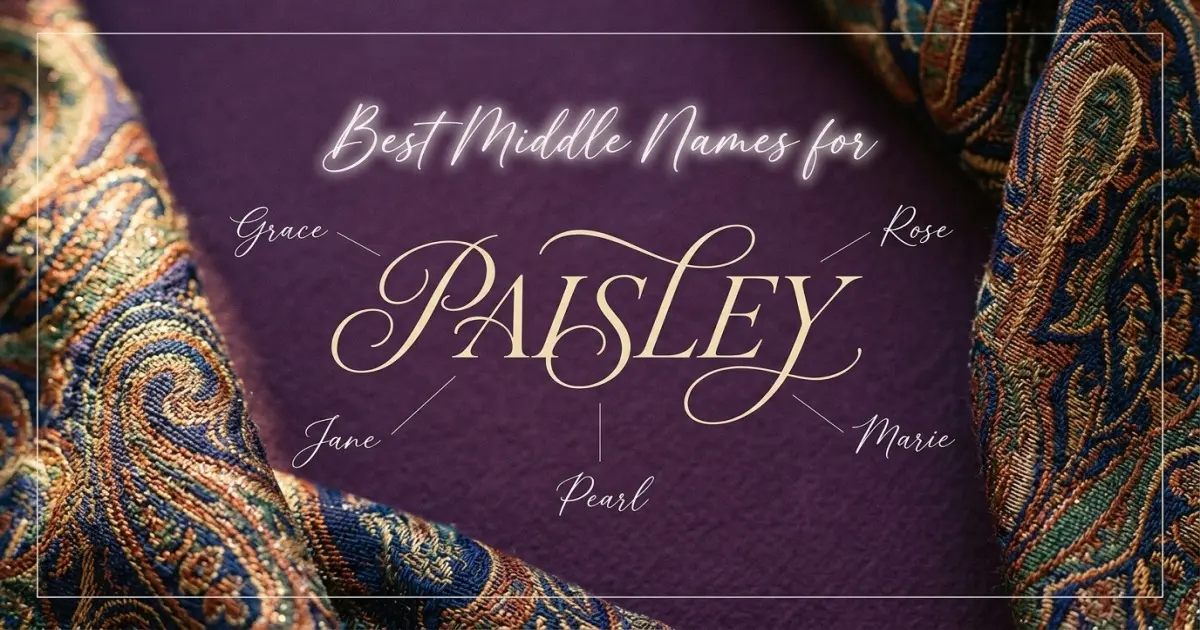
A middle name often carries the part of a child’s identity that the first name cannot safely carry alone. The first name has to walk into daylight immediately. It has to sound natural on a school roster, in a waiting room, on a team list, and in the mouth of a stranger who knows nothing about why it was chosen. The middle name gets more privacy, and that privacy makes it powerful. It can add steadiness to a bright first name, soften something sharp, honor a family line without overwhelming the child, or simply create the extra structure that makes a full name feel finished instead of fashionable.
That matters especially with Paisley. Paisley is lively, visual, and instantly contemporary in American use. It already has color in the sound. It also carries the residue of place-name and textile associations, which gives it style before the middle name even enters. That means the middle name has a clear job: it must decide whether the full combination sounds more grounded, more polished, more Southern, more literary, more modern, or more quietly classic. A weak middle leaves Paisley floating. A strong one gives it shape. The combination works best when the emotional color of the first name stays intact, which is easier to judge once you revisit Paisley meaning.
What kinds of middle names help Paisley feel styled, not flimsy
| Style | Recommended Names | Why it works with Paisley |
|---|---|---|
| Crisp one-syllable anchors | Jane, Claire, Rose, June, Mae, Ruth | These names give Paisley a clean finish and stop the full combination from sounding too airy or too decorative. |
| Soft classic balances | Louise, Elise, Noelle, Marie, Anne, Helen | They add polish and maturity without taking away Paisley’s warmth and easy friendliness. |
| Vintage and old-soul pairings | Pearl, Frances, Irene, Blythe, Maeve, Edith | These deepen Paisley’s modern brightness and make the full name feel more rooted and substantial. |
| Modern restrained middles | Quinn, Blair, Jade, Wren, Reese, Tess | A leaner middle keeps Paisley current and trims any risk of the full name sounding overly patterned or busy. |
| Heritage and faith-minded choices | Grace, Ruth, Esther, Hannah, Miriam, Anne | These add seriousness and lineage, which can be especially helpful with a first name as bright and image-rich as Paisley. |
Paisley usually needs a middle name that slows it down a little
Paisley is only two syllables, but it does not behave like a minimalist name. It has movement in the opening Pay-, a buzzing center, and a soft final -lee that makes it feel lively and socially easy. That means the middle name often has to do something very practical: slow the line down just enough that the full name sounds deliberate rather than impulsive.
Why one-syllable middles work so well with Paisley
For many families, the safest and strongest route is a one-syllable middle. Paisley Jane, Paisley Claire, Paisley Rose, and Paisley June all work because they create a pleasing contrast. Paisley provides brightness and texture. The middle provides control. That is often the exact balance a modern place-style first name needs.
One-syllable middles are particularly useful if the surname is long, double-barrelled, or soft in rhythm. In those cases, the middle name becomes the hinge between Paisley’s breezy first impression and the fuller family name that follows. Without that hinge, the full name can start to sound like one long decorative line.
When two-syllable middles help Paisley sound more polished
Two-syllable middles can absolutely work with Paisley, but they need to bring calm rather than more bounce. Paisley Louise, Paisley Elise, Paisley Noelle, and Paisley Helen all succeed because they extend the full name in a controlled way. They add polish, not clutter.
What tends to work less well are middles that repeat Paisley’s exact mood: highly playful, highly airy, or equally trend-forward names with the same kind of bright ending. The goal is not to keep the same energy going forever. The goal is to give Paisley a second step that feels intentional.
The strongest Paisley pairings come from contrast, not more pattern
Because Paisley already carries style in the sound, the middle name usually sounds best when it provides contrast. This is the most important rule to remember. Parents often hear a vivid first name and instinctively reach for another vivid name. Sometimes that works on paper. In ordinary speech, though, it often leaves the full combination sounding more curated than lived in.

Classic middles make Paisley feel more durable
If your goal is longevity, classic middles are often the smartest choice. Paisley Anne feels simple and grounded. Paisley Ruth adds seriousness. Paisley Claire is polished without becoming stiff. Paisley Grace softens the line while still giving it formal breadth. These combinations help Paisley sound like a name that can move through adulthood just as easily as childhood.
This matters because Paisley already feels youthful and bright. A classic middle broadens the full name’s age range immediately. It tells the ear that the child is not trapped inside trend or sweetness. She has a full formal identity waiting behind the sparkle.
Vintage middles give Paisley more depth
Paisley can also pair beautifully with older, more textured middles. Paisley Pearl is one of the strongest combinations in this lane because Pearl is compact, memorable, and weightier than it first appears. Paisley Frances adds literary seriousness. Paisley Irene cools the brightness and gives the name more calm. Paisley Blythe works in a different way: it keeps some lightness, but of a more refined, old-soul kind.
These pairings are especially persuasive for parents who love the modern feel of Paisley but want the full name to sound less immediately trend-led. A vintage middle deepens the shadow the name casts without changing the friendliness of Paisley itself.
Modern middles can sharpen Paisley without making it harsher
If your taste is contemporary and clean, a restrained modern middle can be an excellent fit. Paisley Quinn, Paisley Blair, Paisley Jade, and Paisley Wren all give the name a more tailored silhouette. They trim away some of the softness of the -lee ending and keep the full combination from becoming too decorative.
The caution is not to overcorrect. If the middle is too clipped and the surname is equally clipped, the full name can begin to sound abrupt rather than sharp. The best modern pairing does not fight Paisley. It edits it.
What Paisley sounds like beside a surname matters more than parents expect
Middle-name advice only becomes real when the surname enters the conversation. Paisley is especially responsive to surname rhythm because the first name already has so much style built into it. A middle that works beautifully with one family name may sound weak, crowded, or sing-song with another. Pairing is not just visual; it is rhythmic, and the next useful step is Paisley pronunciation guide.
If the surname is long, Paisley can afford a slightly softer middle
With a longer surname, parents often have more room. Paisley Elise Thompson, Paisley Louise Hernandez, or Paisley Noelle Washington can all sound polished because the surname provides a strong closing frame. In these cases, the middle does not have to do all the balancing alone.
If the surname is short, Paisley usually benefits from discipline
With a short surname, Paisley often sounds best with a crisp, controlled middle. Paisley Jane Hart, Paisley Claire Wells, or Paisley Ruth Dean all feel more complete than combinations that stay equally airy all the way through. The clean middle gives the whole name backbone.
Watch repeated sounds, initials, and ending patterns
Paisley already ends in an -lee sound, so middles that repeat the same bright ending can make the name overly sing-song. Pairings such as Paisley Lily or other similarly light, echoing choices may look charming but should be tested aloud carefully. The same goes for strong alliteration unless the family truly wants that effect.
Initials matter too. Because Paisley is short and memorable, initials can become more visible in monograms, school labels, and signatures than parents expect. A quick check on initials is part of responsible naming, not a fussy extra.
Paisley combinations that feel complete in real life
The strongest middle names are not just attractive on a shortlist. They survive ordinary speech, school paperwork, formal occasions, and the many small contexts where a child’s full name has to feel natural. Paisley needs pairings that let it stay bright while sounding fully formed.
- Paisley Jane — one of the strongest all-purpose pairings, crisp and durable.
- Paisley Claire — polished and controlled, especially good with longer surnames.
- Paisley Rose — warm and feminine, but still disciplined because of the short middle.
- Paisley June — airy, stylish, and especially effective if the surname is longer.
- Paisley Ruth — grounded and serious, ideal if the family wants more weight.
- Paisley Louise — elegant and grown, best when the surname is short enough to support it.
- Paisley Pearl — memorable, old-soul, and stronger than its softness suggests.
- Paisley Frances — literary and substantial, helpful if Paisley feels too bright on its own.
- Paisley Quinn — sleek and current, good for trimming the name’s decorative edges.
- Paisley Elise — graceful and polished without losing the first name’s energy.
What these combinations share is not one narrow aesthetic but one principle: each gives Paisley something it does not already bring in abundance. Some add crispness, some depth, some polish, some restraint. That is exactly what the middle name should do here.
What to avoid when building around Paisley
The first thing to avoid is more pattern on top of pattern. Paisley already sounds vivid and image-rich, so another equally stylized or equally buoyant middle can make the full name feel overdesigned. The second caution is ignoring surname rhythm. Because Paisley is short and bright, the wrong middle can leave the full line sounding either too airy or too crowded.
The third caution is overcompensating for the literal meaning. Paisley’s historical meaning gives the name depth, but parents do not need to choose a solemn middle to make that depth audible. In fact, the name often sounds strongest when paired with something calm and steady rather than overly symbolic. Paisley works best when the middle name provides balance, not commentary.
That is the final practical test: say the full name aloud, write down the initials, and listen for whether the line settles naturally in speech. Paisley already has brightness and individuality. The right middle does not make it louder. It makes it whole.