
Paisley Name Meaning: Meaning, Associations, and Timeless Style
Paisley is one of those names that makes modern ears trust sound before they ever ask about origin. It arrives bright, patterned, and unmistakably current. It sounds like motion, color, and ease. Yet the deeper history of the name points somewhere much older and more grounded: to a Scottish place-root and, in the controlling meaning here, to church; cemetery. That contrast is the real key to Paisley. It is a name whose social life has become lighter and more decorative than its literal beginnings, and that transformation is exactly what makes it so fascinating. Paisley shows how a name can travel from stone and place into fabric, then from fabric into modern identity.
That movement matters because it explains why Paisley feels simultaneously rooted and fashionable. Historically, naming references place it among Scottish town names and also connect it to the famous patterned fabric associated with the town. Socially, though, most contemporary listeners meet Paisley first as a girl’s name that sounds bright and easy to love. The result is a name built from surprising layers: religious and geographic in origin, visual and textile-rich in cultural memory, modern and friendly in present use. Paisley is not just a stylish surface. It is a place-name that learned how to become a pattern, and a pattern that learned how to become a person.
Paisley's U.S. popularity rank over time, 1966–2024
Popularity statistics are based on official data from the Social Security Administration baby name records.
Paisley: A Stylish and Rhythmic Scottish Choice
Paisley behaves as a name with one unmistakable center of gravity, with the girls’ side of the chart carrying nearly all of its recent visibility and momentum. Its modern strength likely reflects its standing as a “surname-style” name that fits the preference for rhythmic and distinctive sounds .
The trace visibility in other tracks behaves more like experimentation than a broad identity shift. Referring to the intricate fabric pattern or the Scottish town, its two-syllable rhythm provides a texture of stylish charm.
Paisley in one clear frame
| Key Facts | Information | Quick Insight |
|---|---|---|
| Name | Paisley | It sounds light and contemporary, but carries more historical texture than many modern place-style names. |
| Primary gender use | Female | The name reads clearly feminine in current U.S. use, even though it still has a faint surname-and-place-name flexibility. |
| Origin | Scottish | Its Scottish grounding gives it a real geographic backbone rather than a purely invented modern feel. |
| Core meaning | Church; cemetery | The meaning is more ancient and physical than the name’s stylish surface suggests, which gives Paisley unusual depth. |
| Pronunciation | PAYZ-lee | The crisp middle consonant and soft ending are a big part of why the name feels bright instead of heavy. |
| IPA | US/UK: /ˈpeɪzli/ | The same basic pronunciation across major English-speaking settings helps Paisley travel easily in daily life. |
| Syllable count | 2 | Two syllables keep the name fast and socially easy, which is one reason it feels more modern than its origins. |
| U.S. girls’ rank (2024) | No. 61 | Official data shows Paisley is firmly established, but still individualized enough to sound chosen rather than generic. |
| U.S. boys’ rank (2024) | No. 11928 | The tiny trace of male use reflects its place-name flexibility, but the name is overwhelmingly female in current practice. |

Why Paisley’s literal meaning and modern mood do not cancel each other out
The most interesting thing about Paisley may be that its literal meaning does not resemble its present emotional tone at all. “Church; cemetery” is a rooted, place-based meaning. It points to ground, memory, stone, community, and the visible architecture of belonging. It is not a decorative meaning. It is not a softness word. It does not belong to the usual contemporary naming vocabulary of sparkle, sweetness, or abstract virtues. And yet Paisley sounds airy, quick, and highly wearable in twenty-first-century American life. That gap between origin and impression is where the name gets much of its force.
Paisley shows how place meanings change in social life
Many place-derived names go through this kind of transformation. A town name or surname begins with something literal: a church, a hill, a river, a clearing, a trade, a settlement. Over time, the original meaning recedes and the sound begins to lead. That is what has happened with Paisley. The meaning remains historically real, and it matters because it gives the name depth. But in modern use, most people are hearing shape, rhythm, and style first. Paisley therefore behaves like a good contemporary name while still resting on a much older and more grounded foundation.
This matters because names with purely fashionable appeal often struggle to feel anchored. Paisley avoids that problem. It may feel modern, but it is not rootless. The controlling meaning reminds us that the name comes from place and institution, from an older geography of communal life. That lends the name a seriousness it does not have to wear on its face.
Why the sound keeps Paisley from feeling solemn
Phonetically, Paisley is quick and bright. The opening Pay- gives it lift. The voiced z in the middle adds energy. The final -lee softens the whole name and keeps it open. This is one reason the name sounds so socially fluent. If it had harsher consonants or a heavier ending, the old place-root might feel more visible. Instead, the sound turns the history into atmosphere rather than burden.
That balance is one of Paisley’s strongest assets. It lets the name carry more depth than its surface suggests without sounding heavy or overexplained. The meaning gives it roots. The sound gives it motion. Both are needed.
There is also something distinctly modern in the way Paisley manages this contrast. Current naming taste often favors names that feel lively and image-rich, but parents still like to know there is something real underneath the style. Paisley satisfies that impulse very neatly. It sounds light enough for the present and old enough to have a past.

Paisley began as a Scottish place before it became a modern girl’s name
Historically, naming guides consistently place Paisley in the category of place names. One project source groups it directly among town and place names. Another explicitly describes it as the name of a town in Scotland famous for weaving. That context matters because it tells us what kind of name Paisley is at base. It did not begin as a saint’s name, a flower, a direct virtue, or a diminutive form. It began as location. That origin shapes how the name still feels now. For parents interested in this heritage, a good next step is names from this linguistic background.
The Scottish place-root gives Paisley backbone
A place-name origin usually gives a name two kinds of strength. First, it gives it factual grounding. The name belongs somewhere. Second, it gives it a layered identity. Place names often gather trade, texture, religion, and local memory over time. Paisley does exactly that. The controlling meaning of “church; cemetery” points to the older physical and institutional root behind the place. The Scottish setting provides the human geography. Together, they make the name feel less invented and more inherited.
This is important in a contemporary naming landscape filled with surnames, words, and place-like names that sometimes sound stylish but thin. Paisley is not thin. It already comes with a locale, a history of usage, and a cultural trail extending beyond the nursery. That does not make it old-fashioned. It makes it credible.
Why the town matters even when parents are choosing the sound
Even if parents are choosing Paisley primarily because they like the sound, the town still matters. It shapes the name’s cultural aura. A name linked to a real place often feels different from a name that merely resembles one. There is a subtle confidence in that. Paisley does not need to invent atmosphere. It already has one.
At the same time, the Scottish place-name origin helps explain why the name can carry both femininity and a slight surname-like edge. Place names often retain a bit of structural neutrality even when they become female-primary. That is visible in Paisley’s current usage. The girls’ ranking is strong and clear, but the tiny trace of boys’ use suggests the name still remembers its broader place-name frame, even if that is now only a faint echo. If you are weighing names with a similar gender profile, visit girl naming ideas.
This helps make Paisley feel versatile. It is feminine in current reality, but not fragile. It has place-name backbone beneath the softness of its ending. That combination is part of the name’s appeal.
Paisley became more than a town once it became a pattern
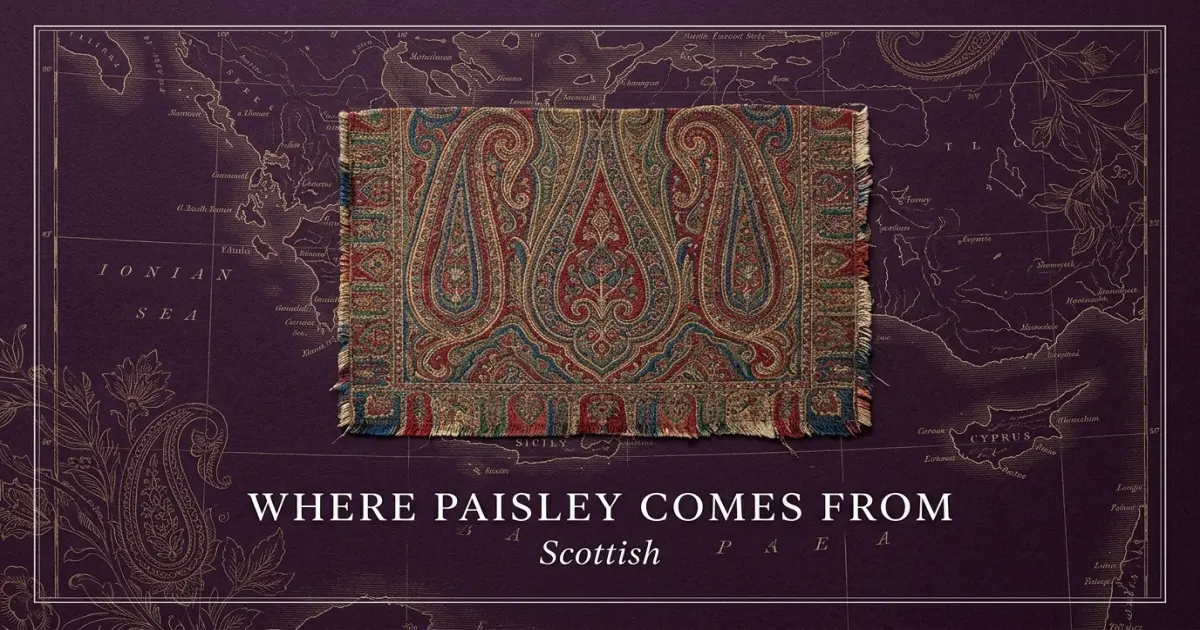
If Scottish geography gives Paisley its root, fabric gives it its cultural image. Multiple project sources connect the name not only to the town but also to the patterned fabric associated with it. That second layer is extremely important because it explains why Paisley feels so visual in modern use. Many names conjure sound first and image second. Paisley often does both at once. Even people who know very little about the Scottish town may still associate the name with the pattern: ornate curves, woven detail, movement, flourish, and design.
The pattern changed the emotional temperature of the name
This textile association is a major reason Paisley feels lighter and more decorative now than its literal place-meaning alone would predict. Fabric has a different emotional register from geography. A fabric name carries texture, color, style, and touch. Once Paisley entered that register, the name gained a visual softness that the older place-root by itself would not necessarily have provided.
That transformation helps explain why the name succeeded so strongly in the modern era. A town name can feel solid but severe. A fabric association can feel stylish but shallow. Paisley gets to have both. The history keeps it grounded. The pattern keeps it lively.
Why Paisley feels decorative without being flimsy
The fact that the pattern is not invented from nothing matters too. It comes through the town. That means even the most decorative association in the name still loops back to real place and real history. The decorative layer is not pure ornament. It is historical ornament. That distinction is subtle, but it gives the name more credibility than many trend-led names built from surface appeal alone.
This is where Paisley becomes more than just another stylish modern girl’s name. It operates at the intersection of geography and design. It belongs to place, but it also belongs to visual culture. That dual identity is unusual and useful. It helps the name feel grounded and expressive at once.
In practical terms, parents often respond to this without articulating it directly. They hear a name that sounds bright. They see a name that looks textured. They may know it is a place. They may vaguely connect it to pattern. All of those impressions gather into one thing: a name that feels lively, visual, and rooted enough not to drift away.
Paisley in current use: bright, feminine, and still a little textured around the edges
Official Social Security Administration (SSA) data places Paisley at No. 61 for girls in the United States in 2024. That rank says something very useful about the name’s social position. Paisley is not experimental or fringe. It is firmly established. Most people will know it, know how to say it, and recognize its general style. But it is also not so overused that it has gone flat. It still sounds like a deliberate choice with flavor.
That is part of why the name remains strong. Paisley sits in a particularly appealing modern category: names that feel familiar and youthful but still distinct in shape. It lives near names like Hadley, Kinsley, Haisley, Presley, and other contemporary American names with bright openings and soft endings. But Paisley differs from many of them because it has more obvious historical layering. It is not just a sound pattern. It is a sound pattern with a place and a pattern behind it.
Socially, the name tends to project brightness, style, and ease. It sounds a little more playful than the plainer classics and a little more grounded than the most purely invented trend forms. That is a very useful middle ground. Paisley can feel at home in a modern suburban classroom, in a more style-conscious urban setting, or in a family that likes names with a little visible texture and regional flavor.
The very low boys’ rank strengthens the same point. Paisley is overwhelmingly a girls’ name in the present moment, but the faint male trace reminds us that it still comes from a broader category of place and surname usage. That residual flexibility gives the name a tiny bit of backbone. It does not read as delicate in the way some decorative-sounding names do. It still carries a little structure underneath the softness.

Where Paisley opens into the rest of a child’s identity
Middle names that steady or refine Paisley
Because Paisley is bright and visually rich, the middle name often determines whether the full combination feels more polished, more grounded, or more playful. A crisp classic can give it discipline. A softer middle can deepen the textile warmth already inside the name. If you want the full pairing logic behind that contrast, see Paisley middle names.
Nicknames that make Paisley more intimate
Paisley is already socially easy, but that does not close off nickname life. In practice, a name like this often develops smaller forms that are less about necessity and more about closeness, family rhythm, and affection. To see how those different moods shorten in real life, explore Paisley nicknames.
Pronunciation that keeps Paisley bright instead of busy
PAYZ-lee is a strong, highly legible pronunciation, and the stable IPA reflects that clarity. The sound is part of the name’s success: easy enough for daily life, lively enough to feel memorable. For the detailed stress pattern, accent notes, and IPA, see Paisley pronunciation guide.
Why Paisley still sounds like Paisley
The most successful names are often the ones that carry more than one kind of memory at once. Paisley does that unusually well. It remembers place. It remembers pattern. It remembers the older religious and burial-ground meaning in its roots, even while sounding airy and fully modern on the surface. It is a name with stone underneath and fabric on top.
That layered identity is exactly why Paisley works. Without the history, it might feel too decorative. Without the sound, it might feel too literal. Without the pattern, it might feel like just another place-name. Instead, it becomes something more interesting: a Scottish name whose literal roots are older and graver than its present brightness, and whose modern life has turned those roots into texture rather than burden. In a naming culture crowded with pretty sounds and thin backstories, Paisley offers a rarer combination. It feels stylish, yes, but it also feels sourced. And that is why Paisley, even now, still sounds like more than a trend.