
How to Pronounce Ollie: Syllables, Stress, and Common Mistakes
The most revealing place to test a name’s pronunciation is not a dictionary page but a real room. Picture a teacher on the first morning of school, moving through a roster at normal speed, with no time for ceremony and no patience for puzzle names. Ollie is the kind of name that usually survives that moment beautifully. The mouth knows what to do almost at once. The stress arrives early, the sound opens cleanly, and the ending lands softly. In everyday life, that matters more than phonetic theory. A name that can be read aloud correctly on the first try carries a certain social ease with it.
That ease is one of Ollie’s quiet strengths. Although the name comes from a much older family of olive-root names, its spoken form feels modern, compact, and highly usable. It does not depend on unusual stress, hidden letters, or imported sound rules. At the same time, it is not completely flat. The American and British versions do shift slightly in vowel quality, and that small difference explains why some parents hear the name as brighter in one accent and rounder in another. So the story of Ollie’s pronunciation is not whether it is difficult. It is why something so simple sounds so friendly, and why its simplicity holds up so well across real English speech.
How Ollie is actually said in real English speech
| Element | Phonetic Detail | Quick Tip |
|---|---|---|
| Common spoken guide | OL-ee | Say it in two quick parts, with the first part carrying the full stress. |
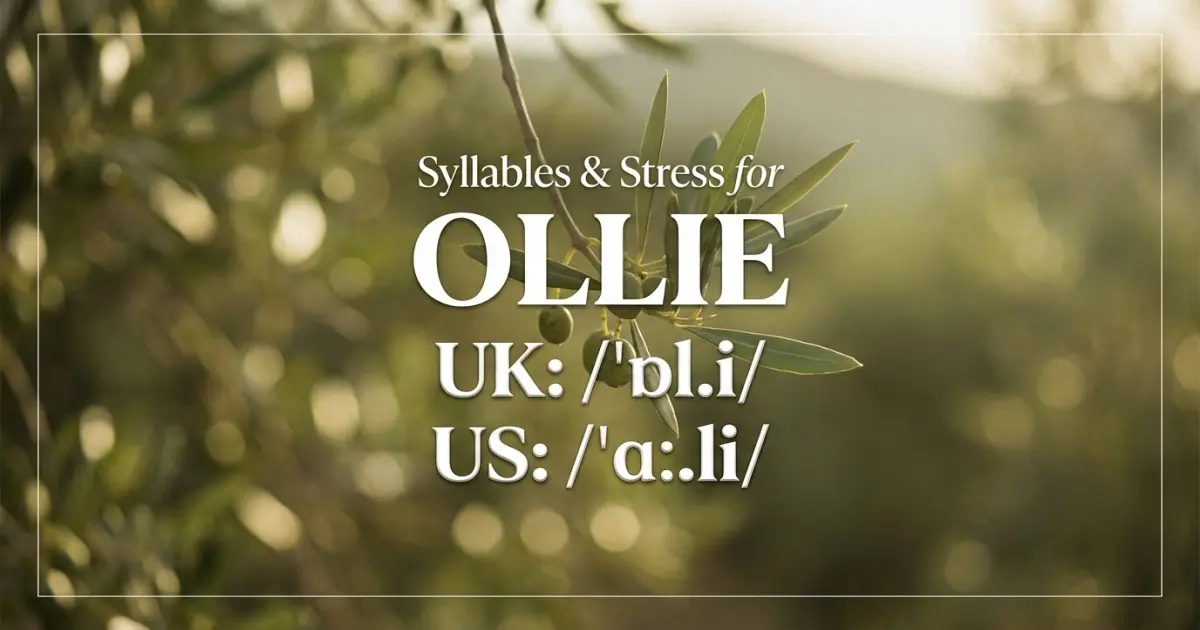
| US IPA | /ˈɑːli/ | In American speech, the first syllable often sounds broad, close to “ahl.” |
| UK IPA | /ˈɒli/ | In British speech, the opening vowel is usually shorter and rounder. |
| Syllable count | 2 syllables | Keep both syllables light and quick; this name should not feel drawn out. |
| Stress pattern | First syllable stressed | The name should begin with emphasis, then soften on the second syllable. |
| Final sound | Ending in a clear “ee” | Do not clip the last syllable too sharply; let it finish cleanly. |
Ollie works because the stress lands before the name can wobble
Two syllables, one clear center of gravity
Ollie is a two-syllable name, and nearly all of its clarity comes from the fact that the stress is fixed on the first syllable. That early stress does an enormous amount of work. It tells the listener where the name begins, shapes the rhythm immediately, and keeps the second syllable from feeling vague. In practical terms, this means the name does not drift. You hear the identity of it right away. Pronunciation lands more fully when the name’s roots and history are already in view, so begin with Ollie meaning.
The simplified guide OL-ee captures this well, even though everyday accents may color the first vowel differently. The key is not to overread the spelling guide. Its purpose is to show the rhythm: strong first beat, soft second beat. That is why Ollie sounds so natural in spoken English. It follows a familiar stress pattern that English speakers handle comfortably in ordinary conversation.
The name also benefits from clean internal architecture. The l is a liquid consonant, which means it flows rather than scrapes. There is no fricative hiss, no harsh stop in the middle, and no final consonant cluster to complicate the landing. Instead, the sound moves from an open vowel into a smooth liquid and then resolves into a bright ee. That sequence makes the name feel warm and socially easy, even before anyone thinks about meaning or style.
Why Ollie sounds friendly instead of formal
Part of Ollie’s friendliness comes from how quickly it opens. Long names can sound stately because they make the speaker travel. Ollie does not travel very far. It gets in, identifies itself, and softens at the end. That softness matters. The final ee sound is common in affectionate and familiar English naming patterns, which helps explain why Ollie feels intimate even when it is used as a full legal name.
That does not make it childish. It makes it conversational. A name can be easy without being flimsy, and Ollie is a good example of that balance.
Ollie in American and British mouths sounds slightly different, but never confusing
The American version: broader and more open
In the United States, the IPA form /ˈɑːli/ points to a broader opening vowel. Many speakers will produce something close to “AHL-ee,” even if they still describe it informally as OL-ee. This is normal. Simplified pronunciation guides are often designed for quick readability, while IPA is designed for accuracy. In real American speech, the first syllable may open wider than the spelling guide seems to suggest.
That broader vowel gives Ollie a slightly warmer, more open sound. It is one reason the name often feels relaxed and sunny in American English. The first syllable breathes a little more, and the second syllable follows lightly behind it.
The British version: rounder and a touch shorter
In the United Kingdom, /ˈɒli/ usually produces a rounder, shorter opening sound. The result is still unmistakably Ollie, but the vowel sits differently in the mouth. British speakers may sound a little more compact on the first syllable, which can make the name feel crisper overall.
This difference is small enough that it rarely causes misunderstanding. It is not the kind of accent variation that changes identity. It simply changes color. Parents sometimes worry about pronunciation when names travel across borders, but Ollie is one of those names that stays recognizably itself even when the vowel shading shifts.
Why the accent change does not create a naming problem
Some names become unstable across accents because their stress moves, their vowels collapse, or one variety of English pushes them toward an entirely different sound. Ollie avoids that. The stress stays on the first syllable. The liquid l remains central. The final ee remains clear. That consistency is what makes the name travel so well. An American child named Ollie and a British child named Ollie may not sound identical, but they still sound immediately comparable.
Where people can get Ollie slightly wrong
The most common mistake is overthinking it
Because Ollie looks familiar, most people pronounce it correctly on the first try. When mistakes do happen, they often come from hesitation rather than ignorance. A speaker sees the written form and briefly wonders whether it should be stretched, stylized, or linked too strongly to another name in the same family. That is how pronunciations that feel too formal or too invented can appear.
One small risk is pushing the first syllable toward something more like “oh” than the actual spoken pattern supports. Another is making the second syllable too heavy, as though the name needed a dramatic finish. Neither version sounds natural. Ollie should feel quick and settled, not theatrical.
Why Ollie is not Oliver, Olive, or Olly with a mystery twist
Ollie belongs to the broader olive-name family, but it should not be pronounced as if it were merely a fragment cut out of a longer formal name and left unfinished. Oliver has its own three-syllable rhythm. Olive has a different ending and a different stop point. Ollie should keep its two-syllable integrity. It is not a partial sound. It is a complete spoken unit.
Spelling variants can also invite slight confusion. A form like Olly may look similar enough to be pronounced the same, but the doubled consonant and the final vowel pattern in Ollie strongly cue the familiar two-beat English reading. That is one reason the standard form feels easy for most readers.
Ollie becomes even easier once you practice it in full phrases
Sound neighbors that teach the mouth the right movement
If someone wants a quick way to lock in the pronunciation, the best method is to compare Ollie to nearby English sound patterns rather than overstudying symbols. The ending works much like the ending in familiar names with a bright ee finish. The middle liquid consonant keeps the name from sounding clipped or sharp. Once a speaker hears that combination of open beginning, smooth center, and light ending, the name tends to stay fixed. Once the sound pattern is clear, some shortenings stop feeling optional and start feeling natural, and the clearest map is in Ollie nicknames.
It can also help to think of Ollie as a name that should never feel labored. If you say it and feel as though you are pausing, dragging, or reshaping the vowels too carefully, you are probably making it harder than ordinary speech requires.
Practice lines that make Ollie feel natural
The best practice lines are simple and social, because that is where the name lives most naturally. Try saying these aloud at everyday speed:
- “Ollie, dinner’s ready.”
- “Have you met Ollie yet?”
- “Ollie is on the class list.”
- “We’re waiting for Ollie at the gate.”
- “Ollie said he’ll be there soon.”
If the name moves cleanly through those lines without snagging, the pronunciation is probably sitting in the right place. That is a useful test because names are not usually spoken in isolation. They are spoken in motion, inside sentences, with ordinary breath and ordinary feeling.
And that is ultimately why Ollie performs so well. Its pronunciation is not memorable because it is difficult. It is memorable because it disappears into speech in the right way. The name arrives clearly, stays warm, and leaves almost no friction behind it.
Common Questions About Pronouncing Ollie
Is Ollie easy for most people to pronounce on sight?
Yes. Ollie is one of those names that most English speakers can read correctly the first time because the stress pattern and ending feel familiar.
Why does Ollie sometimes sound slightly different in the US and the UK?
The main difference is the opening vowel. American speech often uses a broader first sound, while British speech tends to keep it shorter and rounder. The name itself remains the same.
Should Ollie be said more like “AHL-ee” or “OL-ee”?
Both guides are trying to point toward the same basic rhythm: strong first syllable, soft second syllable. In practice, the exact vowel color depends on accent, while the stress pattern stays stable.
Is Ollie likely to be misheard or missaid often?
Usually not. Its short length, clear stress, and familiar ending make it a low-friction name in classrooms, introductions, and everyday conversation.