
Ollie Name Meaning: Origin, Character, and Quiet Strength
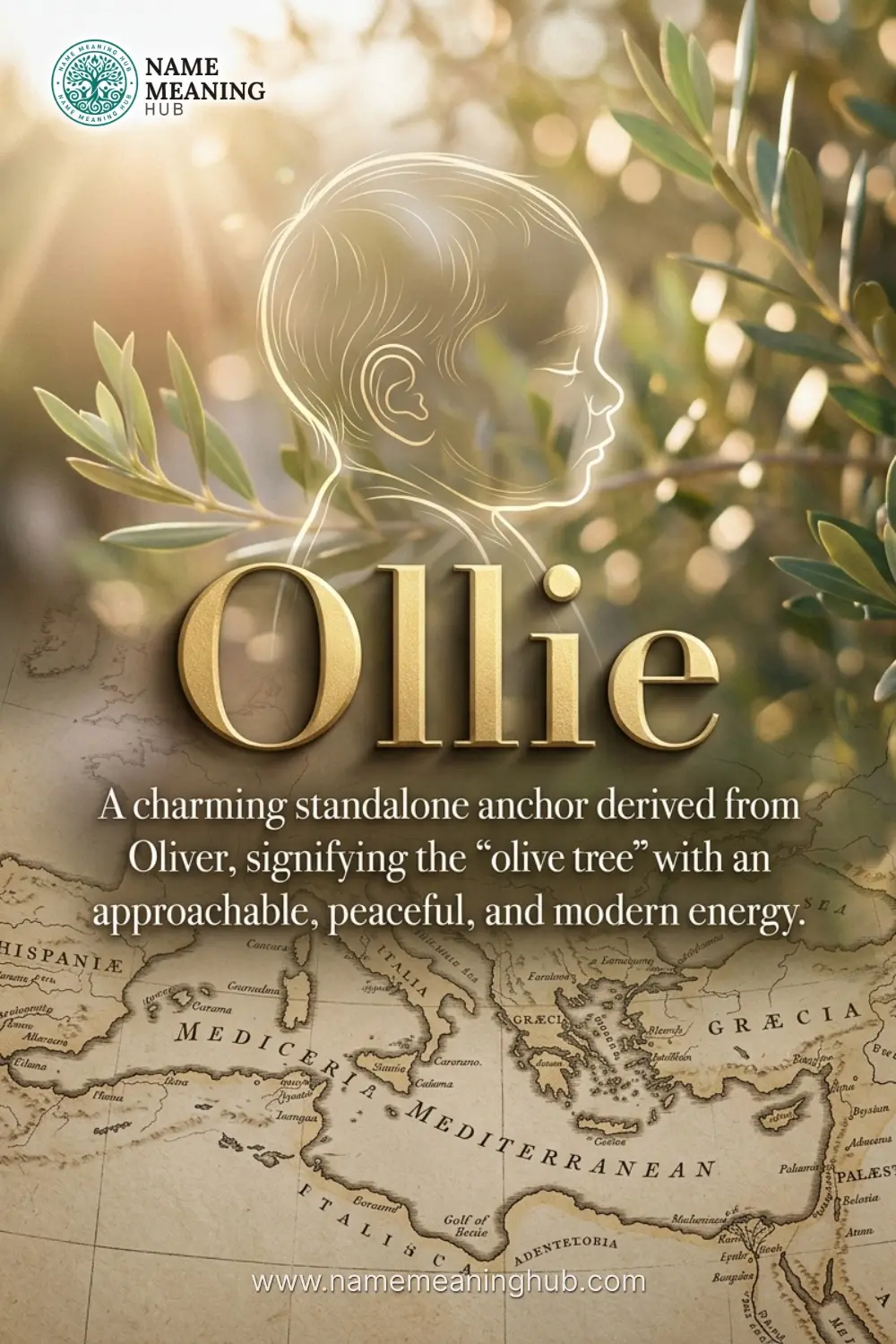
Ollie looks, at first glance, like the kind of name modern parents invent when they want something lighter than a formal classic. It is brief, quick to say, impossible to overdecorate, and so familiar in sound that it seems to arrive already smiling. But that first impression is only half the story. Underneath the bright, compact surface sits one of the oldest images in the naming tradition of the West: the olive tree. That is what gives Ollie its unusual tension. It sounds like a nickname caught in motion, yet its root image is ancient, cultivated, and durable.
That compression is what makes the name interesting. Ollie takes a long historical inheritance and folds it into two easy syllables. It belongs to the same broad family as Oliver, Olive, and Olivia, but it does not feel borrowed from them in a helpless way. Instead, it feels like the modern endpoint of a much older naming habit: a formal name softens in speech, gains emotional reality in family life, and eventually becomes strong enough to stand on its own. Ollie is that process made visible. It carries the rootedness of the olive tree without sounding solemn, and it carries the friendliness of a diminutive without sounding disposable.
Ollie's U.S. popularity rank over time, 1880–2024
Popularity statistics are based on official data from the Social Security Administration baby name records.
Ollie: A Diminutive with Growing Standalone Charm
Ollie reads as a name with one home base plus a smaller second track, maintaining a steady and clear identity on the boys’ side of the chart. Its growing charm as a standalone choice often reflects a naming-culture preference for “nickname-style” favorites that feel both classic and friendly .
While the girls’ lane shows meaningful continuity, the name’s primary visibility remains anchored in its Latin roots. Meaning “olive tree,” its two-syllable, soft ending helps the name travel well while remaining a distinctive alternative to its parent name, Oliver.
Ollie in one clear frame
| Key Facts | Information | Quick Insight |
|---|---|---|
| Name | Ollie | The doubled consonant and -ie ending make it feel affectionate at first hearing, which is part of its modern appeal. |
| Primary usage | Male | It can cross gender lines in theory, but current usage reads more clearly masculine in everyday American naming. |
| Origin family | Latin | Its deeper lineage places it inside the olive-name tradition rather than among invented modern short forms. |
| Core meaning | Olive tree | This is a concrete image, not an abstract virtue, which gives the name texture and a sense of lived history. |
| Pronunciation | OL-ee | The stress falls immediately, so the name lands with clarity and warmth rather than formality. |
| IPA | US: /ˈɑːli/ | UK: /ˈɒli/ | The vowel shifts slightly by accent, but the structure stays stable, making the name easy across English-speaking settings. |
| Syllable count | 2 | Two syllables help Ollie feel agile and conversational, with none of the weight that longer classics sometimes carry. |
| U.S. boys’ rank (2024) | No. 1044 | It is recognizable without being overexposed, which often appeals to parents who want familiarity without saturation. |
| U.S. girls’ rank (2024) | No. 2256 | The name is not locked shut to girls, but current data shows that its center of gravity is clearly with boys. |
Ollie and the old steadiness inside the olive tree
The strongest thing about Ollie is that its meaning is tangible. Some names come wrapped in ideals such as strength, joy, or wisdom. Ollie comes with an object you can picture: a tree, a landscape, a cultivated world. That matters more than it may seem. Names attached to real things tend to feel less rhetorical and more inhabitable. A child can grow into them without having to perform them. Ollie does not ask a boy to sound heroic, noble, or grand. It offers something quieter: growth, rootedness, and a sense of continuity.
Because the image is a tree rather than a flower or a jewel, the name also avoids fragility. It belongs to that category of nature-linked names that feel sturdy instead of ornamental. Modern naming culture has made plenty of room for botanical and landscape names, but not all of them travel equally well across age and context. Ollie benefits from being attached to a tree-image while also being filtered through an established human naming tradition. That means it can borrow the solidity of a nature name without sounding overtly rustic or overtly poetic.
There is also an important difference between meaning and mood. The meaning says olive tree; the mood says ease. Put those together, and the name acquires its unusual balance. It sounds sociable, but its root is serious. It feels contemporary, but its underlying image is old enough to have survived languages, religions, and literary fashions. That combination is a large part of why Ollie does not collapse into cuteness, even though it clearly has a playful surface. The name has enough depth beneath its friendliness to keep from floating away.
How Ollie stepped out of the shadow of Oliver
When short forms stop feeling temporary
Historically, Ollie makes the most sense as part of a broader pattern. Many short forms begin as household speech: affectionate, practical, intimate. They live first in kitchens, schoolyards, and family letters before they appear on formal records. Over time, some of them detach from the longer form that once justified them. English-speaking naming has done this repeatedly. Familiar, speech-sized names become full legal identities because people stop hearing them as abbreviations and start hearing them as complete social selves.
That is exactly where Ollie now lives. It may still call Oliver or Olive to mind, but it no longer depends on either one for legitimacy. It has the self-contained feel of other short names that have long since crossed that threshold. The sound is finished. The spelling is settled. The emotional signal is clear. Parents who choose Ollie are usually not choosing a placeholder while secretly meaning Oliver. They are choosing the shorter form because the shorter form says what they want more exactly: approachable, bright, and unforced.
This matters for style. A shortened name can fail when it still sounds like a fragment left over from a fuller identity. Ollie does not have that problem. The repeated l gives it visual body, and the closing -ie gives it tonal softness, but the name still feels complete in the mouth. It begins firmly, ends cleanly, and does not need explanation. That is why it can stand on a birth certificate without apology.
The literary road that made the broader family familiar
Ollie also benefits from the long familiarity of the wider Oliv- family in English-speaking culture. The family does not arrive as a stranger. Olivia has strong literary memory, especially through Shakespeare, and Oliver has an even broader public life through literature and ordinary naming history. By the time Ollie appears, the ground has already been prepared. People know the sound cluster. They trust its shape. They do not hear it as invented noise.
That background matters because cultural familiarity is often what allows a shorter form to thrive. A name like Ollie can sound fresh only because its deeper family has been present long enough to make the freshness feel safe. It has inherited the recognizability of Oliver and Olivia while shedding some of their formality. In practical terms, that means Ollie feels modern without feeling unstable. It belongs to a lineage that has already passed through literature, public life, and ordinary domestic use.
There is another advantage here. Oliver can sometimes feel more polished, more bookish, even a little more traditional than a parent wants. Olive can feel lovely but more explicitly botanical and, in American use, distinctly feminine. Ollie moves differently. It keeps the olive-root meaning but changes the temperature of the name. What was once stately becomes nimble. What was once literary becomes conversational. What was once formal becomes immediate.
Why Ollie sounds easy before it sounds serious
The phonetic trick hidden in two syllables
Some names announce themselves with weight. Ollie does the opposite. It reaches the stressed syllable at once, opens broadly, and then softens. The result is an unusually friendly sound shape. There is no difficult consonant cluster, no trailing formality, no syllabic drag. It is the sort of name most children can say early and most adults can remember after hearing once. That ease is not trivial. Ease is one of the hidden engines of name durability.
The first syllable does most of the work. It is round, open, and direct. The second syllable releases the name gently rather than ending it sharply. This gives Ollie a social quality that many parents notice even if they would not describe it in phonetic terms: the name sounds welcoming. It does not have to be performed. It does not ask for distance. It introduces itself almost before the speaker has finished saying it.
That friendliness is reinforced by the -ie ending, which English speakers often associate with intimacy, familiarity, and warmth. Yet Ollie avoids becoming flimsy because the opening is solid enough to carry the softness. The name is not airy in the way some contemporary vowel-heavy names can be. It still has structure. That is why it can feel cheerful without sounding unserious.
Why friendliness is not the same as flimsiness
Parents often worry about names that sound very young. The concern is not childishness itself, but longevity. Will the name age? Will it still work in a classroom, on a résumé, in a professional setting, in a difficult conversation? Ollie handles that test better than many names in its tonal register because its friendliness sits on top of a rooted meaning and a familiar naming lineage. It has softness, but it also has provenance.
In style terms, Ollie sits near names such as Archie, Alfie, Teddy, and Louie, but it has a slightly different flavor from each. It is less vintage-aristocratic than Archie, less nursery-retro than Teddy, less courtly than Louie, and less overtly old-world than Alfie. Ollie feels plainer in the best sense of the word: cleaner, greener, more adaptable. It can fit a child who is energetic and sociable, but it can also fit a child who is thoughtful, dryly funny, or reserved. The name does not force a persona as aggressively as trendier short forms often do.
That flexibility is part of its strength. Some names tell the world too much, too early. Ollie leaves room. It suggests warmth and approachability, but it does not box the child into a single social script. For parents who want a name with charm but not theatricality, that can be the deciding factor.
Ollie in the modern nursery: visible, but not overrun
Official Social Security Administration (SSA) data places Ollie at No. 1044 for boys in the United States in 2024, with a much rarer No. 2,256 showing for girls that same year. Those numbers tell an important story. Ollie is not obscure, but it is not carrying the burden of overfamiliarity either. Most people will know how to hear it, spell it, and place it. At the same time, it is unlikely to feel like one of the dominant names of its generation.
For many parents, that is the sweet spot. A name too high on the charts can feel overdistributed before a child has had a chance to make it his own. A name too far outside common usage can create friction every time it is introduced. Ollie avoids both extremes. It has enough public life to seem established and enough distance from the top of the charts to keep its individuality.
The male lean is also clear. While the name is not impossible for girls, the current American pattern makes it read much more naturally as a boys’ name. That clarity can be useful for parents who want softness of sound without ambiguity of primary usage. In other words, Ollie gives access to tenderness in tone while still reading as firmly masculine in present-day context. To compare tone, familiarity, and fit across similar names, explore classic and modern boy names.
Where Ollie opens outward
Middle names that can steady Ollie
Because Ollie is short and tonally warm, it often benefits from a middle name with a little more weight or reach. The best partners usually bring contrast: a longer classic, a crisp one-syllable anchor, or a name with a straighter consonant profile. That contrast prevents the full name from feeling overly soft and gives parents room to shift the overall style slightly more traditional, more modern, or more literary. If you want the full pairing logic behind that contrast, see Ollie middle names.
Nicknames that Ollie barely needs but can still carry
One quiet advantage of Ollie is that it already behaves like a nickname while functioning as a full name. That means parents are not forced into another layer of shortening. Some families will leave it untouched, which suits the name perfectly. Others may use affectionate variants in private, but the larger point is that Ollie arrives already intimate, already social, and already usable in daily life. To see how those different moods shorten in real life, explore nicknames for Ollie.
Pronunciation questions that disappear once you hear Ollie aloud
Ollie is one of those names that looks exactly like it sounds. The American and British vowels differ slightly, but the stress pattern is stable and the spoken form is easy to catch. That makes it a low-friction choice across classrooms, family circles, and public introductions. The pronunciation page, if explored further, is less about solving confusion than about appreciating how efficiently the name works. If you want the full sound pattern behind that rhythm, read how to pronounce Ollie.
What Ollie finally offers
In the end, Ollie succeeds because it manages a difficult double task. It sounds light without being flimsy, and it carries history without sounding burdened by history. The olive tree beneath it gives the name memory, age, and rootedness. The short spoken form gives it speed, warmth, and present tense life. Few names hold those qualities together as naturally as this one does.
That is why Ollie lingers. Not because it is loud, rare, or elaborate, but because it solves a modern naming problem with unusual grace. It gives parents a boy’s name that is gentle without being weak, familiar without being tired, and meaningful without sounding overly symbolic. It is the old world cut down to size for contemporary life, still carrying its roots, still recognizably human, and still easy to love when spoken aloud. Ollie does not merely sound friendly. It sounds lived in, as though it has already crossed generations and arrived ready for another. For more names connected to this tradition, see names with Latin roots.
What Parents Ask About the Meaning of Ollie
Does Ollie age well beyond childhood?
Yes, more than some parents expect. Its surface is playful, but its deeper lineage and concrete meaning give it enough substance to move into adult life. The name feels easy on a child, but it does not depend on childishness to work.
Is Ollie too much of a nickname for the birth certificate?
Not anymore. In current naming culture, Ollie reads as a complete given name rather than a casual placeholder. It still carries echoes of Oliver or Olive, but it no longer requires either one in order to feel legitimate.
Will Ollie be hard to pair with a surname?
Usually it pairs easily because it is short, clear, and rhythmically simple. It works especially well with surnames that add a little structure or gravity, though parents should still say the full name aloud to check pace, repetition, and initials.
Is Ollie likely to be confused or misspelled?
The risk is low. The pronunciation is intuitive, and the spelling is familiar to most English speakers. Occasional variation with forms like Olly may appear, but the standard written form is straightforward enough that correction should be minimal.