
Nicknames for Ollie: Cute, Cool, and Natural Ideas
Nicknames are rarely just shorter versions of a name. More often, they are social signals: evidence of who gets to be close, who gets to tease, who gets to soften the edges, and who knows the child well enough to reshape the sound. A formal name may carry status or heritage, but a nickname usually carries relationship. It is what happens when a name enters daily life and starts picking up fingerprints. That is why nickname culture can reveal more about a name’s real personality than its dictionary meaning ever could.
Ollie is especially interesting on this front because it already sounds like a nickname before anyone touches it. It is compact, friendly, and emotionally open. That means the nickname story around Ollie is not about necessity. No one needs to shorten it to make it usable. Instead, the secondary nicknames that grow from Ollie tend to signal mood, age, and setting. Some are quick and sporty. Some are soft and domestic. Some are playful inventions that would only make sense inside one household. In other words, Ollie does not generate a huge nickname tree. It generates a believable one. A playful nickname can tilt the mood in interesting ways, but the base note of the name comes from Ollie meaning.
What Ollie’s nickname landscape really reveals
| Group | Suggested Nicknames | Persona | Use Context |
|---|---|---|---|
| Default everyday form | Ollie | Warm, approachable, easygoing | School, introductions, family life, most formal everyday use |
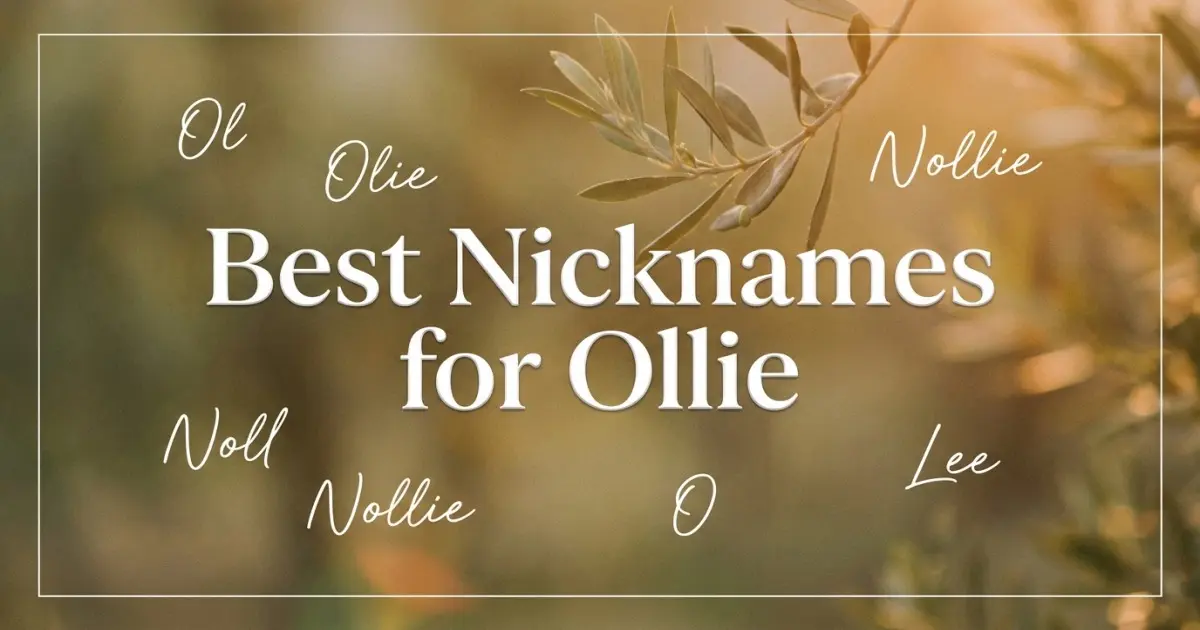
| Short clipped forms | Ol, O, Olls | Casual, sporty, quick-moving | Friends, siblings, teammates, text threads, joking address |
| Playful buddy forms | Ollie-O, O-Man, O | Comic, affectionate, socially confident | Home, close friends, childhood play, informal family banter |
| Soft pet-name extensions | Ollie Bear, Ollie Bug, Ollie Boy | Tender, protective, very close | Parents, grandparents, early childhood, bedtime or comfort moments |
| Ending-based variants | Lee | Low-key, private, lightly individual | Used occasionally by family or one close friend rather than by everyone |
How Ollie behaves like a nickname before anyone shortens it
Why the name starts intimate
Some names need years of use before they sound warm. Ollie begins warm. Its two-syllable structure, the rounded opening, and the familiar -ie ending all make it feel immediately close to the ear. That is one reason it has such broad appeal. It sounds social without sounding flimsy. But that same quality also changes the nickname logic. A longer formal name like Alexander or Theodore invites shortening because the full version carries more ceremony than daily life usually needs. Ollie does not have that problem. It already arrives at the size of everyday speech.
That means families choosing Ollie should not expect a long menu of natural spin-offs. The nickname pool is narrower than it would be for Oliver, because the name is already doing the emotional work of a short form. The good news is that this makes the nickname culture around Ollie feel more authentic. Any second-layer nickname that appears usually comes from genuine use rather than from a forced attempt to engineer variety.
Why secondary nicknames become social rather than structural
With Ollie, the next nickname is usually not a linguistic necessity. It is a social gesture. A sibling may say O because that is fast and funny. A parent may say Ollie Bear because comfort language naturally expands affectionate names rather than shrinking them. A group of friends may land on Olls because it sounds loose and familiar. In every case, the nickname says something about the relationship and the setting.
That is a strength, not a limitation. It means the child is unlikely to be trapped in a name with too many competing identity versions. Ollie will still be Ollie almost everywhere, which creates continuity. The nicknames around it act more like weather than geography: they shift the mood without changing the map.
Ollie’s opening sound is where the quickest nicknames live
Why “Ol” and “O” work at all
The opening of Ollie carries most of the recognizability, so it is the first place people trim. That is how Ol and O arise. These forms are not elegant in a formal sense, but that is not their job. They function as speed-language. A sibling shouting across a room, a friend reacting in a text thread, or a teammate greeting him with exaggerated ease is more likely to clip the name down to its first audible unit than invent something elaborate. Many short forms only become obvious once the opening sound is clear, which is why how to pronounce Ollie belongs naturally here.
O in particular has the feel of modern casual address. It is brief, a little stylized, and almost always dependent on tone. Spoken warmly, it feels affectionate. Spoken performatively, it can feel funny or mildly swaggering. That makes it plausible, but not universal. It is the kind of nickname more likely to come from peers than from grandparents.
Why clipped forms suit the outside world
The opening-based nicknames are the ones most likely to survive outside the home. Ol and O have the right bluntness for school corridors, sports practice, and friendships built on speed rather than sentiment. They are not deeply personal; they are socially efficient. That makes them useful once a child gets older and begins moving through peer groups where shorter, sharper address forms often emerge naturally.
Still, these are not guaranteed lifelong forms. Because Ollie is already short, many people will simply stop at Ollie. The clipped versions are best understood as side routes, not replacements.
The middle of Ollie creates the most natural buddy-style variations
Why “Olls” sounds plausible
The doubled ll in Ollie gives the name a soft center, and that softness is exactly what allows a form like Olls to work. This is the most believable secondary nickname for Ollie because it sounds like something friends would arrive at casually rather than invent ceremonially. It has a slightly sporty, slightly laddish quality, but in a relaxed rather than aggressive way. It feels like a nickname given by familiarity, not performance.
Olls works especially well because it preserves the recognizable heart of the name while changing the texture. Ollie is rounded and friendly. Olls is a little brisker and more peer-facing. That shift is exactly what many real-life nicknames do: they keep identity intact while changing social temperature.
Why “Ollie-O” belongs to play, not paperwork
Another natural development from the middle and full rhythm of the name is Ollie-O. This kind of nickname is playful rather than permanent. It has bounce, rhyme, and a slightly performative feel, which makes it perfect for childhood banter, family joking, or a friend group that enjoys sing-song address. What it does not have is neutrality. It is too stylized to become the everyday public default for most people.
That distinction matters. Good nickname advice is not just about what can be formed from a name. It is about where each form realistically belongs. Ollie-O is believable because it sounds like something that would arise spontaneously in speech. It is not the kind of nickname a person would likely choose for himself in every setting.
The ending of Ollie is where tenderness usually gets added
Why the “-ie” ending invites affection instead of more shortening
The end of Ollie already carries affection. In English, -ie endings often signal familiarity, softness, and emotional access. Because that work is already being done, the ending does not usually produce lots of clever new nicknames. Instead, it attracts additions. Parents and grandparents are more likely to build onto Ollie than cut it down. That is where forms such as Ollie Bear, Ollie Bug, and Ollie Boy come from.
These are not public identities. They are tenderness markers. They belong to bedtime, reassurance, amusement, and very close family routines. They may last for years or disappear quickly, but while they exist, they often become some of the most emotionally meaningful forms of the name.
When “Lee” works and when it does not
The only truly ending-based short form with some plausibility is Lee. Even then, it is likely to be private and occasional rather than dominant. It works best when used by one specific person, almost as a personal code rather than a socially shared nickname. Because Lee is also a separate, established name, it can feel a little detached from Ollie if overused. That is why it rarely becomes the primary nickname lane.
Used lightly, though, it can sound gentle and understated. This makes it one of those nicknames that may matter more inside a family than outside it.
When Ollie gets older, the nickname logic changes
Early childhood tends to expand the name
In the earliest years, Ollie usually attracts additions rather than reductions. Adults instinctively lengthen affectionate names when speaking to babies and toddlers, so forms like Ollie Bear or Ollie Boy feel natural. The child is small, the voice around him is soft, and the nickname becomes part of caretaking language.
School age tends to keep the default
Once school begins, most children named Ollie will likely remain just Ollie. The name is already short, already memorable, and already easy for teachers and friends. This is the age when names often settle, and Ollie settles quickly because it does not need translation.
Teen and adult life usually favors clipped or joking forms
As peer culture becomes more influential, the likely nickname activity shifts toward O, Ol, or Olls. These forms suit faster, less sentimental environments. They can sound athletic, ironic, or casually loyal depending on who says them. But even then, most adults named Ollie would probably still introduce themselves as Ollie. The secondary nicknames live at the edges of identity, not at the center.
The best nicknames for Ollie sound discovered, not engineered
That is the real lesson of Ollie. Because the name already functions as a socially complete short form, its best nicknames are the ones that emerge naturally from real use. The strongest options are not exotic. They are believable: O, Ol, Olls, the occasional Lee, and a handful of affectionate family extensions that belong to private life. Anything more elaborate risks sounding like a parent trying to force a second act onto a name that has already arrived finished.
And that may be the deepest charm of Ollie. It does not need to be rescued from formality or softened into intimacy. It begins there. The nicknames around it simply show where intimacy travels next: toward speed among friends, toward tenderness at home, toward play in childhood, and toward lightly worn shorthand in adult life. In that sense, Ollie is not a name with endless nickname potential. It is a name with just enough.
Common Questions About Nicknames for Ollie
Does Ollie even need a nickname?
Usually no. Ollie already sounds like an intimate everyday name, so most people can use it comfortably without shortening it further.
What is the most natural extra nickname for Ollie?
For many families and friend groups, the most believable options are O or Olls. They feel casual and human rather than manufactured.
Are cute pet-name versions of Ollie too childish?
Not in private family use. Forms like Ollie Bear or Ollie Boy work well in early childhood, as long as they are treated as affectionate home language rather than the child’s public identity.
Will a child named Ollie outgrow the nickname stage?
Ollie tends to age well because it functions as a full modern given name, not just a temporary baby form. The more playful secondary nicknames may change over time, but Ollie itself usually remains usable at every age.