
Best Middle Names for Jane: Timeless Pairings with Better Rhythm
A middle name often carries the part of the naming story that the first name cannot afford to carry in public. The first name has to move quickly through the world: it appears on class lists, job applications, introductions, signatures, and forms where strangers make immediate judgments. The middle name works more quietly. It can preserve a grandmother, soften a severe first name, steady a romantic one, or let parents keep a private family thread without forcing that thread into everyday use. In other words, the middle name is where naming becomes editorial. It is the place where feeling is shaped into structure.
That role becomes especially important with Jane. Jane is only one syllable, but it does not feel small. It already has authority, moral clarity, and a long cultural memory. Because it is so compact, whatever follows it becomes highly visible. A middle name after Jane does not just decorate the full name. It widens it, warms it, historicizes it, modernizes it, or sharpens it. That is why pairing matters here more than many parents first assume. Jane by itself sounds complete. Jane with a middle sounds interpreted. The combination works best when the emotional color of the first name stays intact, which is easier to judge once you revisit Jane meaning.
How the right middle name changes what Jane feels like
| Style | Recommended Names | Why it works with Jane |
|---|---|---|
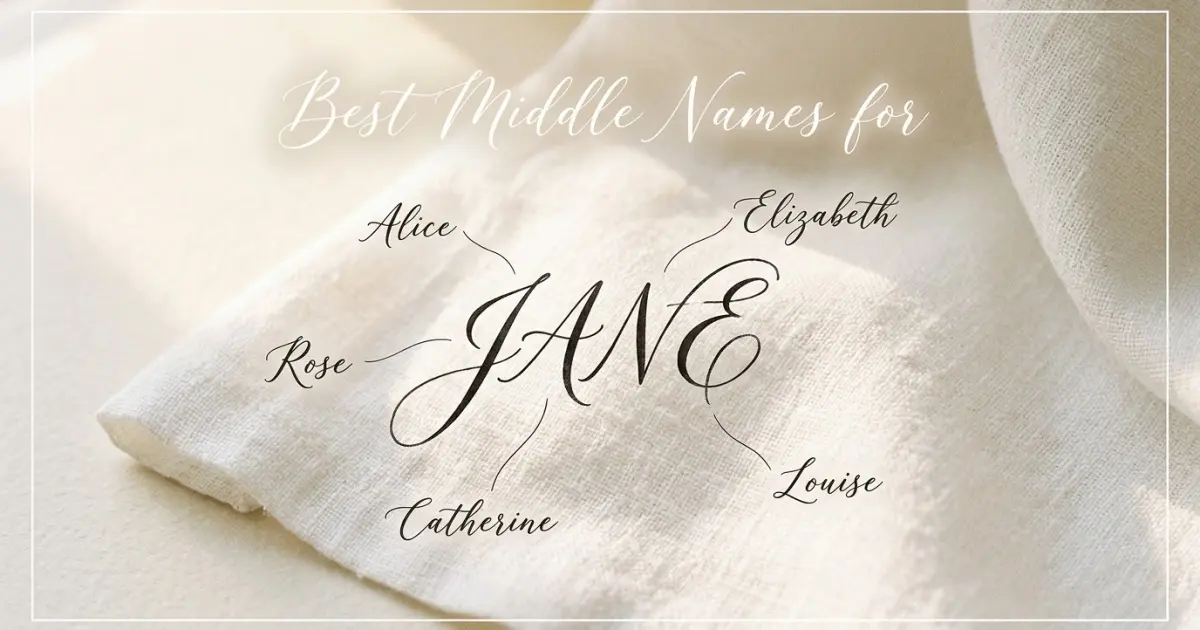
| Classic and graceful | Elizabeth, Catherine, Louise, Margaret | Jane is short enough to support a fuller middle, and these names add depth without overpowering its clean strength. |
| Quiet traditional | Grace, Ruth, Anne, Marie | These preserve Jane’s restrained elegance and make the full combination feel rooted and durable. |
| Modern tailored | Blair, Quinn, Reese, Lane | These sharpen Jane and pull it toward a cooler, more contemporary social read. |
| Softly romantic | Elise, Celeste, Sophia, Noelle | They widen Jane’s emotional range and give the full name more lyricism without weakening its authority. |
| Family-honor friendly | Helen, Susan, Patricia, Eleanor | Jane fronts the name with clarity while the middle quietly carries lineage, memory, or compromise. |
| Fresh but restrained | June, Wren, Sage, Claire | These keep the full name feeling light and intentional, but still disciplined enough for Jane’s style. |
Jane needs a middle name that adds width without blurring the line
Why one-syllable first names make the middle more important
Long names often dominate the full combination. Jane does not dominate. It leads. That distinction matters. Because Jane is only one syllable, the middle name stands closer to it in the ear. There is no elaborate front section to absorb the listener before the second name arrives. The result is that the middle becomes unusually influential. Jane Elizabeth sounds entirely different from Jane Blair, even though the first name stays unchanged. One combination feels historical and fully formal; the other feels concise and modern.
This is one reason Jane is such a rewarding first name for careful pairers. It can take many directions well, but it also exposes lazy pairing instantly. A weak middle leaves the full name feeling thin. A fussy middle makes Jane seem overmanaged. The best pairings recognize that Jane already provides the backbone. The middle should bring contour, not confusion.
Why Jane benefits from contrast more than duplication
Jane already offers restraint, clarity, and finish. That means the middle usually works best when it supplies a different texture. A fuller traditional middle can add sweep. A modern one can add edge. A soft one can add warmth. What tends to work less well is choosing a middle that repeats Jane’s exact plainness without adding anything new. Jane Anne, for instance, may be perfectly valid in a family-honor sense, but stylistically it can feel almost too stripped back unless the surname brings enough richness to complete the line.
That is the central pairing principle here: Jane does not need another Jane beside it. It needs a second note that explains what kind of elegance the family wants.
Jane with longer middles often sounds most complete
Why Jane Elizabeth and Jane Catherine still work so well
Historically, one of the most reliable ways to build around Jane has been to place a longer middle behind it. Jane Elizabeth, Jane Catherine, Jane Louise, and Jane Margaret all succeed for the same reason. Jane gives the full name its clean, unmistakable opening. The longer middle adds historical depth, rhythm, and a fuller visual shape. The result feels neither crowded nor sparse. It feels proportioned.
These names also help Jane carry different kinds of family ambition. Jane Elizabeth sounds complete and socially formal in the classic English sense. Jane Catherine feels composed and literary. Jane Louise is gentler and more European in mood. Jane Margaret sounds intelligent and durable. None of these middles undermines Jane’s simplicity. They show how simplicity can carry serious weight.
When a longer middle is especially useful
A longer middle becomes particularly helpful when the surname is short. Jane Cole, Jane Reed, or Jane Shaw are all excellent in themselves, but a fuller middle often gives the complete name more balance: Jane Elizabeth Cole, Jane Louise Reed, Jane Catherine Shaw. In such combinations, the middle acts almost like architectural span, preventing the full name from sounding too abrupt.
This is also the safest route for families who want Jane to feel unmistakably substantial. Because Jane is so concise, a longer middle can reassure parents that the full name still carries ceremony when needed. The child may use Jane daily, but on formal documents the name has breadth behind it.

Jane with shorter middles sounds brisk, modern, and exact
The one-syllable middles that keep Jane beautifully spare
Short middles after Jane can be excellent, but they create a very different atmosphere from the longer classics. Jane Grace, Jane Ruth, Jane Claire, and Jane Wren all keep the full name taut and disciplined. These combinations appeal to families who want understatement all the way through. They sound edited, not decorative. They also tend to work especially well with longer or more complex surnames, where the surname itself supplies the final lift.
Among these, Jane Grace is perhaps the clearest illustration of how a short pairing can still feel complete. The repetition of restraint is intentional there: one syllable, one syllable, and then a surname that carries the final proportion. Jane Ruth is firmer and slightly more severe. Jane Claire is airy but controlled. Jane Wren feels fresher and more current, though still not flashy.
When shorter middles start to feel too bare
The danger with short-after-short pairing is not ugliness. It is underbuilding. Jane Rose can be lovely, but with a clipped surname it may feel almost too slight. Jane Anne, Jane May, or Jane Faye can be meaningful, but they often depend heavily on the surname to finish the composition. If the surname is also one syllable and not especially resonant, the full name can begin to sound more like an outline than a complete structure.
That does not mean parents should avoid short middles. It means they should test the whole name honestly. Jane rewards discipline, but it also punishes thinness.
The best Jane combinations often depend on the surname more than parents expect
Jane with a long surname can stay lean
If the surname is long, formal, or heavily syllabic, Jane often works best with a shorter middle. Jane Grace Montgomery, Jane Claire Hernandez, or Jane Ruth Calloway all have breathing room because the surname is already doing significant rhythmic work. In these cases, the middle does not need to expand. It needs to keep the name from becoming overly grand.
This is one of Jane’s practical strengths as a first name. It can live comfortably at the front of long, elaborate surnames without sounding swallowed by them. But the middle must cooperate. An equally heavy middle can make the full name sound overfilled.
Jane with a short surname usually wants a middle with more body
If the surname is brief, a fuller middle often becomes the best choice. Jane Margaret Cole has more presence than Jane Grace Cole. Jane Louise Hart feels more finished than Jane Anne Hart. The issue is not that the shorter version is wrong. It is that Jane’s compact authority leaves little excess sound to absorb a clipped ending. A longer middle restores proportion.
Parents often discover this only when they say the full name out loud in formal contexts. A good test is to imagine the name on a diploma or read aloud at a ceremony. Jane, perhaps more than many first names, reveals quickly whether the full line is properly built.
Initials and sound collisions still matter
Because Jane is so visually simple, awkward initials or poor sound transitions become more noticeable. Check the initials in full. Pay attention to repeated consonants with the surname, and test how the middle begins after the final n of Jane. Jane Naomi may sound elegant to some ears and slightly snagged to others. Jane Eleanor flows well, but Jane Nora may depend more on surname rhythm. These are not reasons to overcomplicate the process. They are reminders that minimal names require exact judgment. If you want the IPA, accent detail, and stress pattern behind the flow advice, the next stop is Jane pronunciation guide.
Jane can go modern, but it should not lose its authority
Modern middles after Jane can work beautifully because Jane itself is so historically grounded. Jane Blair, Jane Quinn, Jane Reese, and Jane Lane all bring a contemporary sharpness without making the first name feel uprooted. These combinations are especially useful for families who love Jane’s restraint but want the full name to sound more current and less overtly classic.
The best of these combinations preserve Jane’s authority rather than flatten it. Jane Blair works because Blair has shape and edge. Jane Reese is cooler and more minimalist. Jane Quinn sounds especially crisp because both names are compact but not weak. These pairings prove that Jane is not only a traditionalist’s name. It can also serve as a strong anchor in a more modern naming style.
What tends to fail are middles that make Jane sound suddenly decorative in a way that clashes with its character. Jane does not mind beauty. It minds excess. The middle should still sound like it belongs to a person who can sign documents, be called across a room, and grow older without needing reinvention.
Where Jane starts to feel overdesigned
- Avoid highly ornate middles that ask Jane to do stylistic work it was never meant to do.
- Be cautious with pairings that are too bare when the surname is also short and clipped.
- Check initials carefully. Jane is so clean that awkward letter combinations feel even more noticeable beside it.
- Say the full name in ordinary sentences, not just as a pretty idea. Jane must work in real speech.
- Do not assume that sentimental value alone is enough. The strongest tribute is one that can actually be carried with ease.
The risk with Jane is never that it will sound weak on its own. The risk is misjudging how much support or contrast it needs from the middle. Jane is honest that way. It reveals imbalance quickly.
The best middle for Jane lets restraint feel rich instead of empty
The strongest middle name for Jane is the one that gives the full name proportion. Sometimes that means a longer classic such as Elizabeth, Catherine, Margaret, or Louise. Sometimes it means a precise short form such as Grace, Ruth, or Claire. Sometimes it means a modern edge like Blair or Quinn. The answer depends on the surname and on the family’s preferred social read. But the principle remains stable: Jane should sound deliberate, not bare; composed, not overcurated.
Jane already brings moral clarity, cultural depth, and one of the cleanest sound shapes in the language. What the middle name must bring is dimension. When the pairing is right, the result feels effortless in the deepest sense: not because no thought went into it, but because the thought was good enough to disappear. That is the ideal with Jane. The middle should not compete with its restraint. It should show just how rich restraint can be.
Middle Name FAQ for Jane
Does Jane work better with long or short middle names?
Jane can work with either, but longer middles often give it more formal balance, especially with short surnames. Short middles tend to work best when the surname is long enough to supply the final weight.
What kind of middle makes Jane feel most timeless?
Classic middles such as Elizabeth, Catherine, Louise, Grace, or Margaret usually make Jane feel most durable. They support the name’s restraint rather than competing with it.
Can Jane work with modern middles like Blair or Quinn?
Yes. Jane is strong enough to anchor modern middles very well. The result often feels clean, smart, and contemporary without losing the first name’s authority.
What should parents avoid when pairing a middle with Jane?
The main cautions are imbalance and overdesign. Jane usually suffers either when the full name is too thin or when the middle becomes so ornate that it fights Jane’s essential simplicity.