
Jane Name Meaning: History, Meaning, and Modern Appeal
Some names survive by adapting endlessly to fashion. Others survive by refusing to be impressed by fashion at all. Jane belongs to the second group. It is a name built on restraint, and restraint is harder to sustain than ornament. At one syllable, Jane has almost nowhere to hide. There are no decorative endings, no drifting vowels, no elaborate historical costume to do the work for it. What it has instead is clarity: a quiet theological meaning, a clean English form, and the kind of social authority that comes from having been useful for a very long time. Jane is not a name that asks for attention. It assumes attention can come later, once character has arrived.
That is what makes the name more interesting than it first appears. “God is gracious” is not a flashy meaning. It does not promise brilliance, beauty, or victory. It speaks in the language of gift, mercy, and unearned favor. Paired with a one-syllable form this direct, the meaning becomes even stronger. Jane does not dramatize grace. It normalizes it. The name suggests that steadiness can be beautiful, that kindness does not need ornament, and that simplicity can carry more cultural weight than names twice its size. In a naming era often crowded with texture and performance, Jane remains radical in a quieter way: it sounds like enough.
Jane's U.S. popularity rank over time, 1880–2024
Popularity statistics are based on official data from the Social Security Administration baby name records.
Jane: A Timeless and Universal Pillar of Grace
Jane functions as a name with one unmistakable center of gravity, sustained by its standing as a perennially popular choice for girls for over a century. This “timeless English classic” often reflects a naming-culture preference for choices that provide a sense of reliability and strength .
The name has resisted broad crossover shifts, maintaining a stable center in the girls’ lane. Meaning “God is gracious,” its simple single-syllable structure remains both polished and widely trusted across generations.
Why Jane still feels complete in a louder naming age
| Key Facts | Information | Quick Insight |
|---|---|---|
| Name | Jane | The form is brief and unmistakable, which gives the name unusual confidence before any backstory is added. |
| Primary Gender Use | Female | Jane reads clearly feminine in modern English, but without excess softness or decorative fragility. |
| Origin | English | The English origin gives the name a plainspoken social footing that matches its uncluttered sound. |
| Core Meaning | God is gracious | The meaning points toward gift and mercy rather than achievement, which gives Jane quiet moral depth. |
| Common Pronunciation | JAYN | The single strong syllable is one reason Jane feels so decisive and memorable in public life. |
| IPA (US) | /dʒeɪn/ | The sharp opening consonant and long vowel create a name that sounds clear without feeling hard. |
| IPA (UK) | /dʒeɪn/ | The shared U.S. and UK pronunciation helps Jane remain socially stable across English-speaking contexts. |
| Syllables | 1 | One syllable gives Jane unusual force. It cannot drift, which is part of its durability. |
| U.S. girls’ rank (2024) | No. 269 | Official data places Jane in a useful zone: familiar enough to feel rooted, uncommon enough to feel intentional. |
Jane makes grace feel plain, durable, and near at hand
Why “God is gracious” gives Jane more depth than ornament ever could
Many names associated with virtue sound aspirational, almost like a wish cast forward over a child. Jane does something subtler. “God is gracious” is not framed as personal triumph. It is not a reward, a title, or a character résumé. It is a statement about what has already been given. That matters. The name begins not in self-assertion, but in dependence and gift. It speaks from the logic of grace, which is to say favor that is received rather than earned.
That theological structure changes the emotional tone of the name. Jane does not suggest a child must become extraordinary in order to justify the beauty of her name. Instead it suggests a world in which value is not entirely self-manufactured. That is one reason the name can feel so humane. It does not burden the person with grandeur. It allows dignity to arrive quietly.
Why Jane’s restraint makes the meaning stronger, not weaker
If the same meaning were attached to a larger, more ceremonial name, it might sound explicitly devotional or formal. Jane keeps it closer to everyday life. The effect is almost paradoxical: the plainer the form, the more the meaning seems to settle into ordinary speech. Grace becomes less abstract when carried by a name this direct. It feels less like a slogan and more like a habit of being.
This is one of Jane’s deepest strengths. It takes a meaning with real spiritual weight and lets it move through the world without strain. The name does not need to announce its moral architecture because the form itself already models a kind of disciplined humility. Jane sounds like a person, not a theme. That makes the underlying meaning more believable. It feels lived rather than displayed.
In practical family terms, that is often exactly what parents want. They may value grace, gratitude, or mercy, but they do not want a name that sounds overdetermined. Jane solves that problem elegantly. It carries conviction without spectacle. That combination is rare.
Jane is short enough to disappear, yet it never really does
What one syllable does to the social life of a name
Jane is a one-syllable name, and that makes it unusually exposed. A one-syllable name cannot rely on musical flourish or layered rhythm to create atmosphere. It has to work through outline alone. Jane does. The opening consonant gives it immediate definition. The long vowel opens the sound without making it soft-edged. The final consonant closes the name neatly. The result is a name that sounds crisp, but never brittle.
That economy is part of why Jane feels so adult even in childhood. Some short names become cute or slight. Jane does not. It sounds ready from the beginning. There is no sense that it is a diminutive waiting for a longer formal version to stand behind it. It is already the finished thing.
Why Jane sounds cleaner than many fashionable names
Modern naming often leans toward complexity disguised as softness: multiple vowels, trailing endings, layered syllables, elaborate internal rhythm. Jane offers the opposite. It is simple in the strictest sense, but never empty. That is a difficult balance to achieve. A short name without depth can feel generic. Jane does not feel generic because its compact sound is backed by history, meaning, and social memory.
The phonetic structure helps. The j sound gives the name a clear entrance, neither too soft nor too abrupt. The long ay vowel adds openness and keeps the name from sounding shut. The final n closes it with calm rather than force. There is almost no wasted sound in it. That is part of why Jane feels so competent. The name is efficient, but not cold.
Why Jane’s plainness is actually a form of style
One of the common misunderstandings about Jane is that because it is plain, it is neutral. It is not. It carries a very particular aesthetic: discipline, legibility, and confidence without adornment. In cultural terms, that can read as literary, intelligent, grounded, and even quietly severe in the best sense. Jane does not flirt with the listener. It assumes the listener can catch up.
This is why the name keeps returning. Not because it reinvents itself dramatically, but because each new era rediscovers the power of not overdoing things. Jane remains one of the strongest examples of how little sound a name actually needs when what is there has been perfectly chosen.
Jane has long belonged to the English-speaking imagination because it sounds ordinary in the highest sense
Historically, Jane became a name of the visible everyday woman
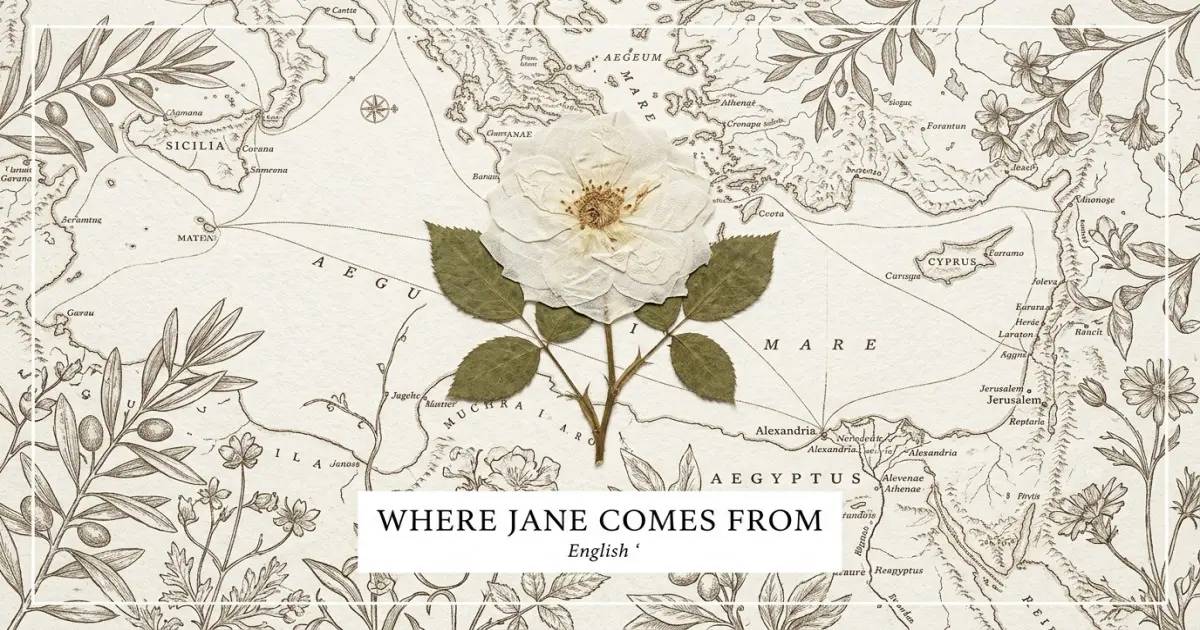
Historically, Jane became one of the foundational women’s names in English. That matters because the name gathered social meaning beyond its origin. It came to feel intelligible across class, region, and generation. It could belong to a heroine, a neighbor, a child, a grandmother, a professional, or a woman no one had yet written down. Few names manage that kind of range. Many names become tied to one aesthetic class of person. Jane became more democratic than that. If you want to compare Jane with names from the same heritage, browse a wider list of English names.
There is a reason such names endure. A broadly legible name often acquires a kind of cultural seriousness. It becomes less about novelty and more about trust. Jane carries that trust. It sounds as if it has been tested in ordinary life, which is often a stronger recommendation than sounding dazzling on first encounter.
Why Jane’s literary aura never overwhelms its usability
Jane also benefits from an unmistakable literary atmosphere, but importantly, that atmosphere does not trap the name. It does not feel like a costume name or a reference that has to be performed. Instead, the literary associations around Jane have helped preserve the impression of intelligence, emotional steadiness, and interior life. The name feels readable without becoming too self-conscious about being read.
This is another part of its success. Jane can seem simple on the surface while still carrying layers. That makes it unusually adaptable. Families can choose it because they value clarity, because they love its understatement, because they want a name with moral center, or because they simply trust it. The name accommodates all of those motives without collapsing into vagueness.
In that sense, Jane is not “just classic.” It is one of the strongest examples of how a classic becomes classic in the first place: by being usable, intelligible, and deep enough to survive repeated cultural handling.
What Jane’s 2024 ranking really says about the name now
Recognizable, but not the obvious default
Official Social Security Administration (SSA) data shows Jane ranked No. 269 for girls in the United States in 2024. That is a revealing position. The name is clearly still alive in public naming culture. No one hearing it will think it vanished. But it is also far enough from the very top of the charts to retain freshness. For many parents, that is ideal. Jane feels rooted, but not overassigned. If you want a wider view beyond Jane, browse classic and modern girl names.
This ranking also changes how the name reads socially. A generation ago, some families may have worried that Jane felt too expected or too old-fashioned. In a contemporary context, that exact restraint becomes part of the appeal. Jane now sounds not default, but chosen on purpose. It signals judgment rather than habit.
Why Jane feels fresher now than louder names often do
There is a paradox in naming culture: when many names compete for uniqueness through added texture, the cleanest names begin to feel newly distinctive. Jane benefits from that shift. Its brevity and composure stand out in a field crowded by flourish. That does not make it trendy in a shallow sense. It makes it timely because people have begun to remember what understatement can do.
Jane also ages extremely well within a generation. It does not belong only to infancy, or only to youth, or only to adulthood. That life-span flexibility often matters more than a chart spike. Parents choosing Jane are often choosing long-term clarity over short-term excitement, and that tends to make a name feel smarter over time.

If Jane is already on your shortlist, these are the next questions it opens
Once parents are drawn to Jane, the next stage usually is not about whether the name is strong enough. It is about how to shape the full experience of it. Because Jane is so compact, the surrounding decisions matter. A middle name can either add softness, historic depth, or sleek contrast. Nicknames, if they emerge at all, reveal whether a family wants to warm the name domestically or preserve its directness. Pronunciation is simple, but with one-syllable names, exact sound still matters because there is nowhere for imbalance to hide.
Middle names that either widen Jane or keep it beautifully spare
Jane can take a longer middle exceptionally well because it leaves so much room. But it can also pair beautifully with another short classic if the surname carries enough weight. The key is deciding whether the full name should feel more literary, more tailored, or more quietly traditional. If you want the full pairing logic behind that contrast, see Jane middle names.
Nicknames that make Jane softer without erasing its authority
Jane does not need a nickname, but short names often develop intimate forms anyway. Those forms tend to say more about the family’s style of affection than about the name’s practical needs. With Jane, any nickname becomes a social choice rather than a necessity. To see how those different moods shorten in real life, explore nicknames for Jane.
Pronouncing Jane so the clarity stays clean and complete
One-syllable names depend heavily on precision. Jane works because the opening consonant is clear, the vowel is open, and the ending closes gently. Even a very simple name keeps its elegance by being said well. If you want the full sound pattern behind that rhythm, read how to pronounce Jane.
Why the name Jane keeps its authority
At its deepest level, Jane is a lesson in how little a name needs when what it has is true. One syllable. One clean meaning. One stable social shape. And yet inside that apparent simplicity is a serious philosophy of naming: grace is enough; restraint is enough; being fully legible is not the same thing as being ordinary in the empty sense. Jane proves that a name can be modest in sound and still carry immense cultural and emotional weight.
That is also why Jane remains so moving. It does not try to outrun history or outshine its neighbors. It simply keeps doing what it has always done well: it gives a person a name that sounds trustworthy. Not loud. Not ornamental. Trustworthy. In a world that often confuses complexity with importance, Jane continues to offer a different vision of significance. It suggests that the durable things are sometimes the plainest to say and the hardest to improve.
In the end, Jane lasts because it knows what grace actually looks like in language. Not excess. Not display. Not a performance of goodness. Just the right amount of sound carrying more than enough meaning. That is why Jane never really disappears. Jane is the art of having nothing to prove and still leaving a mark.
Jane Meaning FAQ
Is Jane too simple to feel special today?
No. In a naming landscape crowded with elaborate forms, Jane often feels more distinctive because of its restraint. Its simplicity reads as intentional rather than plain in the empty sense.
Does Jane age well across a lifetime?
Yes. Jane is one of the rare names that feels plausible at every stage of life because it is not tied to one age, one social role, or one fleeting style.
What makes Jane feel literary without feeling fussy?
Its literary atmosphere comes from cultural depth and repeated use, not from ornament. The name still sounds like a real person first, which keeps it usable and grounded.
Why does Jane’s meaning matter if the name sounds so plain?
Precisely because the form is so plain, the meaning stands out more clearly. “God is gracious” gives Jane moral and emotional depth without burdening the name with spectacle.