
How to Pronounce Jane: Syllable Guide and Easy Stress Tips
The real pronunciation test for a name does not happen in a phonetics class. It happens at a school doorway, when a teacher glances at a roster and has one second to decide whether to hesitate. It happens in a waiting room when a nurse calls a child forward. It happens in a meeting when someone introduces a colleague without rehearsal. Jane is the kind of name that usually clears that test instantly, and that ease is part of its power. But one-syllable names create their own pressure. There is nowhere for uncertainty to hide. If the opening is off, the whole name is off. If the ending gets swallowed, the name loses its clean authority immediately.
That is why Jane is worth looking at more closely than its simplicity seems to require. In everyday English, the name is pronounced JAYN. It is short, but not blunt; clear, but not cold. The opening consonant gives it definition, the vowel gives it openness, and the final consonant closes the sound with calm precision. Jane sounds easy because its structure is efficient, not because it is empty. In practice, the name works best when it is said cleanly and without fuss. The elegance of Jane is not in decorative sound. It is in exact proportion.
How Jane is actually said when people say it naturally
| Element | Phonetic Detail | Quick Tip |
|---|---|---|
| Everyday pronunciation | JAYN | Say it as one clean, complete beat. Jane should sound finished the moment it is spoken. |
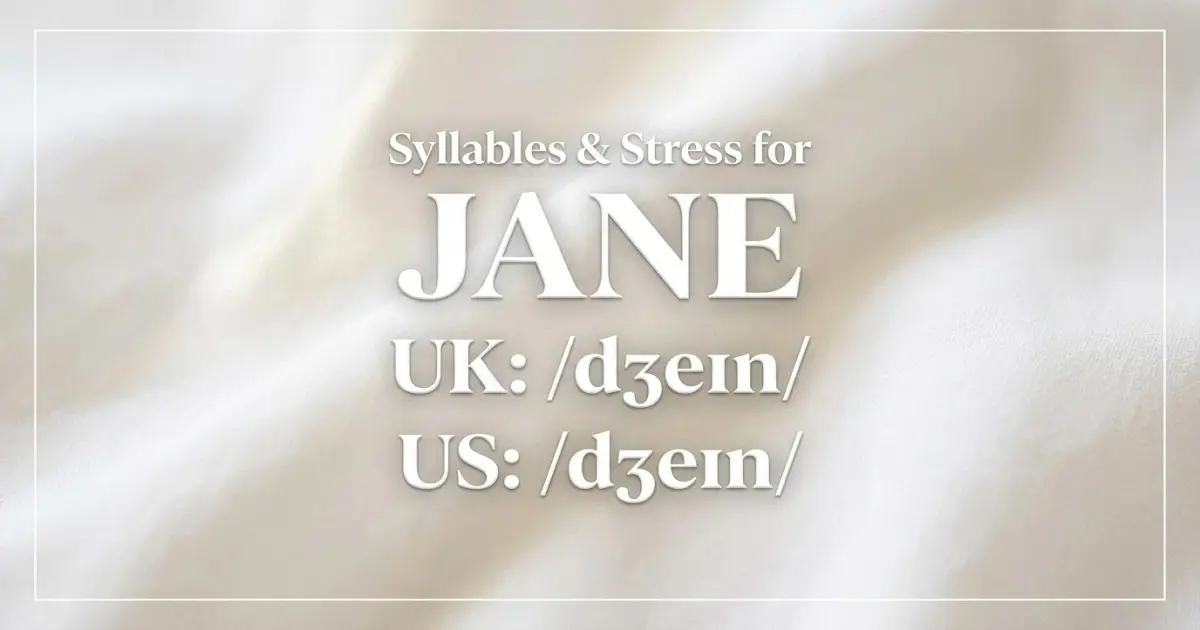
| IPA (US) | /dʒeɪn/ | The opening sound is a voiced affricate, then a long ay vowel, then a firm but gentle final n. |
| IPA (UK) | /dʒeɪn/ | The British and American forms are effectively the same, which helps Jane stay socially stable across accents. |
| Syllable count | 1 syllable | There is no second beat to recover on, so clarity matters from the first sound onward. |
| Stress pattern | Full stress on the only syllable | Jane should not feel clipped or half-spoken. Its single syllable carries the entire name. |
| Opening sound | j as in “jam” | Start with a clear voiced entrance. The opening should sound crisp, not mushy or softened away. |
| Vowel core | Long ay sound | The vowel is what keeps Jane from sounding severe. Let it open fully before the final consonant closes. |
| Ending sound | Final n | Do not drop the ending. That final consonant is part of what makes Jane feel complete and adult. |
Why Jane sounds stronger than many longer names
Jane is one syllable, but it is not one flat sound
Because Jane has only one syllable, people sometimes assume there is nothing much to explain about it. In fact, one-syllable names are often more exacting than longer ones. A longer name can absorb slight hesitation because the rest of the syllables help the listener recover the pattern. Jane cannot. Every element arrives at once. That is why its pronunciation feels so decisive when done well. The sound matters more once you know what the name is meant to carry, which is why the wider frame starts in Jane meaning.
The name begins with /dʒ/, a voiced affricate. In accessible terms, that means the sound begins like a stop and releases like a fricative. It is the same sound heard at the start of “job” or “jam.” That opening gives Jane its firmness. It does not drift in gently. It arrives with shape. After that comes the long /eɪ/ vowel, the same family of sound heard in “day” or “name.” This is the part that opens the name and gives it brightness. The final /n/ then closes the sound without harshness.
The final consonant matters more than people think
With Jane, the ending is not a minor detail. Drop or weaken the final n, and the name begins to lose its adult steadiness. That is one reason Jane feels more composed than some other one-syllable names. It ends with quiet closure. There is no dramatic flourish, but there is a full stop. The result is a name that sounds self-possessed.
This is also why Jane can feel elegant in formal settings without sounding ornate. The sound pattern is compact, but it is not thin. It has an opening, a center, and a finish, all inside one syllable. That internal completeness is part of why the name remains so durable in real life.
Jane keeps its shape across American and British English
The stability of Jane is part of its social power
One advantage of Jane is that standard American and British English pronounce it in essentially the same way: /dʒeɪn/. That level of agreement is not trivial. Some names look simple on paper but move noticeably across accents. Jane does not. The vowel quality may shift very slightly from speaker to speaker, as all vowels do, but the overall shape remains stable. The opening affricate stays firm. The long ay stays central. The final n stays present.
That stability helps explain why Jane feels so culturally settled. A name that survives intact across regions often sounds more trustworthy in everyday life. People do not feel they are guessing at it. They feel they already know it.
Why small accent differences do not really alter Jane
Of course, no living language is perfectly uniform. Some speakers may make the vowel a little brighter. Others may make the final n slightly lighter or more nasal. But these are edge differences, not identity changes. Jane remains Jane. It is one of those names whose simplicity protects it rather than exposing it.
This is especially helpful in public-use terms. A child named Jane is unlikely to face repeated uncertainty about how her name should sound. That ease is part of the name’s practical beauty. It does not just look composed. It behaves composed.
The most common Jane mistakes come from underpronouncing it
Swallowing the final consonant
The most common pronunciation problem with Jane is not saying it wrongly so much as saying it too loosely. If the final n gets swallowed, the name can sound incomplete or overly casual. Because Jane is only one syllable, the final consonant does important structural work. It should be present, even in fast speech.
Making the vowel too flat or too short
Another issue is compressing the vowel so tightly that the name loses its openness. Jane needs the full long ay sound. If that vowel is flattened or clipped, the name can sound harder and less graceful than intended. The vowel is what gives Jane its brightness. The consonants alone would make it much more severe.
Overthinking a very simple name
Ironically, some people overcompensate with simple names. They slow down too much, trying to pronounce the name “perfectly,” and end up making it sound more formal than natural. Jane does not need ceremony. It needs cleanliness. One firm opening, one open vowel, one finished close. That is enough.
How to practice Jane so it sounds like everyday life
Put Jane inside real phrases
The easiest way to internalize Jane is not to repeat it in isolation, but to use it where names actually live:
- “Jane, you’re up.”
- “This is Jane.”
- “Has Jane arrived yet?”
These examples matter because a one-syllable name behaves differently in connected speech than it does in a dictionary-style demonstration. Jane usually holds up beautifully. The opening carries well, and the ending prevents the name from dissolving into the sentence around it.
How to know you are saying Jane naturally
You are probably pronouncing Jane well when it feels complete without feeling forced. The opening should be clear. The vowel should open fully. The final n should close the name without being punched. If any one of those three parts disappears, Jane loses some of what makes it sound composed. When all three are present in balance, the name does exactly what it should do: it sounds simple, strong, and finished.
That is the deeper lesson of Jane’s pronunciation. The name is not impressive because it is complicated. It is impressive because it wastes nothing. Said well, Jane is proof that one syllable can still contain poise, clarity, and force.
Pronouncing Jane: Common Questions
How do you pronounce Jane in everyday English?
Jane is pronounced JAYN. It is a one-syllable name with a clear j opening, a long ay vowel, and a final n that should be heard.
Is Jane pronounced differently in American and British English?
Not in any major way. Standard American and British English use essentially the same pronunciation, which is one reason the name feels so stable and familiar.
What is the most common pronunciation mistake with Jane?
The most common issue is underpronouncing it, especially by weakening the final n or shortening the vowel too much. Jane sounds best when the full syllable is completed.
Why does Jane sound so strong even though it is only one syllable?
Its strength comes from structure. The opening affricate gives it shape, the long vowel gives it openness, and the final consonant gives it closure. Nothing in the name is wasted.