Best Middle Names for Imogen: Pairings That Feel Light, Polished, and Easy
A middle name does a quiet kind of work. It is not the name most people call across a playground or write at the top of a school paper, yet it often becomes the private counterweight that changes how a full name feels. Parents reach for it when they want to honor family without crowding the first name, when they want a formal option that can wait in the wings, or when they simply need the whole name to land with more certainty. With a name like Imogen, that second layer matters even more, because Imogen already arrives with shape, sound, and personality. It is a three-syllable name with a distinct opening stress and a soft, rounded ending, so the middle name is not decoration. It is the device that decides whether the full name feels brisk, romantic, academic, contemporary, or quietly aristocratic.
That is why choosing a middle for Imogen is less about finding another pretty name and more about managing proportion. Official data shows Imogen ranked No. 1,126 for girls in the United States in 2024, which gives it an interesting modern position: familiar enough to be recognized, uncommon enough to still feel chosen. A middle name can either reinforce that poised individuality or blur it. The best pairings give Imogen room to breathe, keep the rhythm clean, and create a full name that works not only in birth announcements and family photos but also on forms, introductions, email signatures, and adult life. The combination works best when the emotional color of the first name stays intact, which is easier to judge once you revisit Imogen meaning.
Where Imogen changes mood: a middle-name map for the full combination
Before narrowing the field, it helps to see the larger logic. Some middles sharpen Imogen and make it feel tailored. Others soften it and bring out its lyrical side. The strongest combinations usually create contrast without collision.
| Style | Recommended Names | Why it works with Imogen |
|---|---|---|
| Crisp and classic | Claire, Jane, Grace, Ruth | One-syllable middles give Imogen a clean finish and keep the full name elegant rather than over-decorated. |
| Softly romantic | Rose, Elise, Louise, Celeste | These choices keep the line flowing and add warmth without making Imogen feel overly ornate. |
| Tailored and intelligent | Kate, Blair, Frances, Simone | These middles lend structure and seriousness, useful if you want Imogen to sound modern, composed, and adult-ready. |
| Light but modern | June, Maeve, Wren, Skye | Short contemporary middles keep Imogen distinctive while preventing the combination from feeling heavy. |
| Long-form elegance | Alexandra, Olivia, Helena, Juliet | Longer middles can work when the vowel pattern stays clear and the surname is simple enough to carry the extra length. |
Imogen sounds best when the middle name changes the pace
Why one-syllable middles give Imogen authority
Imogen already has internal movement: three syllables, a strong first beat, then a softer glide toward the end. Because of that, a short middle often creates the most satisfying balance. Imogen Claire, Imogen Jane, Imogen Grace, and Imogen Ruth all work for the same reason: they stop the line at exactly the right moment. Nothing spills. Nothing gets sugary. The effect is polished and controlled. Pairing is not just visual; it is rhythmic, and the next useful step is how to pronounce Imogen.
These pairings are especially useful when the surname has two or more syllables. If the family name is something like Anderson, Holloway, or Bennett, a short middle helps the whole structure stay upright. It also improves daily usability. Full names get spoken most often in formal settings, and crisp combinations are easier to say cleanly under pressure: at graduations, in offices, over the phone, and in introductions where clarity matters.
Why two-syllable middles can soften Imogen without slowing it down
Two-syllable middles work when they bring a distinct new texture rather than repeating the same music. Imogen Louise and Imogen Elise have enough movement to feel graceful, but their endings are clearer and more linear than Imogen’s own soft finish. That difference matters. A good pairing should feel like a progression, not an echo.
This is where many parents find their best compromise. If one-syllable middles feel too severe, a well-chosen two-syllable option gives Imogen more warmth. The trick is to avoid middles that dissolve into a similar murmuring softness. You want the second name to answer Imogen, not drift beside it. Clear consonants and a strong vowel shape usually help.
When longer middle names still work with Imogen
Long middles are possible, but they demand discipline elsewhere. Imogen Alexandra can sound stately. Imogen Juliet can sound refined and vivid. Imogen Helena can feel cultured and balanced. But these combinations need a cooperative surname. If the surname is already long, double-barrelled, or heavily consonantal, a long middle can tip the name from memorable into cumbersome.
A useful rule is simple: if both the middle and surname are long, say the whole name aloud several times at natural speed. If you start unconsciously dropping part of it, that is your answer. A name should survive ordinary speech, not just look impressive on paper.
Imogen with classic middles feels composed, not crowded
Traditional middles that steady the name
Imogen Claire, Imogen Jane, Imogen Rose, and Imogen Louise all belong to the category of names that have already proved they can support a strong first name without competing with it. They are dependable not because they are dull, but because they know their role. With Imogen, that role is important. The first name already carries the personality. The middle should often supply ballast.
These combinations are particularly appealing for parents who want the first name to remain the headline while the middle adds familiarity and ease. Imogen can sound clever, artistic, and a little unusual in some settings. A classic middle reassures the ear. It tells listeners that the full name belongs comfortably in the world, not just in a mood board.
Classic pairings that age well
Another strength of traditional middles is longevity. Children rarely choose their names, but they do live inside them for decades. Imogen Grace works for a toddler, a teenager, and a judge. Imogen Jane works for a child who wants simplicity and for an adult who may one day prefer using her middle professionally or personally. Research and long-standing naming practice both suggest that middle names often become a backup identity later in life, so choosing one that can stand alone is a practical advantage, not merely a sentimental extra.
Imogen can lean modern, but the right middle keeps it from feeling fashionable-only
Fresh middles that keep the line clean
If you want Imogen to feel more current, the smartest route is usually brevity. Imogen June is bright and lean. Imogen Maeve has substance without heaviness. Imogen Wren feels cool and contemporary, though it works best with a simpler surname because the overall style is sharper. Imogen Skye brings lift and openness, especially if the last name is more traditional.
What these middles do well is preserve Imogen’s distinctiveness while removing any sense of fuss. They are modern, but not flimsy. They also suit families who want a name that can sit naturally beside contemporary sibling names without forcing Imogen into a more vintage or formal frame than they actually want.
Modern choices to approach carefully
What deserves caution are middles that are also soft, fluttery, and three-syllable. With Imogen, that can produce a full name that sounds beautiful for two seconds and then vanishes in memory. The issue is not that lyrical names are wrong. It is that Imogen already supplies lyricism. The middle should give contour. If both names are misty, the full combination loses edge.
Also be careful with middles that begin or end in sounds too close to Imogen’s final sound. Repetition can make the name feel mumbled. A pairing should sound intentional when spoken once at normal speed, not only after careful enunciation.
Imogen and the surname: this is where flow becomes real life
Check the bridge between middle and surname
Parents often focus on first-plus-middle and forget the final handoff into the family name. But that last transition determines whether the full name actually works. Imogen Claire Bennett is clean because each part is distinct. Imogen Elise Abbott may feel softer and more continuous. Neither is automatically wrong, but they create very different impressions.
If your surname begins with a vowel, a middle with a firmer consonant opening can help. If your surname is short and abrupt, a smoother middle may soften the landing. This is less about rigid rules than about hearing the full architecture. The middle name should help the surname arrive well.
Initials deserve a practical check
Initials are an unglamorous but necessary part of the process. A beautiful combination can lose appeal once the monogram, school login, or email shorthand is considered. Check the initials in the obvious orders, and do not forget that some children later use first-middle-last initials constantly in academic and professional life. This is also a good moment to think about whether you want the middle name to provide a useful fallback initial or an elegant signature line.
Be realistic about length
If the surname is double-barrelled or already long, Imogen usually benefits from restraint in the middle slot. Imogen Claire Montgomery-Smythe remains manageable. Imogen Alexandra Montgomery-Smythe is striking, but it asks a lot of the child in writing, spelling, and repeated introduction. Practicality is not unromantic. It is part of what makes a full name livable.
Middle names that give Imogen room to grow into different versions of herself
The most useful middle names do not lock a child into one single performance of femininity or one social mood. Imogen already has presence. That means the middle can widen her options. Imogen Frances feels thoughtful and grounded. Imogen Kate feels brisk and self-possessed. Imogen Rose feels softer without becoming fragile. Imogen June feels modern and bright. Imogen Louise feels quietly formal. Each version of Imogen is still recognizably the same name, but the second name changes the social temperature.
That is the real test. A good middle name should not merely sound good after Imogen. It should create a full identity that can flex across time. The combination should work on a birth bracelet, in a school register, on a wedding invitation, in a published byline, and in the flat voice of bureaucracy when someone reads it from a form. Imogen is distinctive enough that it does not need help being noticed. What it needs is a middle name that helps it travel well.
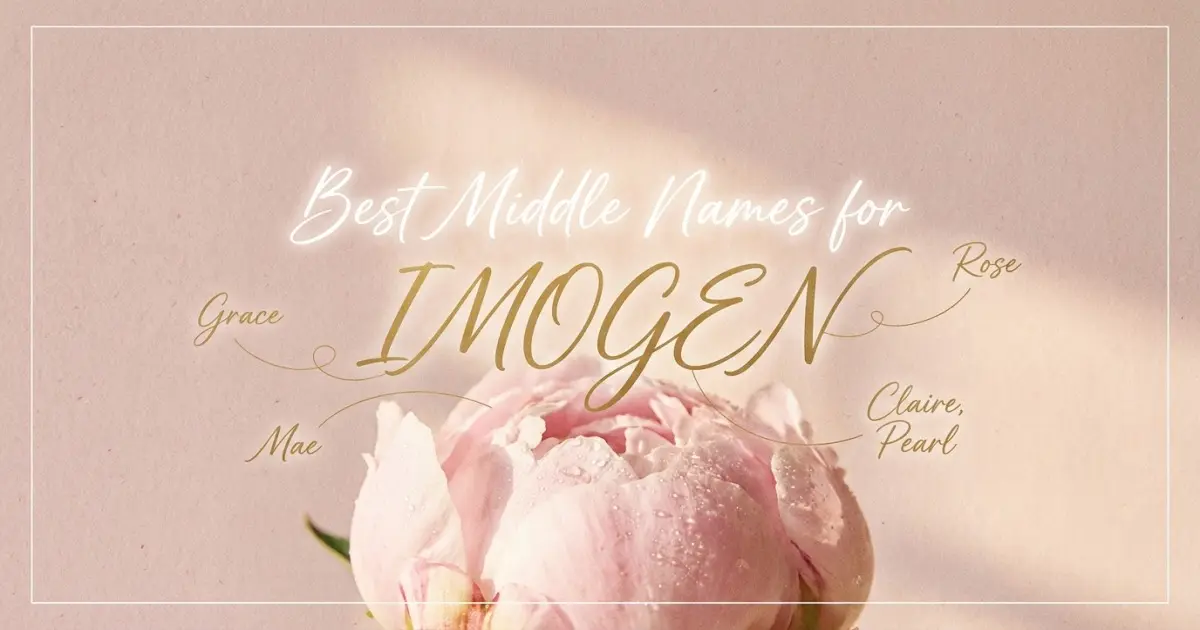
For many families, that leads to a shortlist like this: Imogen Claire, Imogen Jane, Imogen Grace, Imogen Rose, Imogen Louise, Imogen Elise, Imogen June, and Imogen Maeve. They are not all the same style, but they share one strength: each gives Imogen shape, not clutter.
Best Middle Name Matches for Imogen: FAQ
Should Imogen have a short middle name?
What kinds of middle names clash with Imogen?