
How to Say Imogen Correctly: A Sound Guide with Common Missteps
The pronunciation problem with Imogen usually happens in a very specific moment: a teacher pauses over a class list, a receptionist reaches the “I” section, or someone who has only seen the name in writing tries to say it before hearing it spoken. It is the kind of hesitation that comes from spelling, not from difficulty. Once heard aloud, Imogen is not especially hard to say. But on the page, it invites second-guessing. People may over-pronounce the middle, lean too heavily into the final syllable, or search for a more visibly phonetic route through the letters.
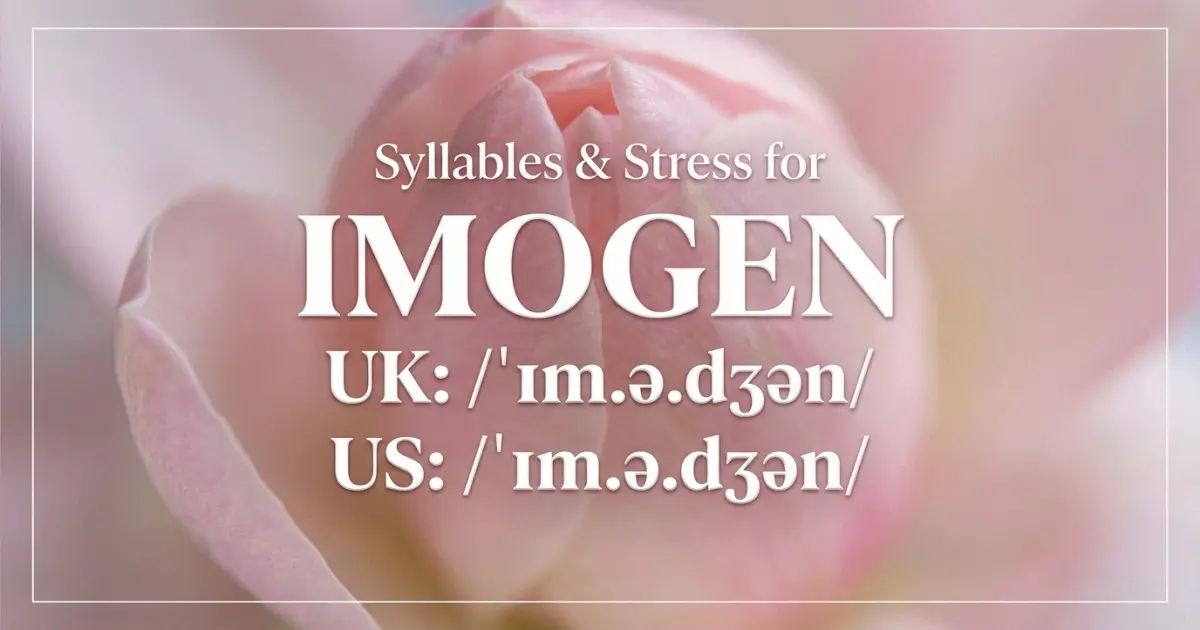
That is why the most useful way to explain Imogen is not as a rare puzzle but as a name with one strong beat and two softer follow-through sounds. In everyday American English, the pronunciation used here is IM-uh-juhn. Both the U.S. and U.K. IPA forms are /ˈɪmədʒən/, which tells you something important immediately: the stress pattern stays stable. The name begins firmly, then relaxes. If you keep that rhythm, Imogen sounds natural almost at once.
How Imogen is actually said once someone stops staring at the spelling
The easiest way to make Imogen feel manageable is to separate what the letters suggest from what English speakers naturally do with the sound. The table below clarifies the version most useful in real speech.
| Element | Phonetic Detail | Quick Tip |
|---|---|---|
| Everyday pronunciation | IM-uh-juhn | Put the emphasis on the first syllable and let the rest soften. |
| IPA (U.S.) | /ˈɪmədʒən/ | The stress mark before the first syllable shows where the voice should land. |
| IPA (U.K.) | /ˈɪmədʒən/ | The core rhythm is the same on both sides of the Atlantic. |
| Syllable count | 3 syllables | Think of it as one strong beat followed by two lighter ones. |
| Stress pattern | First-syllable stress | Say IM clearly, then move quickly through the rest. |
| Final sound | “-juhn” | Aim closer to “juhn” than “jean” or “jen” said too sharply. |
Imogen has three syllables, but only one of them should lead
The first syllable carries the name
The heart of Imogen is the opening IM. That is where the name takes its shape. In the IPA, the first vowel is /ɪ/, the short vowel English speakers hear in words like “sit” or “him.” It is not stretched, not theatrical, and not especially exotic. The job of the speaker is simply to give that first syllable enough weight that the rest of the name can fall into place behind it. The sound matters more once you know what the name is meant to carry, which is why the wider frame starts in Imogen meaning.
This matters because many pronunciation errors come from distributing emphasis too evenly. English does not usually treat names like Imogen that way. It prefers a strong stressed syllable followed by reduction. Once you say IM cleanly, the name stops feeling ornate and starts feeling conversational.
The middle syllable is reduced on purpose
The second syllable in Imogen is the kind of sound English often weakens in connected speech. In the IPA, it is represented with a schwa: ə. That is the neutral “uh” sound heard in countless unstressed syllables. This is one reason Imogen can be misread by people seeing it for the first time. The spelling tempts the eye to give the middle more value than the mouth actually does.
For practical purposes, that means you should not dwell on the middle. Do not try to turn it into a dramatic “oh” unless you are consciously using a different personal or family pronunciation. In the pronunciation used here, the middle is light and transitional. It helps the name move, but it is not where the spotlight belongs.
The ending is softer than it looks
The final syllable, juhn, contains the consonant sound /dʒ/, an affricate. That term sounds technical, but the effect is familiar. It is the same basic opening sound English speakers know from “judge” or “jam.” After that comes another reduced vowel, which keeps the ending from sounding overly sharp. That is why Imogen should not be clipped into something overly bright like “jen” with hard edges, and it should not drift into “jean” either. The target is softer and more neutral: juhn.
When people say Imogen well, they usually do not sound as though they are pronouncing three separate blocks. They sound as though they are releasing one firm opening into a gentler finish: IM-uh-juhn.
Where Imogen gets mispronounced, and why the mistakes are so predictable
When the spelling pulls the middle syllable too hard
One common mistake is to over-read the letters in the center of the name and produce a fuller middle vowel than everyday speech naturally wants. This often happens because English readers are trying to honor the spelling carefully. The intention is understandable, but the result can make Imogen sound heavier and more segmented than it usually does in fluent use.
The easiest correction is rhythmic, not intellectual. Do not ask whether each vowel is getting enough attention. Ask whether the name flows. If the middle feels as prominent as the beginning, it is probably too strong.
When the ending is pulled toward “jean” or a very sharp “jen”
Another predictable error comes at the end. Some speakers see the letters and head toward a long “een” sound, while others over-correct and make the last beat too clipped. Neither is ideal for the pronunciation used here. The final syllable is gentler. It lands closer to “juhn,” with a relaxed vowel and no dramatic flourish.
This is a useful place to trust the ear more than the eye. If the ending sounds elegant but slightly stiff, or overly bright and abrupt, soften it. Imogen should feel settled when it ends, not snapped shut.
Accent differences tend to be smaller than people expect
Because the U.S. and U.K. IPA forms here are the same, the broad structure of Imogen does not shift much across these two reference pronunciations. The main differences, when they occur in real speech, are usually in coloring rather than in pattern. One speaker may make the first vowel slightly tenser, another may let the reduced middle syllable disappear faster, but the name still keeps its front-loaded stress and its soft final landing.
That is reassuring for parents. Imogen is not a name that becomes unrecognizable the moment it crosses accents. The main thing to preserve is the rhythm. If the first syllable leads and the other two soften, most speakers will sound close enough to feel natural.
Imogen becomes easier when you pair it with familiar sound neighbors
What the name is close to in English sound terms
Imogen can feel unfamiliar visually even when its sound pattern is not. It belongs to a very recognizable English rhythm: stressed opening, reduced middle, softened finish. That rhythm is one reason people usually improve quickly once they hear the name once. It also helps to notice that the opening Im- is plain and accessible, and the final -juhn uses an ordinary English consonant shape. The challenge is not the sounds themselves. It is the temptation to give too much authority to the written vowels. Once the sound pattern is clear, some shortenings stop feeling optional and start feeling natural, and the clearest map is in Imogen nicknames.
There is no difficult liquid consonant cluster to manage here, no thorny sequence of fricatives, and no unusual final stop. The only slightly technical piece is the affricate /dʒ/, and even that is already familiar to English speakers. In other words, Imogen looks more intimidating than it sounds.
Practice lines that make Imogen feel natural in the mouth
The best practice lines are ordinary, because that is where pronunciation settles. Try saying the name in a full sentence rather than in isolation:
“Imogen, your table is ready.”
“I spoke with Imogen this morning.”
“Imogen will join us after lunch.”
These lines work because they force the name into normal speech rhythm. If you can say them smoothly without slowing down at the middle, you are almost certainly saying Imogen well. Another useful test is contrast. Say “IM-uh-juhn” once slowly, then once at conversation speed. The second version should sound lighter, not less correct.
Why Imogen rewards confidence more than caution
People often mispronounce names because they approach them too delicately, as though precision requires hesitation. Imogen usually improves with the opposite instinct. Once you know the pattern, say it cleanly: IM-uh-juhn. The stress belongs up front. The middle syllable should relax into schwa. The ending should close softly with juhn, not strain for a grander or more literal reading of the letters.
That balance is part of the name’s appeal. Imogen has literary shape on the page, but in the mouth it is more straightforward than it first appears. It sounds thoughtful without sounding fragile, distinctive without asking people to perform it. In practical terms, that makes it a strong everyday name. Once heard once, it tends to stay heard correctly. And that is usually the best kind of pronunciation outcome a name can have.