
How to Say Francesca Correctly: A Quick Guide to Saying It Well
The pronunciation of Francesca usually becomes real in a very ordinary scene: a teacher on the first day of school, a receptionist reading a waiting-room list, or a host pausing over the spelling for half a second before saying the name aloud. It is a familiar enough name that many people recognize it instantly, but it is also elegant enough that some speakers hesitate, wondering whether to flatten it into something English and brisk or let it keep its fuller Italian rhythm. That small pause is where pronunciation matters most. A name like Francesca does not sound difficult once it is heard correctly. It only asks the speaker to trust its shape.
In everyday spoken English, the clearest guide is fran-CHESS-kuh. That pattern gives the name three syllables, with the emphasis squarely in the middle. The opening is quick and grounded, the center carries the force, and the ending relaxes rather than striking hard. This is why Francesca sounds polished when spoken well. It has movement, but also structure. The mistake people make is usually not that they cannot say it. It is that they either overcomplicate it or rush past its natural stress.
How Francesca is actually said once the page turns into sound
| Element | Phonetic Detail | Quick Tip |
|---|---|---|
| Everyday pronunciation | fran-CHESS-kuh | Keep the middle syllable strongest and let the last one soften. |
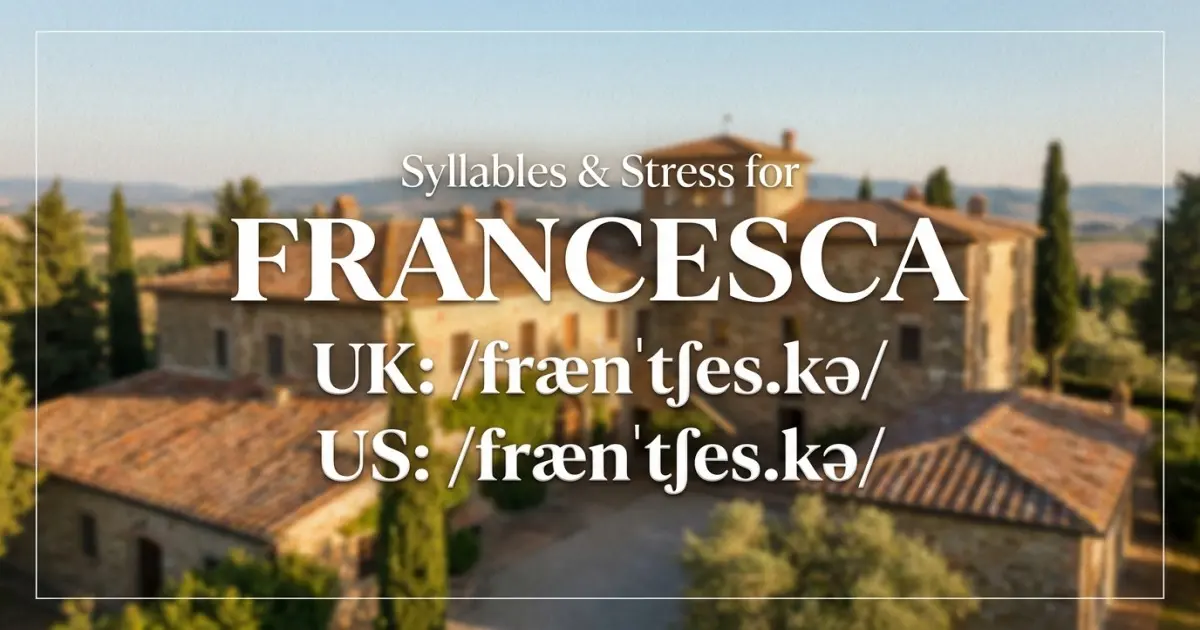
| IPA (US) | /frænˈtʃɛskə/ | The stress mark before tʃɛs shows that the middle syllable carries the emphasis. |
| IPA (UK) | /frænˈtʃɛskə/ | US and UK follow the same basic pronunciation pattern here. |
| Syllable count | 3 syllables | Think of it as quick, strong, soft: fran-CHESS-kuh. |
| Stress pattern | fran-CHESS-kuh | Do not spread equal weight across all three parts. |
| Ending sound | Light -kuh | Finish gently, not with a clipped -ka or an overpronounced final beat. |
Francesca lives or dies by the middle syllable
Why the stress belongs on CHESS
The heart of Francesca is the second syllable. That is what gives the name its poise. In the pronunciation fran-CHESS-kuh, the first syllable opens the line, but the middle syllable provides the identity. If a speaker weakens that center, the name can start to sound uncertain or overly flattened. If they emphasize the first syllable too heavily, it can drift toward a more blunt, anglicized rhythm. The middle is what keeps the name recognizably Francesca. Before focusing only on syllables and stress, it helps to step back into the fuller frame of Francesca meaning.
This is also why the supplied IPA matters. In /frænˈtʃɛskə/, the stress mark appears before the middle syllable. That is the instruction the ear needs. The opening fran should be clear, but not dominant. The middle CHESS should be the strongest beat. The final kuh should land softly, almost like a release. That three-part structure is what makes the name feel elegant rather than crowded.
The sound mechanics inside Francesca
Phonetically, Francesca is easier than it first appears. It begins with the fr cluster: a fricative f followed by the liquid consonant r. That combination creates a forward-flowing start rather than a hard stop. The middle contains ch, which is technically an affricate, giving the stressed syllable a crisp but not harsh center. Then the name ends with a relaxed schwa-like sound in -kuh, which is why the finish should never sound overly hammered or theatrical.
Put another way, the sound structure of Francesca is already balanced. It begins with movement, peaks in the center, and softens at the end. A good pronunciation simply respects that built-in architecture.
Francesca across accents stays more stable than people expect
What does not really change
One of the useful things about Francesca is that it travels well across accents. The provided U.S. and U.K. IPA forms are the same, which tells you something important: even when speakers bring regional color to the vowels, the overall pattern remains stable. The name still has three syllables. The stress still sits in the middle. The ending still softens rather than hits sharply.
That kind of stability matters in real life. Some names change character noticeably between accents because the vowels shift or the stress relocates. Francesca usually does not do that. A British speaker and an American speaker may color the opening vowel slightly differently, but the name remains recognizably the same because its rhythm is so strong.
What listeners may notice first
If there is any accent difference, most people will notice it in the opening vowel of fran. Some speakers may make it sound a little broader or flatter, while others keep it tighter. But this is a nuance, not a redesign. The central CHESS is the true anchor, and that tends to remain clear in most English-speaking environments.
The ending can vary a little too. Some speakers will reduce the final -kuh more strongly, especially in faster speech. Others will articulate it more fully. Still, the last syllable should remain light. It should never sound like the speaker is trying to prove that the name ends in -ca.
Where Francesca gets mispronounced, and why the errors are predictable
Mistake pattern one: putting too much weight on the first syllable
A common mistake is to say FRAN-ches-ka with the first syllable doing too much work. This often happens when people see the familiar opening Fran- and assume the name behaves like a straightforward extension of Frances or Francis. But Francesca is not a name that should feel front-heavy. Its shape depends on the middle syllable lifting the line.
When the first syllable is overemphasized, the name loses some of its grace. It can start to sound choppy or overly English in the wrong way. The fix is simple: ease off the opening and let the center carry the name.
Mistake pattern two: flattening the ending into a hard -ka
Another predictable misstep is to turn the ending into a sharply pronounced -ka. On paper, the spelling can tempt the eye in that direction. In speech, however, the ending is better handled lightly as -kuh. If the final syllable becomes too hard, the whole name can sound mechanical. You lose the softness that makes Francesca feel refined.
This matters especially in introductions and formal settings. A name spoken with a hard finish can sound like it has been decoded rather than actually known. The best pronunciation sounds lived-in, not over-enunciated.
Mistake pattern three: rushing the middle because the name looks longer than it is
Francesca can look visually elaborate, which sometimes makes speakers rush it. They try to get through it quickly, assuming that a three-syllable Italian name must be complicated. In fact, it is the opposite. The name is only three syllables and follows a very clear stress pattern. Rushing it usually causes more trouble than speaking it naturally.
The practical correction is to remember the pulse: fran-CHESS-kuh. Quick, strong, soft. Once that pattern is secure, the name becomes easy to say at normal conversational speed.
Francesca has sound neighbors, but they should not pull the name off course
Names that sit nearby in the ear
Francesca lives near several names that can shape expectations. Frances and Francis share the beginning. Franca and Frances may influence how some speakers treat the opening stress. Even Frankie, as a nickname, can make listeners mentally shorten the name before they have fully heard it. But those are neighbors, not instructions. When the stress sits in the center, the nickname logic often follows that same center of gravity, which is why Francesca nicknames is the natural next step.
The full form should still keep its own center of gravity. The opening may be familiar from other names in the family, but the middle syllable is what keeps Francesca from collapsing into something shorter or more generic.
Why nicknames can actually help with pronunciation
Interestingly, the nickname ecosystem around Francesca can sometimes help people learn the full pronunciation rather than confuse it. A name like Cesca draws attention to the center of the name. A name like Frankie reminds people that the full form is related to the Frances family, but not identical in rhythm. Even so, the full pronunciation should always come back to the same pattern: fran-CHESS-kuh.
Francesca becomes easiest when you practice it in ordinary speech
Practice lines that bring the rhythm into focus
The easiest way to learn Francesca is not by staring at symbols but by saying the name in real sentences. Try it in short, natural phrases:
“Francesca, your table is ready.”
“This is Francesca from the office.”
“Can Francesca come to the front desk?”
In each case, the middle syllable should feel like the point of lift. If the name sounds too heavy at the start, reduce the first beat. If it sounds too sharp at the end, soften the last one. The goal is not to stage the name. The goal is to let it fall into natural speech.
A practical memory cue
If someone needs a quick reminder, the best cue is this: start steady, stress the center, finish soft. That gives you the whole personality of Francesca in one sentence. It is not a name that wants dramatic force. It wants proportion.
Francesca sounds best when the speaker trusts its elegance
The best pronunciation of Francesca is not the most theatrical one or the most overcareful one. It is the one that respects the name’s natural line. Three syllables. Stress in the middle. Soft ending. That is enough. The name already contains its own grace. A speaker only needs to avoid dragging it toward bluntness or pushing it toward display.
That is part of why Francesca remains so appealing. It looks refined on the page, but it is much more manageable in the mouth than some people assume. Once the listener hears fran-CHESS-kuh correctly even once, the name usually settles into memory and begins to sound exactly as it should: elegant, clear, and entirely livable.