
Elsie Pronunciation: Easy Breakdown and Speaking Tips
The real pronunciation test for Elsie usually happens in ordinary life, not in a dictionary. It happens when a teacher reaches the name on the first day of school, when a pediatrician calls it from the waiting room, or when a grandparent reads it on a card and wants to say it correctly at once. Elsie looks friendly and familiar, which helps, but names with vintage warmth sometimes invite tiny hesitations because people momentarily wonder whether they should say them more formally than everyday speech actually requires.
With Elsie, the answer is refreshingly simple. The name is pronounced EL-see. The stress falls on the first syllable, and the second syllable stays light and bright. Once that rhythm is clear, the name becomes very easy to say. Elsie is not a complicated name. It is a name whose charm depends on keeping the sound clean, quick, and natural rather than overthinking the spelling.
What Elsie is clarifying every time it is spoken aloud
| Element | Phonetic Detail | Quick Tip |
|---|---|---|
| Everyday Pronunciation | EL-see | Say it in two clear beats, with the first syllable carrying the weight. |
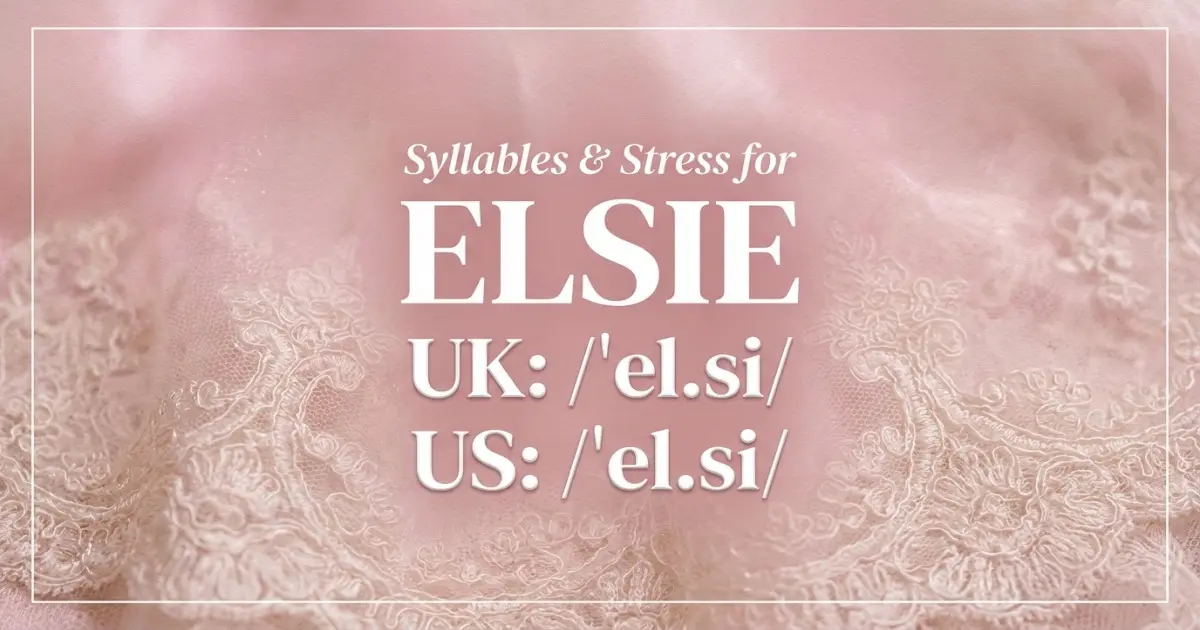
| IPA (US) | /ˈɛlsi/ | The opening vowel is the short e sound in words like bell or red. |
| IPA (UK) | /ˈɛlsi/ | The pronunciation stays essentially the same in both major English accents. |
| Syllable Count | 2 syllables | Think of it as Els + ie, not one blurred sound. |
| Primary Stress | First syllable | Lean gently on EL, then let the second syllable brighten and release. |
| Ending Sound | Clear -see | Do not reduce the ending too much; the final ee sound gives Elsie its sparkle. |
Elsie sounds best when the first syllable stays grounded
The center of Elsie is its opening syllable. EL is where the ear finds the name first, and that is why the stress belongs there. In phonetic terms, the first vowel is /ɛ/, the same short open sound heard in bed, well, or dress. This matters because if the first vowel shifts, the whole name changes character immediately. The sound matters more once you know what the name is meant to carry, which is why the wider frame starts in Elsie meaning.
That short e keeps Elsie from sounding either too clipped or too airy. It gives the name warmth and familiarity. A longer or tenser opening vowel would make the name feel more distant. The actual sound of Elsie is much friendlier than that. It begins close to the mouth and stays there.
Why the consonant cluster in Elsie matters
Elsie starts with a compact cluster of sounds: the vowel /ɛ/, the liquid consonant l, and the soft s that leads into the second syllable. This sequence is part of why the name feels smooth. The l is a liquid consonant, which simply means it lets the name flow instead of stopping it sharply. That flow prevents Elsie from sounding blunt, even though the stress sits firmly at the front.
Why the stress should not move forward or flatten out
Because Elsie is only two syllables, any confusion about stress is immediately noticeable. The first syllable should always carry the name. If someone over-softens the opening and gives the second syllable too much importance, the result sounds less natural. Elsie is not meant to rise at the end. It begins clearly and then brightens gently.
Elsie’s second syllable is where the name gets its light
If the first syllable gives Elsie its grounding, the second gives it its charm. The ending is -see, with a clear long ee vowel /i/. This is not a heavy ending, but it is an important one. It adds lift. Without it, Elsie would feel much more abrupt and much less affectionate.
This second syllable is also what makes the name feel naturally friendly in English. Many names with -ie or -y endings take on a familiar, bright quality, and Elsie benefits from that pattern. The ending is not childish in a narrow sense, but it is undeniably warm. That warmth is part of the pronunciation, not just the name’s style reputation.
Elsie is not “Else-ee” with a hard split
One small mistake some speakers make is separating the name too strongly, almost as if the first part were the full word else followed by a separate ee. In natural speech, the transition is smoother than that. Elsie should feel like one flowing unit, not two clipped pieces glued together.
Elsie is also not “El-zee”
Another occasional misfire is turning the s into something closer to a z sound. In standard everyday pronunciation here, the middle consonant stays a clear s. That is part of what keeps the name bright and lightly vintage rather than harsher or more angular.
Elsie across accents keeps the same clean backbone
One of Elsie’s practical advantages is that the U.S. and U.K. pronunciations given here are exactly the same: /ˈɛlsi/. That means the name is unusually stable across major English accents. Speakers may differ slightly in pace, sharpness, or how crisp the final vowel feels, but the actual structure of the name remains unchanged. The stress stays on the first syllable, the short e stays in place, and the ending remains see.
This kind of stability is more important than it may seem. Some names shift substantially across dialects, which can create uncertainty in multilingual or international settings. Elsie does not do that. It stays itself. That makes the name especially easy to carry in ordinary life.
Why Elsie is easy to hear correctly after one exposure
The sound pattern of Elsie is built from familiar English materials. The first syllable feels close to words like else and El- names such as Ella or Ellie. The second syllable uses a very familiar long ee ending. Once someone hears the full pattern one time, it is usually very easy for them to repeat it correctly later.
Where people stumble on Elsie, and how to correct it quickly
Most pronunciation mistakes with Elsie are small, not dramatic. The name is readable and socially familiar. But short names magnify tiny errors, so even a slight vowel shift can change the whole feel. The good news is that the fixes are simple.
Elsie is not “Ell-see-ah” or any expanded form
Sometimes people see the vintage softness of the name and unconsciously try to make it more elaborate than it is. That is unnecessary. Elsie works precisely because it is compact. It should remain a clean two-syllable name, not an expanded or ornamental version of itself.
Elsie is not “EL-suh” with a reduced ending
The second syllable should stay bright. If the ending weakens into something like suh, the name loses its shape and begins to sound incomplete. The final ee sound is not decorative. It is structural. It gives the name its finish. Private forms usually grow from the way a name is actually repeated at home rather than from formal spelling, so see nicknames for Elsie.
Practice lines that make Elsie sound natural
- “Elsie, your turn is next.”
- “Is Elsie coming after school?”
- “Elsie left her book on the table.”
- “Hi, I’m Elsie.”
These lines matter because names sound truer in sentences than in isolation. If Elsie feels smooth and unforced in ordinary speech, the pronunciation is likely right.
Why Elsie stays so easy to say in everyday life
Elsie works phonetically because it balances grounding and brightness in just two syllables. The first syllable gives the name warmth and structure. The second gives it lift and friendliness. Nothing in the sound is wasted. That efficiency is one reason the name remains so appealing. It sounds polished without being formal and affectionate without becoming over-cute.
The simplest pronunciation advice is still the best: start with EL, keep the short e vowel clear, and let the name finish with a light, bright -see. Once that rhythm is in place, Elsie sounds exactly as it should—natural, graceful, and very easy to live with.