
Dakota Name Meaning: Meaning, Heritage, and Gentle Strength

Some names announce status. Some promise beauty. Dakota does something rarer and, in many ways, more difficult. It begins with relationship. “Friend; ally” is not a private or ornamental meaning. It is social from the first breath. It implies presence, trust, and the kind of human character that matters most when life becomes difficult. A friend is not an abstract virtue. An ally is not a decorative ideal. Both words belong to action. They suggest someone who stands with, not simply someone who stands out. That gives Dakota an unusual moral center. It sounds open, modern, and unforced, but the meaning underneath it is quietly serious.
That seriousness is part of why the name has endured. Dakota feels broad-shouldered without sounding heavy, and emotionally warm without becoming sweet. It moves easily through contemporary naming culture because it is unisex, familiar, and highly usable, yet the meaning keeps it from feeling empty or purely stylistic. In a naming world often crowded with words about brightness, royalty, or beauty, Dakota offers a different inheritance. It honors solidarity. It suggests that identity is not only about what a person is, but about how a person stands beside others. That makes the name feel not just strong, but socially intelligent.
Dakota's U.S. popularity rank over time, 1915–2024
Popularity statistics are based on official data from the Social Security Administration baby name records.
Dakota: A Strong and Genuinely Shared Ally
Dakota behaves like a name with a fluid identity that still feels stable, showing meaningful visibility across both sides of the chart. This “friend” choice likely travels well due to its soft-vowel sound and strong Native American roots .
The chart indicates that while both sides are visible, its structure travel well due to its simplicity. Reaching a record peak in the mid-1990s, it carries a texture of approachable character that remains current.
What Dakota says before anyone hears the backstory
| Key Facts | Information | Quick Insight |
|---|---|---|
| Name | Dakota | The form feels contemporary and easygoing, but the meaning underneath it gives the name far more ethical weight than style alone. |
| Primary Gender Use | Unisex | Dakota’s flexibility is one of its greatest strengths because the name sounds socially open rather than tightly coded. |
| Origin | Native-American | The origin gives Dakota cultural and historical depth, helping the name feel rooted rather than merely modern. |
| Core Meaning | Friend; ally | This is a meaning about relationship and character, not just image, which makes Dakota feel active and human-sized. |
| Common Pronunciation | duh-KOH-tuh | The strong middle syllable gives Dakota its confident rhythm and keeps the name from sounding too soft or vague. |
| IPA (US) | /dəˈkoʊtə/ | The American form highlights the rounded center of the name, which helps it sound sturdy and approachable at once. |
| IPA (UK) | /dəˈkəʊtə/ | The British form stays close enough to the U.S. version that the name remains recognizable and stable across accents. |
| Syllables | 3 | Three syllables give Dakota movement and ease, allowing it to sound relaxed without losing definition. |
| U.S. girls’ rank (2024) | No. 272 | Official data shows Dakota remains well known for girls, but still not so saturated that it feels overused. |
| U.S. boys’ rank (2024) | No. 328 | The boys’ ranking confirms the name still operates meaningfully across genders, even if present-day use is somewhat stronger on girls. |

Dakota begins with loyalty, and that changes everything
Why “friend; ally” feels stronger than many virtue meanings
Many names with positive meanings point toward beauty, light, peace, or grace. Those are admirable images, but they often remain inward or atmospheric. Dakota works differently. “Friend; ally” is interpersonal. It describes a bond, a stance, a form of reliability that only matters because other people exist. That makes the name feel unusually practical in its moral imagination. It does not praise the child for being radiant or beloved in the abstract. It imagines the child as someone who stands with others. For more names connected to this tradition, see baby names from this cultural background.
That social emphasis gives Dakota a different emotional profile from many other contemporary names. It sounds open-hearted without sounding fragile. It suggests trustworthiness without becoming preachy. Most importantly, it is a meaning people understand immediately. Everyone knows what a friend is. Everyone knows what it means to need an ally. That directness helps the name feel grounded in life rather than suspended above it.
Why Dakota’s meaning belongs to action, not decoration
An ally is not a static identity. It is a role tested by behavior. Friendship, too, is one of those human realities that only becomes meaningful through repeated action: staying, listening, helping, telling the truth, returning when needed. This is why Dakota feels more substantial than some names that sound equally modern. The meaning does not sit passively inside it. It points outward into conduct.
That outwardness is one of the reasons the name has held up so well across decades of changing naming taste. Dakota may sound easy and contemporary, but the idea beneath it is enduring. Human beings do not stop needing friends. They do not stop needing people who can be counted on. Names rooted in these needs often age better than names rooted only in mood or aesthetic fashion.
This also gives Dakota a rare combination of warmth and strength. A name meaning “friend” might have become too soft. A name meaning “ally” might have become too martial. Together, the two meanings create balance. One brings tenderness, the other steadiness. One suggests welcome, the other backbone. That is a compelling pair of qualities for any name to carry.

The sound of Dakota keeps the meaning from feeling overly solemn
The middle of Dakota is where the confidence lives
Dakota is pronounced duh-KOH-tuh, and the stressed middle syllable is what gives the name its center of gravity. The first syllable is light, almost understated. The middle arrives with strength and roundness. The final syllable releases gently. This rise-and-settle pattern helps explain why the name sounds relaxed and sturdy at the same time. The structure is casual enough for everyday life, but defined enough to hold real presence.

That matters because a name with a meaning like “friend; ally” could easily have sounded either too gentle or too forceful. Dakota avoids both extremes. The soft opening keeps the name approachable. The strong center keeps it from dissolving. The result is a rhythm that feels socially fluent and emotionally balanced.
Why Dakota sounds modern without sounding flimsy
Contemporary naming taste often favors names with clear rhythm, open vowels, and a certain ease in the mouth. Dakota fits comfortably into that sound world. But unlike some names that rely almost entirely on freshness of sound, Dakota has enough internal shape to keep its footing. The k at the center provides structure, and the three-syllable pattern gives the name flow without making it decorative.
There is also a reason the name feels so portable. It is easy to say, easy to hear, and easy to remember. Those are practical virtues. Names that survive in real life are rarely beautiful by sound alone; they must also function under pressure. Dakota does. It works in introductions, on forms, in classrooms, and in adult professional contexts without sounding either too informal or too stiff.
That phonetic usability strengthens the meaning. A name about friendship and alliance should sound approachable enough to belong to an actual person. Dakota does not merely gesture at warmth. It sounds like someone you could know.
Dakota’s unisex identity is not incidental. It is part of the name’s strength
What Dakota’s split ranking says about the name now
Official Social Security Administration (SSA) data places Dakota at No. 272 for girls and No. 328 for boys in the United States in 2024. Those numbers show something important. Dakota is not a theoretical unisex name that lives mostly on one side. It remains meaningfully present for both genders. At the same time, the rankings suggest slightly stronger current familiarity on girls. That does not weaken the name’s unisex status. It clarifies how the culture is hearing it right now. If you want to branch out from Dakota without leaving this category, explore shared boy and girl names.
For girls, Dakota may feel confidently established without being predictable. For boys, it may feel a touch more distinctive, but still completely legible. In both cases, the name retains social flexibility. That is one reason it continues to appeal to families who want openness without ambiguity so extreme that the name loses shape.
Why Dakota wears gender openness so well
Some unisex names feel as though they are crossing from one side of the naming map to another. Dakota feels more naturally shared than that. Part of the reason is that its meaning is not strongly attached to conventional gender scripts. Friendship and alliance are not coded in the way floral softness or inherited surname hardness sometimes are. They belong to human character more broadly.
The sound supports that breadth. Dakota has structure, but not aggression. It has openness, but not fragility. That balance allows the name to remain credible across a wide range of social presentations. In contemporary naming, that kind of balance is increasingly valuable. Families often want room, but not vagueness. Dakota offers room with edges.
In practical terms, the name can read warm, athletic, grounded, modern, or quietly adventurous depending on who wears it. That versatility is part of its social intelligence. Dakota does not force one performance. It makes several possible.
Dakota feels contemporary because it combines openness with solidarity
Why the name fits the modern ear so well
Current naming culture has shown a sustained appetite for names that are approachable, image-rich, and slightly outside older formal traditions without becoming strange. Dakota fits that appetite almost exactly. It sounds easy, but not empty. It feels familiar, but not dull. And because it is unisex, it carries a certain social looseness that many contemporary families actively seek.
But the name’s modernity is not the whole point. Dakota lasts because what it means still matters. In an era often defined by individualism, a name meaning “friend; ally” can sound almost quietly countercultural. It does not place the child at the center of a spotlight. It imagines the child in relation to other people. That gives the name more ethical texture than many fashionable choices possess.
Why Dakota feels warmer than many other modern unisex names
Some contemporary unisex names are admired for their sleekness, but they can read emotionally cool. Dakota does not usually have that problem. The rounded middle syllable and the relational meaning underneath it keep the name from feeling detached. Even when it sounds modern, it still sounds personable. That is not a small advantage. Families often want names that feel current without sounding emotionally blank. Dakota often succeeds on exactly that point.
Socially, the name tends to project steadiness, friendliness, and a certain outdoor ease, but it is the meaning that makes those impressions cohere. Without “friend; ally,” Dakota would still be usable. With it, the name gains moral direction. It becomes more than a style choice. It becomes an argument about what kind of strength matters.
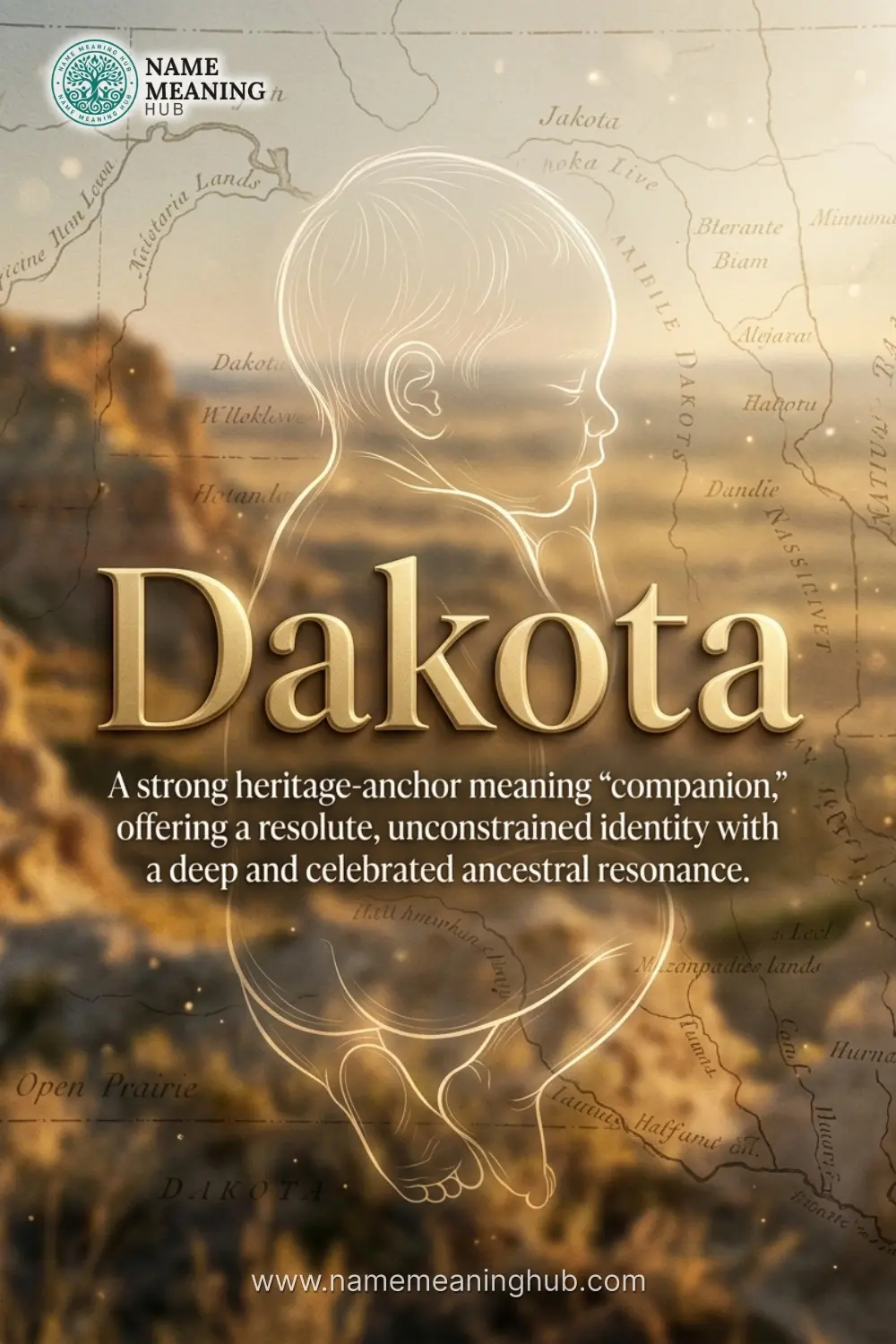
If Dakota is already on your shortlist, these are the next questions it opens
Once Dakota begins to feel right, the next stage is usually not whether it is strong enough. It is how to shape the full experience of the name. Because Dakota is unisex, socially open, and sound-forward, the surrounding choices matter. A middle name can tilt it more classic, more feminine, more masculine, or more modern. Nicknames can either preserve its easygoing strength or bring out a softer, more playful side. Pronunciation is stable, but the center syllable still deserves attention because that is where much of the name’s confidence lives.
Middle names that tell people how to read Dakota
Dakota’s flexibility means the middle name often does more interpretive work than parents expect. A classic middle can anchor it. A sharper modern middle can keep it sleek. A softer middle can warm it without weakening it. If you want the full pairing logic behind that contrast, see Dakota middle names.
Nicknames that reveal whether Dakota stays cool or turns intimate
Because the name is already friendly in full, nicknames are more about household tone than necessity. Some families may use Dakota intact. Others may naturally create forms that feel more playful, closer, or more obviously child-centered. To see how those different moods shorten in real life, explore Dakota nicknames.
Pronouncing Dakota so the strength stays centered
The name works because the stress lands cleanly in the middle. Preserving that strong center keeps Dakota sounding confident and socially easy rather than flattened by haste. If you want the full sound pattern behind that rhythm, read Dakota pronunciation guide.
Why the name Dakota still sounds like trust you can hear
At its deepest level, Dakota is compelling because it makes relationship sound strong. That is harder than it seems. Many names can sound bold. Many names can sound beautiful. Fewer can sound reliably human. Dakota does. It carries a meaning that points toward loyalty and companionship without becoming sentimental, and it does so in a form that still feels current and relaxed in real life.
This is why the name continues to resonate. It offers something many families want but do not always know how to name directly: a child who is not imagined only as singular and dazzling, but as trustworthy, connected, and capable of standing beside others. That is a deeply meaningful aspiration, and Dakota expresses it without strain.
In the end, Dakota lasts because it turns social virtue into style without reducing that virtue to style. It is warm, but not weak. Open, but not shapeless. Modern, but not morally empty. Most of all, it reminds us that one of the strongest identities a person can carry is also one of the oldest: Dakota is what solidarity sounds like when it becomes a name.
Common Questions About the Meaning of Dakota
Is Dakota truly a unisex name?
Yes. Current U.S. ranking data shows Dakota remains established for both girls and boys, even if present-day use is somewhat stronger on girls.
Does Dakota’s meaning feel more gentle or more strong?
It carries both. “Friend” gives the name warmth, while “ally” gives it backbone. Together they create a meaning that feels relational and strong at the same time.
Why does Dakota feel modern without sounding trendy?
The sound is contemporary and easy, but the meaning is deeply human and not tied to a short-lived fashion. That balance helps the name feel current without seeming disposable.
Does Dakota age well into adulthood?
Yes. Dakota’s stable pronunciation, unisex flexibility, and grounded meaning help it move easily from childhood into adult professional and personal life.