
How to Pronounce Anne: An Easy Sound-by-Sound Breakdown
A name like Anne usually gets tested in ordinary places first: on a school attendance list, at a doctor’s reception desk, in the pause before someone repeats it back to make sure they heard correctly. That is where pronunciation stops being theoretical. Some names invite hesitation, extra syllables, or a polite follow-up question. Anne usually does not. It lands fast, clean, and finished. A teacher says it once, and the room understands it. That real-life ease is one of the name’s quiet strengths.
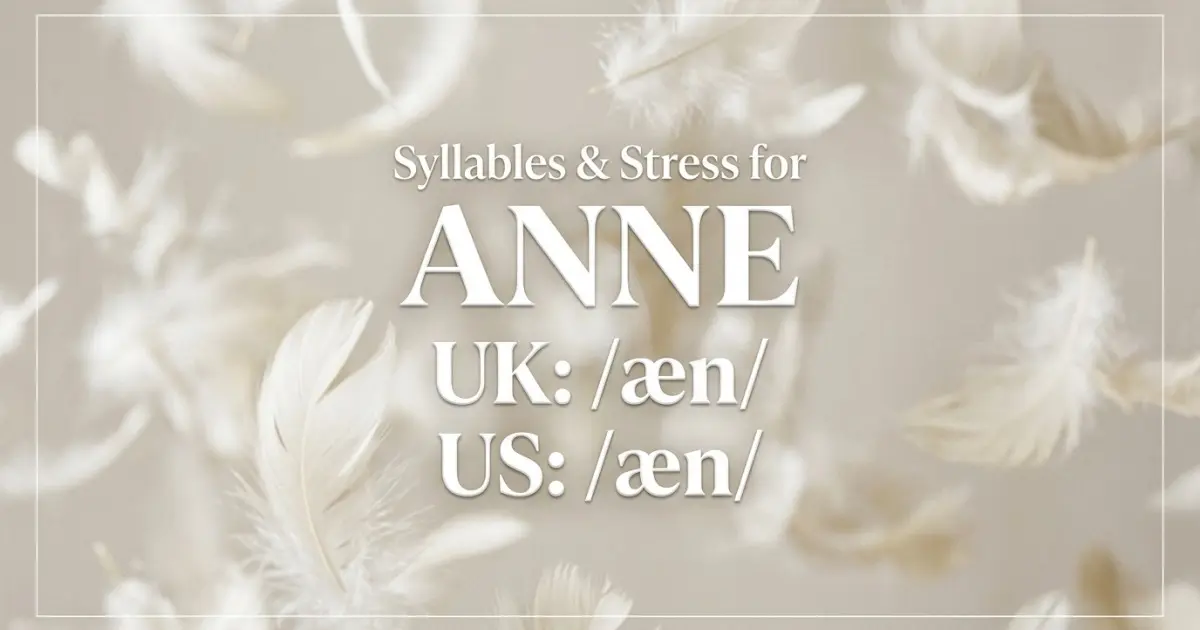
But simplicity can be deceptive. Short names often look easy because they contain so little material, yet that small amount of sound has to carry everything: identity, tone, rhythm, and memorability. Anne works because its pronunciation is compact without becoming blunt. It is a one-syllable name spoken as AN, with the same IPA in both U.S. and UK usage: /æn/. That makes it unusually stable across accents. The name does not need a long guide to be pronounceable, but it does reward a close look, because its clarity is exactly what gives it polish.
How Anne Is Actually Said in Everyday English
| Element | Phonetic Detail | Quick Tip |
|---|---|---|
| Common spoken form | AN | Say it in one clean beat, not stretched into two parts. |
| IPA (US) | /æn/ | The vowel is the same short front sound heard in words like “cat” or “hand.” |
| IPA (UK) | /æn/ | There is no meaningful U.S./UK split here, which makes the name highly portable. |
| Syllable count | 1 syllable | Anne should feel quick and complete, never broken into extra beats. |
| Stress pattern | Full stress on the only syllable | Since Anne has one syllable, all the energy sits in that single sound. |
| Ending sound | Final /n/ sound | Let the name close neatly with the nasal ending instead of flattening or dropping it. |
| Main comparison point | Rhymes with “man” and “can” | If you can say “can,” you already have the core sound of Anne. |
Anne in the Mouth: One Syllable, Full Stress, No Waste
Anne is pronounced as a single stressed syllable: AN. That may sound almost too obvious to explain, but it matters because one-syllable names rely on proportion. There is nowhere to hide a weak vowel, no second syllable to soften the line, and no ornamental ending to carry warmth. Everything happens at once. The name begins with a broad, open front vowel and closes with an n, a nasal consonant made by directing sound through the nose while the tongue touches the ridge behind the upper teeth. Before focusing only on syllables and stress, it helps to step back into the fuller frame of Anne meaning.
The vowel is what makes Anne feel familiar
The vowel in Anne is the short a sound represented in IPA as /æ/. In everyday terms, it is the same sound many English speakers use in words like “cat,” “hand,” and “lamp.” That is one reason Anne feels so easy to say. It uses one of the most familiar vowel shapes in English. There is no glide, no diphthong, no need to move toward another vowel mid-word. You open into the sound and stop cleanly.
The final N keeps Anne from feeling airy
Without the closing n, Anne would drift. The ending gives the name its discipline. Linguistically, that final consonant is a nasal rather than a liquid consonant or a fricative, which means it closes the name softly but definitively. You do not hiss out of it, and you do not let it melt away. You land on it. That neat landing is why Anne sounds composed rather than decorative.
Because the name has only one syllable, stress is simple: the entire name carries the stress. There is no secondary beat to consider. Anne should sound direct, not rushed, and certainly not stretched. The correct rhythm is one clean pulse.
Where Anne Usually Goes Wrong
Anne is not a high-risk pronunciation name, but it does attract a few predictable mistakes, mostly because it sits close to other familiar forms in English and French naming traditions.
Anne is not Annie
This is the most common practical confusion. Anne and Annie are closely related, and people often move from one to the other casually in speech. But pronunciation-wise they are not interchangeable. Anne is one syllable: AN. Annie is two syllables: AN-ee. The extra ending changes not only the rhythm but the social feel of the name. Anne sounds more formal and finished. Annie sounds warmer and more familiar.
Anne is not said like the French name Anne in French speech
In English-language use, Anne is generally spoken as /æn/. Some people, seeing the French origin, may wonder whether it should be said more like a French form or with a softer continental coloring. In standard English usage, it usually is not. The practical, everyday pronunciation remains AN. That is the form most speakers expect and the one that creates the least friction.
Anne should not be flattened into a vague “uhn”
In very fast speech, some speakers weaken short names and reduce them toward a duller central vowel. Anne should resist that. It wants the bright short a, not a lazy schwa-like blur. If the name starts sounding like a swallowed “uhn,” it loses the crispness that makes it elegant.
Anne Across Accents Still Stays Remarkably Stable
One of Anne’s strongest pronunciation advantages is that it changes very little between major English accents. Official guidance places both U.S. and UK IPA at /æn/, which is unusually tidy. Plenty of names shift noticeably across regions. Anne mostly does not.
What stays the same in U.S. and UK speech
The one-syllable structure stays the same. The stress stays the same. The final n stays the same. Most importantly, the core vowel remains recognizably the same short front vowel. A speaker from Boston, London, or Chicago may color the edges of the sound slightly according to accent, but the name remains immediately identifiable.
Why that stability matters in real life
Names that travel cleanly across accents have a practical social benefit. They are repeated back correctly more often. They need less correction in introductions. They tend to feel established rather than fragile. Anne belongs to that category. It is one of those names that can move through airports, classrooms, offices, and family circles without needing a pronunciation footnote.
Anne Beside Its Sound Neighbors
Sometimes the easiest way to master a name is by hearing what it is next to. Anne lives near several familiar sound neighbors, and each one clarifies something about its pronunciation. Because the strongest energy lands early, the shorter forms often grow from the opening of the name, and that pattern is easier to see in Anne nicknames.
Anne and Ann are spoken alike in everyday English
In most English-speaking contexts, Anne and Ann are pronounced the same way. The spelling difference is visual and stylistic, not usually phonetic. That means Anne gains the elegance of its final e on the page without changing what happens in the mouth.
Anne versus Anna, Annie, and Ana
Anna opens the name outward into two syllables. Annie adds an affectionate ending. Ana may vary depending on language background. Anne, by contrast, stays compact. It is the clipped, formal center of this name family. When someone says Anne correctly, it should sound leaner than Anna and firmer than Annie.
How to Practice Anne Until It Sounds Natural
Fortunately, Anne does not need elaborate drilling. The best practice is short, clear, and spoken in realistic phrases.
Quick mouth cue
Start with the vowel from “cat.” Then add the final n. Say it once, not twice: Anne.
Useful practice lines
Try these aloud:
- “Anne is here.”
- “This is Anne.”
- “Have you met Anne?”
- “Anne wrote the note.”
If the name begins to sound too soft, brighten the vowel. If it starts to sound too clipped, let the final n land gently instead of chopping it off. The ideal result is poised, fast, and unmistakable.
That is the achievement of Anne as a spoken name. It does not demand attention through unusual sounds or complicated music. It earns clarity through exactness. One syllable, one stress, one familiar vowel, one clean ending. In pronunciation, as in style, Anne proves how much grace can live inside a very small space.
Pronouncing Anne: Common Questions
How do you pronounce Anne in English?
Anne is usually pronounced AN, with one syllable. In IPA, that is /æn/.
Are Anne and Ann pronounced differently?
In most everyday English use, they are pronounced the same way. The difference is mainly in spelling and style, not sound.
Is Anne pronounced the same in the U.S. and the UK?
Yes, broadly speaking. Standard guides give both U.S. and UK pronunciation as /æn/, so the name stays very stable across accents.
What is the most common pronunciation mistake with Anne?
The most common mix-up is turning Anne into Annie. Anne should stay one syllable, not two.