
How to Pronounce Yasmin: How the Name Is Usually Said
The pronunciation test for Yasmin does not usually happen in a naming book. It happens in a classroom doorway, at a doctor’s reception desk, during an awards ceremony, or in the pause before a new colleague says a name aloud for the first time. That is where pronunciation stops being abstract and becomes social. Yasmin is a particularly interesting case because it is not difficult in the ordinary sense, yet it does carry a real accent split in English. In one setting, it is likely to be heard as yaz-MEEN. In another, it may arrive as YAZ-min. Both forms are recognizable, both belong to real usage, and both preserve the same underlying name.
That matters because the name’s elegance depends partly on how confidently it is said. Yasmin is short, clean, and internationally mobile, but the rhythm changes the atmosphere. In American usage, the stress often moves forward into the second syllable, giving the name a lifted, polished finish. In British usage, the first syllable is often stronger and the ending shorter, making the name sound brisker and more compact. The good news is that neither version breaks the name. The core identity stays intact: the opening Yaz- or Yas-, the floral root, and the compact two-syllable frame all remain easy to recognize.
How Yasmin is actually said when people know the name
| Element | Phonetic Detail | Quick Tip |
|---|---|---|
| Common U.S. form | yaz-MEEN | Put the main stress on the second syllable and let the ending ring clearly. |
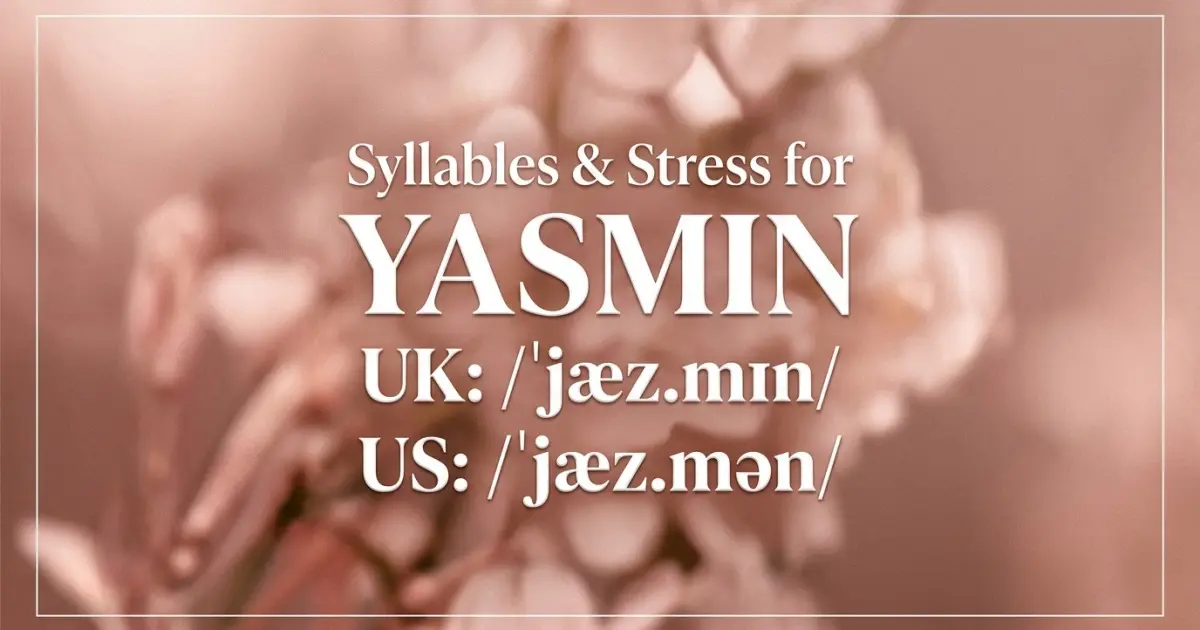
| U.S. IPA | /jæzˈmiːn/ | The long ee sound at the end is the anchor of the American form. |
| Common U.K. form | YAZ-min | Keep the stress on the first syllable and make the second syllable shorter and lighter. |
| U.K. IPA | /ˈjæzmɪn/ | The ending is shorter than in the American form, more min than meen. |
| Syllable count | 2 syllables | Yasmin is compact; it should not be stretched into three beats. |
| Opening sound | Yaz- with a voiced z | That z sound gives the name its energy and keeps it from sounding too soft. |
| Ending sound | -MEEN in the U.S.; -min in the U.K. | The ending is where the two major English pronunciations separate most clearly. |
Yasmin depends on which English you are hearing
The American Yasmin rises at the end
In the U.S. form, Yasmin is most naturally heard as yaz-MEEN. The IPA given for that version, /jæzˈmiːn/, shows the stress marker before the second syllable. That detail matters because it changes the whole personality of the name. A second-syllable stress gives Yasmin lift. The name begins lightly, then sharpens and brightens at the end. It sounds sleek, elegant, and a little more overtly refined. The sound matters more once you know what the name is meant to carry, which is why the wider frame starts in Yasmin meaning.
This version also gives more room to the final vowel. The long ee in MEEN lengthens the ending just enough to make the name feel polished rather than clipped. In everyday life, this is often the form English speakers in the United States will default to, especially if they are already familiar with related names in the Jasmine family.
The British Yasmin lands earlier
In the U.K. form, the IPA /ˈjæzmɪn/ places the main stress on the first syllable. That makes the name sound more compact: YAZ-min. The first beat carries the weight, and the second syllable closes more quickly. Instead of ending in a long een, the name resolves with a shorter ih sound. The result is not less elegant, just more concise. The British form often sounds brisker and more grounded, whereas the American form sounds slightly more lifted and lyrical.
What is useful here is that the difference is systematic rather than confusing. Speakers are not inventing random variants. They are expressing two familiar English stress patterns around the same name. Once a family knows which pronunciation they prefer, they can model it consistently without needing to argue that the other form is illegitimate.
What stays the same in both versions
Even with the stress shift, the name’s structure remains stable. Both versions begin with the same yaz- sound, both remain two syllables, and both preserve the strong floral identity of Yasmin. This stability is one reason the name travels so well across countries and communities. A slightly different rhythm does not obscure the name. It simply colors it.
Why Yasmin sounds crisp even though it means a flower
Phonetically, Yasmin is a compact and well-built name. It begins with the palatal glide y, which keeps the opening soft, but that softness is immediately strengthened by the voiced fricative z. A fricative is a sound made with controlled airflow, and the z in Yasmin matters because it gives the name a small line of force. Without it, the name would be much blurrier. Then come the nasal consonants m and n, which soften the close. In simple terms, Yasmin begins in air, sharpens in the middle, and settles gently at the end.
That sequence helps explain why the name does not sound overly delicate despite meaning “jasmine flower.” Many floral names rely on liquid consonants like l and r or open vowels that keep everything airy. Yasmin is different. It has enough friction and enough closure to feel composed. That is one reason it ages so well. It can sound graceful on a child, but it is equally convincing on an adult in formal settings.
The name also benefits from brevity. With only two syllables, Yasmin is easy to recall after one hearing. There is no clutter to work through. That economy gives the pronunciation unusual resilience. Even when speakers disagree slightly about stress, they are still almost always saying something unmistakably close to the intended name.
Where Yasmin is most likely to be misheard
Stress confusion is the main issue
The biggest pronunciation challenge with Yasmin is not misreading the letters. It is deciding where the stress belongs. If someone has learned the name mostly in American settings, they may instinctively say yaz-MEEN. If they know it through British usage, they may say YAZ-min. This is less a mistake than a regional expectation. Still, for families who strongly prefer one version, it helps to know in advance where the correction will probably be needed.
Turning Yasmin into Jasmine is a different problem
A second issue is substitution rather than pronunciation. Because Yasmin lives near Jasmine, Jasmin, and Yasmine in the broader name family, some people may drift toward a more familiar variant when reading quickly. That is not really a sound error so much as a recognition shortcut. The simplest fix is usually the most practical one: “It’s Yasmin, with a Y.” Once that is established, the pronunciation itself is usually easy.
The ending should not become too heavy
In both major English forms, the second syllable should stay clean. In the American pronunciation, the ending is longer, but not theatrical. In the British pronunciation, it is shorter, but not swallowed. If the ending becomes overemphasized, the name can feel overperformed. Yasmin works best when it is said with confidence rather than flourish. When the stress sits in the center, the nickname logic often follows that same center of gravity, which is why nicknames for Yasmin is the natural next step.
How to make Yasmin feel natural in the mouth
Use real sentences, not isolated repetition
The easiest way to learn a name is to say it in ordinary speech. Practice lines for the American form might sound like this:
- “Yasmin is here.”
- “This is Yasmin.”
- “Can Yasmin come to the front, please?”
In those lines, the American version should rise into -MEEN. The British form uses the same sentences, but with the first syllable taking more weight: YAZ-min. In either case, real speech helps far more than sounding out the name letter by letter.
Choose one family form and model it clearly
If a family prefers the American pronunciation, consistency matters. The same is true for the British one. Most people learn names socially, not analytically. That means repeated confident use usually does more good than lengthy explanation. Yasmin is short enough that once people hear the preferred form a few times, they tend to retain it.