
Wolfgang Pronunciation: Sound Breakdown for Confident Speech
Picture a music teacher calling names before rehearsal, or a receptionist reading from an appointment list. Wolfgang is one of those names that looks dramatic on the page but becomes simple once spoken aloud. It does not need four steps or a special explanation. It is two firm beats: WOLF-gang.
The key is to let the first syllable carry the name. Wolfgang begins with the familiar word wolf, then lands on gang with a clear final sound. Because the spelling is striking and German in origin, some speakers may expect something more complicated. In everyday English, though, the pronunciation is direct, compact, and memorable.
Wolfgang Is Said Best When the First Beat Stays Strong
| Element | Phonetic Detail | Quick Tip |
|---|---|---|
| Everyday pronunciation | WOLF-gang | Say it in two beats, with the main emphasis on WOLF. |
| Syllable count | 2 syllables | Break it as WOLF / gang; do not add an extra middle sound. |
| Stress pattern | First syllable stress | The name should begin strongly, then finish cleanly. |
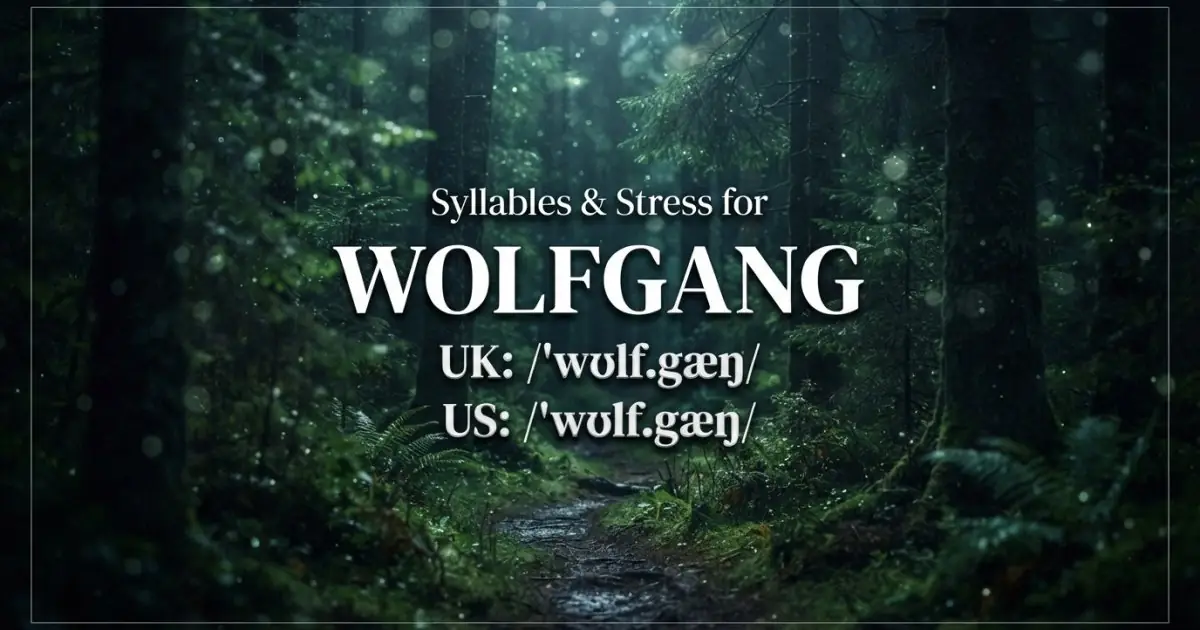
| U.S. IPA | /ˈwʊlfɡæŋ/ | The stress mark before the first syllable confirms that WOLF carries the weight. |
| U.K. IPA | /ˈwʊlfɡæŋ/ | The listed IPA is the same for U.S. and U.K. English. |
| Main pronunciation risk | Overcomplication | Avoid turning Wolfgang into three syllables; it is not Wolf-uh-gang. |
The Two Syllables of Wolfgang Make the Name Easier Than It Looks
Wolfgang has a bold visual presence, but its spoken form is simple. The name divides into two parts: WOLF and gang. The first syllable is stressed, so it should sound slightly stronger, longer, and more important than the second. Pronunciation lands more fully when the name’s roots and history are already in view, so begin with Wolfgang meaning.
The opening WOLF carries the identity of the name
The first syllable sounds like the English word wolf. This is helpful because it gives speakers a familiar anchor. The w begins softly and roundly, the l acts as a liquid consonant that gives the syllable a full, dark quality, and the final f is a fricative, made by letting air pass through a narrow opening.
That combination gives Wolfgang a textured opening. It is not a sharp or clipped first syllable. It has breath, shape, and weight. In careful speech, the l should remain audible enough that the word does not become woof.
The ending gang should land clearly
The second syllable, gang, should be lighter than WOLF but still clear. It begins with a hard g and ends with the same hard sound. This gives the name its decisive finish.
The final sound matters because it keeps Wolfgang from fading away. If the ending is swallowed, the name loses some of its structure. A good pronunciation lets the name start with strength and end with definition: WOLF-gang.
The IPA for Wolfgang Shows a Rarely Complicated Name in a Clean Form
The IPA pronunciation for both U.S. and U.K. English is /ˈwʊlfɡæŋ/. The small stress mark before the first syllable shows that the emphasis comes immediately. Unlike longer names where speakers must search for the stressed beat, Wolfgang tells the ear where to begin.
Why the IPA confirms the everyday guide
The IPA reflects the same plain-English guide: WOLF-gang. The first vowel is the sound in wolf, not a long wole sound. The second syllable uses the vowel heard in many English pronunciations of gang. Together, the IPA confirms that the name does not need a hidden vowel, extra syllable, or shifted stress.
This is useful for a German-origin name because some speakers may assume a more foreign pronunciation is required. In everyday English, the listed pronunciation is straightforward and stable.
Accent differences are small
Because the IPA is the same for U.S. and U.K. English, Wolfgang does not shift dramatically across these two accents. The main difference may be the exact color of the vowel in wolf or gang, depending on the speaker’s regional accent.
Some speakers may make the first vowel slightly darker or rounder. Others may make the a in gang a bit flatter or broader. These differences are normal accent color, not separate pronunciations. The essential pattern remains WOLF-gang.
Common Mistakes With Wolfgang Come From Adding Too Much
Wolfgang is more often overpronounced than mispronounced. Because it looks old-world and formal, speakers may try to make it more complicated than it is. The safest approach is to trust the two-syllable structure.
Do not add an extra vowel
The most common mistake is saying something like Wolf-uh-gang. Wolfgang has two syllables, not three. Keep the transition from WOLF to gang clean and direct.
Do not stress the second syllable
Another mistake is saying wolf-GANG, with too much emphasis at the end. The correct rhythm is WOLF-gang. The second syllable should finish the name, not overpower it.
Do not soften the final g too much
The final g should be heard. If the name becomes something like WOLF-gan, it loses the clean landing that gives Wolfgang its strong shape. The ending should be firm without being exaggerated.
Sound Neighbors Help Wolfgang Feel Familiar in Conversation
Wolfgang shares sound territory with names and words that English speakers already know. The first syllable connects directly to Wolf, while the full two-beat rhythm is similar in simplicity to names like Conrad, Henrik, Otto, and Magnus, which also feel old-rooted and strong. Because the strongest energy lands early, the shorter forms often grow from the opening of the name, and that pattern is easier to see in Wolfgang nicknames.
A useful memory cue is: say Wolf, then add gang. Do not pause too dramatically between the two parts; simply let the first syllable lead and the second syllable land.
Practice lines for saying Wolfgang naturally
Use these lines to practice the name in ordinary speech:
- This is Wolfgang.
- Wolfgang is here today.
- I spoke with Wolfgang.
- Welcome, Wolfgang.
- Wolfgang, come this way.
In each sentence, let WOLF carry the weight and let gang finish clearly. The pronunciation should feel strong, but not forced.