
How to Pronounce Tzvi: A Simple Pronunciation Guide
Imagine a teacher standing at the front of a classroom with a new roster, moving through familiar names until one spelling asks for a second look: Tzvi. The pause usually happens on the page, not in the sound. Once the name is heard, it is short, bright, and complete: TSVEE. It has one syllable, a crisp opening, and a long ee ending that makes the name easier to repeat than its spelling may first suggest.
That small moment of explanation is part of Tzvi’s character. The name has Hebrew origin and means “deer; gazelle,” a meaning that suggests alertness, lightness, speed, and graceful motion. Official data shows Tzvi ranked No. 1168 for boys in the U.S. in 2024, so it remains rare enough that many English speakers may be meeting it for the first time. The pronunciation guide is simple but important: begin with the ts sound, move directly into v, and finish with a clear ee.
Tzvi Is Said in One Swift Sound: “TSVEE”
| Element | Phonetic Detail | Quick Tip |
|---|---|---|
| Standard pronunciation | TSVEE | Say it as one syllable, with a crisp tsv opening and a bright ee ending. |
| Syllable count | 1 syllable | Do not split it into two beats; Tzvi should stay compact. |
| Stress pattern | Single stressed syllable | Because Tzvi has one syllable, the whole name carries the stress. |
| U.S. IPA | /tsviː/ | The American form keeps the ts opening and ends with a long ee sound. |
| U.K. IPA | /tsviː/ | The U.K. form matches the U.S. pronunciation, making the sound stable across major English accents. |
| Opening sound | ts | Start with the sound at the end of “cats,” but place it at the beginning. |
| Middle sound | v | Move quickly from ts into a clear v, as in “very.” |
| Ending sound | ee | Finish with the long vowel in “see,” “tree,” and “me.” |
The Everyday Pronunciation of Tzvi Is Shorter Than It Looks
The everyday pronunciation of Tzvi is TSVEE. The name has only one syllable, even though the spelling may look complex to English readers. The easiest way to learn it is to hear the opening as a cluster: ts plus v, followed by ee. It should not become “TIZ-vee,” “Tuh-ZEE,” “ZEE-vee,” or “Taz-vee.” The sound matters more once you know what the name is meant to carry, which is why the wider frame starts in Tzvi meaning.
The most useful spoken cue is: “Start with the sound at the end of cats, then add vee.” That gives the name its correct shape: TSVEE. The sound may feel unusual at the beginning of a word because English usually places ts at the end of words, not the start. But the sound itself is familiar. The challenge is position, not difficulty.
Why Tzvi should not be stretched into two syllables
Because the spelling includes several consonants, some speakers may try to create an extra vowel and say “TIZ-vee” or “tuh-ZVEE.” That changes the name’s shape. Tzvi is meant to be compact. The consonants move quickly into the long ee ending, creating one bright syllable rather than two separate beats.
This one-syllable shape matters because it matches the name’s meaning. A name meaning “deer; gazelle” benefits from speed and lightness. Tzvi should sound swift, not labored.
Tzvi’s IPA Shows a Stable Sound Across U.S. and U.K. English
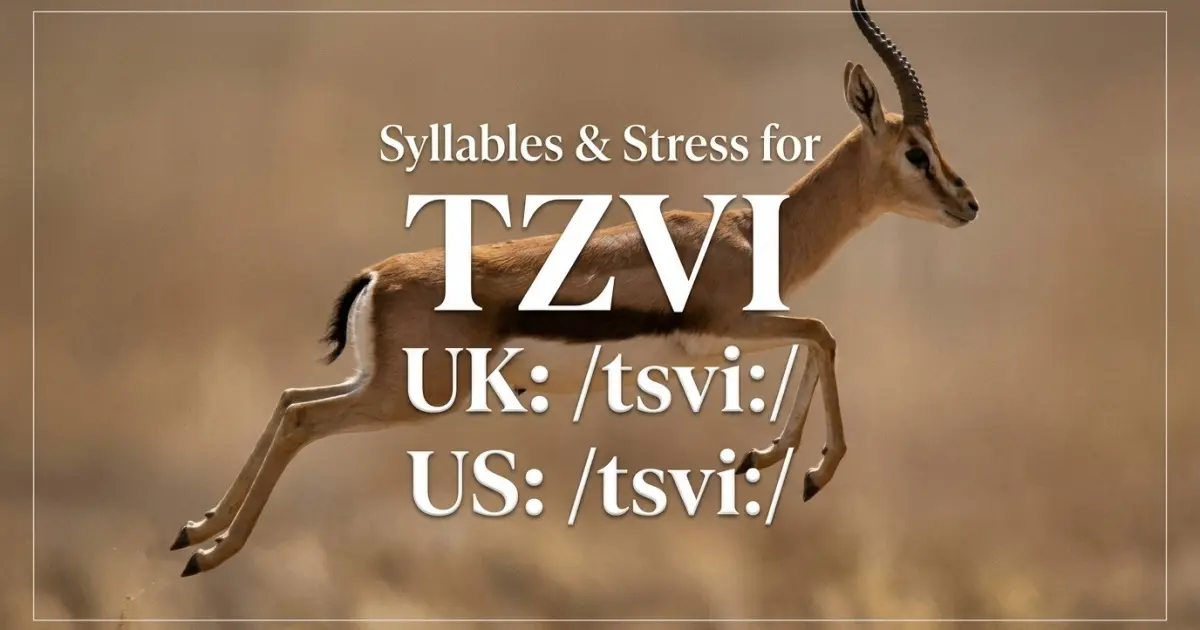
The U.S. IPA pronunciation of Tzvi is /tsviː/, and the U.K. IPA pronunciation is also /tsviː/. That matching form is helpful because it shows that the name does not change much across major English accents. The core pronunciation remains the same: one syllable, tsv at the beginning, long ee at the end.
How the “ts” opening works
The ts sound is common in English, but most often at the end of words such as “cats,” “hats,” and “lights.” Tzvi asks speakers to move that familiar sound to the front. A slow practice form can help: say “cats,” notice the final ts, then begin Tzvi with that same sound.
Once the ts is in place, the rest of the name is direct. The v should be voiced, meaning the vocal cords vibrate. In everyday terms, it should sound like the v in “very,” not the f in “ferry.” The final ee then completes the name clearly.
Why the U.S. and U.K. forms match
Tzvi has no final r, no reduced second syllable, and no vowel that changes dramatically between common U.S. and U.K. pronunciations. The name’s structure is compact enough to remain stable. Regional accents may slightly color the final ee, but the name remains TSVEE.
The Sounds Inside Tzvi Make It Crisp, Bright, and Distinctive
Tzvi has a dense sound structure packed into one syllable. The opening ts is crisp. The following v is a voiced fricative, which means it is made with gentle friction and vibration. The final ee gives the name brightness and release. Together, these sounds make Tzvi feel quick and alert.
This sound pattern suits the meaning “deer; gazelle.” The name does not sound heavy or slow. It moves quickly from a compact opening into a clear vowel. That creates a sense of agility, like a small name with a sudden leap inside it.
Sound neighbors can help speakers remember Tzvi
Tzvi is not closely matched by many common English names, but a few sound cues help. The opening ts can be practiced from words like “cats” or “hats.” The ending sounds like “vee.” Put together, the guide becomes: “cats” ending plus “vee” — TSVEE. Because the strongest energy lands early, the shorter forms often grow from the opening of the name, and that pattern is easier to see in Tzvi nicknames.
Names such as Levi, Avi, Zev, and Ari may help place Tzvi within a broader sound family of short Hebrew-rooted names, but Tzvi has its own sharper opening. That distinctiveness is part of the name’s identity and should not be smoothed away too much.
The Most Common Tzvi Pronunciation Mistakes Come From Adding Extra Vowels
Tzvi is short, but the spelling can lead readers to insert sounds that are not there. Most mistakes happen when English speakers try to make the consonant cluster easier by adding an extra vowel.
Mistake 1: Saying “TIZ-vee”
This is one of the most likely errors. Tzvi does not begin with “tiz.” The opening should be tsv, not tiz-v. A helpful correction is: “It’s one syllable: TSVEE.”
Mistake 2: Dropping the opening T
Some speakers may simplify the name to “Zvee.” That is easier, but it does not preserve the full sound. The t in the tz cluster should be present, creating the crisp ts opening.
Mistake 3: Turning the ending into “vy”
The final vowel should be a long ee, not a short or reduced ending. Tzvi should rhyme loosely with “vee,” not with “ivy” or “heavy.” Keep the final sound clean and bright.
Practice Lines Help Tzvi Become Easy in Real Speech
Tzvi becomes much easier when practiced as one compact sound rather than as a cluster of letters. The goal is to keep the opening crisp and the ending bright without adding an extra vowel.
Slow practice
TSVEE.
Tzvi.
This is Tzvi.
Tzvi is here.
Everyday family practice
Good morning, Tzvi.
Tzvi, come here for a moment.
We saved a seat for Tzvi.
I’d like you to meet Tzvi.
Full-name practice
Tzvi Asher.
Tzvi Gabriel.
Tzvi Benjamin.
Congratulations, Tzvi.
The clearest introduction is usually: “Tzvi, pronounced TSVEE.” If someone needs help with the opening, add: “Start with the sound at the end of cats, then say vee.” That explanation keeps the correction simple, respectful, and easy to remember.
Tzvi Pronunciation FAQ
How do you pronounce Tzvi?
Tzvi is pronounced TSVEE. It has one syllable, beginning with a crisp tsv sound and ending with a long ee.
How many syllables are in Tzvi?
Tzvi has one syllable.
What is the IPA pronunciation of Tzvi?
The U.S. and U.K. IPA pronunciation of Tzvi is /tsviː/.
Is Tzvi hard to pronounce?
Tzvi may look unfamiliar, but it is short once learned. The main challenge is the opening tsv cluster. Say it as one syllable: TSVEE.
Is Tzvi pronounced the same in the U.S. and U.K.?
Yes. The U.S. and U.K. pronunciations are both TSVEE, with only minor accent coloring possible on the final vowel.