
Theodora Name Meaning: Symbolism, Heritage, and Everyday Appeal
Theodora does not sound like a name invented for a trend cycle. It sounds inherited, carried, kept. That matters because its meaning, “gift of God,” could easily become overly sweet in a lesser form. Instead, Theodora has spent centuries gathering something firmer around it: liturgy, empire, scholarship, family memory, and the kind of formal dignity that makes a name feel larger than a single moment of fashion. It belongs to the old world of names that were meant to say more than “we liked the sound.” They made an argument about life itself. A child was not merely welcomed. She was received.
That is what gives Theodora its unusual power today. It offers gratitude without softness alone, reverence without stiffness alone, and elegance without fragility. Parents often respond first to the meaning, but the name survives because of structure as much as sentiment. It is long, but not unwieldy. It is unmistakably feminine, but not flimsy. It sounds ceremonial in full and companionable in shorter forms. In an era crowded with clipped names and fast impressions, Theodora moves at an older rhythm. It asks to be said properly, and in return it gives a child a name with memory, scale, and a sense of consequence.
Theodora's U.S. popularity rank over time, 1880–2024
Popularity statistics are based on official data from the Social Security Administration baby name records.
Theodora: A Grand and Timeless Gift of God
Theodora presents a chart pattern of a broader past with a clearer present, reflecting high naming momentum in 1885 that now offers the name renewed force. Its current rise likely suggests revival energy, as parents rediscover “heritage classics” that feel both noble and structurally reliable.
The absence of crossover usage helps the name maintain its clear feminine clarity across generations. Meaning “gift of God,” its rhythmic four-syllable sound provide an elegant and durable texture that remains distinctive.
Theodora in One Clear Frame
| Key Facts | Information | Quick Insight |
|---|---|---|
| Name | Theodora | The form feels complete and historical, which is part of why it carries presence before any nickname enters the room. |
| Primary Gender Use | Female | Theodora reads clearly as feminine, yet its shared lineage with Theodore gives it intellectual weight rather than decorative softness. |
| Origin | Greek | Its Greek roots place it in one of the oldest naming traditions still active in English, giving it durability instead of novelty. |
| Core Meaning | Gift of God | This is a meaning of gratitude, not vanity. It frames the child as received with wonder rather than displayed for effect. |
| Pronunciation | thee-uh-DOR-uh | The central stress on “DOR” gives the name lift and authority, preventing four syllables from feeling vague or floaty. |
| IPA (US/UK) | /ˌθiəˈdɔːrə/ | The American and British forms align neatly, which helps the name travel well across English-speaking settings. |
| Syllable Count | 4 | Four syllables can sound grand, but here they are arranged cleanly enough to remain usable in everyday speech. |
| U.S. girls’ rank (2024) | No. 812 | Official data shows rarity without obscurity: uncommon enough to feel distinctive, familiar enough to be understood on sight. |

Theodora and the Weight of “Gift of God”
Some names with devotional meanings function almost entirely as statements of belief. Theodora does something more complex. “Gift of God” is spiritually legible, but it is also emotionally legible to people who are not reading the name through doctrine alone. Many parents hear in it an old human instinct: to describe a child as bestowed rather than manufactured, as blessing rather than project. That distinction matters. Theodora does not sound boastful. It sounds thankful.
What keeps the meaning from slipping into sentimentality is the name’s bearing. Theodora does not flutter. It lands. The opening “Theo-” has light in it, but the second half steadies the name with shape and gravity. That makes the meaning feel inhabited rather than embroidered on top. A parent can choose Theodora because the child arrived after waiting, difficulty, prayer, surprise, or simply overwhelming joy, and the name will still hold in adulthood. It does not trap the child inside permanent infancy. It allows gratitude to mature.
This is why Theodora often appeals to families who want more than prettiness. They may like names with substance, names that acknowledge mystery, names that carry inherited moral or spiritual language without sounding preachy. Theodora belongs to that category. It says something about how the child is regarded, but it does not reduce her to a slogan. There is room inside it for seriousness, wit, ambition, reserve, scholarship, style, and strength. The meaning opens the door. The structure keeps the room large.
Theodora Comes from an Elegant Greek Exchange
Theodora is built from two ancient Greek elements: theos, meaning “God,” and doron, meaning “gift.” The beauty of the construction is its clarity. This is not a name whose meaning must be excavated through several layers of modern reinterpretation. Its architecture is old and direct. That helps explain why it has survived across centuries, languages, and Christian traditions. It was meaningful from the beginning, and it remained intelligible because the idea at its center is so durable.
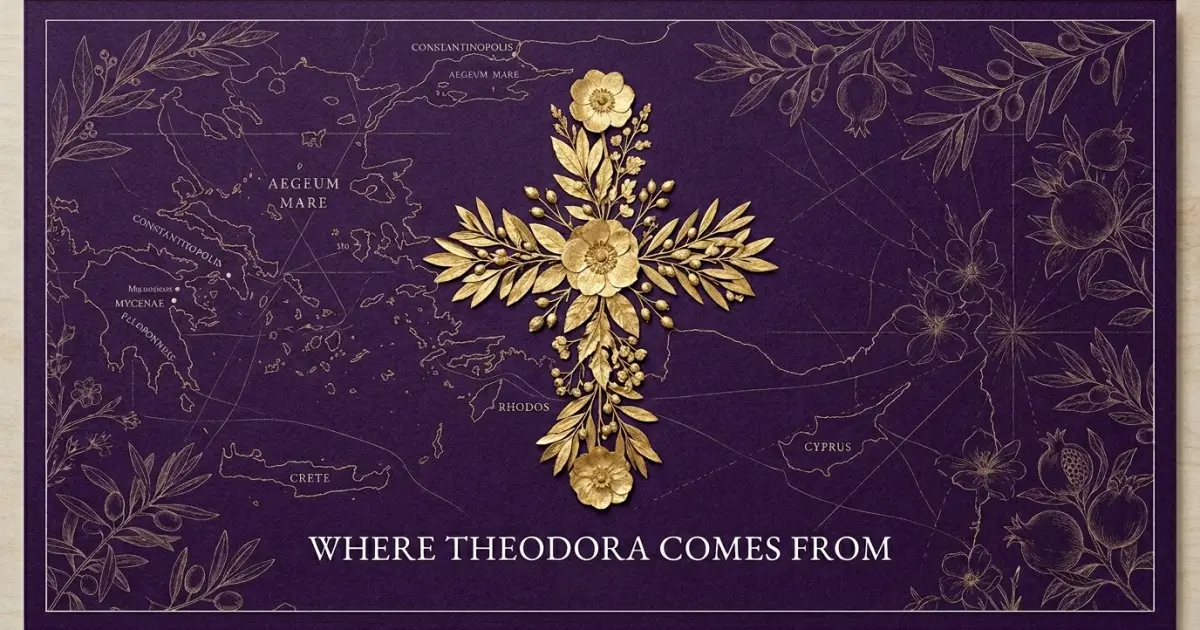
Theodora also belongs to a larger family of names formed around the same gift-language. Its masculine counterpart, Theodore, carries the same elements in the same order. Its close cousin Dorothea reverses them, placing the “gift” before “God.” That reversal is one of the most interesting things about the name world around Theodora. Dorothea often feels literary, slightly softer, and more antique in an English-speaking ear. Theodora feels more upright, more architectural, and somehow more public. They are linguistic relatives, but they do not leave the same impression.
That difference helps explain Theodora’s current appeal. It shares the intellectual and historical depth of Dorothea, but it moves closer to the now-familiar Theodore, which has trained modern ears to accept the “Theo-” opening as warm, smart, and usable. In practical terms, that means Theodora benefits from both history and proximity. It sounds rooted in classical language, yet not stranded there. Parents who want an old Greek name that still feels like it belongs in a contemporary school roster often hear that balance immediately. To view more names linked to this cultural tradition, explore names with Greek roots.
Theodora Has Already Passed Through Empire, Faith, and Memory
Theodora is not merely ancient in the abstract. It has lived publicly. One of the strongest historical anchors for the name is the sixth-century Byzantine Empress Theodora, whose political intelligence and force helped prevent the name from ever reading as only delicate. Her presence matters even for families who do not know the details of Byzantine history. The association lingers in the atmosphere of the name. Theodora sounds like a woman who could govern, negotiate, survive, and intervene. That is very different from the emotional weather around many devotional names.
The name also traveled through Christian history in ways that kept it liturgical and lived-in at the same time. For centuries, Greek-derived names circulated not only through scripture-adjacent culture but through saints’ calendars, courts, aristocratic households, convent records, and formal family naming patterns. As a result, Theodora accumulated both piety and polish. It can sound ecclesiastical in one setting, imperial in another, scholarly in another, and intimate in another. Few names move through so many registers without breaking character.
That historical thickness is part of the modern attraction. Parents are often drawn to names that feel as though they have already survived several worlds. Theodora has done exactly that. It has crossed from Greek antiquity into Byzantine prestige, from religious memory into European naming traditions, and from formal records into modern revival culture. When a name has made that journey and still feels recognizable, it begins to offer a special kind of assurance. It has already proven it can endure change without losing itself.
Why Theodora Feels Grand but Still Usable
Length alone does not make a name grand. Plenty of long names feel diffuse. Theodora works because its four syllables are disciplined. The beginning is clear, the center carries the stress, and the ending is open and familiar. The result is a name that sounds composed rather than ornate. Even people who have never used it before can usually say it after hearing it once. That is one of its practical advantages. It feels elevated, but not inaccessible.
Its social range is unusually wide. On a child, Theodora can sound bright, bookish, and slightly storybook without tipping into costume. On a teenager, it has enough structure to avoid feeling babyish. On an adult, it sounds authoritative and cultivated. This is where many long traditional names either harden or collapse. Some become too severe for childhood; others never quite grow into adulthood. Theodora manages both ends because it contains multiple social speeds. The full form is stately. The shorter possibilities are relaxed. Families can decide how much ceremony they want to use from day to day.
There is also a subtle advantage in the current naming climate. Modern parents often want names that are distinctive but still legible, substantial but not dusty, feminine but not flimsy. Theodora answers all three. It stands apart from lighter vowel-heavy names that can blur into one another, yet it does not feel unfamiliar in the way a truly rare antique revival can. It has recognizable parts, a stable pronunciation, and a cultural memory that many people will sense even if they cannot immediately place it. That combination is hard to manufacture. Theodora already has it.
Theodora in Modern American Use
Official Social Security Administration (SSA) data places Theodora at No. 812 for girls in 2024, which gives the name a very specific position in the modern landscape. It is not common, but it is not invisible. That distinction matters more than parents sometimes realize. A highly ranked name can begin to feel socially flattened by repetition. An ultra-rare name can demand constant explanation. Theodora sits in the more workable middle ground: uncommon enough to feel memorable, established enough that it does not need to justify itself every time it appears. For parents considering similar names, this guide to Girl Names names is a useful next step: girls’ names with meanings.
Its current appeal also benefits from the rise of neighboring styles. Eleanora, Isadora, Theodore, Thea, Nora, Cora, and Dorothea have all helped reopen the ear to antique forms with strong vowel movement and historical depth. Theodora fits that broad revival of names that sound educated, storied, and slightly continental without being inaccessible. Yet it still feels more singular than many of its neighbors. That is because it combines the popular “Theo-” opening with a fuller ending that is still not widely overused.
For parents, this often translates into a useful emotional experience: Theodora feels discovered rather than invented. It sounds as though it belongs to a tradition, but not necessarily to somebody else’s daughter in every classroom. That is a powerful modern sweet spot. The name can satisfy a desire for individuality without depending on unusual spelling, clipped grammar, or trend language to create distinction. In other words, Theodora does not need to perform uniqueness. It simply has character.
Where Theodora Opens Outward
Theodora with middle names: where rhythm does the most work
Because Theodora is four syllables and already rich in texture, it usually pairs best with middle names that either sharpen the line or quiet it. One-syllable middles can give it clean contrast, while simple two-syllable choices can keep the full name from becoming too upholstered. The larger lesson is not minimalism for its own sake, but cadence: Theodora does well when the rest of the name lets her lead. If you want the full pairing logic behind that contrast, see Theodora middle names.
Theodora with nicknames: why the long form never feels trapped
A long formal name succeeds when it contains easier everyday doors, and Theodora does. The obvious shortening paths make it adaptable across childhood and adulthood, which is one reason the full form remains so usable. Families who love the dignity of Theodora are not forced to use all four syllables in every setting, and that flexibility is part of the name’s modern strength. To see how those different moods shorten in real life, explore nicknames for Theodora.
Theodora in pronunciation: what listeners usually learn fast
The pronunciation looks more elaborate on paper than it feels in speech. Once heard, it tends to settle quickly because the stress pattern is intuitive and the vowels are familiar. For most families, the question is not whether people can learn Theodora, but which house style of speed and emphasis they naturally prefer in daily life. For the detailed stress pattern, accent notes, and IPA, see how to pronounce Theodora.
What Theodora Gives Back to the Family That Chooses It
A strong name does more than describe a child. It creates a frame in which that child can be encountered. Theodora offers one of the most compelling frames in the traditional naming world because it holds together three things that do not always coexist: reverence, intellect, and usability. It is a name of thanks, but not passivity. It is a name of history, but not museum glass. It is a name with grandeur, but not theatrical excess.
That is why Theodora lingers. It can begin with the private emotion of parents who feel that a child’s life arrived as grace, but it does not end there. The name has enough backbone to accompany a whole biography. It suits the girl who is serious, the girl who is funny, the girl who is defiant, the girl who is gentle, the woman who becomes formidable. Many names are chosen because they sound lovely in the nursery. Theodora asks a harder and better question: will this still sound true when the child has a will, a voice, a profession, a history of her own? In that sense, Theodora is not only a gift-themed name. It is a name that respects the life that will have to carry it.