
How to Pronounce Sylvia: What People Often Get Wrong
The real pronunciation test for a name does not happen in a baby-name list. It happens in a doorway, over a clipboard, in the second before someone decides whether to guess or ask. A teacher reaches the S section on the first day of school. A nurse looks down at the waiting-room chart. A receptionist glances from the screen to the room and says the name out loud for the first time. Sylvia usually does well in that moment because it looks classical but behaves simply. It has history in it, but it does not demand theatrical handling. Once people hear the rhythm, they usually keep it.
That matters because names with old roots can sometimes sound more difficult than they really are. Sylvia avoids that trap. Its structure is stable, its stress is intuitive, and the broad American and British forms line up cleanly. The name works because the sound pattern is disciplined: one clear opening, one bright middle, one soft landing. In everyday English, that becomes SIL-vee-uh. It is elegant, but it is not fragile. It is literary, but it is not hard to say.
What Sylvia is really clarifying the moment it is spoken correctly
| Element | Phonetic Detail | Quick Tip |
|---|---|---|
| Everyday pronunciation | SIL-vee-uh | Say it in three clean beats, with the first syllable carrying the most weight. |
| US IPA | /ˈsɪlviə/ | The American form is smooth and steady, with no major vowel surprises once the stress is clear. |
| UK IPA | /ˈsɪlviə/ | The British form is essentially the same, which makes Sylvia unusually stable across accents. |
| Syllables | 3 syllables | Think of the name as one firm opening followed by two lighter unfolding syllables. |
| Stress pattern | Primary stress on the first syllable | The name should begin with SIL, not drift toward a flatter middle-heavy rhythm. |
| Opening sound | /sɪl/ | Use the short vowel in “sit,” not a stretched “seel” sound in this pronunciation pattern. |
| Middle sound | /vi/ | The vee should stay bright and clear so the name does not sound muffled. |
| Ending sound | /ə/ | The last syllable should relax gently rather than disappearing completely. |
Sylvia lives on the first syllable
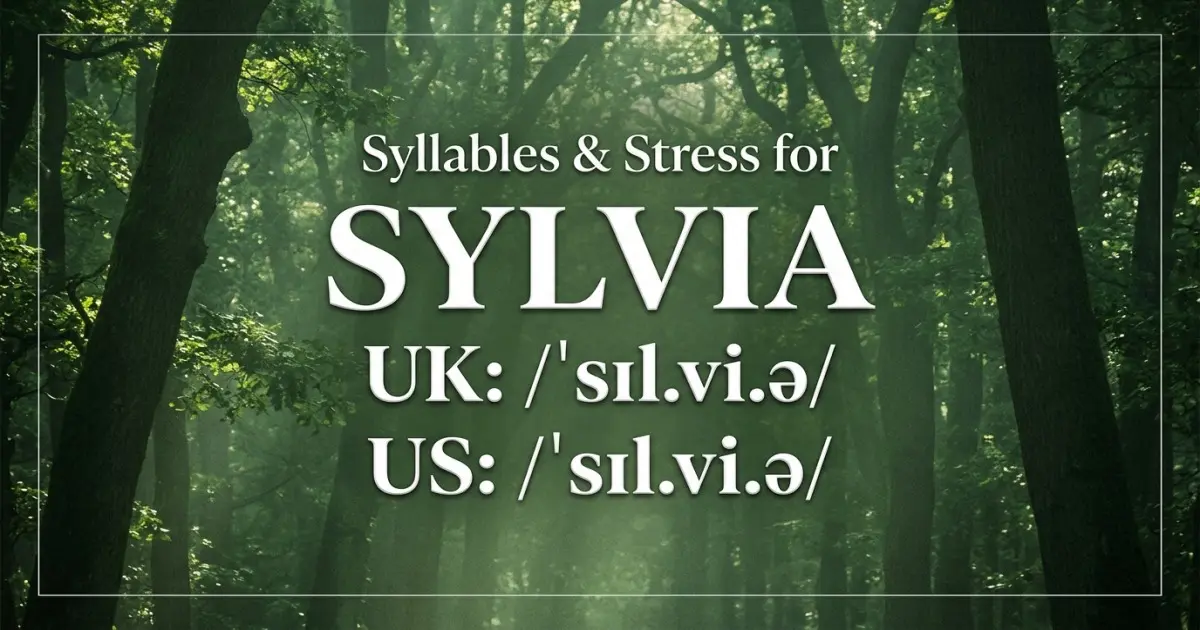
The most important pronunciation fact about Sylvia is that the first syllable carries the name. The stress belongs at the front: SIL-vee-uh. That opening makes the whole name feel grounded and recognizable. English speakers are especially comfortable with names that establish themselves clearly in the first beat, and Sylvia follows that pattern beautifully. The result is a name that sounds composed rather than uncertain. Before focusing only on syllables and stress, it helps to step back into the fuller frame of Sylvia meaning.
The opening vowel is the short i sound written /ɪ/ in phonetics. In plain terms, that means Sylvia should begin like “sil,” not like “seal.” That distinction matters. If the vowel gets stretched, the name starts to move away from the controlled English pronunciation given here and can sound more distant or more stylized than intended. The fact-packet form is very clear: SIL-vee-uh.
Why the opening of Sylvia feels so stable
The first syllable begins with s, a fricative consonant. Fricatives are made with airflow rather than with a hard stop, which helps the name start smoothly instead of abruptly. Then comes the liquid l, which lets the sound glide forward. That combination—fricative into liquid—is part of why Sylvia sounds graceful without sounding weak. It begins softly, but it begins clearly. Because the strongest energy lands early, the shorter forms often grow from the opening of the name, and that pattern is easier to see in Sylvia nicknames.
This also helps explain why Sylvia can sound classical without sounding heavy. Some older names land with a lot of force. Sylvia does not. It opens with control rather than drama.
How the middle and ending keep Sylvia from sounding stiff
After the strong opening comes the bright vee, which gives the name lift. Then the final -uh softens the line. That last syllable matters more than people sometimes realize. Without it, Sylvia would sound clipped. With it, the name breathes. The structure is balanced: strong beginning, bright center, gentle finish.
That is one reason the name works so well in daily life. It has classical weight in meaning and history, but the pronunciation keeps it human-sized.
Sylvia across accents stays impressively consistent
One of Sylvia’s practical strengths is that the broad pronunciation stays the same in American and British English. The fact-packet IPA is identical in both: /ˈsɪlviə/. That is not true of every traditional female name. Many names shift noticeably across accents through vowel changes, swallowed endings, or different stress habits. Sylvia changes much less.
What remains the same in both US and UK speech
In both varieties of English, the first syllable stays stressed, the opening vowel remains short, and the final syllable relaxes rather than competing with the first. The name still unfolds as SIL-vee-uh. This stability is one reason Sylvia travels so well. It rarely demands explanation, and once spoken aloud it usually sounds exactly as listeners expected it to sound.
Where tiny accent differences may still appear
Real speech always has texture, even when the IPA is the same. Some speakers may give the final syllable a touch more presence. Others may move through the middle vee a little faster. Some may make the opening vowel a shade rounder or shorter than others. But these are minor color shifts, not competing pronunciations. The name remains clearly Sylvia in all of them.
That kind of stability is especially valuable in a name with classical roots. It means the name can feel refined without becoming vulnerable to constant correction.
Where Sylvia is most likely to be mispronounced
Because Sylvia looks familiar and literary at the same time, mistakes usually come from overcorrection rather than confusion. Most people know roughly what to do with it. The issue is whether they overdo the first vowel, flatten the ending, or disturb the rhythm.
The first common mistake is stretching the opening too much
The most predictable error is turning the first syllable into something closer to “seel.” That can happen when people try to make the name sound more continental or more formal than it needs to be. But the pronunciation target here is SIL, with the short vowel. That short opening is what keeps the name grounded in ordinary English speech.
The second common mistake is under-pronouncing the ending
Another mistake is letting the final syllable vanish too quickly, so the name feels almost truncated. Sylvia should end gently, but it should still end. The last -uh gives the name softness and helps distinguish it from shorter related forms.
The third common mistake is stressing the name too evenly
Sylvia should not sound like three equal syllables in a row. The opening is the anchor. The middle and ending follow it. If all three syllables are given the same weight, the name loses its natural shape and can sound more mechanical than graceful.
Sylvia beside its sound-neighbors
One useful way to hear Sylvia accurately is to compare it with nearby names. It is fuller and more classical than Sylvie, which trims away the final syllable and feels brighter and more compact. It is firmer than names like Olivia or Livia because the opening SIL gives it a more immediate anchor. It is also lighter than some three-syllable classics because the final syllable is relaxed rather than formal.
These sound-neighbors help explain why Sylvia has lasted. It occupies a middle space that is hard to replace: literary, but not grandiose; natural in meaning, but not rustic in sound; traditional, but still easy in modern speech. The pronunciation carries all of that with very little effort.
Saying Sylvia well in real life: three useful practice lines
Start with the plain form
Sylvia is here.
This isolates the stress pattern. Make sure the first syllable lands clearly and the last syllable stays soft but present.
Then place Sylvia in an everyday sentence
Sylvia will call you back this afternoon.
This tests whether the name still sounds smooth at normal speaking speed rather than only in isolation.
Finally, pair Sylvia with a surname
Sylvia Jane Martin is ready.
Or any full combination you are considering. The best pronunciation test is always the full name in motion, because that is how people actually hear it.