
How to Say Skye Correctly: The Sounds, Stress, and Shape
The moment that reveals whether a name is truly easy to live with is rarely the birth announcement. It is the first ordinary public reading: a teacher scanning the attendance sheet, a pediatric nurse stepping into a waiting room, a camp counselor calling a group to line up, a barista looking down at a cup and deciding whether to guess or ask. Skye usually does well in those moments because it looks almost exactly like the sound it intends to make. It carries atmosphere in meaning, but not confusion in speech. People see it and, more often than not, they say it correctly on the first try: SKY.
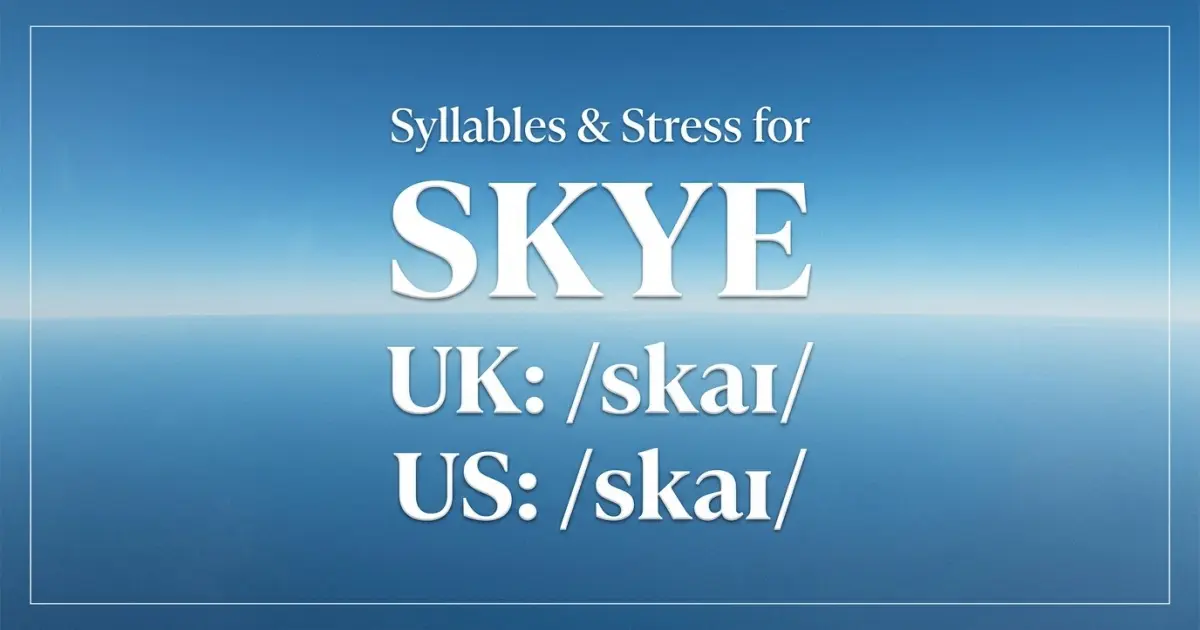
That matters because a one-syllable name lives or dies on clarity. Longer names can survive a slight wobble in stress or a softer vowel because the rest of the name helps listeners recover. Skye has no extra padding. Its whole identity is inside one compact burst of sound. The good news is that the sound is remarkably stable. Standard references treat Skye as a one-syllable name pronounced exactly like the word sky, and the IPA remains the same in standard American and British forms: /skaɪ/. In everyday life, that makes Skye one of the more portable scenic names a child can carry.
What Skye is really asking your mouth to do
This quick guide clarifies why Skye sounds so direct in real life and why its simplicity is one of its major strengths.
| Element | Phonetic Detail | Quick Tip |
|---|---|---|
| Common spoken form | SKY | Say it as one clean beat, not as something stretched into two syllables. |
| IPA (US) | /skaɪ/ | The whole name rides on one diphthong, so keep the vowel moving naturally from start to finish. |
| IPA (UK) | /skaɪ/ | The standard UK form matches the same sound, which helps the name stay consistent across accents. |
| Syllable count | 1 syllable | Skye is a single spoken unit, which is part of what gives it its crisp modern feel. |
| Stress pattern | Full stress on the only syllable | There is no weak syllable to hide in; the name should sound clean and confident from the first consonant onward. |
| Opening consonant cluster | /sk/ | Start with a quick, sharp “sk” as in “skip,” then move immediately into the vowel. |
| Vowel movement | /aɪ/ | This is the same diphthong heard in “sky,” “my,” and “high,” so it should glide rather than sit flat. |
| Spelling note | Skye and Sky sound the same | The final e changes the visual style, not the pronunciation. |
Skye works because the sound is shorter than the imagery
One reason Skye remains so wearable is that its pronunciation is much simpler than its meaning might lead people to expect. The name carries atmosphere, landscape, and a sense of openness, but the sound itself is compact and exact. That contrast is useful. It lets the name feel evocative without becoming cumbersome. Pronunciation lands more fully when the name’s roots and history are already in view, so begin with Skye meaning.
Why the opening cluster gives Skye its clean edge
Skye begins with /sk/, a consonant cluster that gives the name immediate structure. The s is a fricative, meaning air moves through a narrow channel and creates a soft hiss of friction. The k is a stop, produced by briefly blocking and releasing air at the back of the mouth. Together, those two sounds make the opening feel crisp and modern. Skye does not drift into the room. It arrives.
This is important because many airy or scenic names rely on very soft openings and can end up sounding hazy. Skye avoids that problem. Its sound has edge before it has lift. That edge is one reason the name works so well in daily speech. It sounds fresh, but not vague.
Why the diphthong makes Skye feel larger than one syllable
The vowel in Skye, /aɪ/, is a diphthong. That means the sound moves inside the syllable rather than staying in one fixed position. In plain English, the voice glides from an open starting point toward the long ee-like finish that gives us the final sound of “eye.” This motion is what makes Skye feel expansive even though it is only one syllable long.
That matters socially as much as linguistically. A flat one-syllable name can sound abrupt or plain. Skye does not. The vowel gives the name internal movement, so it feels more spacious and more alive than its length alone would suggest.
Where Skye usually goes wrong, even though it looks easy
Skye is not a difficult name, but one-syllable names leave very little room for error. If something goes wrong, the whole name shifts immediately. Most mistakes come from overthinking the spelling or overexplaining the sound.
The most common mistake patterns around Skye
The first mistake is turning Skye into more than one syllable. Because the spelling looks polished and name-like, some speakers hesitate and almost want to separate the sound into something longer. That instinct should be resisted. Skye is simply SKY. Nothing more. No extra vowel, no second beat, no softened ending.
The second mistake is treating the final e as though it should somehow be heard. In practice, it should not. The e is visual rather than phonetic here. It tells the eye that the form is a given name and not only the bare word sky, but the spoken name remains unchanged.
A subtler issue is overdramatizing the vowel. Because the name carries such a scenic meaning, some speakers unintentionally lengthen it too much, as though trying to make it feel more poetic. In good pronunciation, the diphthong should glide naturally and then stop. Skye should sound clean, not theatrical.
Why short names need firmness more than embellishment
With a longer name, a small misstep may still leave enough recognizable sound for listeners to identify it. With Skye, everything rests on accuracy. That is why the best pronunciation of Skye is also the least adorned one. One sharp opening cluster. One natural diphthong. One clean finish. If those parts are in place, the name sounds exactly as it should.
Skye stays remarkably stable across accents
Some names seem easy until they cross regional or national accents. Then vowels shift, stress changes, or the name starts to sound less certain than it did on paper. Skye avoids much of that trouble. In standard American and British English, the IPA is identical: /skaɪ/. That makes it one of the more stable names in its style category.
US and UK Skye are essentially the same in practice
Because the name is only one syllable and built from a very common English sound pattern, it does not vary much between major English-speaking regions. You may hear slight differences in voice quality from one speaker to another, but the core pronunciation stays intact. The opening remains /sk/. The vowel remains /aɪ/. The effect remains SKY.
This is a practical advantage for any child who may move between regions, schools, or countries later on. A name that keeps its shape under different accents usually requires less correction and feels more settled in public life.
Sound neighbors that help people say Skye immediately
If someone hesitates, the quickest help is also the simplest: “It’s just like the word sky.” That one comparison usually resolves everything. Skye lives beside familiar sound neighbors such as sky, why, fly, and high. Because the sound pattern is already embedded in ordinary English, most people do not need technical explanation for long. They only need permission to trust the obvious pronunciation. Because the strongest energy lands early, the shorter forms often grow from the opening of the name, and that pattern is easier to see in nicknames for Skye.
How to practice Skye until it sounds natural and not overcareful
The best pronunciation practice happens in full phrases. Names are spoken inside life, not in isolation. A name that sounds elegant alone can still feel awkward in a sentence if the rhythm is wrong.
Practice lines that make Skye feel automatic
- “Skye, it’s your turn.”
- “Have you met Skye yet?”
- “Skye is on the list.”
- “I’m looking for Skye.”
- “Skye did a great job today.”
When spoken in these natural lines, the name reveals its real character. It does not need help from neighboring words. It holds its own easily. That is one of the chief virtues of Skye as a spoken name: it feels immediate in daily speech, not just beautiful in theory.
A final Skye check
If you want one quick self-test, ask three questions. Are you keeping the name to one syllable? Are you letting the /sk/ cluster stay crisp at the front? Are you pronouncing the vowel exactly as in the word sky? If yes, you are almost certainly saying Skye correctly.
That is the quiet brilliance of the name. Skye carries weather, space, and landscape in its meaning, but it carries almost no friction in speech. It is short, stable, and hard to mishear. In real life, that kind of clarity is one of the reasons the name endures.