
Nicknames for Skye: Easy Picks That Fit Real Life
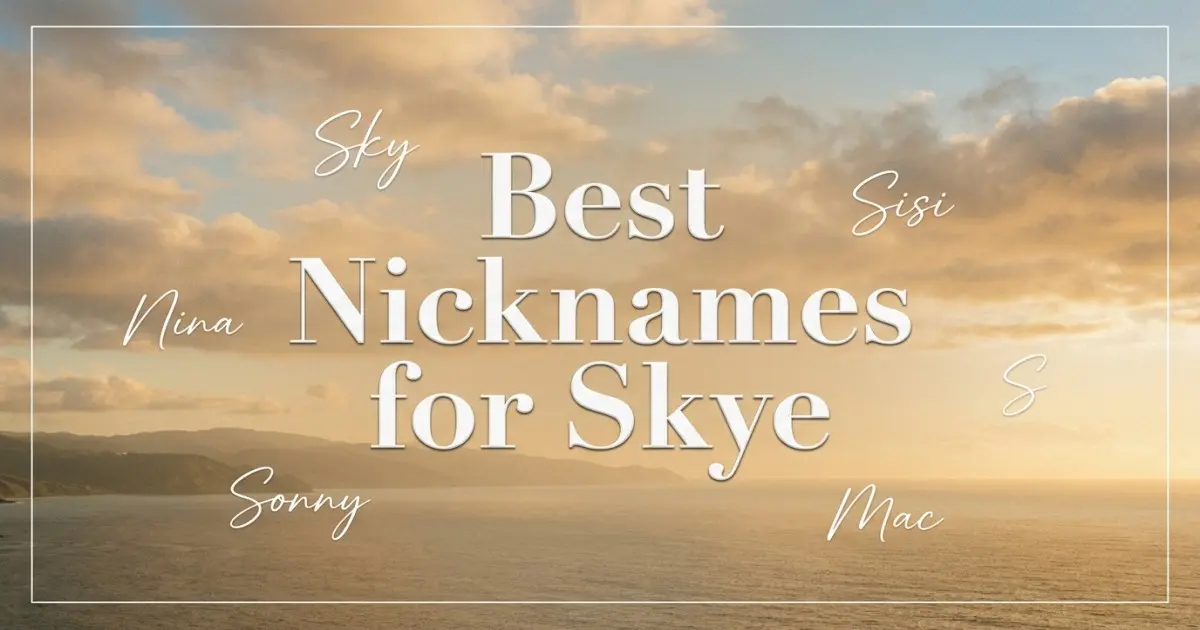
Nicknames are usually treated as little extras, but in real life they behave more like social weather. They show who is close enough to soften a name, who wants to make it quicker, and who is trying to turn a public identity into a private one. A formal name may invite shortening because people need something easier in daily speech. A very short name creates a different situation. There, the nickname is not about efficiency. It is about affection, repetition, play, and the subtle ways families and friends claim a person as their own. That is exactly what makes Skye interesting.
Skye is already only one syllable. It arrives sounding bright, finished, and socially easy. Research suggests that names this compact often resist traditional shortening and instead produce nicknames through echoing, spelling shifts, initials, or affectionate expansion. In other words, Skye is already nickname-shaped. That changes the whole conversation. The best nicknames for Skye do not usually cut the name in half. They either preserve the whole sound and make it more intimate, or they move sideways into shorthand that says more about the relationship than about the structure of the name itself. Nicknames add personality at the surface, but the deeper weight of the name still sits in Skye meaning.
What Skye’s nickname landscape reveals about a one-syllable name
Because Skye is already so short, its nickname world is naturally smaller and more intimate than that of longer names. The strongest forms tend to be spelling-light, echo-based, or family-made rather than formally reduced.
| Group | Suggested Nicknames | Persona | Use Context |
|---|---|---|---|
| Full-name loyalists | Skye | Direct, airy, self-possessed | Everyday use when the full name already feels complete enough to stand alone |
| Short and clean | Sky, S | Minimal, modern, casual | Texts, school shorthand, close friends, quick family use |
| Cute echo forms | Sky-Sky, Skye-Skye | Playful, warm, toddler-friendly | Parents, siblings, grandparents, very early childhood |
| Soft affectionate expansions | Skylie, Skye-girl | Cheerful, intimate, home-centered | Family use, playful private speech, affectionate pet-form culture |
| Selective back-half forms | Kye | Sporty, inside-circle, informal | Used only when a family or friend group naturally clips the opening consonant cluster |
| DIY shorthand | S.K., S.J., S | Contemporary, text-based, highly personal | Initial-driven family habits, group chats, private social shorthand |
Skye is already a nickname-shaped full name
This is the first important truth about Skye: many people named Skye will not need a nickname at all. The full name is already brief, vivid, and emotionally legible. It has enough imagery to feel distinctive, but enough phonetic simplicity to function in daily life without any trimming. Teachers can say it. Friends can remember it. Family members can use it affectionately without it sounding formal. That means Skye belongs to a special category of names where the full form often does the work other names assign to a nickname.
This matters because it changes what a nickname means. With longer names, a nickname often becomes the practical social version. With Skye, a nickname is more likely to signal closeness or a specific family style. It is optional, not required. That makes nickname choices more revealing. If a child called Skye ends up being called Sky-Sky at home, that tells you something about the tone of the household. If she becomes S in texts, that tells you something about peer culture. If she stays simply Skye, that tells you the full name already feels intimate enough.
In other words, Skye is one of those names where the absence of a nickname can be as meaningful as the presence of one. It suggests confidence in the full form. It suggests that the name does not need softening or shortening to become usable.
The opening of Skye is too brief to divide, so most nicknames simplify instead
Because Skye is only one syllable, its sound zones work differently from those of longer names. There is no roomy middle to carve into. There is no separate ending syllable waiting to become a pet form. Instead, most believable Skye nicknames either preserve the whole sound or simplify the way it is represented.
Why Sky works as a nickname even though it sounds identical
Sky is the most obvious alternate form, and it is useful precisely because it changes the visual style without changing the spoken one. In real life, this kind of nickname often appears first in writing: on texts, notes, contact lists, or social media handles. The spoken name remains the same, but the simplified spelling creates a slightly leaner, more casual version of the identity.
That is a legitimate nickname pattern for modern life. Not every nickname has to sound different aloud. Some operate through written intimacy or ease. Sky feels a little less polished than Skye, a little more stripped-back, and a little more casual. That makes it a plausible “public shorthand” without requiring any real phonetic change.
Why S and initial-based forms belong to contemporary nickname culture
S is even more minimal. It is not a classic diminutive so much as a modern shorthand form. These single-letter nicknames are common in texting culture, among siblings, and within friend groups that naturally reduce names to initials. If the child has a middle name that creates a usable pair, forms like S.K. or S.J. can also emerge naturally. These are not grand nicknames. They are efficient, intimate, and situational.
What makes them believable for Skye is the name’s shortness. A very long formal name reduced to one letter can sometimes feel too abrupt. Skye already lives close to that minimal zone, so the shift to S or S.K. feels less dramatic. It is not replacing the name. It is simply privatizing it.
The whole sound of Skye acts like the stressed center
In a one-syllable name, the entire word becomes the stressed center. That changes nickname formation completely. Since there is no obvious internal syllable to extract, affectionate nicknames tend to arise from repeating or expanding the whole sound rather than slicing it apart. Nicknames often grow from the stressed part of a name rather than from spelling alone, so the next useful step is Skye pronunciation guide.
Why Sky-Sky and Skye-Skye sound natural in families
Sky-Sky and Skye-Skye are the most believable cute forms for early childhood because reduplication is one of the oldest and most natural strategies in affectionate speech. Parents, siblings, and grandparents do this instinctively. They repeat the full sound to make it warmer, bouncier, and more child-centered. For a name as short as Skye, that strategy makes far more sense than trying to shorten the word any further.
These forms are not designed for adulthood, and they do not need to be. Their job is different. They live in kitchens, strollers, bedtime routines, and family jokes. They are proof that a one-syllable name can still generate real nickname life, but that life is likely to be emotional rather than practical.
Why Skylie feels plausible and playful
Skylie is a believable affectionate expansion because some nicknames move in the opposite direction from shortening: they add softness rather than remove syllables. For a brief name like Skye, this can be especially natural. Skylie sounds playful, affectionate, and slightly more singable than the full form. It works best in family settings or among people who enjoy nickname culture that adds warmth through extra sound.
It is not likely to become the person’s main social identity, but that is not a flaw. Skylie belongs to the same category as Sky-Sky: a pet form that reveals closeness more than it announces itself publicly.
Skye’s ending is too brief for many nicknames, but one selective form survives
The final sound in Skye is not especially productive, but there is one back-half form worth acknowledging because it can appear naturally in some circles: Kye. This is not the default nickname for Skye, and it will not work in every family. But it is plausible when speakers drop the opening consonant cluster and keep the long vowel structure that remains.
Kye has a different social feel from Sky or Skye. It sounds less airy and a little more sporty or inside-circle. It is most believable when it emerges informally among siblings, teammates, or a close family that tends to clip names in unconventional but repeatable ways. It is not the first nickname most parents would choose in advance, but it can absolutely arise in use.
This is a good example of how nickname logic works for one-syllable names: there may not be many options, but the few that do appear often carry a very strong sense of relationship. Kye is not a general-purpose diminutive. It is a nickname with a specific social setting built into it.
Skye nicknames shift more by intimacy than by age
With many names, nicknames clearly evolve with age. Cute forms fade, tougher forms take over, and adults often return to fuller versions later. Skye behaves a little differently because the full name works at every stage already. A toddler can be called Skye. A professional adult can be called Skye. A grandmother can be called Skye. The nickname therefore becomes less about developmental necessity and more about social distance.
A family may use Sky-Sky or Skylie in the early years and then gradually let those forms disappear as the child grows. Friends may use Sky or S in text threads while teachers and colleagues continue with Skye. A partner may invent a private affectionate form much later that no one else uses. This flexibility is one of Skye’s quiet advantages. The name does not trap the child inside a single nickname script. It allows layers.
That means parents do not need to overdesign the nickname question in advance. For Skye, the most believable nickname often emerges from real use. The name’s brevity makes forcing a nickname more obvious than it would be with a longer form. The strongest result is usually the one that appears naturally because it suits the people around the child.
The best Skye nicknames feel discovered, not manufactured
Because Skye is already short, scenic, and complete, the best nicknames are usually the least engineered. Sky works because it is a natural written simplification. S works because modern shorthand culture makes it feel easy and intimate. Sky-Sky works because affection loves repetition. Skylie works because families often expand short names to soften them. Kye works only when the circle around the child makes it make sense. None of these nicknames needs to be forced.
That is what makes nickname life around Skye so revealing. The full name remains strong enough to stand on its own, and the nicknames that grow around it mostly serve to show who is close enough to change the weather around the name. With Skye, that may be the most honest outcome of all. The nickname does not rescue the name from being too long or too formal. It simply marks intimacy.