
Shane Name Meaning: A Timeless Choice with Meaningful Roots
Shane is a name that does something remarkable with almost no excess. It carries a sacred meaning, “God is gracious,” but it does not sound ceremonial. It is only one syllable long, clean on the page, immediate in the mouth, and almost startlingly direct. That contrast is the key to its appeal. Some names wear their spiritual weight visibly. Shane hides it inside simplicity. It sounds like a modern first name built for ordinary life, yet underneath that plainspoken surface sits one of the oldest and most enduring human hopes: that grace exists, and that it reaches people personally.
That is why Shane remains so persuasive. Official Social Security Administration (SSA) data shows it ranked No. 601 for U.S. boys in 2024, while appearing only rarely for girls far below that level. It is clearly familiar, but no longer crowded. More importantly, attached Irish naming references show that Shane is bound to Sean, the Irish form connected to John, and that it echoes a northern pronunciation of Sean. That history matters because it gives the name a double character. Shane feels contemporary and minimal, but it stands inside a long line of names shaped by grace, translation, and spoken adaptation. It is a one-syllable name with centuries behind it.
Shane's U.S. popularity rank over time, 1933–2024
Popularity statistics are based on official data from the Social Security Administration baby name records.
Shane: A Friendly and Reliable Gaelic Standout
Shane presents a chart pattern of a broader past with a clearer present, reflecting a massive naming cycle that reached its height at #40 in 1973. While it now behaves as a “legacy classic,” it continues to offer a sense of reliability and friendly, approachable strength parents already trust.
While historical traces exist for girls, the modern era defines it as a primarily masculine staple. As a variation of John meaning “God is gracious,” its simple single-syllable punch provides a sense of durable character.
Why Shane feels so stripped down and still so full
| Key Facts | Information | Quick Insight |
|---|---|---|
| Name | Shane | The name looks spare and modern, which makes its deeper spiritual meaning feel unexpectedly concentrated. |
| Primary usage | Male | Current use reads strongly masculine, but the soft vowel and smooth consonants keep the name from sounding harsh. |
| Primary origin | Irish | Its Irish identity gives the name cultural grounding even though its ultimate meaning reaches back through older biblical tradition. |
| Core meaning | God is gracious | This is a statement of favor rather than force, which gives Shane unusual emotional depth for such a short name. |
| Pronunciation | SHAYN | The single syllable makes the name sound decisive, even while the meaning speaks of gentleness and grace. |
| Syllable count | 1 | Its brevity is one of its greatest strengths: memorable, easy to use, and resistant to clutter. |
| U.S. boys’ rank (2024) | No. 601 | Shane remains clearly alive in use, but with enough breathing room now to feel more deliberate than routine. |
| U.S. girls’ rank (2024) | No. 13216 | The name appears very rarely for girls, which reinforces its overwhelmingly male profile in present-day usage. |
Shane turns grace into something speakable in one breath
The most striking thing about Shane is how compactly it carries its meaning. “God is gracious” is not a light idea. It belongs to the language of gift, mercy, favor, and unearned kindness. In older naming traditions, that kind of meaning often arrived in names with obvious scriptural weight or formal structure. Shane does the opposite. It takes a profound statement and condenses it into a single clear beat. That compression is part of what makes the name powerful. Nothing in it is wasted.
Grace is also a particular kind of strength. It is not victory, command, or domination. It suggests that what is given matters as much as what is earned. That makes Shane feel morally different from many common boys’ names. It does not begin by announcing rank or conquest. It begins by acknowledging benevolence. This gives the name an unexpectedly humane center. Even if most listeners never stop to parse the meaning, they often still hear something unforced in it. Shane sounds like a name that does not need to prove itself loudly.
That quietness is part of its modern appeal. Families who want a boys’ name that feels strong without being armored often find something especially attractive in Shane. The name is self-contained and masculine, but it is not aggressive. Its meaning offers the child a kind of dignity built not on hardness, but on favor. In a naming culture still crowded with explicit symbols of power, that is an unusually elegant alternative.
How Shane emerges from Sean and the older John tradition
The attached naming references are especially helpful here because they show that Shane is not an isolated creation. One reference describes Shane as a masculine name derived from Sean, which itself derives from John. Another Irish reference goes further and states that Shane echoes the northern pronunciation of Sean. That is a valuable clue. It shows the name emerging not from theoretical etymology alone, but from speech—real regional speech, heard and repeated until it stabilized into a name of its own. For more names shaped by the same tradition, explore Irish baby names.
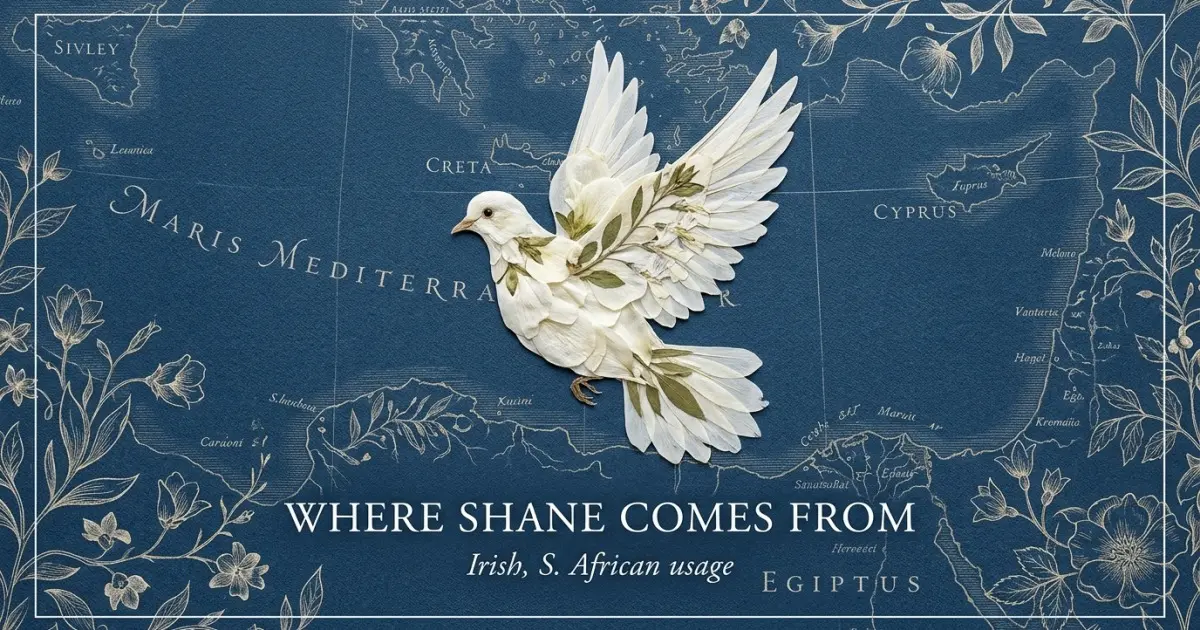
From John to Sean to Shane
This chain matters because it gives Shane more depth than its surface simplicity suggests. John is one of the great enduring grace-names of the Western naming tradition. Sean became the Irish form rooted in that line. Shane, in turn, becomes a spoken echo that takes on its own identity. That is a fascinating kind of evolution. The name is not merely translated. It is pronounced into being.
Names that emerge through spoken change often feel especially alive because they carry the marks of actual human usage rather than of purely written inheritance. Shane belongs to that category. It sounds modern partly because it was shaped by the ear as much as by the page. That gives it a naturalness many formally “older” names do not quite have.
Why the Irish route changes the atmosphere
Although Shane ultimately participates in the same grace-centered tradition as John and Sean, it creates a distinct mood. John is stable and foundational. Sean is unmistakably Irish and historically resonant. Shane feels leaner, quicker, and more contemporary, even though its meaning is equally ancient. This is one reason the name travels so well. It carries history without sounding burdened by it.
The attached Irish reference also notes that phonetic spellings like Shaun and Shawn grew popular and later receded as Sean became more easily recognized internationally. That helps explain part of Shane’s charm. It sits in that same world of pronunciation and adaptation, but emerged as a separate, durable form rather than a mere spelling workaround. Shane sounds intentional, not improvised.
Shane sounds cleaner than most grace-names, and that changes how the meaning lands
Phonetically, Shane does almost everything in a single gesture. It begins with the soft friction of sh, glides through the long ay vowel, and closes with a firm n. There is no ornament, no extra syllable, no heavy cluster. The name is all line. This matters because sound and meaning reinforce each other in an unusual way here. A name meaning grace could easily become airy or fragile. Shane avoids that because the shape is so controlled.
The long vowel gives the name openness. The initial consonant makes it smooth rather than abrupt. The final n gives enough closure to keep the whole word from drifting away. This is one reason Shane sounds calm rather than sentimental. It is soft, but it is not weak. The phonetics keep the name grounded.
This sound pattern also helps explain why Shane has worn so well across generations. It is simple enough to be universally usable, but distinctive enough to remain memorable. The single syllable gives it speed. The vowel gives it light. The consonants give it shape. That balance is hard to achieve in a one-syllable name, and Shane does it exceptionally well.
Shane belongs to a family of grace-names, but feels more modern than most of them
Because Shane sits in the John-Sean tradition, it belongs to a much larger family of names that center divine favor. But among those grace-names, Shane occupies a very distinctive place. John is foundational and timeless. Sean is deeply Irish and still culturally marked. Shaun and Shawn are more phonetic and more tied to particular modern decades. Shane feels leaner than all of them. It has the grace meaning, but not the heavier historical casing.
This is why Shane often reads as more contemporary than its relatives even when it has been around for generations. It sounds like the edited form, the version in which the older religious inheritance has been compressed into something sleek enough for modern naming taste. Yet because the meaning remains so rich, the result does not feel empty. The name has been refined, not reduced.
That same dynamic helps Shane stand apart from other short Irish-leaning boys’ names such as Shea, Sean, Finn, or Rory. Shea is softer and more airy. Sean is denser with cultural and orthographic history. Finn is brighter and more image-based. Rory is more lively and textured. Shane, by contrast, feels clean and almost architectural. It has less color on the surface, but more grace underneath.
Why Shane has kept its masculine profile without sounding hard-edged
Official SSA data showing Shane at No. 601 for boys and far lower for girls confirms what most listeners already hear: the name remains primarily male in current usage. Yet it reaches that masculine profile differently from many other boys’ names. Shane does not rely on blunt consonants, aggressive imagery, or overtly heroic symbolism. It stays masculine through clarity and usage rather than through force. To continue browsing names with a similar gender identity, see boys’ names with meanings.
Masculinity through restraint
This is one of the name’s most modern strengths. Shane sounds male without sounding defensive about it. The single syllable and the steady ending do a great deal of that work. So does long-standing male use. But the softer opening and grace-centered meaning keep the name from feeling rigid. The result is a masculinity shaped by restraint rather than by pressure.
That makes Shane especially attractive for families who want a boys’ name that allows space for warmth, intelligence, or emotional fluency. The name does not demand hardness as proof of strength. It simply assumes the child can carry grace without losing solidity.
The social effect of a name this concise
One-syllable names often feel socially efficient, and Shane is no exception. It is easy to hear, easy to say, and easy to remember. Those practical strengths matter because they help the name move cleanly through daily life. But in Shane’s case, the efficiency also creates style. The name sounds as though it has already been pared down to what matters most. That can give it a quiet confidence that longer names sometimes struggle to maintain.
Its relative rarity now only sharpens that effect. Shane sounds familiar, but not overhandled. That makes it feel more personal than it once might have at moments of heavier use.
Shane still feels current because it does not overstate itself
The modern ranking is useful here. At No. 601 for boys in 2024, Shane remains socially legible but no longer lives in the overexposed center of naming culture. That gives it a kind of freshness. The name is known, but no longer automatic. For many families, that is an ideal place for a name to be. It carries recognition without repetition fatigue.
Shane also benefits from having a sound that never depended on one era’s fashion markers. It is not tied to elaborate spelling, not burdened by trend-driven syllables, and not overbuilt around a single cultural moment. That helps it age well. A small boy can carry Shane easily. So can an adult, a professional, or an older man. The name already contains adulthood because it never needed juvenile ornament.
That is why Shane continues to feel usable even when it is not dominant. It does not need fashion to justify itself. It already has sound, history, and meaning working in close alignment.
Where Shane opens next
Middle names can either broaden Shane or keep it sharply minimal
Because Shane is so concise, middle names often do unusually important work. A longer classic middle can give the full name more depth, while a shorter one can preserve its stripped-down clarity. If you want the full pairing logic behind that contrast, see Shane middle names.
Nicknames matter less with Shane than with fuller names
One of Shane’s advantages is that it is already compact and complete. Any nicknames usually arise from affection or play rather than from a need to simplify the name for daily use. To see how those different moods shorten in real life, explore nicknames for Shane.
Pronunciation is one of Shane’s strongest practical gifts
The pronunciation is clean, stable, and low-friction. That ease supports the name’s social durability and helps its deeper meaning stay quietly intact rather than needing constant explanation. For the detailed stress pattern, accent notes, and IPA, see how to pronounce Shane.
Why Shane still sounds like grace without ornament
The deepest appeal of Shane is that it takes one of the great old naming meanings and strips away everything except the essentials. “God is gracious” could easily belong to a more visibly biblical or heavily traditional name. In Shane, that same meaning becomes immediate. It fits inside one syllable. It moves without fuss. It sounds like an old truth told plainly.
In literary terms, Shane feels like a name that knows restraint is its own form of style. It does not pile on history even though it has it. It does not announce grace even though it means it. Instead, it lets the sound stay clear and the meaning stay deep. That is why the name remains so persuasive. Shane turns favor into form and gives mercy a modern voice. And that is what gives Shane its lasting force: it sounds like grace reduced to exactly what must remain.