
Rosalina Name Meaning: Meaning, Legacy, and Style
Rosalina is the kind of name that makes gentleness feel architectural. At first glance, its meaning, “gentle rose,” may seem easy to understand: floral, soft, beautiful, feminine. But names that last rarely survive on prettiness alone. Rosalina endures because the phrase does more than decorate. It frames a very particular kind of presence. A gentle rose is not weak. It is composed. It carries beauty with structure, softness with form, fragrance with thorns hidden just out of sight. That tension is the name’s real strength. Rosalina suggests a person whose grace is not accidental, whose charm is not flimsy, and whose softness is not surrender.
That is why the name feels richer than many rose names at first hearing. It does not only point toward bloom, romance, or sweetness. It implies restraint, poise, and the kind of emotional beauty that can hold its shape over time. The rose in Rosalina is not merely a flower pressed into a nursery theme. It is a symbol of delicacy that survives because it is ordered, rooted, and capable of carrying meaning in many directions at once. The name’s four-syllable music deepens that impression. Rosalina does not rush toward charm. It unfolds. By the time the final syllable lands, the name has already done something quietly unusual: it has made gentleness sound serious.
Rosalina's U.S. popularity rank over time, 1914–2024
Popularity statistics are based on official data from the Social Security Administration baby name records.
Rosalina: A Grand and Rhythmic Gentle Rose
Rosalina functions as a name with one unmistakable center of gravity, reaching an all-time peak for girls in 2024 . Its modern rise reflects a preference for grand variations of floral classics that capture a delicate and romantic spirit.
The lack of a secondary track reinforces its firm, traditional feminine profile. Signifying a “gentle rose,” its rhythmic four-syllable sound gives it an elegant texture that remains fresh .
What Rosalina quietly tells you before the story even begins
| Key Facts | Information | Quick Insight |
|---|---|---|
| Name | Rosalina | The name feels lyrical and romantic, but its deeper appeal comes from the way it balances softness with clear structure. |
| Primary Gender Usage | Female | Its current use and sound place it firmly in the feminine tradition, yet it avoids sounding fragile or overly ornamental. |
| Primary Origin | Latin | The Latin root gives Rosalina historical grounding, which helps its floral beauty feel established rather than invented. |
| Primary Meaning | Gentle rose | This is not only a botanical image. It suggests beauty shaped by calmness, restraint, and inner poise. |
| Pronunciation | roh-zuh-LEE-nuh | The late stress on the third syllable gives the name lift and elegance, helping it sound graceful instead of merely soft. |
| IPA (US) | /ˌroʊzəˈliːnə/ | The American form confirms the name’s layered rhythm and its clear melodic center. |
| IPA (UK) | /ˌrəʊzəˈliːnə/ | The British form remains close enough to preserve the same overall identity across accents. |
| Syllable Count | 4 | Four syllables give Rosalina sweep and presence, allowing the name to feel expansive without becoming heavy. |
| U.S. girls’ rank (2024) | No. 764 | Official data shows Rosalina is established enough to feel familiar, while still uncommon enough to remain a deliberate choice. |
| US Boys’ Rank | Not ranked | Its present-day social reading is clearly feminine, which gives the name immediate clarity in everyday use. |
Why Rosalina makes gentleness sound strong
The phrase “gentle rose” can easily be misread if it is approached too quickly. Gentleness is often mistaken for passivity, and floral names are often treated as if they exist only to be admired. Rosalina refuses both reductions. The word gentle is doing serious work here. It does not describe a person who disappears into politeness. It describes a temperament marked by composure, softness under control, and the ability to move through the world without harshness while still retaining form. In that sense, Rosalina belongs to a long tradition of names that translate beauty into character.
That character matters. Many names are chosen because they sound lovely in isolation. Rosalina sounds lovely, but it also carries an attitude toward beauty. A gentle rose is not unformed or diffuse. It is cultivated. It is ordered. It suggests that elegance is not the opposite of resilience, but one of its expressions. That gives Rosalina a far more durable emotional center than a simpler reading of the name might suggest.
The word “gentle” inside Rosalina is doing more than softening the flower
“Gentle” gives the name moral weight. It pushes the rose away from cliché and toward temperament. This is one reason Rosalina feels more mature than some other floral names. It is not just a name of petals, blush, and decoration. It is a name of tone. Parents often choose names that imply kindness, calm, or light, but those words can become vague in practice. Gentleness, by contrast, is concrete in behavior. It suggests patience, grace under pressure, and a refusal to become coarse. Rosalina therefore implies a type of strength that does not need spectacle.
That quality is especially persuasive in a modern naming landscape where many families want softness without weakness and femininity without fragility. Rosalina offers exactly that balance. It keeps the tenderness, but gives it spine.
The rose inside Rosalina is beauty with memory
The rose is one of the oldest and most enduring images in naming language because it can carry more than one meaning at once. It suggests beauty, of course, but also cultivation, seasonality, and the fact that what is delicate can still be rooted. In Rosalina, the rose feels less like decoration and more like inheritance. It is not only a visual image. It is a way of organizing the whole mood of the name.
That is why Rosalina sounds layered. The rose gives the name immediate warmth, but the modifier “gentle” keeps that warmth from becoming showy. Together, the words create a sense of femininity that is quieter and more deliberate than many parents may first expect. The name does not bloom chaotically. It blooms with manners.
Rosalina belongs to a Latin line, but lives like a modern romance
The Latin origin matters because it gives Rosalina an older backbone beneath its dreamier surface. Without that root, the name might risk feeling like a purely decorative modern construction, assembled for sweetness and sound alone. But Rosalina does not feel assembled. It feels inherited. That inherited quality is one reason the name sounds so settled in the mouth. Its beauty is not improvised. It comes from a form with history behind it. To explore the wider naming world around Rosalina, visit a wider list of Latin names.
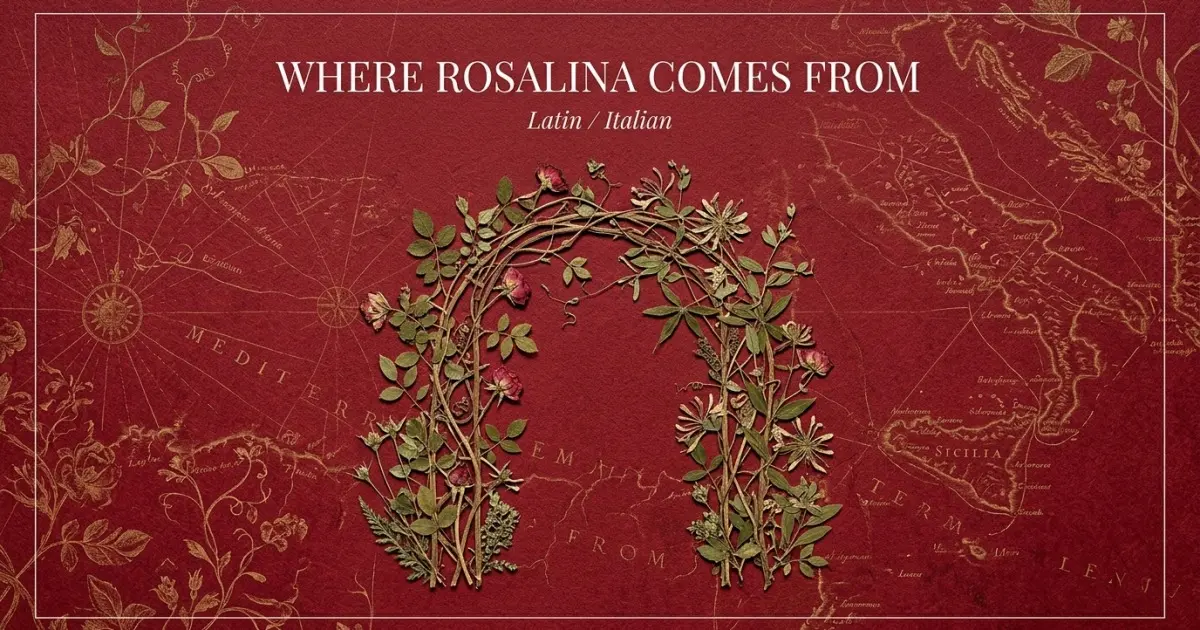
Latin-rooted names often carry a particular kind of polish in English-speaking life. Even when they are floral or lyrical, they tend to feel organized rather than excessive. Rosalina benefits from exactly that effect. It is romantic in tone, but the Latin structure gives it shape. That combination helps the name move across generations more successfully than a purely fashion-driven floral name might. It can feel old-world, but not dusty; elegant, but not fragile; feminine, but not overstated.
Why Rosalina sounds older than trend, but younger than formality
Rosalina occupies a very appealing middle register. It is older in spirit than many current naming trends, but younger in tone than some more formal historic names. That in-between quality makes it especially usable. The child who bears it receives a name with grace and sweep, but not one that sounds locked inside a museum case. Rosalina feels alive. It has history, yet it still breathes easily in present-day life.
This may be one reason the name feels both literary and accessible. It can belong in a storybook, but it does not need a storybook to survive. It brings its own atmosphere and then adapts to the person carrying it.
Rosalina’s Latin character keeps the romance from drifting
Some long feminine names are beautiful but structurally soft, as though they might float away if not held down by context. Rosalina avoids that problem because the Latin root gives the name an inner line. Even without knowing the etymology in detail, listeners tend to hear that the name has bones beneath the bloom. That is why Rosalina feels composed rather than sugary. The name is musical, but it is not loose.
That composure helps it age well. A name tied too tightly to sweetness can feel thinner in adulthood. Rosalina’s rooted structure helps it sound credible on a child, persuasive on a young woman, and elegant on an adult without changing identity at all.
How Rosalina sounds like bloom and restraint at once
Much of Rosalina’s appeal lives in its phonetic design. The name begins softly, moves through a gentle middle, and then rises into its strongest stress on the third syllable: LEE. That delayed emphasis is one of the reasons the name sounds so graceful. It does not strike hard at the beginning. It opens, travels, and then brightens. The result is a name that feels unfolding rather than bluntly declared.
This matters because four-syllable names can easily lose focus if their rhythm is too even. Rosalina avoids that danger by having a strong melodic center. The stress on the third syllable acts as a spine. It gives the name height and forward movement, while the softer opening keeps it from sounding severe. In other words, the sound of Rosalina performs the same balance that the meaning suggests: beauty guided by order.
Why the rose image feels audible in Rosalina
The rounded opening roh and the soft transition into the middle syllables give the name an immediate floral warmth. Yet the brightness of LEE stops the sound from becoming too hushed. This is what makes Rosalina feel more vivid than some other long rose names. It has softness, yes, but it also has lift. It sounds awake.
That phonetic wakefulness helps translate “gentle” into something active rather than passive. The name is not drooping. It is alive with motion, but that motion remains smooth and measured.
Why Rosalina can sound grand without sounding heavy
Length alone does not create elegance. Sometimes it only creates drag. Rosalina succeeds because the syllables are distributed well. The first half is light enough to invite the ear in. The stressed third syllable provides the moment of arrival. The final syllable softens the exit. This kind of internal architecture is why the name feels substantial without becoming overburdened. It has room, but also direction.
Rosalina in modern life feels known, but never crowded
Official Social Security Administration (SSA) data places Rosalina at rank 764 for girls in 2024. That is an unusually attractive position for a name like this. Rosalina is visible enough to feel socially established, which means it is unlikely to confuse or alienate people in daily life. At the same time, it remains far enough from overexposure to preserve individuality. That balance matters. A richly melodic name can lose some of its specialness if it becomes too common. Rosalina has not reached that point. For parents considering similar names, this guide to Girl Names names is a useful next step: classic and modern girl names.
This middle ground suits the name perfectly. It allows Rosalina to feel considered rather than obscure, graceful rather than trendy. Parents who choose it are not choosing something difficult for the sake of difference, but they are also not surrendering to the most crowded part of the chart. The name therefore arrives with a quiet kind of confidence. It sounds chosen, not defaulted into.
Why Rosalina feels distinctive without trying too hard
Many names that aim for elegance lean too heavily on unusual spelling or theatrical styling. Rosalina does not need those tricks. Its distinctiveness comes from its natural form. It is longer than many everyday names, but not so elaborate that it becomes impractical. It is floral, but not thin. It is feminine, but not brittle. Those balances make it memorable without making it self-conscious.
Rosalina’s social impression now
In contemporary use, Rosalina often reads as graceful, bright, and slightly storybook in the best sense. It can feel romantic, but not overworked; polished, but not cold. That makes it appealing to parents who want beauty with a little air around it, a name that sounds elevated without losing human warmth. Rosalina belongs to that rare class of names that can feel special on first hearing and still feel livable on the tenth thousandth.
Rosalina among floral names: why it feels more composed than fragile
Floral names often divide into two broad kinds. Some feel direct and simple, almost like naming the flower itself and letting the image do all the work. Others expand the floral base into something more elaborate and atmospheric. Rosalina belongs to the second group, but it distinguishes itself because it is not merely elaborate. It is measured. The name’s modifier, its Latin grounding, and its strong internal rhythm all keep it from becoming overperfumed.
That is why Rosalina can carry romance without collapsing into fragility. It does not ask to be admired from a distance. It asks to be inhabited. The rose remains visible, but the name does not reduce the person to a symbol. Instead, it offers a model of femininity in which delicacy and discipline can coexist. That is a harder and more interesting achievement than simple prettiness.
Where Rosalina opens next
Rosalina and the middle-name question
The right middle name usually decides whether Rosalina feels more classic, more luminous, or more sharply balanced in full form. If you want the full pairing logic behind that contrast, see middle names for Rosalina.
Rosalina and the nickname question
Its four-syllable shape naturally creates a rich nickname life, which gives the name flexibility across childhood and adulthood. To see how those different moods shorten in real life, explore Rosalina nicknames.
Rosalina and everyday pronunciation
Its pronunciation is one of its hidden strengths: long enough to sound elegant, but structured clearly enough to remain practical in daily speech. For the detailed stress pattern, accent notes, and IPA, see Rosalina pronunciation guide.
Why Rosalina keeps the rose without becoming fragile
The deepest appeal of Rosalina lies in the way it transforms floral beauty into character. “Gentle rose” could have been a smaller meaning than this name deserves. Instead, in Rosalina it becomes a full vision of presence: graceful, rooted, calm, and quietly strong. The name does not deny softness. It redefines it. Gentleness becomes a mode of strength. Beauty becomes a matter of bearing. Even the rose becomes less a decoration than a form of disciplined life.
In literary terms, Rosalina is a name of cultivated grace. It sounds as though it has been shaped rather than merely adorned. The child who carries it receives more than a floral image. She receives a name that suggests that tenderness can have contour, that elegance can endure, and that the most memorable beauty is often the beauty that knows how to hold itself. That is why Rosalina lingers. It does not simply bloom. It remains.
Historical Roots and Meaning of Rosalina: FAQ
Does Rosalina feel too romantic for real life?
No. Rosalina is undeniably romantic, but its Latin grounding and strong internal rhythm help it feel structured and usable rather than overly dreamy.
What is the strongest part of Rosalina’s meaning?
The strongest part is the way “gentle rose” combines softness with discipline. The name suggests not only beauty, but beauty shaped by calmness and poise.
Is Rosalina more classic or more modern in style?
Rosalina stands in a very appealing middle space. It feels classic in root and tone, but modern enough in use to sound fresh rather than antique.
Will Rosalina age well into adulthood?
Yes. Its musicality suits childhood, but its structure and emotional depth give it enough seriousness to remain persuasive in adult life as well.