
Randolph Name Meaning: Heritage, Strength, and Sophistication

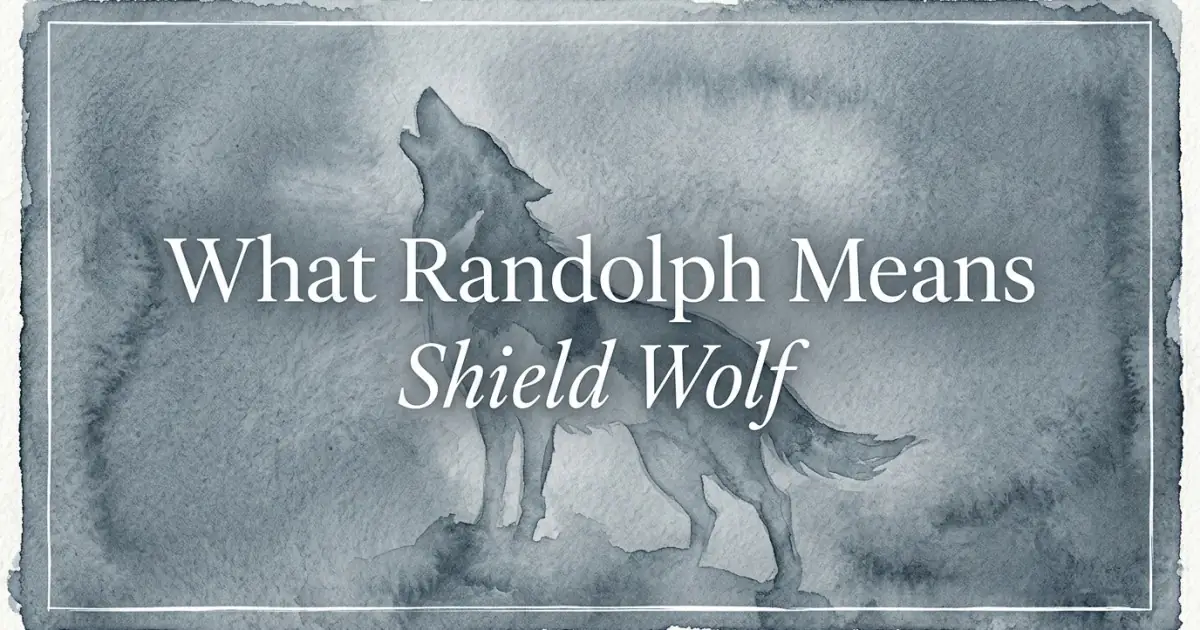
A shield is built to stand between danger and what must be protected. A wolf survives by reading its surroundings, moving with purpose, and remaining alert to the needs of the group. Randolph brings those two images together in the meaning shield wolf. The combination is not merely a declaration of strength. It presents strength as a responsibility: power becomes most valuable when it is used to guard, endure, and create enough safety for others to stand beside it.
Pronounced RAN-dolf, Randolph has two syllables, first-syllable stress, and a dense consonant structure that gives it substantial presence. Its Germanic origin places the name within an older naming tradition built from compact, concrete ideas. Official Social Security Administration (SSA) data places Randolph at No. 5,588 among boys’ names in 2024, making it exceptionally uncommon in current American use. The name therefore arrives with an unusual balance: it sounds established and formal, yet its rarity gives a modern bearer considerable room to define what Randolph means in everyday life.
Randolph's U.S. popularity rank over time, 1880–2024
Popularity statistics are based on official data from the Social Security Administration baby name records.
Randolph: A Dignified and Sturdy Heritage Pillar
Randolph presents a chart pattern of a broader past and a clearer present, reflecting a massive naming cycle that reached its highest momentum in the early 20th century. While its adoption is selective today, its current standing suggests a “vintage revival” as parents rediscover heritage gems that feel both warm and authoritative.
The absence of crossover usage reinforced its focused masculine profile. Meaning “shield wolf,” its simple structure provides a sense of permanent resonance that has stood the test of time.
Randolph Brings Its Protective Structure into Focus
| Key Facts | Information | Quick Insight |
|---|---|---|
| Name | Randolph | An eight-letter name with a substantial written form, giving it an established and formal visual presence. |
| Primary gender usage | Male | Its firm consonants and historic structure give Randolph a traditionally masculine profile without determining the bearer’s personality. |
| Origin | Germanic | The origin gives Randolph a defined linguistic home and connects it with an older compound-name tradition. |
| Meaning | Shield wolf | The meaning joins protection with alert strength, shifting attention from power alone to the purpose for which power is used. |
| Pronunciation | RAN-dolf | First-syllable stress makes the name immediately recognizable, while the compact second syllable gives it a firm finish. |
| U.S. IPA | /ˈrændɒlf/ | The American form moves from a stressed opening vowel into a tightly closed final syllable. |
| U.K. IPA | /ˈrændɒlf/ | The matching British form gives Randolph a stable supplied pronunciation across both standards. |
| Syllable count | 2 | The name sounds substantial despite its efficient two-beat rhythm. |
| U.S. boys’ rank (2024) | No. 5588 | Randolph is exceptionally uncommon in current American use, allowing one bearer to become the strongest local association with the name. |
Randolph Turns Strength into a Duty of Protection
The meaning “shield wolf” contains two different forms of strength. The shield is made, carried, and placed deliberately. The wolf is living, responsive, and capable of adjusting to changing conditions. One image suggests defense through structure; the other suggests survival through awareness.
Together, they create a richer interpretation than a simple promise of toughness. Randolph can express the hope that strength will be disciplined, attentive, and useful to other people.
The shield introduces responsibility before force
A shield is not designed primarily to attack. Its purpose is to absorb impact, create distance from harm, and preserve the person or community behind it. That function gives the first half of Randolph’s meaning an ethical dimension.
Protection can take many forms in ordinary life. It may mean defending someone who is being treated unfairly, setting boundaries around a family, keeping a promise during a difficult period, or creating calm when other people feel unsafe. None of these actions requires physical strength. They require judgment, courage, and the willingness to accept responsibility.
This interpretation keeps Randolph from becoming a name defined only by aggression. The shield matters because something worth protecting exists behind it.
The wolf contributes alertness and adaptability
The second element introduces movement. A wolf does not survive by remaining motionless behind a fixed barrier. It watches, listens, adjusts, and responds to changes in the environment.
That makes “shield wolf” a useful contrast. Randolph can suggest both the steadiness needed to hold a position and the intelligence needed to know when that position should change. Protection without awareness can become rigid. Awareness without commitment can become unreliable. The combined meaning allows room for both.
A modern Randolph may be calm or energetic, social or private, physically adventurous or intellectually focused. The wolf image does not assign him a wild or dominant personality. It can simply support the idea of attentiveness to people, place, and consequence.
Protection should never become control
Names associated with guardianship can be interpreted too narrowly. A child may be told that he must always be strong, rescue everyone, or take responsibility for emotions that do not belong to him. That is not a healthy burden to attach to Randolph.
Protection is most meaningful when it respects another person’s agency. It offers support without possession, boundaries without domination, and courage without demanding constant self-sacrifice.
Randolph’s meaning can therefore serve as a legacy rather than an assignment. It may express a family’s admiration for reliability and courage while leaving the bearer free to define how those qualities appear in his own life.

Randolph’s Germanic Origin Gives the Name an Older Architecture
Randolph is identified as Germanic in origin. Its meaning combines two concrete elements rather than relying on an abstract description. This construction gives the name a built quality: it feels assembled from ideas intended to work together. To explore the wider naming world around Randolph, visit names with Germanic roots.
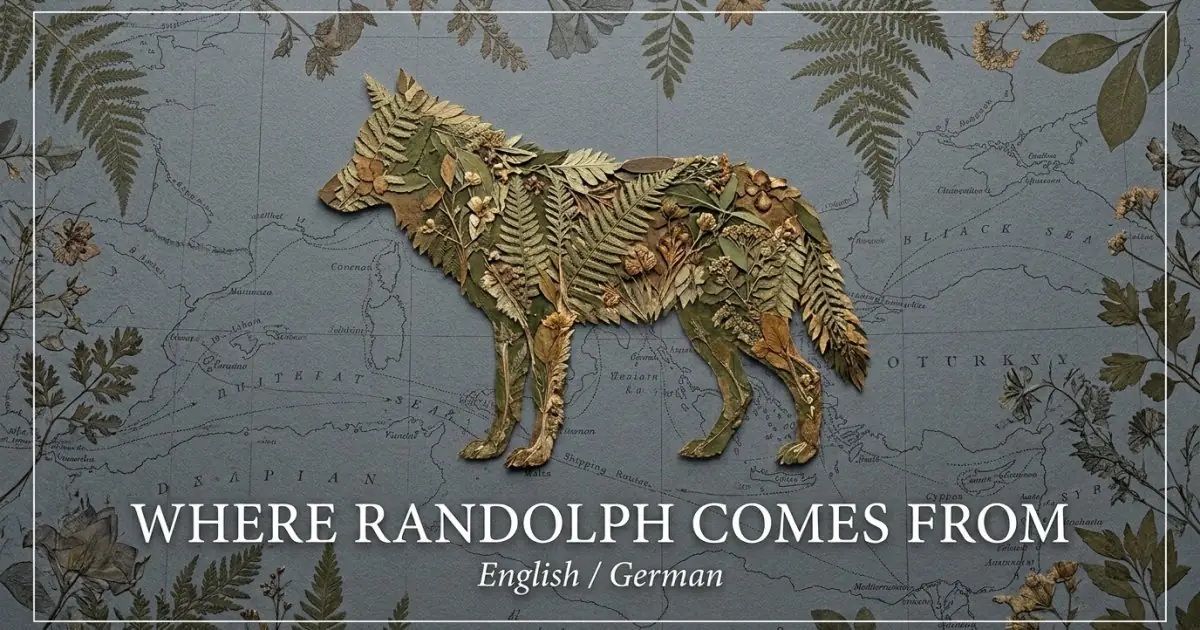
That older architecture remains visible in the modern English form. Randolph does not sound newly created from fashionable syllables. It carries the density and formality of a name that has passed through generations of use, even though it is rare today.
Concrete meanings made character visible
Names built from objects, animals, social roles, and qualities translate human hopes into memorable images. A shield can be pictured. A wolf can be recognized. Their combination gives Randolph a meaning that remains easy to understand even when the linguistic history feels distant.
This concreteness also allows different generations to reinterpret the name. Earlier communities may have heard military protection, family defense, or group loyalty. A modern family may hear emotional steadiness, moral courage, and the ability to respond wisely under pressure.
The meaning remains stable, but the human application evolves.
The full form preserves weight that nicknames can soften
Randolph has a formal, complete sound. Its eight letters and consonant-rich ending give it more visual and auditory weight than shorter contemporary names.
That formality does not make it unusable in childhood. It simply creates a strong contrast between the complete name and possible familiar forms. Randolph can appear on official documents and professional profiles, while a shorter nickname may belong to family, school, or friendship.
This duality can be valuable. The bearer does not need to abandon the full name in order to sound approachable, and he does not need to give up an affectionate nickname in order to claim a more formal adult identity.
The name carries history without requiring nostalgia
Choosing Randolph does not require parents to recreate an earlier naming era. The name can be used in a contemporary family without costume, ceremony, or a deliberately old-fashioned lifestyle.
Its age gives it depth, but the child gives it relevance. Once Randolph belongs to a particular person, daily experience becomes more important than the historical tone people initially hear.
Randolph Makes the Wolf Relational Rather Than Solitary
Popular culture often treats the wolf as an emblem of solitary independence. The phrase “shield wolf” points in another direction. A shield exists in relation to someone or something else. It implies proximity, responsibility, and a reason to remain present.
This changes the emotional center of the name. Randolph does not need to represent the isolated strong figure who requires no one. Its meaning can support strength that belongs within relationships.
Dependability grows through repeated presence
Protection is rarely one dramatic act. More often, it is created through consistency: showing up, listening carefully, remembering what matters, and responding when circumstances become difficult.
A person becomes trustworthy through repetition. Randolph can therefore carry a quieter form of courage than its powerful meaning initially suggests. It may describe the person who remains when excitement passes and practical work begins.
This interpretation gives the name emotional range. Strength is not limited to confrontation. It may appear as patience, honesty, preparation, or the willingness to repair harm.
Belonging does not remove individuality
Being part of a group does not require surrendering personal judgment. A wolf within a social structure still responds to its environment as an individual animal. In human terms, loyalty is healthiest when it includes discernment.
A Randolph may care deeply for family, friends, or community while still setting boundaries and questioning harmful expectations. Protection should not demand silence in the face of wrongdoing.
The name can therefore hold both connection and independence. The bearer may belong strongly without becoming absorbed by the group.
Real strength includes receiving protection
The shield image can make it tempting to imagine Randolph only as the protector. Yet no person can remain the shield in every situation. Everyone needs care, rest, guidance, and places where vulnerability is safe.
A meaningful interpretation of Randolph allows the bearer to receive what the name describes. He may protect others at times and rely on them at others. Mutual protection creates stronger relationships than one person carrying all responsibility alone.
Randolph Sounds Like a Name Built to Hold Its Ground
Randolph is pronounced RAN-dolf. The supplied American and British IPA forms are both /ˈrændɒlf/. The name contains two syllables, with primary stress on the first.
Its sound begins openly and ends in a compact consonant cluster. That movement mirrors the name’s broader character: accessible at the entrance, substantial at the finish.
The opening “RAN” gives Randolph immediate momentum
The name begins with /r/, a liquid consonant whose exact production varies across English accents. It moves directly into /æ/, the stressed vowel heard in words such as cat and hand.
The /n/ closes the first syllable with a nasal sound. Together, these elements create the clear opening beat:
RAN-dolf
The first syllable should remain the strongest part of the name. It should not be weakened into ruh or shifted toward a later stress.
The central D gives the two syllables a firm hinge
The /d/ sound begins the second syllable and creates a clear boundary after Ran. It is a voiced stop consonant, produced by briefly blocking airflow with the tongue and releasing it while the vocal cords vibrate.
This consonant prevents Randolph from sounding overly fluid. It acts as a hinge between the open first syllable and the denser ending.
The final “dolf” gives Randolph its weight
The final syllable contains the vowel /ɒ/ followed by /l/ and /f/. The /l/ is a liquid consonant, while /f/ is a voiceless fricative made by directing air between the lower lip and upper teeth.
The final consonants close the name decisively. Randolph does not trail away. It ends with enough structure to support formal use, professional settings, and a wide range of surnames.
Despite that density, the name remains only two syllables. Its weight comes from consonant arrangement rather than length.
Randolph Occupies a Formal Space Few Modern Names Fill
Randolph may be perceived as traditional, scholarly, surname-like, historic, or distinctly formal. These impressions are subjective, but they grow naturally from its length, consonant structure, and uncommon contemporary use.
Style neighbors may include Reginald, Roland, Raymond, Conrad, Edmund, Walter, Frederick, and Wilfred. These names are not all linguistic relatives. They simply share qualities such as established masculine usage, Germanic or traditional character, firm consonants, and an adult formal profile.
The name feels serious without requiring a serious child
Randolph carries dignity in its full form, but that does not mean the bearer must be solemn, reserved, or conventional. A playful child can wear a formal name without contradiction.
In fact, the contrast may give Randolph greater flexibility. The complete form offers structure, while family nicknames can express warmth, humor, and affection.
Rarity makes Randolph feel more individual than old-fashioned
A familiar traditional name may carry many strong associations. An exceptionally uncommon one has more room to be redefined.
Randolph may initially remind listeners of an earlier generation, but that impression can change quickly when the name belongs to a contemporary child. Personal experience has the power to move a name from historical distance into present life.
The full name can travel across life stages intact
Randolph has enough formality for adult use without requiring alteration. It can appear naturally on academic work, professional correspondence, artistic credits, official records, and family documents.
A nickname may be used for convenience or intimacy, but the full form does not need to be replaced as the bearer grows.
Randolph’s No. 5588 Ranking Marks Exceptional Rarity
Official SSA data places Randolph at No. 5,588 among boys’ names in 2024. It is therefore exceptionally uncommon in current American use.
No girls’ ranking is supplied for the same year, and Randolph’s primary usage is male. The available figure should be understood as a one-year snapshot of boys’ naming rather than proof of a long-term trend. For parents considering similar names, this guide to Boy Names names is a useful next step: strong boy names and meanings.
One Randolph may define the name for an entire community
A boy named Randolph may be the only bearer in his classroom, neighborhood, or social circle. Because the name is easy to spell once heard and follows a familiar two-syllable pattern, its rarity does not depend on extreme complexity.
This allows distinction without requiring constant explanation. The name may be unusual, but its structure remains recognizable.
The ranking does not show whether Randolph is rising or falling
A single year of data can establish current rarity but not direction. Randolph should not be described as returning, disappearing, or becoming fashionable without broader evidence.
The reliable conclusion is narrower and more useful: Randolph was exceptionally uncommon among boys in the United States in 2024.
Living with Randolph Means Balancing Weight, Warmth, and the Surname
Randolph should be spoken with the middle name and surname as one complete identity. Its two syllables can support either a short middle or a more expansive honor name, but its consonant-rich ending deserves attention.
A lighter middle can soften Randolph’s formality
Middle names with open vowels, softer consonants, or a flowing rhythm can create contrast after Randolph’s firm ending. A one-syllable middle can also keep a long surname from making the complete name too heavy.
A substantial traditional middle may work well when the surname is short. The goal is not to minimize Randolph’s weight but to distribute it evenly across the full name.
Repeated R, D, L, and F sounds require testing
Randolph already contains several prominent consonants. A middle or surname repeating many of them may create either strong cohesion or excessive density.
Say the complete name at ordinary conversational speed. Slow, careful pronunciation can hide transitions that feel crowded in everyday speech.
Initials and nickname possibilities belong in the final decision
Write the first, middle, and surname initials together and check for unintended abbreviations. Then consider how the full form and likely nicknames will coexist.
Randolph is formal enough to benefit from an easy familiar option, but parents should also be comfortable using the complete name regularly. A legal name should not exist only as paperwork while another name carries the child’s entire social identity.
Three Paths Continue the Story of Randolph
Middle names for Randolph can soften or reinforce its structure
A concise middle can create breathing room after Randolph’s firm ending, while a longer honor name can deepen its formal identity. Surname length, repeated consonants, initials, and family significance should guide the pairing. If you want the full pairing logic behind that contrast, see middle names for Randolph.
Nicknames for Randolph can bring warmth into the full form
Randy, Rand, Rando, Dolph, and initial-based options create different social impressions. Because Randolph sounds formal in full, a nickname can provide intimacy without replacing the complete identity. To see how those different moods shorten in real life, explore Randolph nicknames.
Pronouncing Randolph depends on preserving its two strong movements
The essential pattern is RAN-dolf. A fuller pronunciation guide can clarify the stressed opening vowel, the dense final consonants, and common mistakes such as adding a third syllable. For the detailed stress pattern, accent notes, and IPA, see Randolph pronunciation guide.
Randolph Defines Strength by What It Chooses to Protect
Randolph begins with two concrete images: the shield and the wolf. One is constructed to stand between danger and vulnerability. The other survives through awareness, movement, and relationship with its surroundings. Their combination produces a name with real force, but force is not its final message.
The Germanic origin gives Randolph an older linguistic architecture, while its two-syllable pronunciation keeps the name efficient in daily speech. Its formal sound can travel intact from childhood into adulthood, and its exceptional contemporary rarity gives a new bearer space to make the name feel current.
The meaning should not require Randolph to become fearless, dominant, or permanently responsible for everyone else. Protection is strongest when it includes judgment, boundaries, mutual care, and the courage to receive help as well as offer it.
That is the enduring idea within Randolph: strength becomes honorable not when it proves how much power it possesses, but when it recognizes what deserves to be kept safe. The shield matters because someone stands behind it. The wolf matters because survival is never only about standing alone.