
How to Pronounce Paislee: A Simple Pronunciation Guide
Paislee is the kind of name that gets tested in a very ordinary public moment: a teacher on the first day of school, a receptionist calling from a waiting room, a coach reading a roster aloud before practice starts. In those moments, a name either opens smoothly in the mouth or catches on its own spelling. Paislee usually opens smoothly. Even though the spelling looks modern and slightly customized, the spoken form is clear and direct in everyday English: PAYZ-lee. That matters, because a name with a creative surface often succeeds or fails based on whether people can say it without hesitation.
The good news is that Paislee does not ask for much once you understand its rhythm. It has only two syllables, the stress falls where English speakers expect it to fall, and the final -lee is familiar from many other modern names. The part that gives people pause is usually not the overall structure, but the middle sound: whether it should be voiced like a z or softened toward an s. In standard everyday use, the answer is the brighter one. Paislee is PAYZ-lee, not a flattened PACE-lee. Once that point is clear, the name becomes highly manageable in speech.
What Paislee is really doing when people say it aloud
| Element | Phonetic Detail | Quick Tip |
|---|---|---|
| Everyday pronunciation | PAYZ-lee | Say it in two clean beats, with the first beat carrying the weight. |
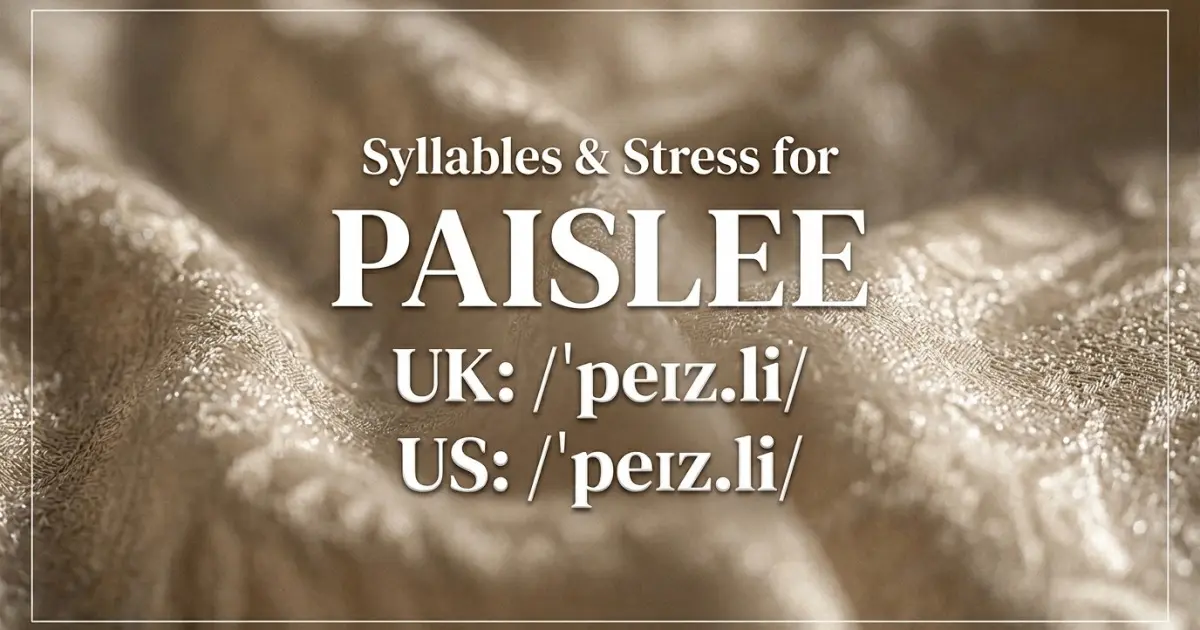
| IPA (US) | /ˈpeɪzli/ | The stress mark shows that the name begins strongly, not gently. |
| IPA (UK) | /ˈpeɪzli/ | The US and UK form are effectively the same, which keeps the name stable across accents. |
| Syllable count | 2 syllables | Keep it compact. Paislee should sound bright and quick, not stretched out. |
| Stress pattern | First syllable stressed | Put the emphasis on PAYZ, then let the ending fall lightly. |
| Opening vowel | /eɪ/ as in “day” | Think of the vowel in “pay,” not a short peh sound. |
| Middle consonant | /z/ voiced fricative | The center should buzz slightly like the z in “zebra,” not soften into an s. |
| Ending | /li/ as in “lee” | Finish neatly and lightly. The second syllable should not compete with the first. |
Paislee sounds modern because the name lands hard at the front
The first syllable gives Paislee its whole profile
Paislee has two syllables, but they are not equal in weight. The first syllable, PAYZ, carries almost all the force of the name. That stressed opening is one reason the name feels current and socially easy. English speakers are very comfortable with names that declare themselves early and then resolve quickly. Paislee fits that pattern neatly. Pronunciation lands more fully when the name’s roots and history are already in view, so begin with Paislee meaning.
The opening vowel is a diphthong, written /eɪ/, which means the sound glides slightly as it is spoken. It begins around an eh position and moves toward ee, much like the vowel in “day” or “pay.” That glide gives the name lift and brightness. Without it, Paislee would sound flatter and heavier. The first syllable is doing almost all the charisma work here.
The final “lee” softens the name without weakening it
After the front-loaded energy of PAYZ, the ending -lee releases the line gently. This matters because it keeps the name from sounding abrupt. A harder ending might make Paislee feel blockier or more surname-like. The final /li/ gives the name a familiar feminine finish in modern English, and it is one reason the pronunciation feels immediately readable even to people seeing the spelling for the first time.
That last syllable should be light. It is not where the name lives emotionally. It is where the name lands. If the second syllable becomes too heavy, Paislee can start to sound over-separated, almost as if it were two words placed side by side instead of one continuous name. The strongest delivery is confident up front and relaxed at the end.
Paislee’s middle sound is the pronunciation detail that matters most
Why the “z” matters more than people think
The central consonant in Paislee is /z/, a voiced fricative. That description sounds technical, but the practical meaning is simple: the sound should carry a little vibration. It should buzz, not hiss. This is the difference between PAYZ-lee and a flattened form that sounds closer to PACE-lee. That small distinction changes the whole texture of the name.
Because the name is linked to Paisley and related spellings, many English speakers already expect this voiced z sound. It gives the name brightness and modernity. If the center becomes an s, the name can feel less natural in contemporary use. The voiced consonant is one of the reasons Paislee sounds lively rather than simply sweet.
The spelling can tempt a softer reading
The spelling is where hesitation sometimes begins. People who focus closely on the letters may wonder whether the center should sound like s, especially because English spelling is so inconsistent. But in actual everyday pronunciation, the voiced /z/ is the stronger guide. Once heard once, it tends to stick. Paislee is not a difficult name to remember phonetically. It just benefits from that one point being settled early.
This is also why the pronunciation feels more stable than the spelling may suggest. The writing looks personalized, but the spoken pattern belongs to a familiar sound family. In practice, that often makes the name easier to live with than people expect.
Paislee beside Paisley, Payslee, and other visual neighbors
The pronunciation stays steady even when the spelling changes
One useful fact about Paislee is that related spellings such as Paisley or Payslee usually do not create a major pronunciation shift in everyday English. The visual styling changes, but the spoken core tends to remain the same: PAYZ-lee. That is helpful, because it means the spelling can feel individualized without forcing the child into constant correction.
In social life, people often hear a name before they see it, or see it before they hear it. Paislee does relatively well in both directions. Once spoken, it sounds natural. Once explained, it is easy to retain. The pronunciation pattern is simple enough that alternative spellings do not usually destabilize it.
Why Paislee does not sound like “paisley pattern” in a clumsy way
Because the name is connected to the familiar word paisley, many parents wonder whether the pronunciation will feel too tied to the textile term. In practice, it usually does not. The reason is that the stress pattern is already the same, and the word is well established in English. People are not struggling to invent a new sound. They are reusing one they already know. That familiarity reduces friction.
What changes is the social setting, not the phonetics. As a given name, Paislee is heard as personal rather than patterned. The pronunciation stays steady, but the meaning shifts from object or place association into human identity.
How to practice Paislee until it feels effortless in real life
Break Paislee into two clean beats
The simplest way to practice the name is to say it once in its two natural parts: PAYZ + lee. Then say it again more smoothly, letting the first part carry the emphasis. This helps speakers avoid two common errors at once: flattening the stress or softening the middle consonant too much.
If it helps, think of the name as one bright beat followed by one light beat. The structure is simple. It does not need overpronunciation. In fact, Paislee sounds better when it feels natural and quick rather than carefully over-separated.
Practice lines that sound like actual conversation
Names usually settle best inside real speech, not in isolation. Try these aloud:
- “Paislee will be right back.”
- “I spoke with Paislee this morning.”
- “Please welcome Paislee.”
- “That belongs to Paislee.”
If the name sounds too flat, strengthen the opening syllable. If it sounds too hissy, make sure the middle consonant is voiced like a z. If it sounds too sing-song, lighten the final -lee. Once those three small adjustments are in place, Paislee becomes very easy to say with confidence.