
Paislee Name Meaning: Its Roots, Symbolism, and Lasting Identity
Paislee is one of those names that sounds light before you discover how rooted it really is. On first hearing, it belongs easily to the modern landscape of bright two-syllable girls’ names: quick, cheerful, visually tailored, and unmistakably current. But the deeper story runs in the opposite direction. Beneath the friendly spelling and lively sound is a place-name tradition tied to old ground, built community, and sacred association. That tension is what makes Paislee worth reading closely. It sounds playful, but it comes from settlement. It feels new, but it stands on older cultural stone.
That contrast gives the name its central interpretive thread. Paislee is not a modern invention in the pure sense, even though its spelling looks unmistakably contemporary. It is better understood as a modern refashioning of an older Scottish place-name form, one whose meaning points not to fantasy or abstraction but to the kinds of places where communities gather, remember, worship, and bury their dead. In other words, Paislee is a name in which surface brightness and historical gravity coexist. The style is current. The emotional architecture is old. And that is exactly why the name has more depth than its sweetness first suggests.
Paislee's U.S. popularity rank over time, 1990–2024
Popularity statistics are based on official data from the Social Security Administration baby name records.
Paislee: A Trendy and Artistic Nature Blend
Paislee reads as a name with one unmistakable center of gravity, where its visibility is concentrated entirely on the girls’ side of the chart. Reaching its record height in 2016, its rise likely suggests it benefits from a style family of nature-inspired names that parents trust for being fresh and patterned .
The lack of crossover reinforcements its clear and focused feminine identity. Its simple two-syllable rhythm carries a sense of energetic charm and modern resonance.
Paislee, read in one clear frame
| Key Facts | Information | Quick Insight |
|---|---|---|
| Name | Paislee | Paislee looks unmistakably modern, but its deeper identity comes from an older place-name tradition rather than from a newly invented sound alone. |
| Primary origin | Scottish | The Scottish origin gives the name geographic and cultural footing, which keeps it from feeling weightless even in its trend-forward spelling. |
| Core meaning | church; cemetery | This is a surprisingly grounded meaning for such a bright-sounding name, linking it to sacred ground, memory, and settled community. |
| Pronunciation | PAYZ-lee | The strong first syllable and clean ending make Paislee sound vivid and easy, which helps explain its modern appeal. |
| IPA | US /ˈpeɪzli/; UK /ˈpeɪzli/ | The same general pronunciation across US and UK English keeps the name socially portable and simple to carry. |
| Syllable count | 2 | Two syllables give Paislee speed and brightness, making it feel familiar even when the meaning underneath is much older. |
| Primary usage | Female | Current use places Paislee firmly in the feminine lane, especially because the -lee ending visually softens the older place-name base. |
| Related standard form | Paisley | Modern naming references often treat Paislee as a spelling variant of Paisley, which helps explain how an established place-name became a styled given name. |
| U.S. girls’ rank (2024) | No. 643 | Official data shows that Paislee remains visible and recognizable, but not so dominant that it has become socially invisible. |
Paislee is softer than its meaning and stronger than its spelling
There are names whose meanings sound exactly like the way the names feel. Paislee is not one of them. The sound is lively, airy, and easy to smile through. The meaning, by contrast, points toward old institutions and older emotional ground: church and cemetery. That difference is not a flaw. It is the source of the name’s complexity. Paislee sounds like motion, but it means place. It sounds youthful, but it refers to permanence. It sounds decorative, but it carries communal memory.
This matters because names with old place-meanings often age better than names built entirely from fashion texture. A name tied to a real site, a town, a church, or a burial ground already belongs to human history before it belongs to personal style. That gives it durability. In Paislee’s case, the brightness of the modern spelling does not erase that older foundation. Instead, it creates a layered effect. Parents may choose the name because it feels cheerful and current, but the child inherits something more substantial: a word historically linked with where people gather, worship, mourn, and remain.
The mention of cemetery inside the meaning can understandably surprise modern readers. It is not the kind of gloss that appears in the sentimental language of many contemporary baby names. Yet when read historically rather than sensationally, it makes sense. Churchyards and burial grounds were not only places of loss. They were places of continuity, ancestry, and collective memory. They marked the long human fact of belonging somewhere. Read in that way, Paislee’s meaning becomes much richer. It does not point toward morbidity. It points toward sacred and remembered ground.
That deeper reading helps the name escape shallowness. Without its roots, Paislee might risk sounding merely cute. With its roots, it becomes a name that does something more interesting: it hides gravity beneath brightness. The result is a contemporary feminine name whose emotional center is steadier than its surface first suggests.
From Scottish place-name to Paislee
Paislee begins as place before it becomes person
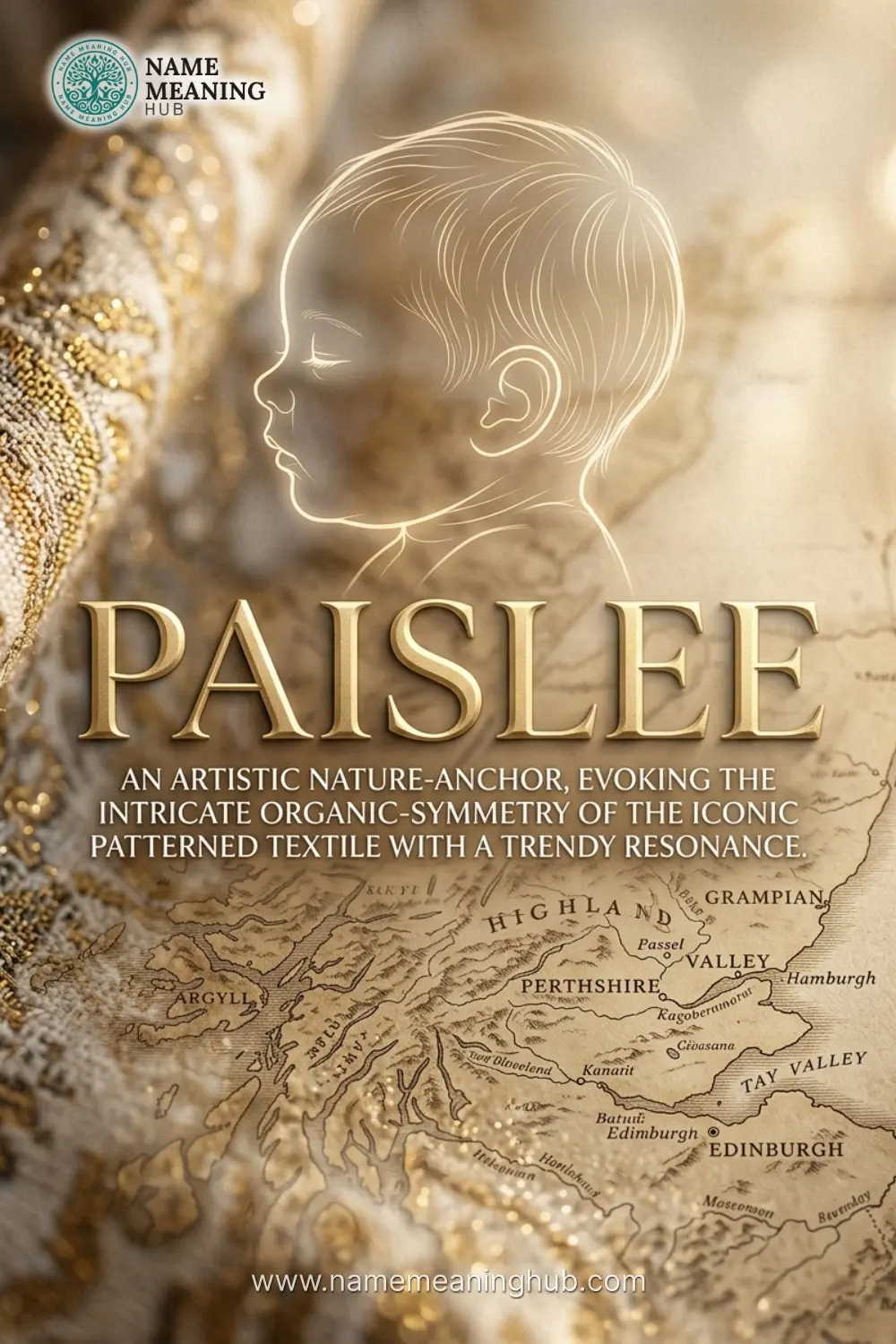
Historically, modern naming references treat Paislee as a spelling variant of Paisley, and Paisley itself is described as a Scottish town name that moved into personal naming over time. That matters because it clarifies the name’s deepest identity. Paislee did not begin as a free-floating invented girls’ name. It comes out of a place-name tradition, and place-names often carry meanings that are older, stranger, and more communal than the meanings of ordinary first names.
That place-first history explains why Paislee feels different from names that are simply styled for sound. A place-name has already lived another life before it enters the nursery. It has geography, memory, and the pressure of real human use behind it. Even when the modern spelling softens and updates the surface, the older pattern still matters. Paislee is therefore not just modern; it is modernized. That is a more interesting category.
It also helps explain the name’s unusual semantic field. Words like church and cemetery do not come from the logic of modern personal naming at all. They come from settlement, from architecture, from public life. When such meanings survive inside a contemporary given name, they create exactly the kind of depth Paislee has. The name may feel airy, but its source is grounded.
The town and the textile widened the word’s afterlife
The story does not stop with place alone. Naming references also note that Paisley became widely associated with the famous woven textile pattern that took its name from the Scottish town. That second life matters because it helped the word travel further into general cultural recognition. A town name became not only a place marker but also a visual one, connected to pattern, fabric, and design.
This complicates the atmosphere of Paislee in useful ways. On one side, the deeper meaning points toward church and cemetery, toward institution and memory. On the other, the wider modern imagination may also hear echoes of ornament, fabric, and pattern. The name therefore sits at an unusual intersection: sacred ground, lived place, and decorative association. That is a great deal of layered history for such a playful-looking form.
In naming terms, this helps explain why Paislee could become attractive to modern parents. The older town association gives it legitimacy. The textile association gives it visual flair. The revised spelling gives it feminine softness and present-day readability. All three layers work together. Paislee is not just a town name and not just a styled respelling. It is a name shaped by several cultural lives at once.
Why Paislee sounds contemporary even when its roots are old
Phonetically, Paislee feels much younger than its meaning. The pronunciation PAYZ-lee lands immediately. The first syllable is strong, bright, and open. The final -lee gives the name a familiar finish in modern English, especially because that sound has become so common in girls’ names and feminine-leaning spellings. This is one of the clearest examples of how sound can modernize historical material. The root may be old. The rhythm feels current. To see what else belongs in this group, browse feminine baby names.

The name’s first syllable does most of the work. Because the stress arrives at the front, Paislee feels energetic from the first beat. There is no slow unfolding, no heavy ceremonial build. The vowel in PAY gives the name light and visibility, while the z sound adds brightness and a little contemporary polish. That voiced fricative in the center matters. It gives the name its spark. Without it, Paislee would sound flatter and less alive.
The ending, of course, is where much of the social styling becomes visible. The -lee ending is one of the strongest signals of modern feminine naming in English. It softens the older place-name frame and makes the name feel more person-shaped, more child-centered, and more immediately wearable. This does not erase the older root. It simply changes the register through which the root is heard.
That is why Paislee can seem almost paradoxical. Its meaning comes from old ground. Its sound comes from modern naming preferences. It belongs to both. And because the two layers are so different, the name acquires more tonal range than a simpler name might have. It can sound cheerful without being shallow, because the deeper structure keeps pulling downward toward history. If you are drawn to the roots behind Paislee, see names from Scottish tradition.
Paislee in the current naming landscape
Official Social Security Administration (SSA) data places Paislee at No. 643 for girls in the United States in 2024, which gives the name a very specific modern position. It is recognizable. Most people will have heard it or something very close to it. Yet it is not so dominant that it disappears into pure familiarity. That middle position is important. It means Paislee can still feel like a chosen style, not merely an automatic one.
The spelling plays a major role in that effect. Modern naming references list Paislee among a family of alternative spellings related to Paisley, including forms such as Paisleigh and Paislie. That tells you something about how the name lives now. It belongs to a contemporary naming culture that values a familiar sound with a more individualized written surface. Paislee therefore carries not only a name, but a naming attitude: recognizable, but personalized.
That attitude places the name among modern parents’ larger preferences for surname-and-place-inspired girls’ names with softer endings. Paislee sits beside names that feel bright, feminine, and slightly tailored by spelling. Yet it differs from some of them in one important way: its deeper meaning is more anchored than its surface suggests. Where some modern styled names are chosen almost entirely for sound, Paislee still carries a more settled historical base.
The current rank also suggests that the name has not vanished with a single brief trend cycle. It remains socially legible, which means families choosing it now are not operating on novelty alone. They are working with a form that has proven it can live beyond first fashion. That usually gives a name better long-term chances.
How Paislee is perceived beside its neighbors
Style-wise, Paislee sits in a very specific neighborhood. Beside Paisley, it looks more intentionally feminine and more fully adapted into first-name use. Beside names like Kinsley, Ainsley, or Everly, it shares some of the same modern cadence, but its place-name base and older meaning make it feel less purely decorative. Beside something like Willow or Meadow, it sounds less natural-world poetic and more socially structured. It is a built-place name, not a wild-place name.
That difference matters in how the name is felt. Paislee does not evoke untouched landscape. It evokes inhabited ground. Even when listeners are not consciously aware of the meaning, that sense of settlement may be part of why the name feels more stable than some equally bright modern forms. There is an undercurrent of structure in it.
The spelling, however, ensures that the name does not feel austere. The -lee ending keeps it current, accessible, and clearly positioned within twenty-first-century girls’ naming. That combination is precisely what makes Paislee distinctive. It is a modern spelling of an old place-name whose meaning is heavier than its sound, but whose sound remains brighter than its meaning. Few names hold that kind of internal contrast so neatly.
Where Paislee opens next
Middle names that either steady Paislee or let it glow
Paislee already has visual sweetness and rhythmic lift, so the middle-name question is not how to make it prettier but how to decide its balance. The next pairing can make it sound cleaner, more grounded, more romantic, or more tailored. If you want the full pairing logic behind that contrast, see middle names for Paislee.
Nicknames that reveal how much softness Paislee can carry
Because Paislee is already compact and bright, its nickname world is less about shortening for convenience and more about shifting intimacy. The strongest forms either preserve its playful energy or turn it into something warmer and more private. To see how those different moods shorten in real life, explore nicknames for Paislee.
Pronunciation notes that keep Paislee easy in real speech
Paislee’s success depends partly on how immediate it sounds when spoken aloud. The stress pattern, bright first syllable, and familiar ending all make it highly usable, and that phonetic clarity is one reason the name travels so well in everyday life. For the detailed stress pattern, accent notes, and IPA, see how to pronounce Paislee.
Why Paislee still feels like Paislee
Paislee endures because it does something modern naming often tries to do and rarely does this well: it takes a cheerful, contemporary surface and places it over material that is genuinely old. The result is not superficial sweetness, but contrast. A bright sound carries a rooted meaning. A fashionable-looking spelling preserves a place-name history. A name that seems all motion is, underneath, about where people stay, gather, remember, and remain.
That deeper structure is what keeps Paislee from feeling disposable. It may look current, but it is not empty. It may sound light, but it comes from settled ground. And because of that, the name can hold more than one reading at once: sacred place, remembered place, patterned place, modern girl’s name. All of those layers live inside the same word.
In literary terms, Paislee is a name of bright surface and old foundation. It gives the impression of ease while carrying the atmosphere of history underneath it. That is why it remains so intriguing. Paislee still feels like Paislee because it has not chosen between modern charm and inherited depth. It keeps both—and that double life is the true meaning of its appeal.