
Olivia Pronunciation: Easy Breakdown and Speaking Tips

Olivia is the kind of name often heard in places where pronunciation matters because there is no time to stop and repair it: a teacher reading attendance on the first day of school, a pediatric nurse calling from a waiting-room door, a graduation marshal lining students up by full name. In those moments, some names hesitate in the air. Olivia usually does not. Most speakers in English already know where the name is going, and even when accents shift slightly, the structure remains stable. That everyday reliability is part of the name’s appeal. It sounds polished, but it does not behave like a fragile name that needs special handling.
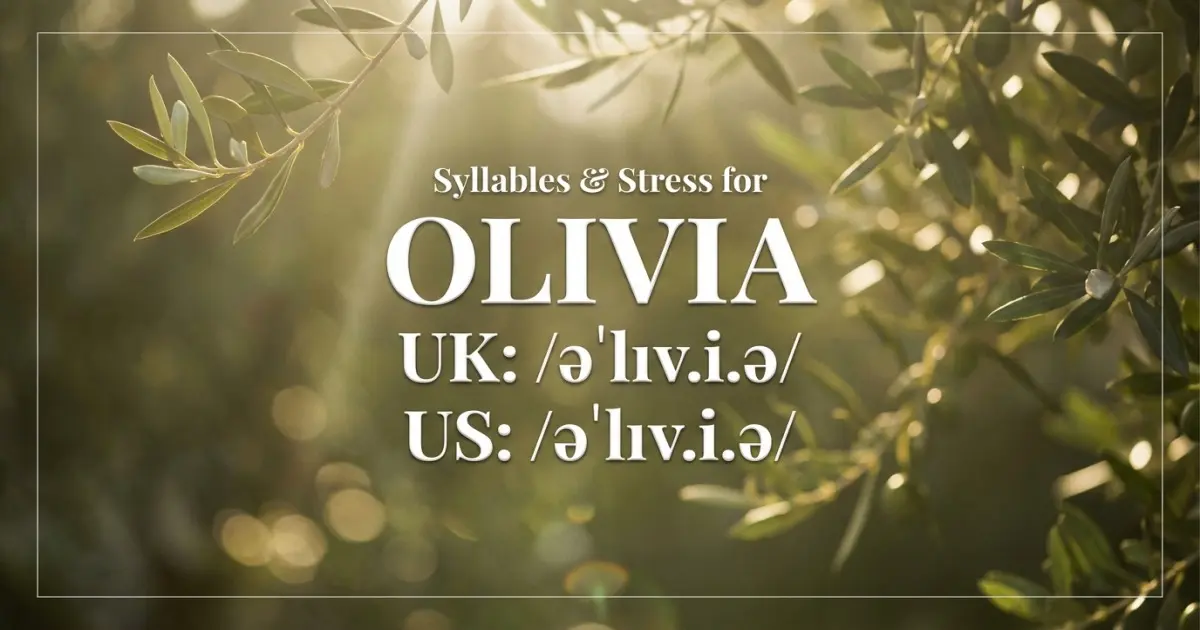
The reason is partly familiarity, but it is also phonetic design. Olivia has four syllables, yet it does not feel cumbersome because the stress lands exactly where the ear wants it: the strong middle LIV. The name opens gently, tightens at the center, and then releases into a lighter ending. That pattern makes Olivia easy to say, easy to hear, and hard to mangle badly. Once you understand the mechanics, the pronunciation feels less like a rule to memorize and more like a rhythm the mouth naturally follows.
What the sound of Olivia is actually doing
Olivia looks long on the page, but its pronunciation is surprisingly efficient. The key is not just the syllable count. It is how those syllables are weighted and connected in real speech.
| Element | Phonetic Detail | Quick Tip |
|---|---|---|
| Everyday pronunciation | oh-LIV-ee-uh | Let the second syllable carry the energy. That is the part listeners lock onto. |
| Syllable count | 4 syllables | Do not rush the ending into one blur. The last two syllables are light, but they are still there. |
| Primary stress | Second syllable: LIV | If you stress the first syllable too heavily, the name starts to sound clumsy. |
| US IPA | /oʊˈlɪviə/ | The American version usually begins with a fuller “oh” sound. |
| UK IPA | /əˈlɪviə/ | Many British speakers reduce the opening to a softer unstressed sound. |
| Opening sound | oh- or a lighter uh-/ə- depending on accent | The opening should be gentle. The name’s real anchor comes later. |
| Ending | -ee-uh | Think of it as a smooth glide rather than two sharply chopped beats. |
| Common pitfall | Overweighting the first syllable or flattening the ending | Keep the center strong and the finish light. |
Olivia works because the stress sits in the right place
The second syllable is the hinge of the whole name
The core of Olivia is not the opening O. It is LIV. That is where the stress falls in both the American and British forms, and that is what keeps the name from drifting into softness. Without that central emphasis, Olivia could sound overly airy. With it, the name has shape. The stressed liv gives the line a firm middle, and everything around it becomes easier to hear clearly. Before focusing only on syllables and stress, it helps to step back into the fuller frame of Olivia meaning.
This is one reason Olivia feels more stable in speech than some other four-syllable names. The opening is light, the center is clear, and the ending relaxes. In sound terms, that means the name has a strong internal architecture. You do not have to force the syllables apart. The rhythm does the work for you.
The consonants help Olivia stay fluid without going vague
There is also a useful contrast inside the name. The l in Olivia is a liquid consonant, which means it helps the name flow. It keeps the transition from the opening vowel into the stressed center smooth. The v, by contrast, is a fricative. It creates a little friction in the middle of the word, just enough to keep the name from becoming mushy. That combination is part of the magic. Olivia feels graceful because of the liquid l, but it stays intelligible because the v gives the ear something to catch.
The ending -ee-uh then softens the release. In careful speech, you can hear all four syllables distinctly. In quick everyday speech, the last part often glides more lightly, but it should still sound like a real ending, not a clipped afterthought.
Olivia changes slightly across accents, but it stays recognizably Olivia
The US and UK versions differ mostly at the front
The supplied IPA forms show the main accent difference clearly. In American English, Olivia often begins with a fuller oh sound: /oʊˈlɪviə/. In many British pronunciations, the opening weakens into a softer unstressed sound: /əˈlɪviə/. That sounds technical on the page, but in practice the difference is small. The name’s identity does not shift because the stressed center remains the same.
This is why Olivia travels so well across English-speaking settings. Some names change character dramatically from one accent to another. Olivia does not. A British Olivia and an American Olivia may not begin the word in quite the same way, but both still land squarely on LIV, and both preserve the same gentle ending. The center holds the name together.
Mistakes usually happen when speakers fight the rhythm
The most common pronunciation problems with Olivia are not dramatic misreadings. They are weight problems. Some speakers make the first syllable too heavy, which gives the name an awkward front-loaded shape. Others flatten the ending so much that the last two syllables lose their clarity. Occasionally people push the middle vowel in the wrong direction and make the name sound closer to an overextended oh-LEE- pattern. That usually happens when they are guessing from spelling rather than following common usage.
A good rule is simple: keep the first syllable light, stress LIV, and let the final ee-uh taper naturally. If the center sounds right, the rest of the name usually settles around it.
Saying Olivia well is really about the middle, not the ending
Sound neighbors can help you hear the shape
If Olivia feels abstract when seen in IPA, it helps to compare it to nearby familiar sounds. The Ol- opening is related to names like Oliver and Olive, but Olivia moves more quickly past that opening and puts its real emphasis on liv. That same core also appears in short forms such as Liv and Livvy, which is one reason those nicknames feel so natural. They are built from the stressed part of the full name. The way the name resolves at the end often decides which short forms feel natural in speech, and that becomes clearer in nicknames for Olivia.
In practical terms, that means the name should never sound like a long decorative cloud of vowels. The center is what gives it identity. Once you say the middle cleanly, the rest can remain relaxed.
Practice lines for getting Olivia into the mouth naturally
The best practice is not repetition in isolation but speaking the name in ordinary phrases. Try these lines aloud at a natural pace:
- Olivia, your table is ready.
- This is Olivia Bennett.
- Olivia and Emma are on the list.
- Can Olivia come to the front, please?
- I spoke with Olivia yesterday afternoon.
These work because they force the name into real speech instead of making it sound staged. If you can keep the stress steady in those sentences, you already know how to pronounce the name correctly.
In the end, Olivia is one of those rare names whose popularity makes phonetic sense. It is familiar, yes, but it is also well built. The liquid l, the fricative v, the strong stressed center, and the light final glide all work together to make the name easy to say without making it plain. That balance is what gives Olivia its enduring spoken elegance. It sounds graceful in the mouth, clear in a crowded room, and steady across different accents. For a name used so widely, that is no small achievement.