
How to Pronounce Odin: An Easy Sound-by-Sound Breakdown
Imagine a name being read from a classroom list for the first time: “Odin.” The spelling is short enough that most people feel confident immediately, but the first vowel still matters. Said correctly, the name opens wide and clear—OH-din. It should not sound clipped, flattened, or uncertain. The voice begins with the long O, then lands lightly on the second syllable.
That simplicity is one of Odin’s strongest practical qualities. The name has Scandinavian origin, means “frenzy; inspiration,” and carries a mythic atmosphere, but its everyday pronunciation is not complicated. Official data shows Odin ranked No. 479 for boys in the United States in 2024, which means more families are using it in real life, not just encountering it in mythology. The key is to preserve its two-beat shape: OH-din, with the stress on the first syllable.
Odin Is Said With an Open First Syllable and a Light Finish
| Element | Phonetic Detail | Quick Tip |
|---|---|---|
| Everyday pronunciation | OH-din | Start with a long O, as in “go,” then keep the ending quick. |
| Syllable count | 2 syllables | Break it into OH + din, not Odd-in. |
| Stress pattern | First-syllable stress | The first syllable should carry the weight of the name. |
| U.S. IPA | /ˈoʊdɪn/ | The stress mark before /oʊ/ confirms that OH is the emphasized syllable. |
| U.K. IPA | /ˈəʊdɪn/ | The opening vowel may sound slightly different by accent, but the rhythm remains OH-din. |
| Opening sound | OH | Use the long vowel sound heard in “open,” not the short vowel in “odd.” |
| Ending sound | din | Let the second syllable be soft and quick, not heavily stressed. |
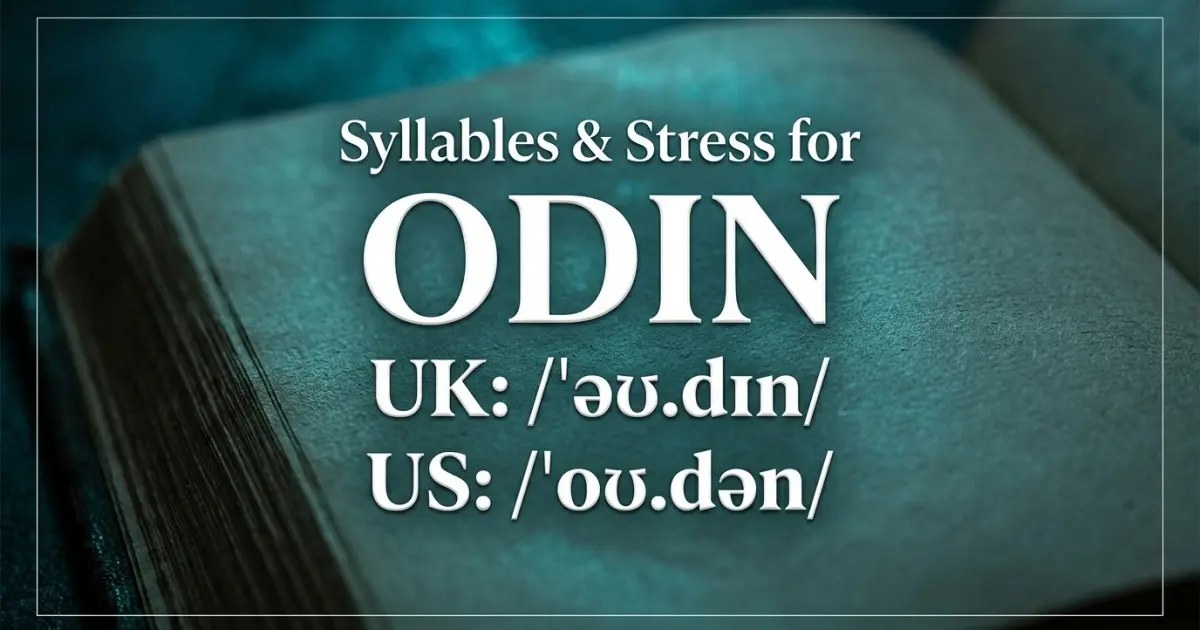
The Two Syllables of Odin Carry Different Weight
Odin is a two-syllable name, but the syllables do not carry equal force. The first syllable, OH, is stressed. The second syllable, din, is lighter. This creates a falling rhythm: the name opens with resonance, then settles. That rhythm is part of why Odin feels both strong and easy to say. Pronunciation lands more fully when the name’s roots and history are already in view, so begin with Odin meaning.
The first syllable is the defining sound. In American English, /ˈoʊdɪn/ begins with the same long O quality heard in words such as go, so, and open. In British English, /ˈəʊdɪn/ represents a similar long-O movement shaped by accent. The difference is subtle for most listeners. In both cases, the name should begin with a long vowel, not a short one.
The opening vowel gives Odin its resonance
The opening O is what makes Odin sound larger than its four letters. Names that begin with open vowels often feel spacious because the voice starts without a hard consonant barrier. Odin begins in open air, then narrows into the final syllable. This gives the name a clean, almost ceremonial sound.
That opening should not be rushed. It does not need to be exaggerated, but it should be clear. The best everyday version is simple: OH-din. A speaker who says it too quickly may blur the long vowel and make the name sound flatter than intended.
The final syllable should stay relaxed
The ending -din should be light. It is not the stressed part of the name, so it should not become oh-DIN. The final syllable works like a landing. It gives the name structure after the open first vowel, but it should not take over the pronunciation.
In fast speech, some speakers may reduce the second syllable slightly, but the name should still remain two syllables. The clean pronunciation is not one long sound and not a drawn-out three-part form. It is OH-din: open, then grounded.
Odin Sounds Slightly Different Across Accents but Keeps the Same Shape
The U.S. IPA for Odin is /ˈoʊdɪn/, while the U.K. IPA is /ˈəʊdɪn/. These symbols show a small difference in how the long O vowel is shaped across accents. American English often uses a rounded oʊ sound, while British English may begin the vowel a little more centrally before gliding upward. For everyday purposes, both point to the same practical guide: OH-din.
This makes Odin easier than many names with uncertain vowel sounds. The spelling is direct, the syllable count is clear, and the stress falls where most English speakers expect it: at the beginning. Even when accents color the opening vowel differently, the name remains recognizable.
American pronunciation keeps the long O clear
In U.S. speech, Odin usually begins like the first syllable of open or the vowel in go. The name should not begin like odd. This is the most important distinction for American speakers: OH-din, not ODD-in.
British pronunciation changes the vowel color, not the stress
In U.K. speech, the opening vowel may have a slightly different glide, but the stress remains on the first syllable. The name still has two beats. A British speaker may not sound exactly like an American speaker saying Odin, but both versions preserve the same structure.
Common Odin Pronunciation Mistakes Are Easy to Hear
Odin is straightforward, but a few mistakes can change the name’s feel. The most common is using a short o, so the name sounds like “ODD-in.” Another is stressing the second syllable, creating oh-DIN. A third is swallowing the second syllable so quickly that the name becomes too close to one beat.
Mistake one: saying ODD-in
This mistake changes the opening vowel. Odin should begin with a long O, not the short vowel in odd or hot. A simple correction is: “It’s OH-din, like the word ‘oh’ plus ‘din.’”
Mistake two: saying oh-DIN
The stress should not fall on the second syllable. Odin is not pronounced oh-DIN. The correct rhythm is OH-din, with the first syllable stronger and the second syllable lighter.
Mistake three: making the ending too heavy
The final n should be clear, but the whole ending should not be overworked. OH-dinnn sounds exaggerated. The best version is clean and natural: OH-din.
Odin Has Familiar Sound Neighbors, but Its Opening Sets It Apart
Odin shares some sound territory with names such as Owen, Otis, Oren, Alden, Aidan, and Boden. These names help explain why Odin is easy for English speakers: the sounds are familiar, even if the mythological background is stronger than most of its neighbors. Odin’s long O gives it clarity like Owen, while the -din ending connects it to names with a gentle final syllable. Once the sound pattern is clear, some shortenings stop feeling optional and start feeling natural, and the clearest map is in Odin nicknames.
What separates Odin is its balance of minimal sound and large cultural presence. It is shorter than many mythological names, simpler than many Scandinavian names, and stronger than many soft two-syllable choices. Its pronunciation supports that balance. OH-din is direct enough for everyday life, but resonant enough to carry the name’s older atmosphere.
Practice Odin in everyday lines
“This is Odin.”
“Odin will be joining us today.”
“Can you give this to Odin?”
“Odin, your appointment is ready.”
“Congratulations, Odin.”
Practice Odin with full-name rhythm
Odin James keeps the name crisp and grounded.
Odin Henry gives the full name a warm traditional finish.
Odin Elias softens the name with a melodic middle.
Odin Alexander adds formality and ceremony.
Odin Leif deepens the northern tone while staying concise.
Pronouncing Odin: Common Questions
How do you pronounce Odin?
Odin is pronounced OH-din, with two syllables and stress on the first syllable.
How many syllables are in Odin?
Odin has two syllables: OH and din. The first syllable is stressed, and the second syllable is lighter.
What is the IPA pronunciation of Odin?
The U.S. IPA pronunciation is /ˈoʊdɪn/. The U.K. IPA pronunciation is /ˈəʊdɪn/.
What pronunciation mistakes happen with Odin?
The most common mistakes are saying ODD-in instead of OH-din, stressing the second syllable, or making the ending too heavy. The clean pronunciation is OH-din.