
Mohammed Name Meaning: History, Symbolism, and a Modern Feel
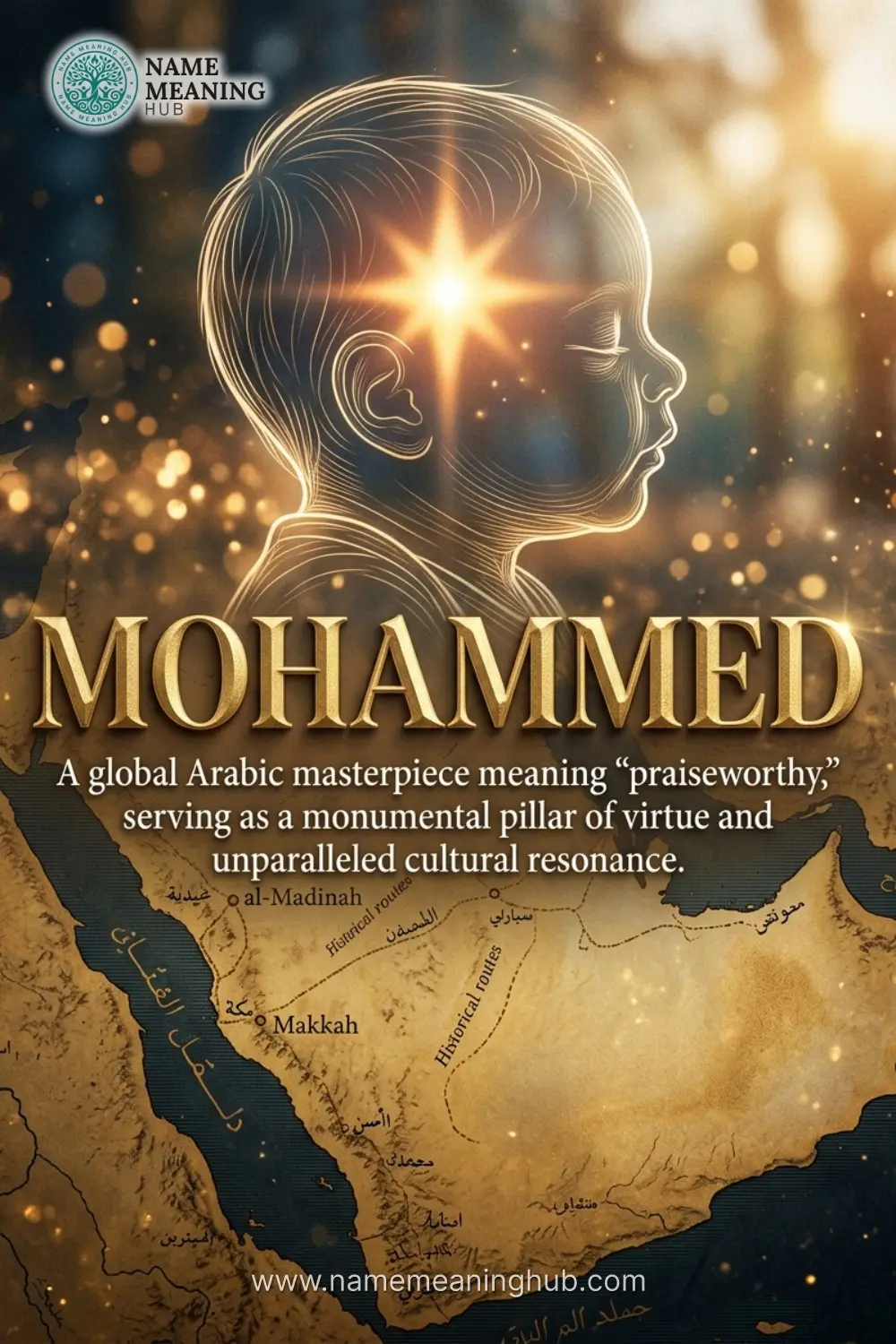
Mohammed is a name built around a word of praise, but its cultural life is far larger than a compliment. The meaning “praiseworthy” sounds simple at first, almost like a quality one might admire and then move past. Yet in the history of names, praise is never only descriptive. Praise is public. It requires witnesses, memory, repetition, and community. That is what makes Mohammed so unusual. It is a name whose meaning depends not only on what a person is, but on what a people say, remember, and honor together. Underneath the syllables is a whole social act: recognition made durable.
That helps explain why Mohammed has remained one of the most powerful naming traditions in the world. Official Social Security Administration (SSA) data for this exact spelling places it at No. 596 for boys in 2024, which on paper may look modest. But that narrow ranking hides the larger truth. Mohammed belongs to a wider family of spellings and transliterations that naming guides consistently connect to one of the most widely used male names in the Muslim world. Its Arabic origin, religious centrality, and long record in modern English-language naming have given it an unusual double life. It is at once devotional and everyday, deeply historical and fully contemporary, solemn in meaning but ordinary in daily use. Few names carry that much inherited reverence and still remain so lived-in.
Mohammed's U.S. popularity rank over time, 1922–2024
Popularity statistics are based on official data from the Social Security Administration baby name records.
Mohammed: A Significant Global Favorite
Mohammed functions as a name with one dominant tradition, showing a clear and steady identity in the boys’ lane. This “praiseworthy” choice often reflects deep cultural and religious roots, giving the name a sense of historical range and modern clarity .
The lack of crossover usage helps the name maintain a singular, focused public identity. Its three-syllable structure and rhythmic stress pattern provide a grounded feel that is widely recognized globally.
What the public record already says about Mohammed
Before looking at history, religion, and sound, it helps to see how the basic profile of Mohammed already tells a much larger story. Even the simplest facts point toward a name with more cultural scale than a single English spelling can show.
| Key Facts | Information | Quick Insight |
|---|---|---|
| Primary origin | Arabic | Mohammed comes from one of the world’s most enduring naming traditions, which gives it historical depth before modern popularity even enters the picture. |
| Core meaning | Praiseworthy | The meaning points to honor recognized by others, making the name social and ethical rather than merely ornamental. |
| Everyday pronunciation | moh-HAM-ed | The stress pattern places the name’s force in the middle, which helps it sound dignified but still natural in daily speech. |
| IPA | US: /moʊˈhæməd/; UK: /məˈhæməd/ | The opening syllable shifts slightly by accent, but the name’s overall structure remains stable and recognizable. |
| Syllable count | 3 | Three syllables give Mohammed more gravity than a clipped modern name while keeping it highly speakable. |
| U.S. boys’ rank (2024) | No. 596 | This specific spelling is established in the United States, though its rank understates the full impact of the larger spelling family. |
| Peak U.S. moment for this spelling | No. 481 in 2001 | The record shows long-term use rather than sudden novelty, which suits a name with such deep religious and cultural continuity. |
| Documented U.S. continuity | Seen from 1922 through 2024 | Even within one spelling, Mohammed has had a durable American presence for more than a century. |
Mohammed turns praise into a daily identity
Many names with positive meanings point toward virtues: strength, wisdom, grace, peace, victory. Mohammed belongs to a narrower and more demanding category. “Praiseworthy” is not merely a trait like beauty or courage. It is a judgment made by a community. To be praiseworthy is to be worthy of esteem, remembrance, or spoken admiration. That makes the name unusually relational. Its meaning is activated by the social world around it.
Why “praiseworthy” feels larger than simple approval
In everyday English, praise can sound light, almost casual. But in the context of naming, praise has weight. It suggests moral regard, honor, and recognized worth. A child named Mohammed inherits not a flashy slogan but a serious commendation. That gives the name a gravity many shorter modern boys’ names do not carry. It points toward character and public esteem rather than style alone. To compare tone, familiarity, and fit across similar names, explore boy baby names.
That gravity also helps explain why the name does not feel decorative, even though the meaning is positive. Some affirming names can sound too polished, too eager to advertise virtue. Mohammed avoids that partly because its cultural history is so much bigger than its dictionary gloss. The meaning is strong, but the name has been lived in by centuries of use. It does not sound newly flattering. It sounds inherited.
Why the meaning still works in ordinary life
The remarkable thing about Mohammed is that such a high meaning has not made it unusably formal. This is often what separates durable names from merely impressive ones. A name may carry reverence and still survive school rosters, family kitchens, airports, and office introductions if its sound is stable enough and its public life broad enough. Mohammed meets both conditions. The meaning remains solemn, but the spoken form is familiar enough in many communities to keep the name human and daily rather than distant.
That balance is one of the deepest strengths of the name. Mohammed can signify deep respect without sounding like a ceremonial title. It remains a person’s name first, even while carrying extraordinary inherited meaning.
How Mohammed became central in Muslim naming life
To understand Mohammed fully, it is not enough to know the etymology. The name’s cultural life is inseparable from its religious centrality. Naming guides consistently connect Mohammed to the Prophet in Islamic tradition, and that association changed the name from a meaningful Arabic word into one of the most enduring and widespread male names in the Muslim world. The shift is crucial. The name did not merely survive because it meant something admirable. It endured because it became attached to one of the most revered figures in religious history. For related names from the same origin family, see more names with similar roots.
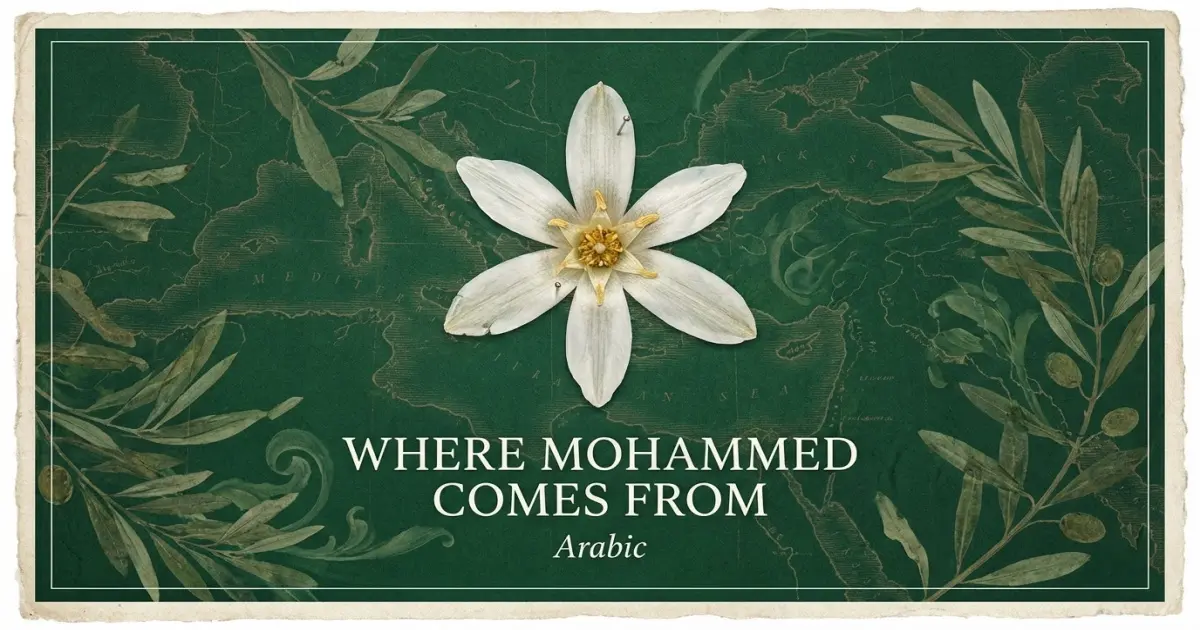
Why the prophetic association gave Mohammed unusual permanence
Historically, names connected to founding religious figures often gain a special kind of durability. They are repeated not just for beauty or fashion, but for reverence, memory, continuity, and blessing. Mohammed belongs firmly to that category. Naming references describe Muslim naming customs as drawing heavily from Qur’anic and traditional Islamic sources, including the Prophet Muhammad and his family. That long devotional pathway explains why the name has such extraordinary reach across countries, languages, and centuries.
Once a name enters ritual life and family practice in that way, it becomes more than a label. It becomes part of inheritance. That is why Mohammed can feel simultaneously personal and collective. A family may choose it for one child, but the name already belongs to a vast continuum of use extending far beyond the household.
Why Mohammed is both reverent and ordinary
The most interesting consequence of that history is that Mohammed does not remain remote. It becomes ordinary through repetition, but without losing its reverence. This is one of the rare privileges of deeply rooted religious names. They can be spoken every day and still retain gravity because their cultural framework is so strong. In many naming traditions, ordinary use eventually empties a name of solemnity. With Mohammed, the opposite often happens: common use confirms its importance.
That gives the name a layered social meaning. It can honor tradition, family, faith, and community all at once, while still functioning as an entirely normal first name in school, work, and everyday conversation. Few names hold that tension so successfully.
Mohammed’s spelling family proves how one name travels
One reason Mohammed can look smaller in some national statistics than it truly is lies in spelling. Naming books list several familiar English forms: Mohamed, Mohammad, Muhammad, and Muhammed alongside Mohammed. These are not separate names in the deeper cultural sense. They are transliterated relatives, shaped by language, geography, and local spelling habits. That matters because any one spelling captures only part of the name’s presence.
Why transliteration makes Mohammed look more fragmented than it is
When a name travels from Arabic into English and other alphabetic systems, spelling becomes a matter of approximation and convention. Different communities settle on different forms, all trying to represent the same underlying name faithfully in another script. That is why Mohammed can appear under several spellings that all remain culturally legible and widely accepted. The fragmentation is visual more than essential.
This is a useful thing to remember when reading statistics. A rank attached only to “Mohammed” does not show the full footprint of the name family. The broader usage is distributed across multiple spellings, each carrying part of the total. That is one reason the specific U.S. rank of No. 596 should not be mistaken for a measure of the name’s wider cultural reach.
Why the spelling variety adds strength rather than confusion
Far from weakening the name, the variety of spellings shows how well it travels. A name that can move across regions and still remain recognizable is a strong name. Mohammed has exactly that quality. It accommodates different linguistic environments without losing its identity. The outer letters shift. The historical and devotional core remains.
This is also one reason the name feels both global and intimate. A child called Mohammed may meet people whose families write the name differently, yet all will recognize the kinship. That is a powerful social feature. It gives the name flexibility without dissolving its center.
Why Mohammed sounds dignified in ordinary speech
Part of Mohammed’s strength comes from sound. The name is usually spoken here as moh-HAM-ed, with three syllables and the main stress falling on the middle. That middle stress matters. It gives the name a center of gravity. Instead of striking sharply at the beginning and then fading, Mohammed gathers energy and lands in the middle before releasing. That creates a feeling of weight and dignity without making the name hard to say.
What the stress pattern does for Mohammed
Names with middle stress often feel more stately than names that place all their force at the front. Mohammed benefits from that. The first syllable opens the line. The stressed middle syllable, HAM, gives it substance. The final syllable softens the finish just enough to keep the name from sounding abrupt. In practical terms, this means Mohammed can feel serious without becoming severe.
That rhythm also helps the name move between formal and informal settings. It sounds appropriate when spoken ceremonially, yet not so elaborate that it becomes awkward in quick daily conversation. This is one of the hidden mechanics behind the name’s durability.
Why the consonants keep the name grounded
Phonetically, Mohammed uses sounds that give it both warmth and structure. The opening m is soft and voiced. The middle h and stressed vowel create breath and openness. The final d gives the line a light stop. Together these sounds make the name feel substantial, but not heavy-handed. The pronunciation does not float. It lands.
This matters because names with high religious or moral significance often risk sounding too ceremonial in ordinary life. Mohammed avoids that risk partly because its phonetic shape is so workable. The name can carry reverence without becoming unusable.
Mohammed in modern records looks smaller than its true reach
The U.S. ranking data for this spelling is informative, but it must be read carefully. Official records show Mohammed at No. 596 for boys in 2024, with its best standing at No. 596 in 2001 and continuous use from 1922 through 2024. Those numbers reveal stability, not novelty. They also reveal only one lane of a much larger naming highway.
That broader reality matters because Mohammed is not a name whose force can be captured by one spelling or one country’s ranking. Naming references describe it as one of the most popular names globally, and the family of spellings confirms why. In statistical terms, the exact spelling may look moderate. In cultural terms, the name remains immense. That difference between paper scale and lived scale is central to understanding it.
It also changes the style position of the name in the United States. Mohammed is established enough to be recognizable, historically deep enough to feel rooted, and culturally large enough that it never depends on local fashion for its legitimacy. That makes it different from names that rise and fall primarily through trend. Mohammed may fluctuate in rank, but its significance does not depend on rank alone.
The three practical questions Mohammed naturally opens next
Middle names that balance heritage, rhythm, and surname flow
Because Mohammed already carries so much cultural and historical weight, middle names usually do one of two things beside it: either add structural simplicity or provide another layer of lineage and meaning. The strongest pairings depend heavily on rhythm, family custom, and the surname that follows. If you want the full pairing logic behind that contrast, see middle names for Mohammed.
Nicknames that navigate intimacy without weakening the full name
Mohammed belongs to a name family with several familiar short forms and variant spellings, but the emotional logic of those nicknames matters. Some belong to family affection, some to peer groups, and some to regional usage rather than simple shortening. To see how those different moods shorten in real life, explore nicknames for Mohammed.
Pronunciation that keeps Mohammed clear across English accents
moh-HAM-ed in American English and a slightly lighter opening in British English are both highly workable. The stable middle stress helps the name remain recognizable even when the first syllable changes a little by accent. For the detailed stress pattern, accent notes, and IPA, see how to pronounce Mohammed.
Why Mohammed still carries praise without losing personhood
At its deepest level, Mohammed is a name about esteem that has survived because it became more than praise. It became tradition, memory, inheritance, devotion, and daily speech. The meaning “praiseworthy” gives the name its ethical core, but history gave it scale. Religious life gave it permanence. Families gave it continuity. Language gave it multiple spellings without breaking its center. All of that is why the name remains so powerful.
In literary terms, Mohammed is a name whose meaning could have remained abstract, but did not. It entered the world of ordinary people and stayed there without losing its gravity. It belongs to the rare class of names that can be spoken in a classroom, whispered in prayer, printed on official records, and carried through generations without seeming emptied by use. That is its real distinction. Mohammed does not merely mean praise. It shows what happens when praise becomes inheritance.