
How to Pronounce Mina: The Practical Guide to Saying It Right
Mina is the kind of name that reveals its strengths in ordinary public moments rather than in theory. A teacher says it for the first time during attendance. A receptionist calls it from a waiting room. A barista repeats it back over café noise. A graduation announcer reaches it after a long list of harder names and, with very little preparation, has to decide where the stress belongs. That is the true test of pronunciation. A name either passes cleanly through daily life or it begins collecting small corrections. Mina usually passes. It sounds exactly like a name most English speakers want a name to sound: clear, warm, and immediately repeatable.
What makes that ease interesting is how much precision is hiding inside it. Mina is not difficult, but it is not shapeless either. The first syllable carries the emphasis. The long vowel does most of the emotional work. The second syllable softens the landing rather than competing for attention. In both American and British English, the standard pronunciation is the same, which helps explain why the name feels so portable. Mina sounds gentle, but its gentleness comes from careful balance, not from vagueness.
What Mina’s sound pattern makes clear at once
| Element | Phonetic Detail | Quick Tip |
|---|---|---|
| Everyday pronunciation | MEE-nuh | Say it in two clean beats, with the first part carrying the stress. |
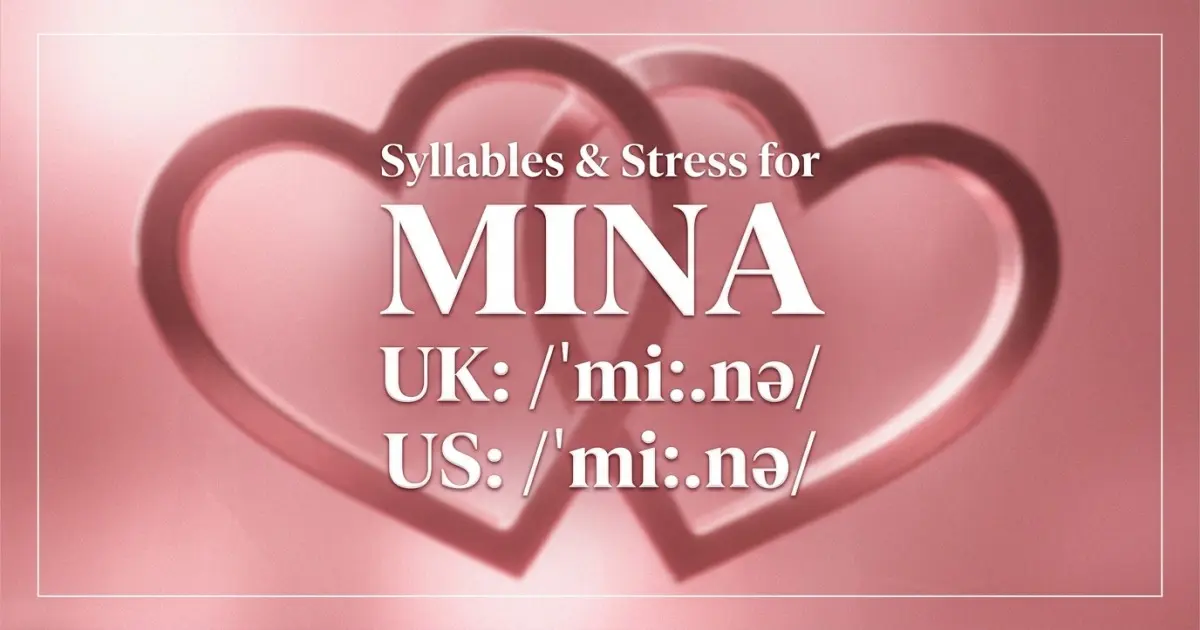
| IPA (US) | /ˈmiːnə/ | The stress mark before the first syllable shows where the voice should land. |
| IPA (UK) | /ˈmiːnə/ | The standard British form matches the American one, which makes Mina unusually stable across accents. |
| Syllable count | 2 syllables | Think of it as MEE + nuh, not as a one-syllable blur and not as mee-NAH. |
| Stress pattern | Strong-weak | The first syllable leads; the second should stay lighter and quieter. |
| Opening consonant | /m/ sound | The name begins softly with the lips closed, which is one reason it sounds warm rather than sharp. |
| Main vowel | Long /iː/ sound | The first syllable rhymes with “see” or “free,” not with “sit” or “day.” |
| Ending | Schwa /ə/ | The last syllable is relaxed and light, like the final sound in “sofa.” |
How Mina is spoken in everyday English
In ordinary speech, Mina is pronounced MEE-nuh. The first syllable is bright and prominent. The second is softer and more neutral. This matters because Mina’s charm depends on that contrast. If both syllables were stressed equally, the name would sound stiff. If the second syllable were made too strong, the whole name would begin to feel more exoticized than natural. Mina works because the sound pattern is calm and balanced. The sound matters more once you know what the name is meant to carry, which is why the wider frame starts in Mina meaning.
Mina starts with a soft consonant, not a sharp one
The name begins with /m/, a voiced consonant produced with the lips together. Unlike a fricative such as f or v, which creates friction in the airflow, /m/ enters gently. That is one reason Mina sounds friendly from the first moment. There is no hard attack. The voice is already warm when the name begins.
This soft opening helps Mina feel intimate without being flimsy. It also makes the name easy to hear in conversation, because the sound is steady and familiar in English.
The long vowel is where Mina gets its brightness
The first syllable uses the long /iː/ vowel, the sound heard in words like “see” and “keep.” This vowel gives Mina clarity and lift. It is a bright sound, and bright vowels often help short names feel open rather than closed-off. That is part of why Mina sounds lighter than some other short vintage-style names.
After that, the name settles into nuh, where the final vowel is a schwa /ə/. The schwa is the most relaxed vowel in English. It does not try to shine. It lets the name come to rest softly. That final lightness is crucial. Without it, Mina would lose much of its grace.
Why Mina’s stress pattern keeps the name clear
The standard pronunciation in both the U.S. and the U.K. is /ˈmiːnə/, and the most important mark there is the stress symbol before the first syllable. Mina is a strong-weak name. The voice lands on MEE, then relaxes into nuh. That rhythm is one of the reasons the name feels so stable and easy to remember.
Mina needs the first syllable to lead
When English speakers hear Mina, they almost always understand it best when the stress arrives early. MEE-nuh feels natural. mee-NAH feels theatrical or foreignized in a way that does not match the standard English use of the name. Stress placement is not a minor detail here. It determines whether Mina sounds calm and familiar or strangely off-balance.
That first-syllable stress also helps Mina behave like a dependable everyday name. Many names that work beautifully in public life follow this same pattern. The ear catches the important part first, and the second syllable simply completes it.
The second syllable should finish, not compete
The ending of Mina is not where the drama happens. It is where the name softens. English speakers do this naturally with many two-syllable names. The first syllable introduces the identity; the second confirms it without demanding equal force. When that rhythm is preserved, Mina sounds effortless.
A useful way to think of it is this: Mina is a name that opens brightly and closes gently. If the closing becomes too heavy, the whole name changes character.
Where Mina stays stable across accents
One of Mina’s major practical advantages is that the standard U.S. and U.K. pronunciations match. Both are given as /ˈmiːnə/. That is not true of every short international-feeling name, and it helps explain why Mina travels so well. It does not require one version at home and another abroad. Most English speakers are aiming at the same sound pattern.
Mina is unusually portable in English-speaking settings
Because the main vowel, the stress pattern, and the light ending all remain stable, Mina usually sounds familiar in American, British, Australian, and many other English-speaking contexts. That portability is a quiet asset. It means the name can move between classrooms, airports, professional spaces, and social settings without inviting constant correction.
Tiny accent differences may still appear
Even when the official form is the same, real speech always has texture. In some accents, the long /iː/ may sound a little tenser or a little more relaxed. In some speakers, the final schwa may approach a very light uh more closely than others. But these are not meaningful pronunciation differences. They are accent colors inside the same name.
There is also no liquid consonant like l or r in Mina to shift dramatically across accents, which helps keep the name stable. Its sound structure is simple in the best sense.
What people get wrong with Mina, and how to fix it fast
Mina is not often badly mispronounced, but a few predictable mistakes do appear. Most come from overthinking rather than ignorance. The spelling looks simple, yet people sometimes try to make it more unusual than it is.
The most common mistake is overemphasizing the ending
Some speakers instinctively push Mina toward mee-NAH, especially if they are influenced by names from other languages or by a desire to sound more “correct” than necessary. But in standard English use, Mina is MEE-nuh. The final vowel is reduced, not fully opened into an ah. Keeping that light schwa at the end solves the problem immediately.
Sound neighbors can also create confusion
Mina lives near names like Nina, Mila, Mena, and Meena. Because of that, listeners may occasionally substitute a neighboring familiar name if they only catch part of the sound. The best protection against this is to pronounce the first syllable clearly and let the n in the second syllable remain audible. Mina should sound cleanly divided into two parts, not smeared together. Because the strongest energy lands early, the shorter forms often grow from the opening of the name, and that pattern is easier to see in Mina nicknames.
Practice lines that make Mina feel natural
The simplest way to lock in the pronunciation is to use the name in ordinary sentences: “Mina is here.” “Have you met Mina?” “Thank you, Mina.” “Mina will call you back.” These lines let the strong-weak rhythm settle naturally. Saying the name in isolation once or twice is useful, but saying it in living speech is better.
A quick mouth-feel guide also helps: begin with a gentle m, move into the long ee sound, touch the n lightly, and let the final schwa relax the ending. The whole name should feel bright at the front and soft at the close.