
Mina Name Meaning: Meaning, Identity, and Lasting Grace
Mina is a compact name with an unusually double life. On first hearing, it sounds light, almost delicate: two syllables, clean vowels, no wasted motion. But the meanings historically attached to it do not stay in that gentle register. Mina carries love, and it also carries resolve. It can be understood as a name of affection, tenderness, and emotional nearness, yet it also belongs to the old Germanic family of names shaped by protection, steadiness, and will. That is the central fact that makes Mina more than merely pretty. It is a small name built on a surprisingly strong frame.
That tension explains why Mina keeps returning. Some names charm but do not anchor. Others feel strong but lose warmth. Mina does both jobs at once. It sounds intimate enough for childhood and clear enough for adult life. It suggests devotion without softness collapsing into weakness. It suggests protection without turning severe. In an age when many parents want a name that feels international, literary, and emotionally intelligent without becoming elaborate, Mina offers something difficult to fake: quiet force. It is not a name that shouts its virtues. It simply carries them with unusual economy.
Mina's U.S. popularity rank over time, 1880–2024
Popularity statistics are based on official data from the Social Security Administration baby name records.
Mina: A Multi-Cultural Melodic Choice
Mina reads as a name with a stable center and a scattered edge, where its primary visibility is anchored on the girls’ side. Its appeal likely reflects its standing as a “short and sweet” multi-cultural name that fits many different naming traditions while remaining easy to use .
The secondary track for boys remains extremely light, reinforcement a clear and singular feminine present. Meaning “love” or “resolute protector,” its simple two-syllable rhythm provides an elegant and accessible feel.
What Mina reveals the moment you look closely
| Key Facts | Information | Quick Insight |
|---|---|---|
| Name | Mina | Short and immediately memorable, Mina feels self-contained rather than abbreviated. |
| Primary Gender Usage | Female | Its public identity is clearly feminine today, though the structure remains spare and modern rather than ornate. |
| Primary Origin | Germanic | The Germanic line gives the name more backbone than its soft sound first suggests. |
| Primary Meaning | Love; resolute protector | Few names hold tenderness and defense in the same breath as elegantly as Mina does. |
| Pronunciation | MEE-nuh | The pronunciation is easy, clear, and highly portable, which helps Mina feel both intimate and globally usable. |
| IPA | /ˈmiːnə/ (US and UK) | The matching U.S. and U.K. forms give Mina a rare kind of cross-accent stability. |
| Syllable Count | 2 | Two syllables keep the name agile, readable, and naturally balanced in everyday speech. |
| U.S. girls’ rank (2024) | No. 608 | Official data shows Mina is visible enough to feel established, but still uncommon enough to feel quietly selective. |
| U.S. boys’ rank (2024) | No. 6680 | Its faint appearance for boys hints at broader international usage, but the name remains overwhelmingly feminine in current American practice. |
Mina carries two old promises in one small sound
The deepest appeal of Mina is that its core meanings do not compete with one another. “Love” and “resolute protector” might seem to belong to different naming traditions—one warm and intimate, the other martial or stoic—but Mina holds them together naturally. This is part of what makes the name feel emotionally modern. It does not force parents to choose between softness and strength. Instead, it suggests that care itself can be a form of strength.
The “love” side of Mina helps explain the name’s warmth in public use. Historically, short names with open vowels often feel closer to the body and voice, as if they were made for ordinary speech rather than ceremony. Mina fits that pattern. It sounds like a name one could say affectionately a hundred times a day without it losing shape. That ease makes the meaning of love feel credible rather than decorative.
But the protector meaning changes the whole emotional architecture. Research on the wider Wilhelmina and William family places Mina near an old Germanic line shaped by resolve, will, and protection. In other words, Mina is not merely a sentiment-name. It belongs to a tradition in which character matters. The protective reading gives the name a strong spine beneath its light surface.
That double inheritance also keeps Mina from feeling one-dimensional. A purely romantic name can become fragile. A purely martial name can become hard. Mina avoids both traps. It suggests affection with standards, tenderness with boundaries, devotion with stamina. That is why the name often feels wiser than its size. It does not describe a mood. It describes a stance toward the world: loving, yes, but not passive; protective, yes, but not cold.
How Mina stepped out from longer names and became fully itself
Mina has another advantage shared by many enduring short names: it likely matured through affectionate use before standing alone. Naming references have long treated it as a shortened or pet form connected to longer names ending in -mina, especially Wilhelmina. That history matters because it gives Mina both intimacy and legitimacy. It sounds naturally close because it once lived in the household register of speech, but it also has a deeper naming lineage behind it. It did not appear from nowhere.
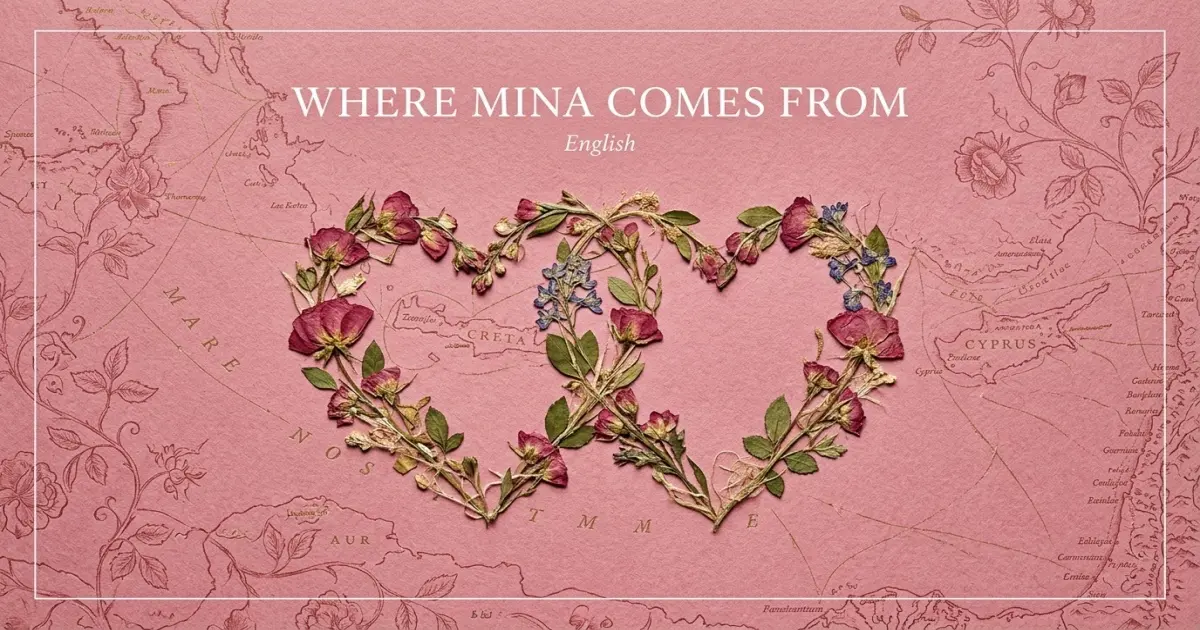
That pattern is often how successful short names are born. They begin in affection and survive because they prove structurally strong enough to stand on their own. Mina has exactly that strength. It does not sound clipped. It does not feel incomplete. Its symmetry—consonant, long vowel, nasal center, open ending—makes it feel finished. So even if it originated in relation to longer forms, it no longer depends on them to justify itself. To view more names linked to this cultural tradition, explore baby names from this cultural background.
The Germanic branch matters especially here. Wilhelmina and related names carry notions of resolve and protection, and Mina inherits that atmosphere while shedding the heavier formal clothing. In that sense, Mina behaves like many contemporary parents want a name to behave: it offers history without the burden of stiffness. The old scaffolding is still there, but the lived-in form is lighter.
This is also why Mina feels more grounded than many other short vintage-adjacent names. Some brief names sound cute but thin. Mina sounds brief and complete. The long route through older European naming traditions gives it depth, while the shorter modern form gives it mobility. It can move easily through contemporary life without becoming detached from its roots.
Why Mina sounds gentler than its meaning, and why that matters
Sound is a major part of Mina’s success. Pronounced MEE-nuh, it begins with a clear, bright long vowel and ends on a soft unstressed syllable. There is no heavy consonant pileup, no abrupt stop, and no ornamental excess. The name enters lightly and leaves lightly. That makes Mina feel emotionally open even before a listener knows what it means.
Phonetically, the name benefits from balance. The opening M is soft and continuous, produced with the lips closed and the voice already engaged. Unlike harsher consonants, it does not attack the ear. The long ee sound adds clarity and brightness. Then the nasal n gently narrows the sound before the unstressed schwa ending relaxes the whole name. It is a very efficient structure. Nothing drags, and nothing jars.
This matters because the sound and the meaning work in productive tension. If Mina sounded severe, the “resolute protector” reading might dominate and make the name feel too hard. If it sounded only airy or ornamental, the meaning of love might turn sentimental. Instead, the sound keeps the name humane. Mina feels approachable first, and then the deeper meanings add weight beneath that approachability.
That balance is especially important in female naming, where many parents now want names that do not force a child into one narrow social script. Mina sounds feminine without frill. It sounds intelligent without coldness. It sounds international without looking or feeling unplaceable. The phonetic design helps all of that. It gives Mina a softness that invites, while the historical meanings ensure that softness is not mistaken for lack of force.
Mina in literature, intellect, and modern imagination
Mina has always been the sort of name that slips easily into fiction and public life because it already feels like a person. It is literary without sounding theatrical, and elegant without demanding ceremony. For many English-language readers, one of the strongest associations is Mina Harker from Bram Stoker’s Dracula, a character whose intelligence, steadiness, and emotional courage helped shape the name’s modern atmosphere. That literary shadow matters because it reinforces the very tension already inside the name: Mina as loving, Mina as resolute.
There is also a quieter intellectual tradition around the name. Twentieth-century public figures such as mathematician and academic leader Mina Rees show another path the name can take—less gothic, less decorative, more lucid and capable. That kind of association is useful because it broadens Mina’s social image. It is not only romantic or antique. It can also read as scholarly, efficient, and composed.
This range is one reason Mina keeps feeling contemporary. Some vintage names return tied to one dominant costume: pastoral, aristocratic, whimsical, or old-Hollywood. Mina resists that reduction. It can feel literary, immigrant-era, European, quietly modern, or even minimally chic depending on context. And because the sound is so clear, those different layers do not fight one another.
In style terms, Mina lives in a highly desirable middle zone. It is softer than some sleek minimalist names, but more disciplined than many romantic revivals. It carries a little shadow, a little light, a little history, a little intimacy. That mix makes it a name people can imagine growing with rather than outgrowing.
Where Mina stands now, and why its current position suits it
Official Social Security Administration (SSA) data places Mina at No. 608 for girls in 2024, with a faint parallel appearance for boys far down the chart. That profile suits the name almost perfectly. Mina is not a name whose appeal depends on saturation. In fact, too much popularity would dull one of its best qualities: the sense that it has been discovered thoughtfully rather than inherited unthinkingly.
Its current rank suggests cultural visibility without overfamiliarity. Most people can say it immediately. Most will find it recognizable. But it still has enough air around it to feel distinctive. That is often the sweetest spot for a name like Mina, which thrives on precision and mood rather than mass momentum.
The faint male ranking is also worth reading carefully. It does not mean Mina is functionally unisex in everyday America. It is not. But it does hint that the name’s structure is internationally flexible in ways many familiar female names are not. That flexibility comes from its brevity, its open vowels, and its broader global life across cultures and languages. If you want a wider view beyond Mina, browse more baby girl names.
Socially, Mina now reads as the kind of name parents choose when they want a vintage-modern balance: something warm but not sugary, short but not clipped, cultured but not showy. It feels more deliberate than generic, yet less effortful than many names chosen for distinctiveness alone. That understated confidence is one of its strongest modern assets.

What Mina opens next
Mina and the middle name question
Because Mina is already so concise, middle names often do important balancing work—either lengthening the full name gracefully or adding a more classical, romantic, or family-rooted second note behind its compact first impression. If you want the full pairing logic behind that contrast, see middle names for Mina.
How nicknames gather around Mina
Mina does not require shortening to feel friendly, but its shape invites affectionate variants in family life, while still retaining enough firmness to remain fully itself in public use. To see how those different moods shorten in real life, explore Mina nicknames.
Why Mina’s pronunciation helps the name travel
The MEE-nuh pattern is one of the name’s quiet strengths: simple, memorable, and stable across major English accents, which lets Mina move easily between private tenderness and public clarity. For the detailed stress pattern, accent notes, and IPA, see Mina pronunciation guide.
Why Mina lingers after louder names fade
Mina lasts in the mind because it does not waste anything. It is brief without feeling slight, affectionate without feeling flimsy, historical without sounding dusty. Most of all, it contains a rare moral and emotional balance. Love and protection are often treated as separate virtues in names, one soft and one hard. Mina suggests that the deepest form of love may be precisely the kind that protects, endures, and stays awake.
That is what gives the name its literary quality, even outside literature. It feels like the name of someone who notices, remembers, and stands her ground. The sound remains gentle, but the meanings beneath it keep that gentleness from dissolving into mere sweetness. In a naming landscape crowded with louder gestures, Mina offers a more difficult achievement: grace with backbone. That is why Mina does not simply charm. It stays.