
Martha Name Meaning: Meaning, Associations, and Timeless Style
Martha is one of those names that can be underestimated because it sounds so familiar. It does not come wrapped in obvious glamour. It does not try to dazzle with rarity or softness. Instead, it arrives with something older and steadier: authority. The meaning attached to Martha is lady, and in older naming tradition that idea often expands into something more exacting—lady of the house, mistress of the household, a woman whose presence organizes a place rather than merely decorates it. That is why Martha feels larger than many people first assume. It is not a fragile name. It is a name of stewardship.
This is also what makes Martha more interesting than its plain surface suggests. Historically, the name carries the atmosphere of someone who can hold a household together, who notices what needs doing, who has both dignity and practical force. That energy was strengthened by one of the best-known Marthas in Western memory, the biblical sister of Lazarus, whose story fixed the name in cultural imagination as one linked to work, hospitality, and domestic seriousness. Official U.S. data shows Martha remains in use today, though at a quieter level than in earlier generations. That quieter position suits it. Martha no longer arrives as background furniture. It arrives as a deliberate choice—solid, unshowy, and unexpectedly strong.
Martha's U.S. popularity rank over time, 1880–2024
Popularity statistics are based on official data from the Social Security Administration baby name records.
Martha: A Traditional Aramaic Lady
Martha functions as a name with one dominant tradition, sustained by a steady and clear identity on the girls’ side of the chart for generations. Its profile often suggests a preference for “heritage classics” that feel polished and professional without becoming overly heavy .
The absence of a secondary track helps maintain a firm and focused public identity. Meaning “lady” in Aramaic, its vintage appeal gives it a texture of durability and character-rich texture that has stood the test of time.
What Martha carries behind its plainness
| Key Facts | Information | Quick Insight |
|---|---|---|
| Name | Martha | The name looks straightforward, but its meaning gives it a deep association with dignity, order, and practical authority. |
| Primary Gender Usage | Female | Martha reads unmistakably feminine, yet it carries a firmer and more workmanlike energy than many soft classic girls’ names. |
| Origin | Aramaic | The Aramaic root matters because it places Martha in a very old language of household role, social standing, and lived responsibility. |
| Core Meaning | Lady | This is not merely decorative rank. In historical use, it suggests a woman with presence, standing, and charge over her domain. |
| Pronunciation | MAR-thuh | The broad first syllable gives the name weight, while the softer ending keeps it human and approachable. |
| Syllable Count | 2 | Two syllables help Martha feel grounded and highly usable, which supports its no-nonsense dignity. |
| U.S. girls’ rank (2024) | No. 667 | Martha is now uncommon enough to feel freshly intentional, not merely inherited by default. |
| Style Position | Classic, biblical, domestic-strength vintage | Martha appeals less through ornament than through trustworthiness, steadiness, and a kind of moral gravity. |
Martha is a name of household authority, not display
The word lady can sound lighter than it really is. In contemporary use, it may suggest politeness, social rank, or refined femininity. But in older naming contexts, especially in the Aramaic line behind Martha, the word carries more practical force. A lady is not merely admired; she presides. She is not simply graceful; she is responsible. That shift matters because it changes how the name should be heard. Martha is not a decorative classic. It is a classic of function and presence.
This is part of why the name has always felt so grounded. Where many female names draw their emotional charge from flowers, jewels, music, or abstract beauty, Martha draws its force from social role. It suggests someone who is situated, someone who can receive guests, hold responsibilities, and keep order without needing to turn those abilities into spectacle. In modern language, one could call this competence. In older language, one might call it mistress of the house. Either way, the core idea is not fragility. It is command in a human scale. If Martha is close to what you want, you may also like baby names for girls.
There is something unexpectedly contemporary in that. Many modern parents want girls’ names with substance beneath the sound—names that suggest capability as much as grace. Martha offers that in a form that is old enough to feel proven. It does not advertise empowerment through loudness. It suggests a quieter and, in many ways, more durable form of power: the ability to carry weight and keep life in motion.
That is also why the name feels morally textured. A Martha is not just someone admired from a distance. She is someone depended upon. This makes the name unusually rich for a short, simple classic. It implies not only a person, but a role in relation to others: a woman who can make a place livable.
How Martha came from Aramaic into the long memory of Europe
The project naming references are especially clear about Martha’s line of descent. One entry describes it as an English, German, Greek, and Scandinavian form derived from Aramaic maretha. Another gives the simple gloss “lady,” while a third expands this into “lady, mistress of the house.” Taken together, those references reveal how the name traveled: not as a vague sound, but as a title-like term carried into multiple languages because its meaning remained intelligible and valuable.
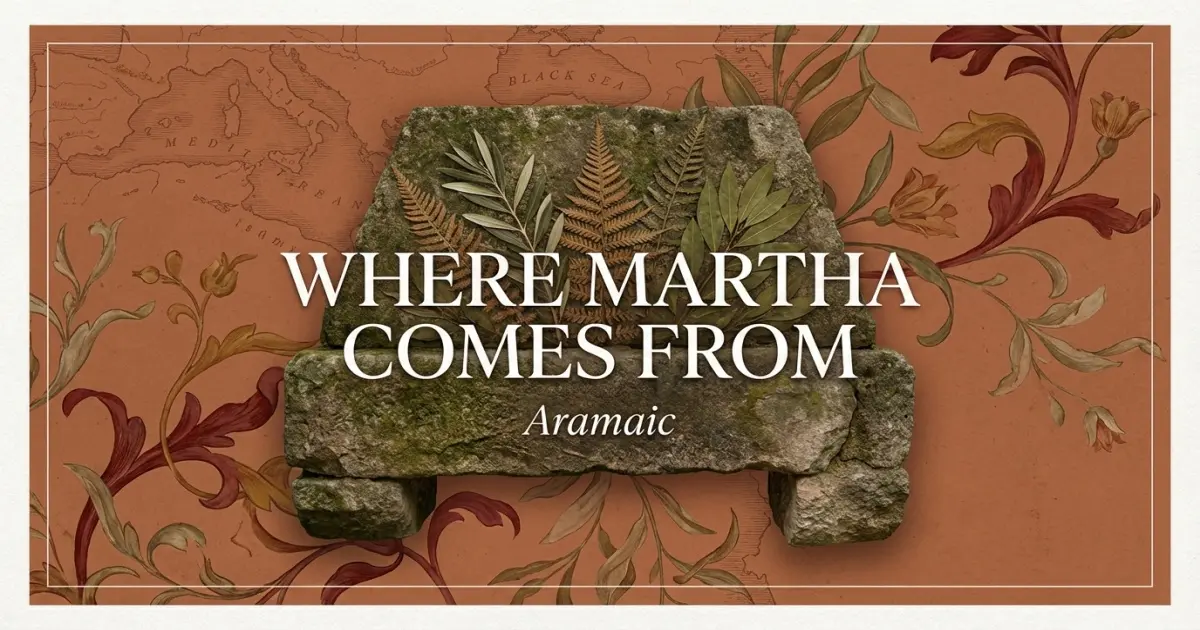
Why the Aramaic root matters for Martha
The Aramaic root matters because it explains why Martha has never felt entirely airy, even in periods when it was common. Names coming from very old Semitic language traditions often retain a kind of solidity. They are connected to household, kinship, faith, or social standing rather than to passing aesthetic mood. Martha belongs fully to that group. It is old in a structural sense. The meaning does not drift. It remains stable across the versions that follow it.
This stability helps explain why forms like Marta, Marthe, Martta, and related versions appear across so many countries in the project books. A name that moves across English, German, French, Greek, Scandinavian, Slavic, Italian, Portuguese, Spanish, Polish, and other traditions usually does so because the underlying idea travels well. “Lady” and “mistress of the house” travel very well. They describe a role many societies understand. For a broader list of names in this heritage, visit browse Aramaic baby names.
Why the New Testament Martha changed the whole atmosphere of the name
The biblical Martha gave the name a second life, and perhaps a stronger one than the bare meaning alone could have done. One project source notes plainly that in the New Testament Martha was the sister of Lazarus, and that because of this character the name became associated with hard domestic work. That line is important. It captures both the strength and the burden of Martha’s cultural legacy.
She is one of those scriptural figures remembered not as an abstraction, but as someone busy, active, and implicated in the practical labor of hospitality. That has made the name feel deeply lived. Martha is not a name of remote holiness. It is a name of kitchens, preparations, care, and the spiritual seriousness embedded in ordinary work. That association has sometimes made the name seem stern, but it also gives it exceptional human depth. A Martha is not imagined floating above life. She is inside it, doing what must be done.
Why the house remains central to Martha’s meaning
Even outside overtly religious settings, the household image continues to define Martha. The project reference that glosses the name as “lady, mistress of the house” is especially useful here because it shows how much of the name’s emotional logic lives in place. A Martha is a woman with a sphere, not in a narrow or limiting sense, but in the sense of someone whose presence shapes an environment. She gives order to space and steadiness to the people in it.
This is also what makes the name feel so tactile. You can imagine a Martha in a room. The name carries furniture, keys, lists, bread, conversation, judgment, memory. It carries the labor of making life hold together. Few names do that so immediately.
What Martha sounds like before anyone thinks about scripture
Phonetically, Martha is far sturdier than many two-syllable girls’ names. MAR-thuh opens with a broad, weighty first syllable that gives the name authority almost immediately. The consonant cluster in the middle adds texture, and the softer ending prevents it from becoming severe. This combination is important. Without the strong opening, the name might sound too plain. Without the softer close, it might sound too hard. Martha gets the balance right.
In American English, the r is more audible; in British English, the name often sounds slightly smoother. But in both, the first syllable does the real work. It anchors the name. That anchoring is part of why Martha feels dependable. The sound itself is not slippery or ornamental. It stays where it is put.
This gives the name a social advantage. Martha sounds serious, but not inaccessible. It can belong to a child, but it carries more naturally into adulthood than many sweetness-based vintage revivals do. It sounds especially credible on a grown woman, which is one of the strongest compliments that can be paid to a name. It means the name is built for a full life, not only for infancy or nostalgia.
The spelling helps too. Martha is almost impossible to misread in English once encountered, and it looks exactly like the kind of name it is: old, established, practical, and clear. In a world full of names that must be explained or corrected, that clarity can become part of the name’s dignity.
Martha after familiarity: rarity, revival, and second sight
Official Social Security Administration (SSA) data places Martha at No. 667 for girls in 2024. That number matters because it means the name now sits outside everyday saturation. Martha is no longer one of those names so common that it vanishes into the furniture of a generation. Instead, it has entered a second phase—rare enough to feel deliberate, familiar enough to feel stable.
This is often the most interesting point in a classic name’s life. Once a name has fallen far enough from overuse, people begin to hear it more clearly again. The cultural residue remains, but the boredom fades. Martha now benefits from that shift. The name still carries memory, but it no longer feels automatic. It sounds chosen.
Why Martha now feels stronger than it once did
There is a peculiar advantage to being out of fashion for a while. It lets the name’s structure reappear. In Martha’s case, what reappears is not prettiness but integrity. Modern ears hear the name differently because it stands against a background of more ornamental or more invention-driven choices. Martha begins to sound almost radical in its plainness. It does not ask to be admired for cleverness. It asks to be trusted.
That change in reception suits the name very well. Martha has never been at its best when treated as cute. It is strongest when heard as capable, historical, and quietly dignified. Rarity now helps listeners hear those qualities again.
Why Martha ages better than many antique revivals
Some old names return because they sound quaint. Martha does not rely on quaintness. It returns because it still says something meaningful: that authority can live in service, that domestic work can hold dignity, and that women’s names do not have to sound delicate in order to be beautiful. Those are durable ideas. They keep the name from becoming merely nostalgic.
That is why Martha can feel newly interesting to modern parents who want a name with moral depth, not just vintage texture. It brings house, history, and seriousness in one clear form.
Martha among its sisters and forms
The project books place Martha inside a broad network of related forms: Marta, Marthe, Martta, Martita, Martina in one line of development, and even nickname-style forms such as Marti or Marty in another. This matters because it reveals something important about the name’s adaptability. Martha may sound firm and complete, but it is not rigid. It travels well.
Marta feels slightly leaner and more continental. Marthe feels more French and restrained. Martita brings an affectionate Spanish diminutive energy. Martha, by contrast, feels like the central English form: full-bodied, practical, and the most explicitly house-rooted in tone. It has a kind of seriousness its variants sometimes lighten, which is part of why it feels so distinctive in English-speaking use.
This also helps clarify what makes Martha special among old biblical names. It is not airy like some saints’ names, not stately in a queenly way, and not abstract in its virtue. It is concrete. It belongs to the room, the table, the bread, the list of tasks, the arrival of guests. That concreteness is why it remains memorable.
The three directions Martha quietly points toward
Middle names can make Martha either softer or more stately
Because Martha already carries such solid structure, middle names usually do one of two things beside it: they either soften the name’s firmness or deepen its old-world dignity. The strongest pairings understand that Martha already brings substance and does not need more of the same without contrast. If you want the full pairing logic behind that contrast, see Martha middle names.
Nicknames reveal the warmer side of Martha
Martha belongs to a name family with a surprisingly rich nickname life. Forms like Marti, Martie, Marty, and regional variants show that even a name this sturdy can open into something lighter and more intimate in family use. That flexibility helps keep the name from becoming too severe. To see how those different moods shorten in real life, explore nicknames for Martha.
Pronunciation is one of Martha’s practical strengths
The name’s pronunciation is stable, intuitive, and widely recognized, which gives Martha a major everyday advantage. It sounds distinctive enough to retain character but familiar enough not to create social friction. That clarity suits the name’s whole ethos. If you want the full sound pattern behind that rhythm, read how to pronounce Martha.
Why Martha still sounds like someone you can lean on
The best way to understand Martha is to hear the meaning “lady” in its older, heavier sense. Not a decorative woman, not a polished figurehead, but someone with charge, with obligations, with a way of making a place cohere. Once that older sense comes back into view, the whole name changes. Martha stops looking plain and starts looking exact.
Its history strengthens this. The Aramaic root gives it depth. The New Testament figure gives it labor, service, and presence. The long line of European forms gives it endurance. The current rarity gives it fresh visibility. None of those layers cancel the others out. Together they make Martha a name with real human density.
That is why Martha lasts. It is not a name that flatters from the outside. It dignifies from within. It sounds like steadiness, responsibility, hospitality, and a kind of mature kindness that does not need performance. In an age when many names aim for shimmer, Martha still offers something rarer and more necessary: the shape of a woman who can be trusted with the house, the work, and the heart of things. That is exactly why Martha remains powerful.