
Margaret Pronunciation: Syllables Explained in a Simple Way
The real pronunciation test for Margaret usually happens in a place that gives no room for revision. A teacher reaches the next name on the attendance sheet. A doctor calls the patient from the waiting room. A host reads the reservation aloud and has one chance to say the name in a way that sounds natural rather than guessed. Margaret is one of those names that looks older and heavier on the page than it actually feels in ordinary speech. Once the rhythm is understood, it does not drag. It lands.
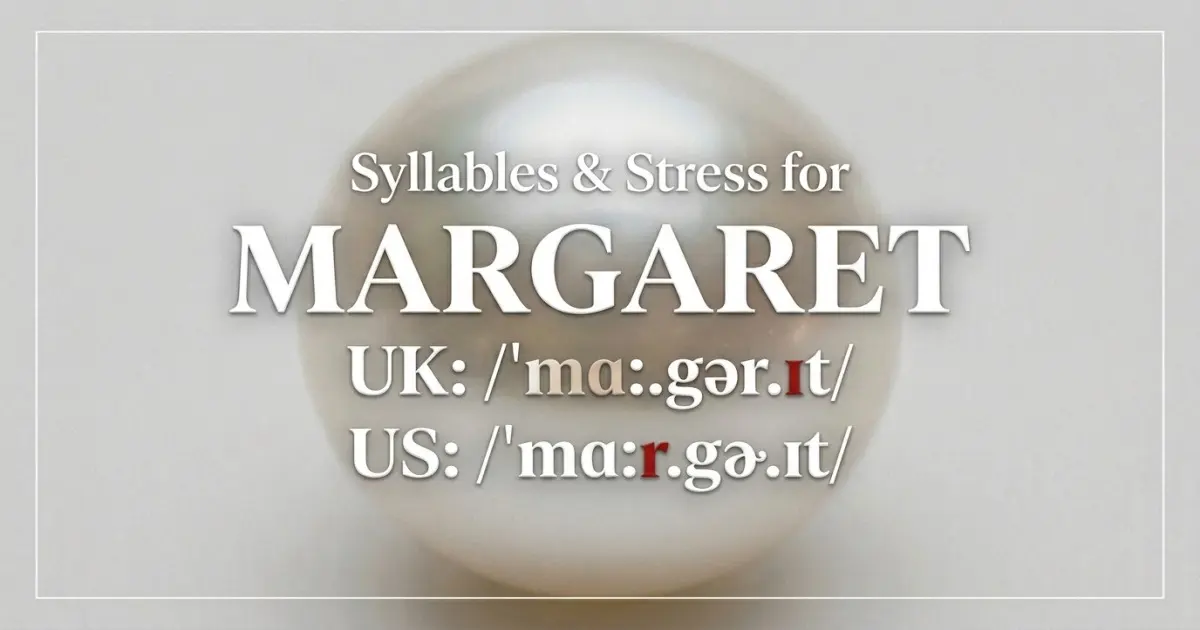
That rhythm matters because Margaret is not pronounced as a stiff museum piece. It is said in American English here as MAHR-guhr-uht, with the strongest energy at the front and the rest of the name moving more quickly than many people expect. Official guidance for this run gives the U.S. form as /ˈmɑːrɡərɪt/ and the U.K. form as /ˈmɑːɡrət/. That means the broad shape remains the same across accents, even though the internal compression changes slightly. Margaret may be a classic, but its pronunciation is built for use, not ceremony.
What Margaret is actually doing when spoken aloud
| Element | Phonetic Detail | Quick Tip |
|---|---|---|
| Everyday pronunciation | MAHR-guhr-uht | Let the first syllable lead clearly and keep the final syllables lighter and quicker. |
| IPA (US) | /ˈmɑːrɡərɪt/ | The stress mark at the front shows that Margaret is led from the opening, not the middle. |
| IPA (UK) | /ˈmɑːɡrət/ | The British form compresses the middle more tightly, but the name still begins from the same strong center of gravity. |
| Syllable count | 3 syllables | Think in three beats: MAHR / guhr / uht. |
| Stress pattern | Primary stress on the first syllable | If the second syllable takes too much weight, the name starts sounding less natural and more overpronounced. |
| Opening vowel | Broad /ɑː/ sound | The open first vowel gives Margaret much of its authority and warmth. |
| Middle consonants | Firm /ɡ/ and liquid /r/ sounds | These keep the name grounded so it does not dissolve into softness. |
| Ending | Reduced and lighter final syllable | Do not over-hit the last beat. Margaret should finish neatly, not heavily. |
Margaret works because the weight is all in the front
Margaret is a front-led name. That is the most important thing to hear. The first syllable carries the identity, the broad vowel gives it dignity, and the rest of the name follows as support. Many speakers who see Margaret on paper imagine something more elaborate than what English actually says. In real conversation, the name is comparatively compact. Pronunciation lands more fully when the name’s roots and history are already in view, so begin with Margaret meaning.
The three-beat structure inside Margaret
Break it once: MAHR / guhr / uht. The opening syllable is full and stressed. The middle is lighter, with the consonant g anchoring the structure. The final syllable is reduced and relatively quick. That is why Margaret sounds solid without becoming cumbersome. It is not three equally weighted parts. It is one strong entrance followed by two softer resolutions.
This structure helps explain why Margaret has remained so usable for so long. A name that begins decisively and then relaxes is easy to hear and easy to remember. The opening broad vowel does a great deal of work. It gives the name seriousness immediately, while the reduced later syllables prevent it from sounding inflated.
Why the name feels firmer than many classic girl names
Phonetically, Margaret has more internal grip than many feminine classics. The m opening is soft, but the g in the center adds backbone. The r is a liquid consonant, which helps the name flow rather than snap, but because it sits next to harder sounds, the flow never becomes overly airy. This is one reason Margaret sounds grounded, even when compared with more obviously lyrical classic names.
That balance is part of its personality. Margaret does not whisper. It does not perform elegance. It sounds composed because its consonants and stress pattern are working together to keep it upright.
Where Margaret usually gets flattened or overhandled
Most mistakes with Margaret come from one of two instincts. Either speakers over-articulate it because they assume an old classic deserves full ceremony, or they flatten it too much because they are aiming for speed. The best everyday pronunciation sits between those extremes.
The too-careful version
One common mistake is giving each syllable too much equal attention, as though the name must be formally preserved in full. That often produces something more laborious than natural English wants. Margaret is not meant to sound like a recitation exercise. The middle and final syllables should not receive the same weight as the first. If they do, the name loses the quiet authority that makes it work.
The too-flat version
The opposite error is reducing the later syllables so aggressively that the name starts sounding clipped or careless. This can happen in fast speech, especially when the speaker already associates Margaret with nicknames like Meg or Maggie and unconsciously rushes the full form. But the reduced syllables still need to be heard. Margaret should be compact, not swallowed.
Where the U.S. and U.K. forms diverge a little
The supplied pronunciation data shows a small but meaningful difference between the American and British patterns. In American English, /ˈmɑːrɡərɪt/ often gives a little more space to the middle and final syllables. In British English, /ˈmɑːɡrət/ compresses the interior more tightly. That does not create two completely different names. It simply means the British form tends to sound slightly leaner and faster. The core identity remains the same in both: strong first syllable, lighter remainder.
This is a useful distinction because it explains why Margaret can sound more clipped in one accent and more rounded in another without ever becoming unrecognizable.
Margaret stays stable even when nearby names interfere
One of Margaret’s advantages is that its broad English pronunciation is well established. Even when speakers know related forms such as Margot, Marjorie, Marguerite, or Margarita, they usually do not mistake Margaret for them once the first syllable is heard. Still, sound-neighbors can subtly influence expectations.
Why related names can pull the rhythm sideways
Marguerite may encourage a more French reading in the mind before the English pattern takes over. Margarita may make people expect a more fully pronounced vowel chain. Marjorie may tempt the ear toward a softer middle. But Margaret is more compact and more front-heavy than any of these. It does not need the extra flourish those related names sometimes carry.
This is also where spelling can mislead. Because the written form looks substantial, some people expect more syllabic weight than English actually gives it. The answer is simple: trust the opening and lighten the rest.
Why Margaret still feels easy in modern speech
Although Margaret is old, its pronunciation is not difficult. It uses familiar English sounds, a stable stress pattern, and a name shape that most speakers recognize immediately. That makes it much more accessible than some other classics that require accent-specific handling or unfamiliar clusters. Margaret’s durability is partly historical, but it is also phonetic. It is easy enough to say well without effort.
That matters because names stay alive not only because people admire them, but because people can actually use them. Margaret passes that test easily.
How to practice Margaret until it sounds natural
The best way to learn Margaret is not to isolate the syllables and overwork them. The better method is to say the name in real contexts where the rhythm has to function naturally. A name should work in motion, not only under inspection. Once the sound pattern is clear, some shortenings stop feeling optional and start feeling natural, and the clearest map is in Margaret nicknames.
Three easy practice lines for Margaret
Try these aloud:
- “Margaret, your table is ready.”
- “This is Margaret from third period.”
- “Margaret will call you back after lunch.”
Each sentence tests something different. The first checks public calling rhythm. The second checks classroom clarity. The third checks how the name behaves in adult-speed speech. If the name feels clumsy, the usual problem is too much pressure on the second or third syllable. Bring the energy back to MAHR, then let the rest settle.
A simple mouth-feel shortcut for Margaret
If IPA is not your preferred tool, remember the name this way: broad start, grounded middle, quiet close. That phrase captures Margaret well. The name should open fully, hold itself together in the center, and then finish without fanfare. Once that pattern settles in the mouth, Margaret stops seeming formal and starts sounding what it really is: a very well-built name.
That is one of Margaret’s hidden strengths. It may look stately on paper, but its pronunciation is efficient, grounded, and deeply familiar. It carries history without needing extra effort to make it speakable, and that is a large part of why it has lasted.
Pronunciation FAQ for Margaret
How do you pronounce Margaret in everyday American English?
The supplied everyday American pronunciation here is MAHR-guhr-uht, with the strongest emphasis on the first syllable.
How many syllables does Margaret have?
Margaret has three syllables. Thinking of it as MAHR, guhr, and uht helps keep the rhythm balanced.
What is the most common pronunciation mistake with Margaret?
A common mistake is giving all three syllables too much equal weight. Margaret sounds best when the first syllable clearly leads and the later ones move more lightly.
Do American and British English pronounce Margaret differently?
Yes, slightly. The American form usually gives a bit more space to the later syllables, while the British form tends to compress them more tightly. The overall structure, however, remains the same: strong front, lighter finish.