
How to Pronounce Jolie: A Simple Pronunciation Guide
The real pronunciation test for Jolie usually does not happen in a naming book. It happens at a school registration desk, in a pediatric waiting room, or during attendance when a teacher pauses over the list and must decide whether to trust the spelling or trust instinct. That small hesitation is revealing. Jolie looks familiar to many English-speaking readers, but it does not behave like an ordinary English phonetic pattern. People often know the name is elegant before they know exactly how to say it. That is why pronunciation matters here more than it might with a more transparent spelling.
Once heard correctly, though, the name becomes easy to carry. Jolie is pronounced zhoh-LEE. It has two syllables, a smooth French-style opening, and a bright stressed ending. The sound is quick, graceful, and surprisingly stable. In practice, most confusion comes not from the name being difficult, but from readers trying to force it into English spelling habits. The goal is not to make Jolie sound elaborate. The goal is to say it cleanly and naturally, with the right opening consonant and the right final stress.
What this guide clarifies about how Jolie is actually spoken
| Element | Phonetic Detail | Quick Tip |
|---|---|---|
| Everyday pronunciation | zhoh-LEE | Think of two clear beats, with the second one stronger than the first. |
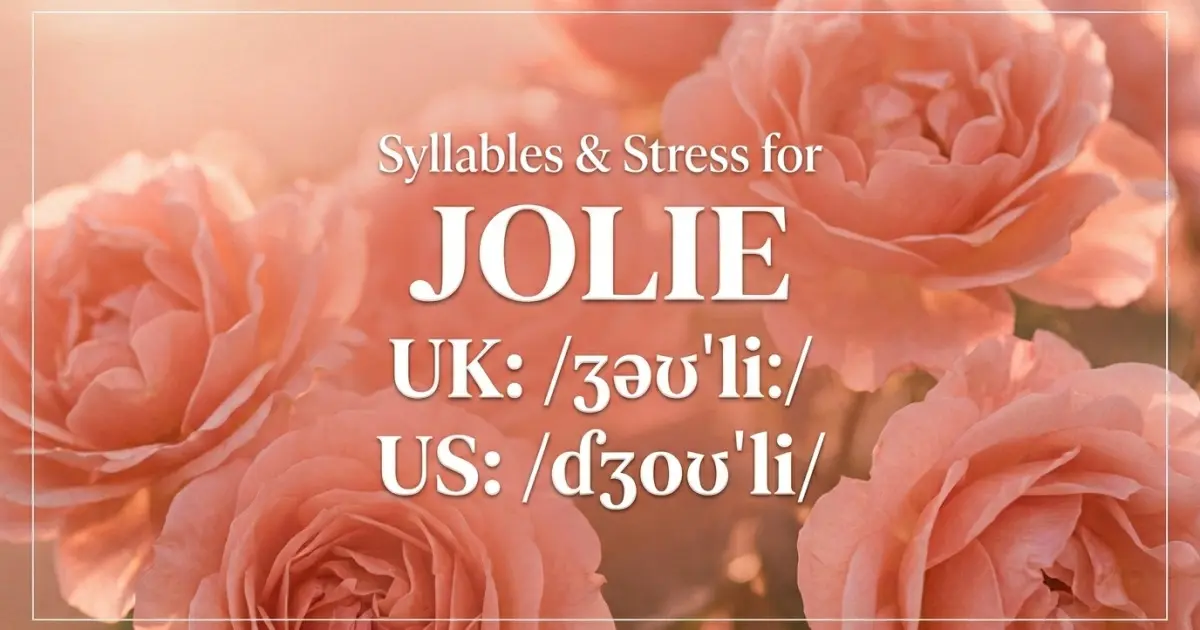
| IPA (US) | /ʒoʊˈliː/ | The first sound is the soft “zh” heard in some French loanwords, not a hard English “j.” |
| IPA (UK) | /ʒəʊˈliː/ | The US and UK forms are almost identical in structure, so the name travels well across accents. |
| Syllable count | 2 syllables | Say it as zhoh | LEE, not as a single blurred sound. |
| Stress pattern | Second syllable stressed | If the emphasis lands on “LEE,” the name usually sounds right. |
| Opening consonant | /ʒ/ voiced fricative | Use a soft “zh” sound rather than a sharp English “j” or “sh.” |
Jolie works by rhythm first and spelling second
The simplest way to master Jolie is not by staring at the letters but by hearing the rhythm. The name has a gentle lead-in and a bright landing: zhoh-LEE. That final stress is important. It gives the name lift. Without it, Jolie can sound flattened or overly Anglicized. With it, the name sounds polished and recognizably French in tone even in ordinary English speech. Before focusing only on syllables and stress, it helps to step back into the fuller frame of Jolie meaning.
Phonetically, the opening consonant is the most distinctive part. The symbol /ʒ/ represents a voiced fricative, a sound made by narrowing the airflow without fully stopping it. In plain terms, it is the soft “zh” sound many English speakers hear in French-flavored words. It is not the hard “j” of “joy,” and it is not the plain “sh” of “shoe.” That single sound gives Jolie much of its elegance.
Why the opening sound matters so much
If the first sound is too hard, the whole name changes character. A hard English “j” can make Jolie feel more abrupt and less refined. A plain “sh” can make it sound hesitant or approximate. The voiced fricative at the front keeps the name smooth. It is one of those small phonetic details that carries a large stylistic effect.
Why the stressed ending makes Jolie memorable
The second syllable, LEE, is where the name resolves. Because the stress lands there, the name feels more dynamic than if it were front-loaded. Research on name perception has long suggested that stress placement influences how graceful or forceful a name feels in speech. Jolie’s final stress gives it brightness and motion. It does not trail off; it finishes clearly.
Where people usually mispronounce Jolie on the first try
Most pronunciation mistakes with Jolie come from English spelling habits, not from the name itself. Readers see the letters and reach for familiar patterns. That is understandable. English often trains people to expect a hard “j” at the beginning and a flatter, more literal reading of the vowels. Jolie resists both of those habits.
The most common mistake patterns
One frequent mistake is beginning the name with a hard English “j,” which makes it sound heavier than intended. Another is shifting the stress to the first syllable, which drains the name of its natural lift. Some speakers may also over-Anglicize the vowels, turning the name into something more clipped and less fluid than zhoh-LEE. All of these errors come from trying to make the spelling behave like standard English rather than letting the pronunciation lead.
What to do if someone says it wrong once
The most useful correction is also the simplest one: “It’s zhoh-LEE.” That everyday guide gives the speaker everything needed at once: the soft opening, the syllable split, and the final stress. Because Jolie is short, most people only need to hear the correction once to adjust successfully.
Jolie across accents stays remarkably consistent
One practical advantage of Jolie is that the US and UK IPA are structurally the same: /ʒoʊˈliː/ in American usage and /ʒəʊˈliː/ in British usage. The difference is mainly in the quality of the opening vowel, not in the shape of the name. The stress still falls on the second syllable. The opening consonant remains the same voiced fricative. The ending still lands clearly on -lee.
What usually stays stable
The sound pattern of Jolie is reliable across major English accents. Speakers may color the first vowel slightly differently, but the overall contour remains intact. That makes the name socially portable. It can be said by English speakers in different regions without becoming a noticeably different name.
What may shift slightly in natural speech
The rounded vowel in the first syllable may sound a touch fuller in American English and a touch narrower in some British speech. This is normal accent variation, not a pronunciation problem. As long as the opening remains a soft “zh” and the stress stays on LEE, the name remains recognizably correct.
Jolie is easiest to learn in ordinary sentences, not isolation
Names live in context. They are called across rooms, spoken in introductions, and repeated in short everyday phrases. That is why practice lines help. They teach the name as speech, not as an abstract phonetic exercise.
Three useful practice lines for Jolie
“Jolie is here.”
“Can Jolie come in?”
“I’m looking for Jolie.”
These lines work because they place the name in familiar English rhythm. If the second syllable still lands clearly in each sentence, the pronunciation is secure enough for real life. The name should sound smooth and quick, not theatrical.
Sound neighbors that help without distorting the name
The most useful memory trick is not to search for a fully matching English name, but to remember the sequence: soft “zh” + rounded vowel + bright “LEE.” For many speakers, the best shortcut is simply the guide zhoh-LEE. That captures the essential tone of the name more effectively than forcing it into a purely English pattern. The way the name resolves at the end often decides which short forms feel natural in speech, and that becomes clearer in Jolie nicknames.
Jolie sounds best when spoken lightly, clearly, and without overcorrection
The danger with elegant-looking names is that speakers sometimes over-handle them. They may slow down too much, exaggerate the French quality, or pronounce each letter as if care alone guarantees correctness. Jolie does not need that kind of performance. It needs confidence more than ceremony. Said well, it is simple: zhoh-LEE.
That is part of the name’s enduring strength. On paper, Jolie may look more intimidating than it actually is. In speech, it is short, stable, and memorable. Once the soft opening and final stress are in place, the name carries itself. That makes Jolie one of those names that may prompt a moment of uncertainty at first glance, but very little trouble once it has entered the ear.
Jolie Stress and Sound FAQ
How do you pronounce Jolie correctly?
The clearest everyday pronunciation is zhoh-LEE. The name has two syllables, and the second syllable carries the stress.
What is the IPA for Jolie?
The US IPA is /ʒoʊˈliː/ and the UK IPA is /ʒəʊˈliː/. In both cases, the structure is the same: a soft “zh” opening and a stressed “lee” ending.
Which syllable in Jolie should be stressed?
The second syllable should be stressed. If the emphasis lands on LEE, the name will usually sound right.
Is Jolie pronounced with a hard “j” sound?
No. The opening uses a soft zh sound, represented in IPA as /ʒ/. It is smoother than the hard English “j” in “joy.”
What is the most common pronunciation mistake with Jolie?
The most common mistake is using a hard English “j” or putting too much emphasis on the first syllable. A quick correction such as “It’s zhoh-LEE” usually resolves the issue immediately.