
Jolie Name Meaning: Its Roots, Symbolism, and Lasting Identity
Some names arrive from myth, some from saints, some from family history, and some from the natural world. Jolie comes from somewhere rarer and more exposed: ordinary language. It begins as an adjective, a word people use in conversation to register delight, grace, and visible appeal. That origin gives the name a special kind of risk and a special kind of power. A mythic name can hide behind legend. A family name can hide behind lineage. Jolie cannot hide. It means “pretty,” and that directness is exactly what makes the name interesting. It turns a familiar social judgment into a lasting personal identity.
But Jolie works because it does more than flatter. In practice, the name does not feel vain or overdone. It feels edited. The French origin gives it polish, the two-syllable structure gives it speed, and the pronunciation zhoh-LEE gives it lift. That combination changes the emotional quality of the meaning. “Pretty” on paper can sound slight. Jolie in the mouth sounds poised. The result is a name that does something difficult: it takes a simple aesthetic word and makes it feel usable, grown, socially agile, and more intelligent than its surface might first suggest.
Jolie's U.S. popularity rank over time, 1947–2024
Popularity statistics are based on official data from the Social Security Administration baby name records.
Jolie: A Chic and Enduring French Favorite
Jolie presents a chart pattern of a broader past with a clearer present, reflecting high naming momentum in 2008 that provides the name with long-running cultural familiarity. It continues to behave as a reliable choice parents trust for its soft sound and chic, international appeal.
The trace presence in other tracks behaves more like niche experimentation than a broad identity shift. Meaning “pretty,” its simple two-syllable structure remains both polished and widely recognized across generations.
How Jolie turns one small French word into a full modern identity
| Key Facts | Information | Quick Insight |
|---|---|---|
| Name | Jolie | The form is concise and stylish, but its appeal depends as much on sound and tone as on visual simplicity. |
| Primary Gender Usage | Female | It fits current girls’ naming patterns while avoiding the more crowded lane of softer, less distinctive favorites. |
| Primary Origin | French | The French frame gives the name elegance and cultural shape, which helps its direct meaning feel refined rather than plain. |
| Primary Meaning | Pretty | The meaning is transparent and immediately legible, but the name’s real strength lies in how gracefully it carries that openness. |
| Pronunciation | zhoh-LEE | The soft opening and bright stressed ending make the name sound polished, not sugary. |
| IPA | US: /ʒoʊˈliː/ · UK: /ʒəʊˈliː/ | The American and British versions are nearly identical in structure, which makes the name stable across accents. |
| Syllable Count | 2 | Two-syllable names often feel quick and contemporary, and Jolie uses that brevity to sound sleek rather than slight. |
| U.S. girls’ rank (2024) | No. 902 | Official data places it in active use but still outside the crowded center of the charts, which gives it freshness without obscurity. |
Jolie is what happens when beauty becomes conversational instead of ceremonial
Many names connected with beauty come wrapped in distance. They may refer to a goddess, a jewel, a flower, or an inherited poetic ideal. Jolie does something much more intimate. It comes from an everyday word. That matters because everyday words carry social life inside them. They are used in homes, streets, restaurants, compliments, jokes, quick observations, and private tenderness. A name like Jolie therefore feels less monumental than some beauty-linked names, but also more alive. It belongs to spoken culture, not just to ceremonial language.
This is one reason the name feels modern even though its underlying word is much older than the current naming cycle. Research on naming taste has long shown that parents often prefer meanings they can immediately understand without translation or extensive explanation. Jolie has that instant legibility. Its meaning is not hidden in etymological roots that only specialists can decode. The appeal is transparent. But transparency alone is not enough. Plenty of transparent names sound too literal once turned into first names. Jolie succeeds because the sound lifts it above literalness.
That distinction is worth dwelling on. “Pretty” as a meaning can easily sound too narrow if treated carelessly. Yet Jolie does not usually register as narrow when spoken aloud. Instead, it tends to suggest polish, charm, visual ease, and social grace. In other words, the name quietly widens its own meaning. It takes a surface word and gives it atmosphere. That is why the name often feels less about prettiness in the childish sense and more about composure, style, and attractive presence.
Why direct meanings are harder than symbolic ones
Direct meanings are, in some ways, the hardest meanings for a name to carry well. A symbolic name can hide inside interpretation. A direct name must survive being understood immediately. Jolie survives because it does not oversell itself. The name is short, elegant, and lightly foreign to English-speaking ears. That small degree of distance is crucial. It keeps the meaning from feeling blunt.
Why Jolie feels more social than decorative
There is also a subtle social quality to the name. “Pretty” is not just a visual category. It is something one person notices and says to another. That makes Jolie feel relational. The name implies perception, response, and admiration. It is less like naming a child after a static object and more like naming her after a quality that appears in interaction. This may be one reason the name feels lively rather than ornamental. It belongs to human exchange.
Jolie carries French polish in a way English can still use naturally
The French origin is doing more work here than many listeners may consciously realize. Without that origin, a name meaning “pretty” could sound too plain in English. The French form gives it contour, elegance, and a slight angle of remove. That remove is beneficial. It keeps the name from becoming merely descriptive and lets it function aesthetically.
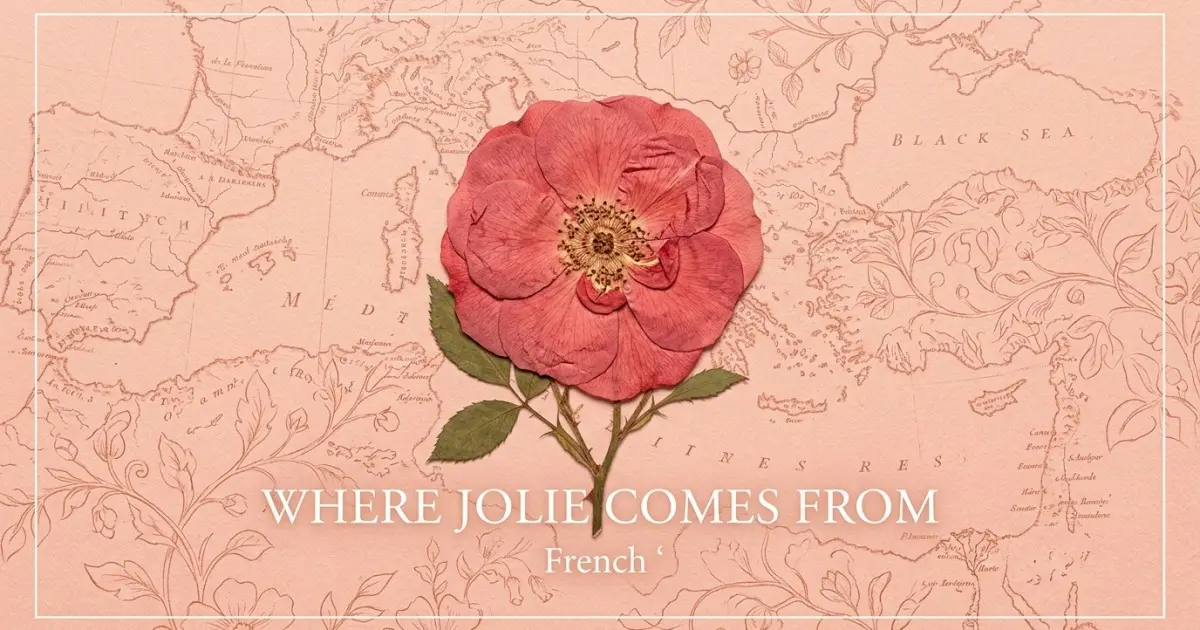
Historically, French has carried a special prestige in naming taste, fashion vocabulary, and the language of refinement. Even when people do not actively think in those terms, the residue of that association remains. French-origin names often feel polished in English-speaking settings because the sounds signal elegance without requiring complexity. Jolie fits that pattern exceptionally well. It is recognizably French in tone, yet simple enough to enter everyday use without strain. If you want to compare Jolie with names from the same heritage, browse explore French names.
This balance between foreignness and familiarity matters. If a name feels too culturally distant for the community using it, people may admire it but hesitate to live with it. If it feels too domesticated, it may lose the special texture that made it attractive in the first place. Jolie sits in an effective middle place. It sounds refined, but not inaccessible. It reads stylish, but not overcurated. It offers a touch of continental polish without asking its bearer to constantly explain it.
That is also why the name has traveled well into modern use. Short, cleanly pronounced names with a modest aura of international sophistication often perform strongly in contemporary naming culture. They look elegant in print, work well in speech, and allow parents to feel they have chosen something distinctive without being exhausting. Jolie belongs squarely in that category.
The sound of Jolie is what keeps “pretty” from becoming too soft
Phonetically, Jolie is doing almost everything right. The opening zh sound, represented in IPA by /ʒ/, is a voiced fricative. It is softer than a hard j but more distinctive than many common initials. That single sound gives the name immediate sophistication. English speakers hear it in certain French loanwords and a small cluster of elegant names, so it carries a refined sonic signal even before the rest of the name arrives.
Then comes the rounded middle vowel, followed by the bright, stressed -LEE. The stress on the second syllable is especially important. It gives the name forward motion. Instead of fading after a soft opening, Jolie rises into clarity. The result is a name that feels shaped rather than blurred. If the meaning alone could have pulled it toward softness, the stress pattern pulls it back toward poise.
Why the second-syllable stress matters so much
Names with final stress often sound a little more lifted, a little more performative, and a little more adult than names that drop all their weight at the beginning. In Jolie, that final stress helps the name feel stylish rather than quaint. It also contributes to its memorability. The name lands on a clear, bright vowel, and that tends to stay in the ear.
How the French opening changes the social impression
If Jolie began with a more familiar English consonant, it might sound much more ordinary. The voiced fricative at the front is what makes the name seem smooth and cosmopolitan. It is not loud, but it is distinctive. Research on name perception often suggests that unusual initials can increase memorability, but only if the rest of the name remains easy. Jolie gets that balance right. The opening is special; the structure is simple.
Jolie in public life: elegant, readable, and less fragile than it first appears
Names built around beauty sometimes suffer from a perception problem. They can sound charming in infancy but too decorative in adulthood, or graceful in theory but socially thin in practice. Jolie escapes much of that risk because it does not feel childish. The shortness of the name keeps it brisk. The French shape keeps it composed. And the meaning, while overtly pretty, is carried with enough restraint that it does not collapse into sweetness.
This is one of the most useful things about the name. On a child, Jolie sounds gentle and polished. On an adult, it can still sound professional, creative, and self-possessed. That age range matters. Many naming guides have long encouraged parents to test a name in more than one life stage, and Jolie performs well under that test. It does not need a longer formal form behind it to feel complete. It is already finished.
The name also sits in an appealing social zone between common and rare. Because the sound is easy after one hearing, it does not feel difficult. Because it is not widely overused, it retains freshness. That combination can help a name feel personally expressive without becoming socially cumbersome.
Middle names Jolie welcomes
Because Jolie is compact and tonally polished, it usually pairs best with middle names that either give it classic balance or deepen its grace. Strong middles can make the name feel steadier, while softer, longer middles can widen its elegance. The first name itself leaves room for careful styling behind it. If you want the full pairing logic behind that contrast, see Jolie middle names.
Nicknames that Jolie barely needs
One of Jolie’s strengths is that it already feels nickname-sized while still reading as complete. Any shortening therefore tends to be affectionate rather than structurally necessary. That gives the name flexibility: it can remain whole in public and still support softer private forms at home. To see how those different moods shorten in real life, explore nicknames for Jolie.
Pronunciation that carries some charm of its own
Although the opening sound may prompt an occasional first glance of uncertainty, the name becomes easy once heard correctly. That helps Jolie feel more usable in daily life than some visually elegant names that remain phonetically awkward even after explanation. If you want the full sound pattern behind that rhythm, read how to pronounce Jolie.
Jolie in the charts: present enough to feel real, rare enough to feel chosen
Official Social Security Administration (SSA) data places Jolie at No. 902 for girls in 2024. That rank is revealing. It tells us the name is genuinely in circulation, but not broadly overexposed. It has crossed the threshold from admired possibility into actual use, yet it remains far from commonplace. For many parents, this is precisely the ideal zone. A name at this level is visible enough to feel socially plausible and rare enough to retain personal charm. To explore more names that sit in this same category, see girl names and meanings.
Names in this range often benefit from a certain freedom. They do not carry the predictable saturation of top-chart favorites, nor do they seem so rare that they invite constant correction or surprise. Jolie is especially well positioned because it combines this level of rarity with an accessible sound and a transparent meaning. In social life, that can make the name feel thoughtful rather than risky.
It is also worth noticing that Jolie’s appeal does not depend on complexity. Some uncommon names ask the listener to absorb unfamiliar spelling, shifting pronunciations, or layered origin stories. Jolie asks much less while still offering a distinctive result. That ease is likely part of why it continues to hold a place in use without losing its freshness.
Why Jolie still feels like a word and why that is part of its charm
Some names become so detached from ordinary language that their original meanings are scarcely felt anymore. Jolie has not fully gone through that transformation, and there is something attractive about that. It still feels close to speech. It still carries the light of the word from which it comes. Instead of weakening the name, that gives it freshness. The name feels alive, not embalmed.
At the same time, Jolie is not just a borrowed adjective pinned onto a birth certificate. The sound, the French origin, the stress pattern, and the current level of use have all helped it cross into genuine naming territory. It has moved from vocabulary into identity without losing the quick emotional clarity that made it attractive in the first place. That is a difficult transition for any word-name to make.
In the end, the name works because it understands something subtle about beauty: beauty in language is not merely what is seen, but what is said well. Jolie carries that truth in miniature. It means “pretty,” but it sounds composed. It begins as an adjective, but it lands as a person. That is why Jolie lingers. Not because it tries too hard to be lovely, but because it turns loveliness into tone, rhythm, and social ease. A small French word becomes a full human style, and that is the lasting achievement of the name.